

What Is the Ultimate Limited Company Year End Checklist for 2026?

Did you know that filing your accounts just one day late in 2026 triggers an automatic £150 penalty from Companies House? For many directors across Stirling, Falkirk, and Alloa, the pressure of staying compliant while managing daily operations is a heavy burden. Using a robust limited company year end checklist is the most effective way to ensure you don’t miss critical deadlines or feel overwhelmed by messy records. It’s about more than just avoiding fines; it’s about reclaiming your mental well-being and focusing on your business growth.
We know how confusing it is to handle HMRC requirements alongside Companies House filings, especially now that the joint CATO filing service has officially closed. You deserve a financial process that feels smooth and predictable rather than a source of anxiety. This guide offers a comprehensive, stress-reducing roadmap to navigating your 2026 year-end requirements with professional precision. We’ll preview the essential steps, from claiming the new 40% First-Year Allowance to meeting your Corporation Tax deadlines, giving you the clarity needed to lead your company forward.
Key Takeaways
- Learn to navigate the separate filing requirements for HMRC and Companies House to avoid automatic penalties and ensure total compliance.
- Organize your financial records efficiently by following a comprehensive limited company year end checklist that focuses on income, expenses, and reconciliations.
- Understand how professional reconciliation helps identify common bookkeeping errors that could otherwise trigger unwanted HMRC investigations.
- Discover how the year-end process provides a clear picture of your financial health, allowing you to focus more on strategic business growth.
- Explore the benefits of total delegation to local experts in Central Scotland, reclaiming your time and mental well-being during the tax season.
What Is a Limited Company Year End and Why Is It Critical?
Every limited company in the UK operates on its own financial calendar. This cycle concludes on your Accounting Reference Date (ARD), which is typically the last day of the month in which your company was first incorporated. Think of this date as the finish line for your financial year. It’s the moment you stop recording new transactions and start summarizing everything that happened over the previous twelve months. For directors in Stirling, Falkirk, and Alloa, this period often brings a mix of anticipation and dread. However, understanding the mechanics can significantly reduce that pressure.
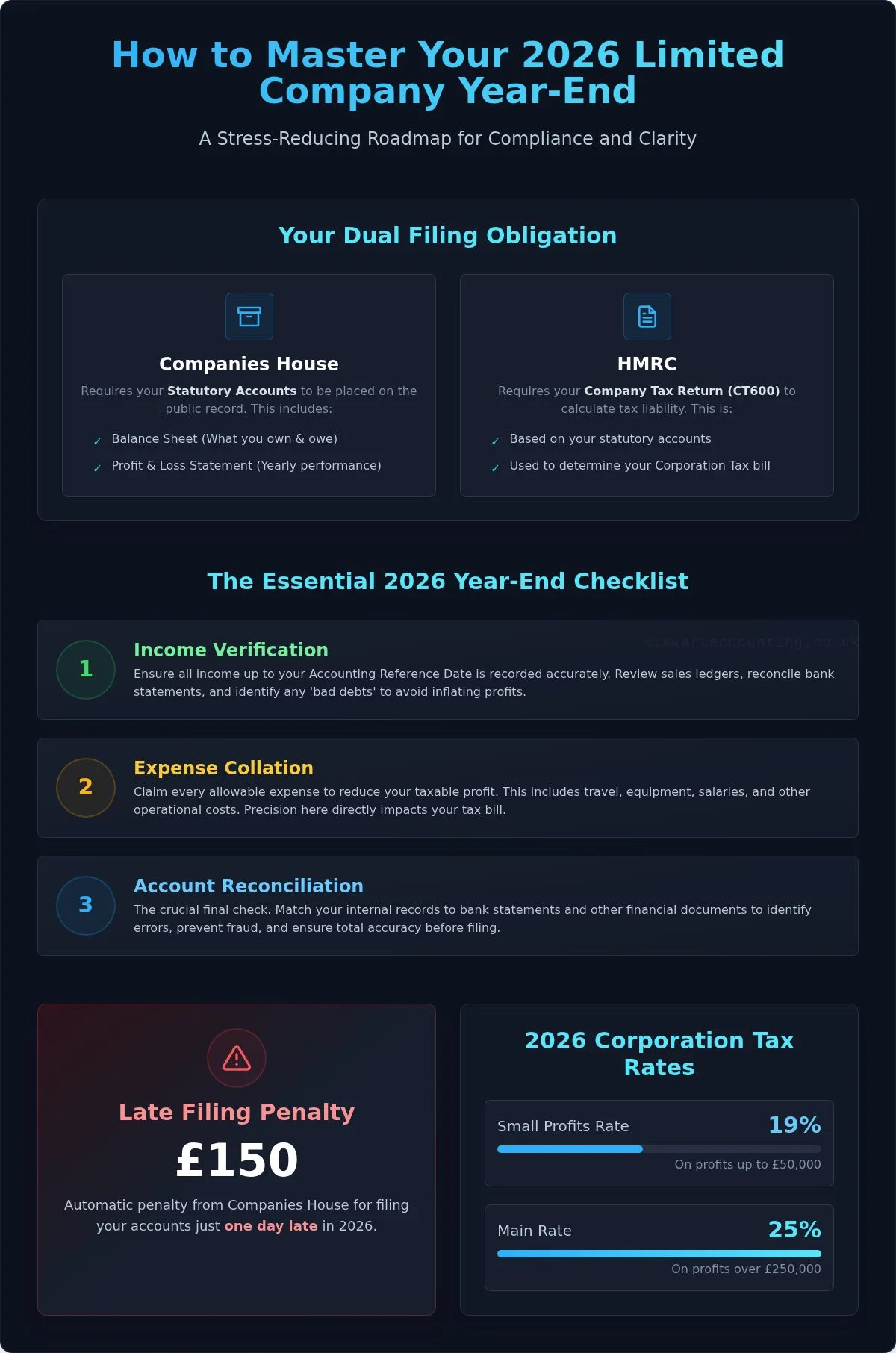
The year-end process involves a dual requirement that often causes confusion. You aren’t just reporting to one authority; you must satisfy both Companies House and HMRC. While Companies House requires your statutory accounts for the public record, HMRC needs your Company Tax Return (CT600) to determine your tax liabilities. Using a structured limited company year end checklist is the best way to ensure you meet both sets of obligations without the last-minute scramble. Beyond simple compliance, these accounts serve as a vital “health check” for your business. They provide a clear, objective view of your company’s performance, helping you make informed decisions for the future.
The Purpose of Statutory Accounts
Statutory accounts are formal reports prepared at the end of every financial year. If you’ve ever asked, What are financial statements?, you’ll find they are primarily composed of a Balance Sheet and a Profit and Loss statement. The Balance Sheet provides a snapshot of what your company owns and owes at a specific moment. Meanwhile, the Profit and Loss statement summarizes your performance over the full year. Maintaining transparency in these documents builds immense credibility. Lenders, investors, and even potential suppliers look at these public records to decide if your business is a reliable partner.
Corporation Tax and the CT600
Your year-end accounts are the foundation for your tax bill. In 2026, the main rate of Corporation Tax is 25% for companies with profits over £250,000, while the Small Profits Rate remains 19% for those earning £50,000 or less. Accurate accounts ensure you are placed in the correct bracket and don’t overpay. When we manage your limited company accounting, we focus on identifying every allowable expense. From travel costs to equipment, claiming these correctly reduces your taxable profit and keeps more money in your business. This link between your statutory filing and your tax liability is why precision is non-negotiable.
The Essential 2026 Year End Accounts Checklist
How do you move from a pile of digital receipts to a polished set of accounts? The transition doesn’t have to be a source of stress. A successful year-end relies on a “clean cut-off.” This means ensuring every transaction dated up to your Accounting Reference Date is included, while those dated after are strictly excluded. Modern tools make this easier. If you use cloud accounting software like Xero, digital readiness is your greatest asset. Ensuring your software is up to date throughout the year prevents a massive backlog when your deadline approaches. Reviewing the official government guidance on year-end accounts confirms that precision in these areas is non-negotiable for 2026 compliance.
Your limited company year end checklist should prioritize the “Big Three”: Income, Expenses, and Reconciliations. This structured approach allows you to tackle one area at a time, reducing the feeling of being overwhelmed. By breaking down complex financial data into manageable categories, you gain a clearer understanding of your business health while satisfying HMRC and Companies House requirements.
Sales and Income Verification
Start by reviewing your sales ledger for any outstanding invoices. If a client hasn’t paid and you don’t expect them to, you may need to write these off as “bad debts” to ensure your profit isn’t artificially inflated. Reconcile every bank statement against your sales records to catch any missing entries. It’s vital to ensure all income received is correctly categorized for the 2026 period. This step prevents you from paying tax on income that actually belongs to the following financial year, keeping your cash flow optimized.
Expenses and Purchase Ledger
Gathering all receipts for business-related travel and subsistence is often where directors lose the most time. We recommend reviewing your recurring subscriptions and direct debits to ensure they are still necessary and accurately recorded. You must also distinguish between capital assets and revenue expenses. For example, qualifying main rate plant and machinery purchased after January 1, 2026, may be eligible for the new 40% First-Year Allowance. Correctly identifying these assets can significantly lower your Corporation Tax bill, provided your documentation is precise.
Payroll and VAT Alignment
Consistency across different tax heads is a major focus for HMRC. You should cross-reference your VAT returns with your annual turnover to ensure they align perfectly. Similarly, verify that your final RTI submissions for the year match your internal payroll records. Don’t forget to check director loan account balances and dividend payments. With the Section 455 tax rate at 35.75% for loans made on or after April 6, 2026, failing to repay these within nine months and one day of your year-end can be an expensive oversight. If you find these requirements daunting, reaching out to a professional can restore your peace of mind while ensuring total compliance.
Reconciling Your Accounts: How Do You Ensure Accuracy?
Reconciliation is the bridge between basic bookkeeping and a set of accounts you can truly trust. While bookkeeping records your daily transactions, reconciliation proves those records are correct. Many directors feel a sense of unease during the year-end period, wondering if a small mistake might lead to an HMRC inquiry. Professional reconciliation eliminates this doubt by cross-referencing your internal data with external evidence. Achieving a “zero-balance” reconciliation, where every penny is accounted for, remains the gold standard for financial accuracy.
Using online accounting services allows for real-time accuracy, making the final year-end push far less daunting. When your software and your bank talk to each other daily, the reconciliation process becomes a series of small, manageable checks rather than a mountain of work. This proactive approach is a central pillar of any effective limited company year end checklist. It ensures that common errors, such as duplicate entries or missed bank fees, are caught long before they reach a tax return. By verifying every figure, you create a shield against investigations and gain total confidence in your financial health.
Bank and Credit Card Reconciliation
Bank reconciliation is the process of ensuring your internal records match external bank data as of the year-end date. This step is non-negotiable. You must match every single transaction on your bank statement to a corresponding entry in your books. If you find “unexplained” transactions, investigate them immediately. A common pitfall for small business owners is the mixing of personal and business spend. If you’ve used a company card for a personal purchase, it must be correctly recorded as a director’s loan or a dividend rather than a business expense. Clear separation here protects you from unwanted scrutiny and ensures your financial statements reflect the true state of the company.
Stocktake and Work-in-Progress (WIP)
If your business holds physical goods, a year-end stocktake is essential. You must value your stock at the lower of its original cost or its net realisable value. This prevents you from overstating your assets if items have become damaged or obsolete. For service-based companies, the concept of Work-in-Progress (WIP) is equally vital. You need to account for services that are partially completed but haven’t been invoiced yet. Failing to record WIP can lead to a misleading Profit and Loss statement, as the costs of the work are recorded in one year while the income appears in the next. Referencing a detailed guide to preparing and filing accounts can provide further technical clarity on these valuation rules. By following these steps, your limited company year end checklist transforms from a simple task list into a powerful tool for financial integrity.
Understanding Deadlines and Avoiding Penalties
Missing a deadline isn’t just about the money; it’s about the unnecessary stress that disrupts your professional liberty. While your limited company year end checklist helps you organize your data, you must also master the timing. A common mistake is assuming that filing your accounts and paying your tax happen at the same time. In reality, Companies House and HMRC operate on different schedules. If you don’t track these separate clocks, you risk falling into an expensive penalty trap that escalates with every passing week.
The Filing Timeline for 2026
Navigating the 2026 filing window requires precision. You must adhere to three primary milestones to remain fully compliant:
- 9 Months After Year-End: This is your final deadline to file your statutory accounts with Companies House.
- 9 Months and 1 Day After Year-End: You must pay any Corporation Tax owed to HMRC by this date. Notice that this payment is often due before you file your actual tax return.
- 12 Months After Year-End: This is the deadline for filing your Company Tax Return (CT600) with HMRC.
Don’t forget the annual confirmation statement. As of February 2026, the fee for this digital filing is £50, and it must be submitted within 14 days of your review period ending. Keeping these dates in mind protects your company from the “Overdue” status that appears on the public register; this can damage your credibility with lenders and suppliers.
The True Cost of Late Filing
The penalties for late filing with Companies House are automatic and non-negotiable. If you are just one day late, the fine is £150. If you delay by one to three months, it jumps to £375. For delays between three and six months, the penalty is £750, reaching a maximum of £1,500 for anything over six months. These amounts are doubled if you file late for two consecutive financial years. HMRC also adds interest charges on late tax payments and can issue tax-geared penalties for late returns. Beyond the financial loss, the reputational damage of having a public record of non-compliance can make it harder to secure funding or business insurance. If you want to avoid these traps and reclaim your time, get in touch with our expert team today for professional year-end support.
How Professional Accounting Services Liberate Your Business
Why do so many directors feel trapped by their financial obligations? Usually, it’s because the tasks involved in a limited company year end checklist feel like a mountain rather than a map. Professional accounting services are about much more than just numbers on a page; they are about restoring your personal and professional liberty. By partnering with a Chartered Accountant, you gain access to a level of reliability and expertise that simple automated software cannot provide. We act as a dependable, supportive partner for small and medium-sized enterprises across Alloa, Stirling, and Falkirk, ensuring your compliance is handled with local expertise and a pragmatic, results-oriented approach.
Moving from basic compliance to strategic growth planning is what separates a thriving business from one that is merely surviving. When you delegate your financial requirements to us, you aren’t just hiring a service; you’re gaining a local partner who understands the specific challenges of the Central Scotland business landscape. This relationship allows you to transition from reacting to deadlines to proactively steering your company toward its long-term objectives. It’s about changing your perspective from “what do I owe?” to “how can I grow?”
Total Delegation: Removing the Burden
Many business owners arrive at the end of their financial year with a metaphorical “shoebox of receipts” or a cluttered digital folder that causes instant anxiety. We take that initial state of complexity and transform it into statutory excellence through methodical, logical processes. Our specialized year-end accounts preparation removes the physical and mental weight of filing from your shoulders entirely. Our total delegation model allows directors to stop worrying about HMRC and start focusing on their next business milestone. This complete transfer of responsibility is the ultimate way to reclaim your time, optimize your finances, and protect your mental well-being.
Strategic Tax Planning and Advice
Compliance is the foundation, but strategic advice is the structure that supports your growth. The real value of professional limited company accounting lies in identifying tax-saving opportunities before the year-end window closes. We look at your unique situation to provide custom advice on the most tax-efficient split between salary and dividends, as well as the benefits of pension contributions. We also ensure you are utilizing the latest capital allowances, such as the 40% First-Year Allowance available for qualifying purchases in 2026. If you want to experience this level of support, we invite you to contact our team for a consultation in Central Scotland to see how we can help you thrive. Using a professional limited company year end checklist managed by experts ensures you never pay more than you strictly owe.
Secure Your Financial Future with Confidence
Navigating your annual requirements doesn’t have to be a source of anxiety. By following a structured limited company year end checklist, you ensure your records are precise and your deadlines are met with ease. We’ve explored how a clean cut-off and professional reconciliation protect your business from penalties and investigations. These steps aren’t just about satisfying authorities. They’re about gaining a clear understanding of your company’s health while reclaiming your mental well-being.
As Chartered Accountants in Alloa, Stirling, and Falkirk, we specialize in small business growth. Our service includes expert tax planning to ensure you keep more of your hard-earned profits. Total delegation means you can stop worrying about the dual requirements of HMRC and Companies House. Instead, you can focus on the growth and lifestyle goals that matter most to you. You’ve built a great business. Let’s make sure your finances reflect that success without the stress.
Reclaim your time and mental well-being; let Stewart Accounting handle your Year End Accounts today.
Frequently Asked Questions
What is the difference between an accounting period and a financial year?
An accounting period is the timeframe HMRC uses to calculate your Corporation Tax, while a financial year refers to the 12 months covered by your statutory accounts. For most businesses, these dates align perfectly. However, if you’ve recently started your company or changed your year-end date, they might differ slightly during that transition. It’s vital to track both to ensure your tax return matches your financial statements.
Do I need to file accounts if my limited company is dormant?
Yes, you must still file accounts with Companies House even if your limited company is dormant. These are simplified “dormant accounts” that confirm your company had no significant transactions during the period. You should also notify HMRC that your company is dormant to avoid unnecessary tax return requests. Failing to file these simple documents can still result in automatic late filing penalties.
How long must I keep my financial records for a limited company?
You must keep your financial records for at least six years from the end of the last company financial year they relate to. This includes all receipts, bank statements, and payroll data. Maintaining a digital limited company year end checklist makes this requirement much easier to manage. Storing records in the cloud ensures you’re always ready if HMRC requests a review of your past filings.
Can I change my company year-end date with Companies House?
You can change your company year-end date by applying to Companies House, provided you meet specific legal criteria. You can shorten your financial year as many times as you like. However, you can usually only lengthen it once every five years, and the new period cannot exceed 18 months. This is a common strategy for businesses aligning their tax year with their natural trading cycle.
What happens if I miss the Corporation Tax payment deadline?
HMRC will charge interest on the outstanding amount from the day after it was due if you miss the payment deadline. Unlike filing deadlines, there isn’t a flat-rate penalty for paying late, but the interest accumulates daily. This interest is not tax-deductible, so it’s a direct cost to your business. It’s always best to pay an estimated amount early if you’re struggling to finalize your exact figures.
Is it better to use Xero or QuickBooks for my limited company year-end?
Both platforms are excellent, but we often recommend Xero for its intuitive interface and seamless integration with other business tools. We provide expert Xero training and support to help you maintain a clean limited company year end checklist throughout the year. This real-time accuracy makes the final submission process much smoother and reduces the stress of the end-of-year rush.
What are allowable expenses for a UK limited company in 2026?
Allowable expenses must be “wholly and exclusively” for business purposes, such as business insurance, professional fees, and office costs. In 2026, qualifying plant and machinery might also benefit from the 40% First-Year Allowance, which can significantly reduce your taxable profit. Identifying every valid expense is a core part of our tax planning service, ensuring you don’t pay more than you strictly owe.
How much does a chartered accountant charge for year-end accounts?
The cost of hiring a chartered accountant depends on the size of your business and the complexity of your financial records. A small SME with clean bookkeeping will typically require less time than a larger firm with multiple revenue streams. As regional experts in Alloa, Stirling, and Falkirk, we provide customized quotes tailored to your specific needs. This ensures you receive high-level expertise that fits your budget.
Recent Posts
22 Oct, 2026
21 Oct, 2026