

Running a limited company in the UK can often feel like you're juggling a dozen different tasks at once. But one ball you absolutely cannot afford to drop is your record-keeping.
So, what do you actually need to keep? In simple terms, you must hold onto records about the company itself, all its financial dealings, and specific tax documents. The golden rule to remember is that most financial records must be kept for at least 6 years from the end of the last financial year they relate to.
Your Essential Guide to Company Record Keeping
Think of your company records as its official diary—a complete and chronological story of its financial health, key decisions, and legal standing. This guide is designed to cut through the legal jargon and give you a clear, practical roadmap. We'll break down exactly what records you need to keep for your limited company and for how long, all in straightforward language.
Let's step away from the dense legal texts for a moment. Our goal here is to explain why these rules exist and how you can comply with them without getting a headache. Proper record-keeping isn't just a box-ticking exercise to avoid penalties; it’s the bedrock of a robust, transparent, and successful business. It's the proof you'll need to secure a loan, attract investors, or simply make smarter strategic decisions.

Why Bother With All This Paperwork?
First and foremost, keeping accurate and detailed records is a legal must-do. This isn't just good advice; it's a requirement laid out in UK law, primarily under the Companies Act 2006 and various HMRC regulations.
The rules are quite clear: financial and accounting records need to be kept for a minimum of 6 years from the end of the financial year they're connected to. This isn't just about your big annual accounts; it includes the nitty-gritty details like every single invoice, receipt, and bank statement.
Let’s use a real-world example. If your company’s financial year ends on 31 March 2024, you must hang onto all records from that year until at least the end of March 2030. If your business is VAT registered, the same 6-year rule applies to all your VAT records and returns. You can learn more about the legal basis for document retention if you want to dive deeper.
Falling short on these obligations can result in some hefty penalties, which makes organised record-keeping a non-negotiable part of good business management.
To give you a clearer picture, let's summarise the key retention periods in a simple table.
Record Retention Periods at a Glance
This table provides a quick summary of the main types of company records and their minimum statutory retention periods for UK limited companies.
| Record Type | Minimum Retention Period |
|---|---|
| Accounting Records (invoices, receipts, etc.) | 6 years from the end of the financial year |
| Company Tax Returns | 6 years from the end of the financial year |
| VAT Records (if registered) | 6 years from the end of the VAT period |
| PAYE Records (for employees) | 3 years from the end of the tax year |
| Company's Statutory Registers (directors, shareholders) | Permanently (for the life of the company) |
| Certificate of Incorporation & Articles | Permanently (for the life of the company) |
As you can see, while the 6-year rule is a great starting point, some documents are so fundamental they need to be kept for the entire life of your company. Think of these as your company's birth certificate and rulebook—they're always relevant.
Keeping Your Company’s Core Legal Records
Putting aside the daily churn of invoices and receipts, every limited company has a core set of legal documents that are, quite literally, its identity. Think of these as your company’s DNA—the fundamental records that prove it exists and lay out the rules it lives by. These aren't just for your filing cabinet; they're legal necessities.
Getting this right is the first step in good corporate governance. These documents are the bedrock for all your financial and operational activities. Without them, your company has no official story to tell Companies House or anyone else.
Your Company's Birth Certificate and Rulebook
At the very top of the list are the documents created the moment your company was born. You need to keep these safe and sound for the entire life of your business, from the day it’s incorporated right up until it's dissolved. They are permanent.
When you form a limited company in the UK, Companies House issues a Certificate of Incorporation, which is the official proof of its registration. Alongside this, you have the Memorandum and Articles of Association. Together, these documents form your company's constitution, governing how it's run internally. Neglecting these can lead to penalties and seriously harm your reputation for being a well-run, compliant business. You can find more insights into why these foundational records are so crucial by exploring guides on limited company requirements.
This image breaks down the main record categories and how long you need to hang onto them.
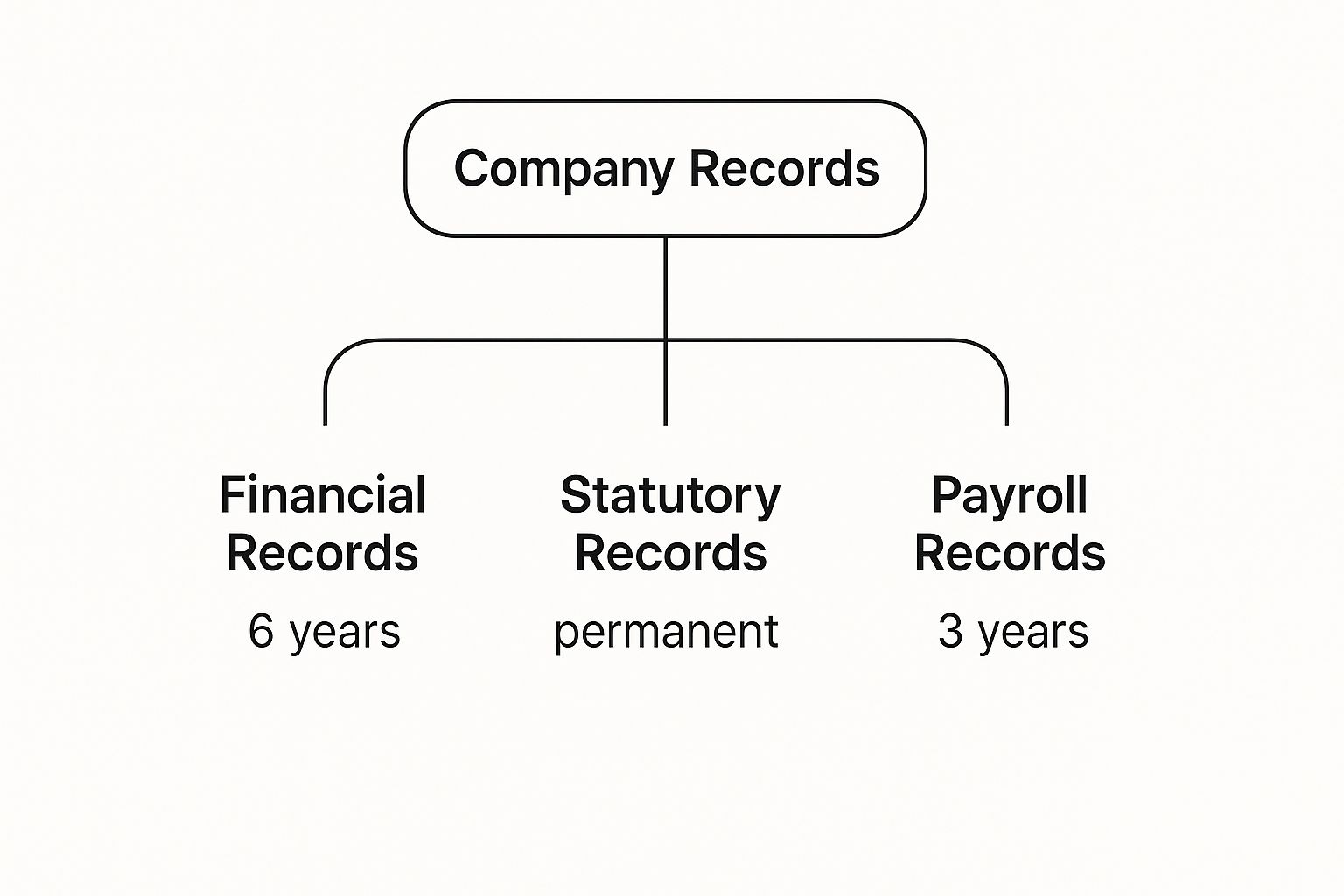
As you can see, while financial and payroll records have set time limits, your core statutory records must be kept permanently.
Maintaining Your Statutory Registers
Beyond the one-off incorporation documents, you also have to keep a series of statutory registers. These aren't documents you create once and forget about; they are living records that track the ownership and management of your company and need to be updated as things change.
Keeping these registers accurate isn't just a bit of admin—it's a legal requirement. The information is vital for filing your annual Confirmation Statement with Companies House, proving you’re running a transparent and compliant operation.
Your key statutory registers include:
- Register of Members (Shareholders): The definitive list of who owns the company.
- Register of Directors: All the details of your current and past directors.
- Register of People with Significant Control (PSC): Information on anyone who has significant influence or control over the business.
- Register of Directors' Residential Addresses: A confidential record that's kept separate from the public-facing register.
These registers paint a clear, up-to-date picture of your company's structure. Forgetting to update them after a change in directors or shareholders is an easy mistake to make, but one that’s simple to avoid. Knowing what records you need to keep for your limited company accounts and for how long is the first step toward building a business that’s resilient and legally sound.
Managing Your Day-to-Day Financial Records
This is the real nitty-gritty of your business finances. We’re talking about the everyday transactions that tell the story of your company's financial life. Your accounting records are the proof behind every single figure on your annual accounts and Corporation Tax Return. Keeping them in good order isn’t just a once-a-year scramble; it's a constant, disciplined process that provides the very foundation of your company's financial health.
Let's put it another way. Imagine HMRC decides to look into a transaction from five years ago. Could you pull up the invoice and bank statement to prove what happened? That's the mindset you need to adopt. This paper trail, whether it's digital or physical, has to be clear, complete, and easy to get your hands on when needed.
The Six-Year Rule in Practice
For the bulk of your day-to-day financial paperwork, the magic number is six. UK law is very clear: you must keep your accounting records for a minimum of six years from the end of the last financial year they relate to. This rule ensures you have all the necessary proof to back up your tax returns and company accounts if HMRC comes knocking.
Letting this slide can create some serious problems. If you can't produce the records, you'll have a tough time proving your income and justifying your expenses, which can lead to painful disputes and penalties. It’s best to think of these records as your company's financial memory; without it, you're left unable to explain past actions or validate your current financial standing.
So, what exactly needs to be kept under this six-year rule? The list is pretty comprehensive but it all boils down to one simple idea: track all the money coming in and all the money going out.
These records aren't just for keeping the taxman happy. They're a goldmine of data for smart business planning. By looking back at spending habits and sales trends, you can make much better forecasts and guide your business with confidence.
Here’s a practical breakdown of the core documents you must hold onto:
- All sales invoices you've sent out to your clients.
- All purchase invoices and receipts for anything you’ve bought for the business.
- All business expense receipts, covering things like travel, meals, and any staff costs.
- Company bank statements for every business account you hold.
- Company credit card statements, along with the receipts for each purchase.
- Details of any significant assets purchased by the company, such as computers, machinery, or vehicles.
- Records of all stock and its value at the end of your company's financial year (if applicable).
Keeping Your Records Organised
Knowing what records to keep for your limited company and for how long is the first step, but keeping them organised is where the real work lies. A shoebox overflowing with faded receipts just won't do. You need a system that's both logical and consistently used.
Thankfully, technology has made this much easier. Many businesses now rely on cloud accounting software like Xero or QuickBooks. These tools let you snap a picture of a receipt and link it directly to a bank transaction, instantly creating a searchable and compliant digital archive. This doesn't just make your year-end reporting a breeze; it gives you a live, up-to-the-minute picture of your financial health—something every business owner should have.
Navigating Specific Tax Record Requirements
While the general six-year rule for accounting records is a solid foundation, it's not the whole story. When you get into the nitty-gritty of tax, you'll find that HMRC has specific rules for different areas, and it’s crucial to get these right. This is especially true if you employ staff or are registered for VAT.
Think of it this way: your general accounting is your main library, but for tax, you need to maintain specialised archives, each with its own set of rules.
If your company has employees, you're operating under the PAYE (Pay As You Earn) system, and that comes with its own clear-cut obligations. You are required to keep all your PAYE records for at least three years from the end of the tax year they relate to. It’s a non-negotiable part of being an employer.
And this goes far beyond just a final payroll summary. You need to keep a complete, detailed trail for every single person on your payroll.
Decoding PAYE and VAT Retention Rules
For PAYE, that three-year retention period is all about proving you've handled your team's pay and deductions by the book. The specific records you need to hang onto include things like:
- Full details of all payments made to your employees.
- A clear record of all deductions, like tax and National Insurance contributions.
- Information on any employee benefits or expenses.
- Copies of all reports submitted to HMRC, such as your Full Payment Submission (FPS).
Now, for businesses registered for Value Added Tax (VAT), the rules are stricter and loop back to that general accounting timeframe. You must keep all your VAT records for a minimum of six years. It's so common, it's often just called the 'six-year VAT rule'.
These records have to be thorough enough for HMRC to trace every figure on your VAT returns. This means maintaining your VAT account, which is essentially the summary of your output tax (the VAT you charge customers) and your input tax (the VAT you pay on business purchases). You’ll also need to hold onto every VAT invoice you send out and receive, along with any relevant import and export documents.
The Shift to Digital Record Keeping
The ongoing rollout of Making Tax Digital (MTD) has completely reshaped how businesses handle their tax affairs. For most VAT-registered companies, MTD makes it mandatory to keep digital records and submit returns using compatible software. The days of relying on paper ledgers for VAT compliance are well and truly over.
Under MTD, it’s not enough to just have scanned copies of your invoices saved on a hard drive. Your records must be stored within a "functional compatible software" system. The key is that this software must be able to connect directly to HMRC's systems, creating an unbroken digital link from your records right through to your submitted return.
This move to digital is all about reducing common errors and making the whole process of tax administration smoother for everyone. Your system needs to capture and store records digitally in a way that meets HMRC's standards. This means ensuring your digital files are complete, easy to read, and securely stored in an approved software package, like Xero. Getting this right is a huge part of answering the question of what records you need to keep for your limited company, and for how long you keep them.
Smart Record Storage and Avoiding Penalties
Alright, so you know what records to keep. That’s half the battle. The other half is figuring out how to store them so they’re safe, sound, and easy to find when you need them. It's a classic dilemma: physical paper versus digital files. But let's be honest, the business world is heavily leaning in one direction.
Digital storage, especially through good cloud accounting software, is a game-changer. It gives you real-time access from anywhere, makes sending documents to your accountant a breeze, and handles a lot of the organisational heavy lifting for you. It's also pretty much essential for staying on the right side of Making Tax Digital (MTD) rules. Physical paper, on the other hand, is bulky and susceptible to all sorts of disasters, from a simple coffee spill to a devastating fire or flood.
Now, if your limited company is swimming in physical paperwork, professional business commercial storage solutions can be a lifesaver, getting everything securely out from under your feet. The smartest strategy, though, is often a hybrid approach. Scan and digitise everything you can, but hang onto truly irreplaceable originals—like property deeds or share certificates—in a secure physical spot.
The Real Cost of Getting It Wrong
Failing to keep proper records isn't just a minor administrative headache. It carries real teeth, with consequences that can hit your company's bank account and your own professional reputation. Both HMRC and Companies House take these duties very seriously, and claiming you "didn't know" the rules won't get you very far.
The penalties are deliberately steep to make you pay attention. If you can't produce adequate records when asked, HMRC can fine you up to £3,000 per tax year for each breach. If the problem has been going on for a few years, those fines can stack up frighteningly fast, turning a simple oversight into a major financial problem.
But it doesn't always stop with fines. In more serious cases, especially if it looks like you’re deliberately hiding something, things can escalate. A full-blown investigation could follow, and if you’re found guilty of a major offence, you could be disqualified from being a company director for up to 15 years.
This isn't meant to scare you, but to underscore just how critical it is to have a bulletproof system from day one. Understanding what records you need to keep for your limited company accounts and for how long is your single best line of defence.
A Simple Checklist for Your Storage System
Want to make sure your system is up to scratch? Run through these quick questions:
- Is it Secure? Are your digital files password-protected and backed up regularly? Are physical papers locked away, safe from damage?
- Is it Accessible? If HMRC asked for an invoice from four years ago, could you find it in a few minutes, or would it take all afternoon?
- Is it Legible? Are your scanned copies crystal clear? Are your paper records kept somewhere they won't fade into blank sheets?
- Is it Compliant? Does your digital setup meet MTD requirements? Are you keeping every document for its full statutory retention period?
If you can confidently answer 'yes' to all of these, you’re well on your way to building a robust, compliant, and—most importantly—stress-free system for your business records.
Got Questions About Your Limited Company Records? We've Got Answers.
Even when you know the main rules, real-life situations can throw up some tricky questions. It's completely normal to feel a bit lost when trying to navigate the finer points of company record-keeping. Getting clear, straightforward answers is the best way to build confidence and make sure you’re ready for whatever comes your way.
Here, we'll tackle some of the most common questions we hear from business owners. We’ll cut through the jargon and give you practical answers to clear up any lingering confusion, ensuring you have the information you need to stay compliant.
What Happens to Records if My Limited Company Closes Down?
This is a brilliant and incredibly important question. So many people think that once a company is dissolved, all the paperwork can just be thrown away. That's a dangerous mistake. Your legal duty to hold onto key records doesn't simply disappear when the business stops trading.
As a director of the former company, you are personally responsible for making sure business documents—especially the core accounting records—are stored securely for the full statutory period. This means you must keep them for at least six years from the date the company is officially dissolved. Why? Because HMRC might have final tax queries, or other official investigations could pop up long after you've closed up shop.
You'll also need to tell Companies House where these records are being kept, creating a clear paper trail even after the business is gone.
Can I Store All My Company Records Digitally?
For the most part, absolutely. In fact, digital storage is now actively encouraged, especially with the government's push for Making Tax Digital (MTD). Let's be honest, it's usually far more efficient, secure, and easier to access than dealing with mountains of paper.
But there’s a big "if". Any digital copy must be a complete and legible replica of the original document. If HMRC or Companies House requests a record, you have to be able to produce it in a readable format. A blurry, unreadable photo of a receipt just won’t cut it.
While you can go digital with most things, I always advise clients to keep the physical originals of certain foundational documents. These often include:
- Signed property deeds or leases.
- Original share certificates.
- Certain signed legal contracts or major loan agreements.
And a final word of warning: always make sure your digital storage is secure, password-protected, and—most importantly—backed up regularly. Losing everything to a hard drive failure is a nightmare you don't need.
I've Lost an Invoice or Receipt—What Should I Do?
First off, don't panic. Losing a receipt happens to everyone, and it's not the end of the world. The key is to act quickly and create a replacement record of the transaction as accurately as you possibly can.
Your first port of call should be to try and get a copy from the supplier. For many online or recurring purchases, this is often surprisingly easy. If that's a dead end, you'll need to manually create a log of the expense.
Note down the essential details of the lost record: the date of the transaction, the exact amount paid, the supplier's name, and a clear description of what you bought. The more detail you can provide, the better.
Supporting evidence is your best friend here. A corresponding line on your company bank or credit card statement is incredibly helpful for proving the expense was real. HMRC is generally reasonable; what they really want to see is a consistent, honest effort to record all your business transactions accurately.
Do I Need to Keep Records of Directors' Expenses Separately?
Yes, one hundred percent. It is absolutely vital to keep meticulous records of every single expense reclaimed by directors. These are not personal expenses; they are business costs that must be treated with the same diligence as any other company purchase.
Each expense claim has to be backed up by a valid receipt or invoice. This is crucial for proving to HMRC that the expense was incurred "wholly, exclusively, and necessarily" for business purposes. That's the strict test HMRC uses to decide if an expense is allowable for Corporation Tax relief.
Keeping a clear, separate log of director expenses stops any blurring of the lines between personal and business spending. It helps you avoid potential tax headaches and ensures your company accounts are transparent and accurate, protecting both the director and the company from scrutiny.
Navigating these rules can feel complicated, but you don't have to do it alone. Stewart Accounting Services specialises in helping businesses across Central Scotland and the UK manage their finances with clarity and confidence. Whether you need support with year-end accounts, VAT returns, or strategic planning, our team is here to give you more time, more money, and a clearer mind. Find out how we can help by visiting stewartaccounting.co.uk.