

What Tax Relief is Available for Small Businesses in the UK?

What if your tax bill wasn’t a source of constant anxiety, but a strategic opportunity to reinvest in your company’s future? For many business owners across Alloa, Stirling, and Falkirk, the weight of complex HMRC regulations often feels like a barrier to growth rather than a manageable part of the job. It’s completely natural to feel overwhelmed by the fear of missing out on legitimate savings or the pressure of looming deadlines. Navigating the various forms of tax relief for small business UK can feel like a full-time role in itself, leaving you with less time to focus on what you actually love doing.
We understand that your ultimate goal is to restore a sense of liberty to your professional and personal life. This article promises to demystify the essential tax reliefs and allowances that can significantly reduce your tax burden in 2026. By delegating the complexity to experts, you can ensure your tax affairs are fully optimized while freeing up vital resources. We will provide a clear overview of the 19% small profit rate, the £1 million Annual Investment Allowance, and the £10,500 Employment Allowance. This guide is designed to help you lower your Corporation Tax or Income Tax bills, improve your cash flow, and finally achieve the peace of mind you deserve.
Key Takeaways
- Learn how the Annual Investment Allowance provides immediate tax relief on up to £1 million of capital expenditure for plant and machinery.
- Discover how to reduce your annual National Insurance bill by £10,500 using the Employment Allowance when managing tax relief for small business UK.
- Understand the specific benefits of the Small Business Bonus Scheme for firms in Central Scotland to lower your property overheads.
- Identify whether your business qualifies for specialist R&D or creative industry credits to unlock additional cash flow for growth.
- Find out why proactive tax planning and professional delegation can protect you from overpaying and reduce the anxiety of HMRC compliance.
What Tax Relief is Available for Small Businesses in the UK?
Tax relief isn’t about finding grey areas or bending the rules. It’s a legitimate, HMRC-approved method to reduce your total tax liability. The government designs these incentives specifically to encourage business investment and stimulate the UK economy. When you claim tax relief for small business UK, you’re participating in a system that rewards you for growing your firm and creating jobs. It’s vital to distinguish these from standard business expenses. While expenses are the day-to-day costs of running your operation, reliefs are specific provisions that lower the amount of profit you’re actually taxed on.
Identifying these opportunities is the first step toward reclaiming your mental well-being. Knowing you aren’t overpaying provides a sense of control and reduces the anxiety often associated with financial compliance. It’s about shifting the burden from your shoulders to a structured, optimized plan that allows you to reinvest in your business’s future.
To better understand how specific investment schemes work, watch this helpful video:
The Difference Between Allowances and Reliefs
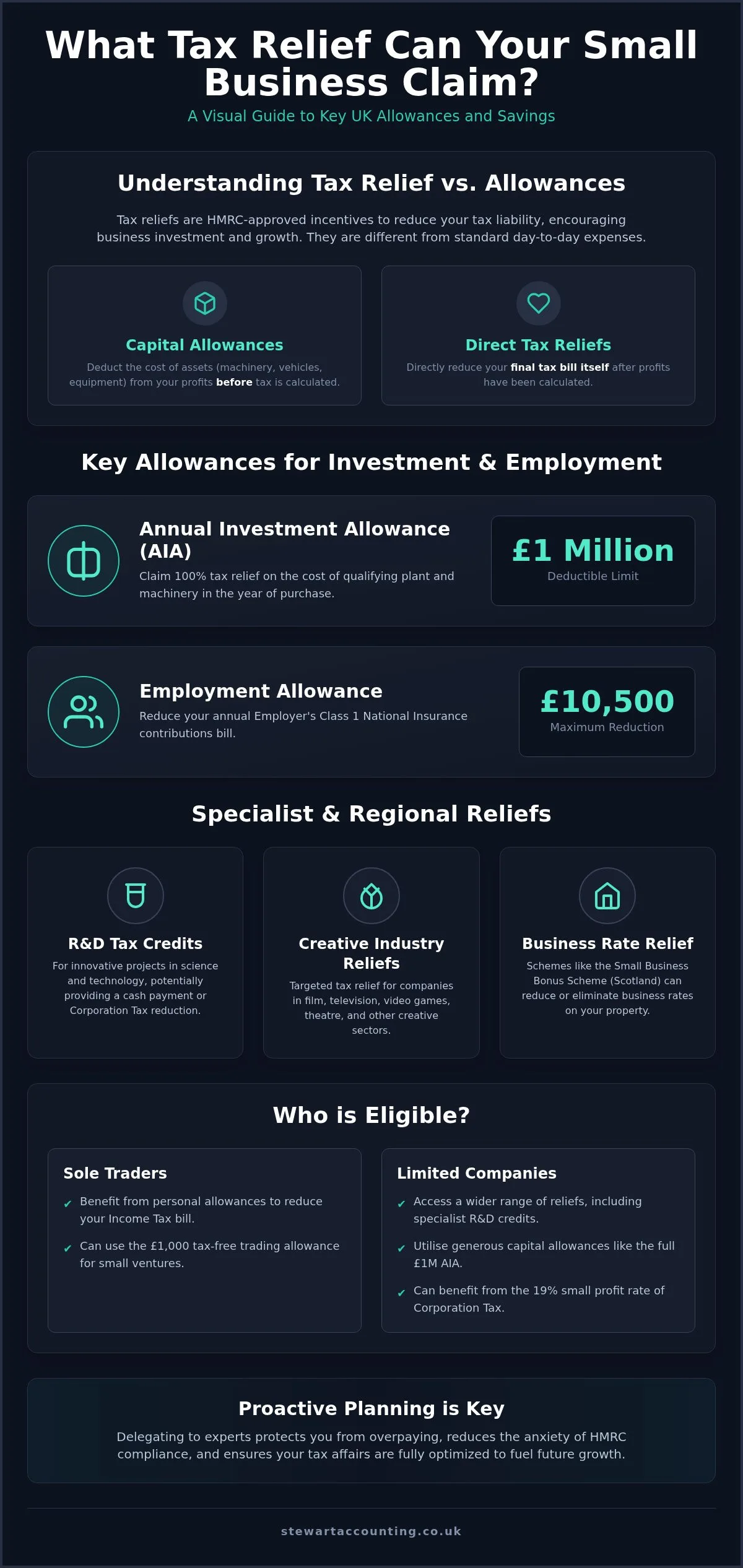
Understanding the terminology helps you communicate better with your accountant. Capital allowances allow you to deduct the cost of physical assets, like machinery, vehicles, or office equipment, from your profits before tax is calculated. In contrast, direct tax reliefs often reduce the final bill itself. These adjustments play a significant role during the preparation of your year end accounts. By correctly applying these within the UK Corporation Tax System, you ensure your business remains efficient and compliant. This distinction matters because it directly affects your immediate cash flow and your long-term financial health.
Who is Eligible for Small Business Tax Relief?
Eligibility often depends on your business structure and your specific industry. Most small entities will find they qualify for at least one form of relief, provided they meet the basic criteria.
- Sole traders: You can benefit from various personal allowances and specific trading reliefs that reduce your Income Tax. This includes the £1,000 trading allowance for very small ventures.
- Limited companies: These entities have access to a broader range of incentives, including R&D credits and specific capital allowances. The size of your company and its annual turnover will dictate which schemes are most beneficial.
Your sector also dictates what you can claim. For example, a tech firm in Stirling might qualify for different incentives than a retail shop in Falkirk or a tradesman in Alloa. Identifying the right tax relief for small business UK requires looking at your specific circumstances rather than following a one-size-fits-all approach. By delegating this analysis to a professional, you can focus on your core operations while we ensure every legitimate saving is captured.
Key Allowances for Business Investment and Employment
Are you planning to upgrade your equipment or hire new staff this year? These decisions shouldn’t just be about operational capacity. They’re also powerful tools for managing your tax liability. By timing your investments correctly, you can access significant tax relief for small business UK, effectively lowering the net cost of your business growth. This strategic approach helps you retain more cash within the firm, providing the resources you need to scale without the weight of an unnecessarily high tax bill.
Maximising the Annual Investment Allowance
The Annual Investment Allowance (AIA) is one of the most generous incentives available to firms in Alloa, Stirling, and Falkirk. It allows you to deduct 100% of the cost of qualifying “plant and machinery” from your profits before tax is calculated. For the 2026/27 tax year, the limit remains at £1 million. This threshold covers the vast majority of SMEs, allowing for immediate relief on essential purchases such as:
- Computers, servers, and office furniture.
- Vans, lorries, and certain specialist vehicles.
- Heavy machinery, tools, and equipment used for your trade.
While limited companies use this to reduce Corporation Tax, sole traders apply it against their total taxable income to lower their personal tax bill. This distinction is vital for accurate financial planning. To ensure you’re capturing every eligible purchase, maintaining professional bookkeeping services is essential. Accurate digital records remove the stress of digging through receipts at the last minute and ensure your asset register is always up to date.
Saving on National Insurance with Employment Allowance
If you’re expanding your team, the Employment Allowance provides a direct reduction in your overheads. For 2026, eligible employers can reduce their annual Class 1 National Insurance bill by up to £10,500. This relief is applied throughout the year until the allowance is fully used. It’s a pragmatic way for the government to support small firms in creating local employment opportunities.
Eligibility rules are specific, particularly for limited companies. If a director is the only employee paid above the Secondary Threshold, the company usually cannot claim this allowance. However, once you hire a second employee or have multiple directors, it often becomes a viable way to claim tax relief for small business UK. Integrating this allowance with efficient SME payroll services ensures the credit is applied correctly and your compliance is handled without you needing to lift a finger.
What happens if your investment exceeds the £1 million AIA limit? In these cases, you can use Writing Down Allowances (WDA). From April 2026, the main rate for WDA is 14%. While this doesn’t offer the same immediate “big hit” as AIA, it provides a steady, methodical reduction in tax over several years. Strategic investment is about more than just spending; it’s about optimizing your long-term cash flow. If you’re unsure how these thresholds affect your specific growth plans, you can speak with our team in Central Scotland for a tailored review of your tax position.
Navigating Small Business Rate Relief in Scotland and the UK
Business rates are essentially a tax on your physical location. For many firms in Central Scotland, this overhead is a significant burden that can drain cash flow before you’ve even made a sale. However, Business Rate Relief acts as a specialized form of tax relief for small business UK that directly reduces your monthly bills. It’s not always an automatic discount; you must ensure your property meets the criteria and that you’ve applied through the correct channels. Reducing these fixed costs is one of the fastest ways to improve your bottom line and find the breathing room you need to grow.
The Small Business Bonus Scheme in Scotland
The Small Business Bonus Scheme (SBBS) is a distinct advantage for firms operating north of the border. While the English system has its own thresholds, the Scottish scheme is designed to support local high streets and industrial estates. Currently, properties with a rateable value of £12,000 or less often qualify for 100% relief, effectively removing business rates from your balance sheet entirely. If your property’s value falls between £12,001 and £15,000, you can still access tapered relief to lower your costs.
How does this work if you have more than one shop or office? If you operate from multiple locations in Alloa, Stirling, or Falkirk, be careful. Local assessors usually combine the rateable values of all your properties. If the total value exceeds certain limits, you might lose your eligibility for the full bonus. This is a common point of anxiety for expanding businesses, but clear planning can help you understand exactly when these thresholds will be triggered.
How to Claim Your Business Rates Reduction
Securing this reduction is a “quick win” for your physical business location. You don’t apply through HMRC for this specific relief. Instead, you must contact the local council for your area, such as Clackmannanshire Council for Alloa, or the Stirling and Falkirk councils. The process usually involves a straightforward application where you declare your property’s rateable value and any other premises you use. Once approved, the relief is typically applied directly to your rates bill.
- Check your rateable value: Ensure the Scottish Assessors Association has an accurate valuation for your premises.
- Report changes immediately: If you move to a new office or take on an additional workshop, notify your council to avoid backdated bills.
- Review annually: Thresholds can change, so it’s pragmatic to check your eligibility at the start of each financial year.
A common pitfall is failing to report a change in circumstances. If you forget to tell the council about a second property, you could face unexpected costs later. We often help our clients navigate these local rules as part of a broader tax relief for small business UK strategy. By delegating the paperwork to experts, you can ensure you’re not paying a penny more in property tax than is legally required.
Specialist Reliefs: R&D and Creative Industry Incentives
Do you think Research and Development (R&D) incentives are only for scientists in white lab coats? This is a common misconception that prevents many firms in Central Scotland from claiming valuable tax relief for small business UK. HMRC defines R&D much more broadly than most owners realize. If you’re solving technical problems, improving manufacturing processes, or developing bespoke software, you could be sitting on a significant tax credit. Shifting your perspective on what counts as “innovation” is the first step toward reclaiming these funds for your business.
Does Your Business Qualify for R&D Relief?
Innovation happens every day in workshops in Alloa and offices in Stirling. In a small business context, R&D involves seeking an advance in science or technology by resolving technical uncertainty. This might include creating more durable construction materials, developing new food processing techniques, or streamlining a production line to reduce environmental impact. Under the merged R&D scheme applicable in 2026, companies can receive a 20% gross credit on qualifying expenditure. While the application process requires precision, the financial reward often provides the capital needed for your next big project.
Creative and Industry-Specific Tax Breaks
The UK’s creative sectors benefit from some of the most targeted incentives in the tax system. For instance, the Orchestra Tax Relief rate is set at 25% from April 1, 2026. Similarly, the Video Games Expenditure Credit (VGEC) offers a 34% credit rate for qualifying developers. These reliefs aren’t just for large studios; they’re designed to help small, local creative entities manage their Corporation Tax liabilities while taking artistic risks. Identifying these niche areas is where the expertise of a chartered accountant in Scotland becomes indispensable for your long-term strategy.
Don’t forget that giving back to your community can also lower your tax bill. Limited companies can deduct the value of qualifying charitable donations from their total profits before tax is calculated. Regardless of which specialist relief you pursue, meticulous record-keeping is non-negotiable. HMRC has increased its scrutiny of these claims, so you need clear evidence of your costs and activities to ensure compliance. Delegating this documentation to professionals ensures your claims are robust and your peace of mind remains intact. If you think your innovation deserves a reward, contact us for a specialist tax review to explore your eligibility.
How Professional Tax Planning Maximises Your Savings
Does the thought of managing your own tax planning keep you awake at night? Many business owners in Central Scotland attempt a “DIY” approach to save money, but this often leads to missed opportunities for tax relief for small business UK. When you’re busy running your firm, it’s easy to overlook a new allowance or forget to time a capital purchase for maximum benefit. Proactive tax planning isn’t just about ticking boxes; it’s about looking ahead. A review conducted months before your financial year end allows you to make strategic decisions that actually lower your bill, rather than just calculating what you owe after the fact.
By delegating these complex tasks to a professional, you’re not just ensuring compliance. You’re actively restoring your personal and professional liberty. Our role is to act as a dependable partner for SMEs in Alloa, Stirling, and Falkirk, turning a source of anxiety into a streamlined process that supports your long-term objectives. This shift allows you to focus on growth while we handle the intricate details of HMRC rules.
The Risks of Missing Tax Relief Deadlines
Errors in self assessment tax returns are more than just a nuisance. They can lead to significant overpayments or, worse, penalties for incorrect claims. HMRC’s increased focus on compliance means that even an honest mistake can trigger a stressful inquiry. Professional oversight acts as a shield, providing you with Tax Investigation Protection and the assurance that your figures are robust. Late filings don’t just cost you money in fines; they drain your mental energy and pull your focus away from your core business activities.
Your Next Steps: A Personalised Tax Strategy
At Stewart Accounting Services, we believe that expert support should improve your lifestyle. Our approach focuses on the “Thematic Triad” of your business life: your time, your money, and your mental well-being. We don’t believe in one-size-fits-all solutions. Instead, we provide a pragmatic, grounded service that addresses the real-world challenges you face every day in Central Scotland.
We offer a free initial consultation to understand your specific needs and desires. Whether you’re a sole trader or a growing limited company, we’ll design a strategy that optimizes every available tax relief for small business UK. It’s time to physically remove the burden of tax from your shoulders. Let us handle the complexity so you can enjoy the peace of mind that comes with knowing your affairs are in expert hands. Reach out to our local team today to start your journey toward a more efficient and stress-free financial future.
Take Control of Your Business Finances Today
Understanding the various avenues for tax relief for small business UK is the first step toward restoring your personal and professional liberty. We’ve explored how the £1 million Annual Investment Allowance and the £10,500 Employment Allowance can significantly improve your cash flow. Additionally, we highlighted the importance of the Small Business Bonus Scheme for our local partners in Central Scotland, ensuring your physical premises don’t become a financial drain.
Managing these complex HMRC rules doesn’t have to be a source of constant anxiety. By delegating your tax affairs to our team of Chartered Accountants at Stewart Accounting Services in Alloa, Stirling, and Falkirk, you can physically remove the burden of compliance from your shoulders. Our specialists in small business tax planning ensure you never miss a legitimate saving while reclaiming your valuable time and mental well-being.
Are you ready to optimize your tax position for 2026? Contact Stewart Accounting Services for a free tax relief consultation and let us help you build a more profitable, stress-free future. You’ve worked hard to build your business; it’s time to ensure your finances work just as hard for you.
Frequently Asked Questions
Can I claim tax relief for working from home as a small business?
Yes, you can claim home office costs to reduce your tax bill. Sole traders often use simplified flat rate expenses based on the hours worked at home each month. Alternatively, you can calculate a fair proportion of your actual utility bills. Limited company directors can claim a flat rate of £6 per week without providing receipts. This is a pragmatic way to ensure your home running costs are recognized as legitimate business overheads.
What is the most common tax relief missed by UK small businesses?
One of the most frequently overlooked opportunities is the claim for pre-trading expenses. Many owners don’t realize they can claim for costs incurred up to seven years before they started trading. Another missed area involves capital allowances on integral features of a building, such as lighting, heating systems, or high-performance aluminum and steel structures like those provided by REALized Project Kft. Identifying these hidden savings is a core part of effective tax relief for small business UK, ensuring you don’t leave money on the table.
You can generally claim R&D tax relief for the previous two completed accounting periods. This means if you’ve recently completed an innovative project but didn’t claim at the time, you might still be able to submit a retrospective claim. It’s a valuable way to inject cash back into your business. However, HMRC requires detailed technical documentation for these backdated claims, so professional assistance is vital to ensure your submission meets their strict compliance standards.
Does a sole trader qualify for the same tax reliefs as a limited company?
No, the available reliefs depend heavily on your business structure. Sole traders primarily focus on personal allowances and trading allowances to reduce their Income Tax. Limited companies have access to a different range of incentives, such as the 19% small profit rate for Corporation Tax and specialized R&D credits. While both structures benefit from capital allowances, the way these are applied to your final bill differs significantly. We help clients in Stirling and Falkirk choose the most efficient path.
Is there specific tax relief available for Scottish businesses only?
Yes, the Small Business Bonus Scheme is a unique benefit for firms operating in Scotland. This scheme can provide up to 100% relief on business rates for properties with a rateable value of £12,000 or less. While the rest of the UK has similar schemes, the thresholds and application processes in Scotland are distinct. This regional support is designed to help local high street shops and small workshops in Central Scotland manage their fixed property costs.
How do charitable donations affect my business tax bill?
Charitable giving is a great way to support local causes in Alloa while reducing your tax liability. Limited companies can deduct the full value of qualifying donations from their total profits before Corporation Tax is calculated. For sole traders, donations are usually handled through Gift Aid on your personal tax return, which effectively increases your basic rate tax band. It’s a clear win-win that supports your community while optimizing your business’s financial resources and reducing your overall burden.
What happens if I claim a tax relief I am not eligible for?
If you mistakenly claim a relief you aren’t entitled to, HMRC may charge penalties and interest on the unpaid tax. In some cases, it can trigger a full tax investigation, which is both time-consuming and stressful. This is why professional oversight is so important. We provide Tax Investigation Protection to our clients, giving you peace of mind that your claims are accurate and fully compliant with the latest 2026 regulations and thresholds.
Do I need an accountant to claim these small business tax reliefs?
While you aren’t legally required to use an accountant, professional guidance is highly recommended for maximizing your tax relief for small business UK. HMRC rules are complex and change frequently. An experienced accountant doesn’t just fill in forms; they identify savings you might miss and ensure your claims are robust enough to withstand scrutiny. Delegating this responsibility to a firm of Chartered Accountants allows you to focus on growth while we handle the technical heavy lifting.