

When it comes to paying corporation tax, there’s one date every director should have circled on their calendar: 9 months and 1 day after your company’s accounting period ends. It’s a fundamental rule of the UK tax system, but it’s surprisingly easy to get caught out if you’re not prepared.
Your Corporation Tax Deadline Explained
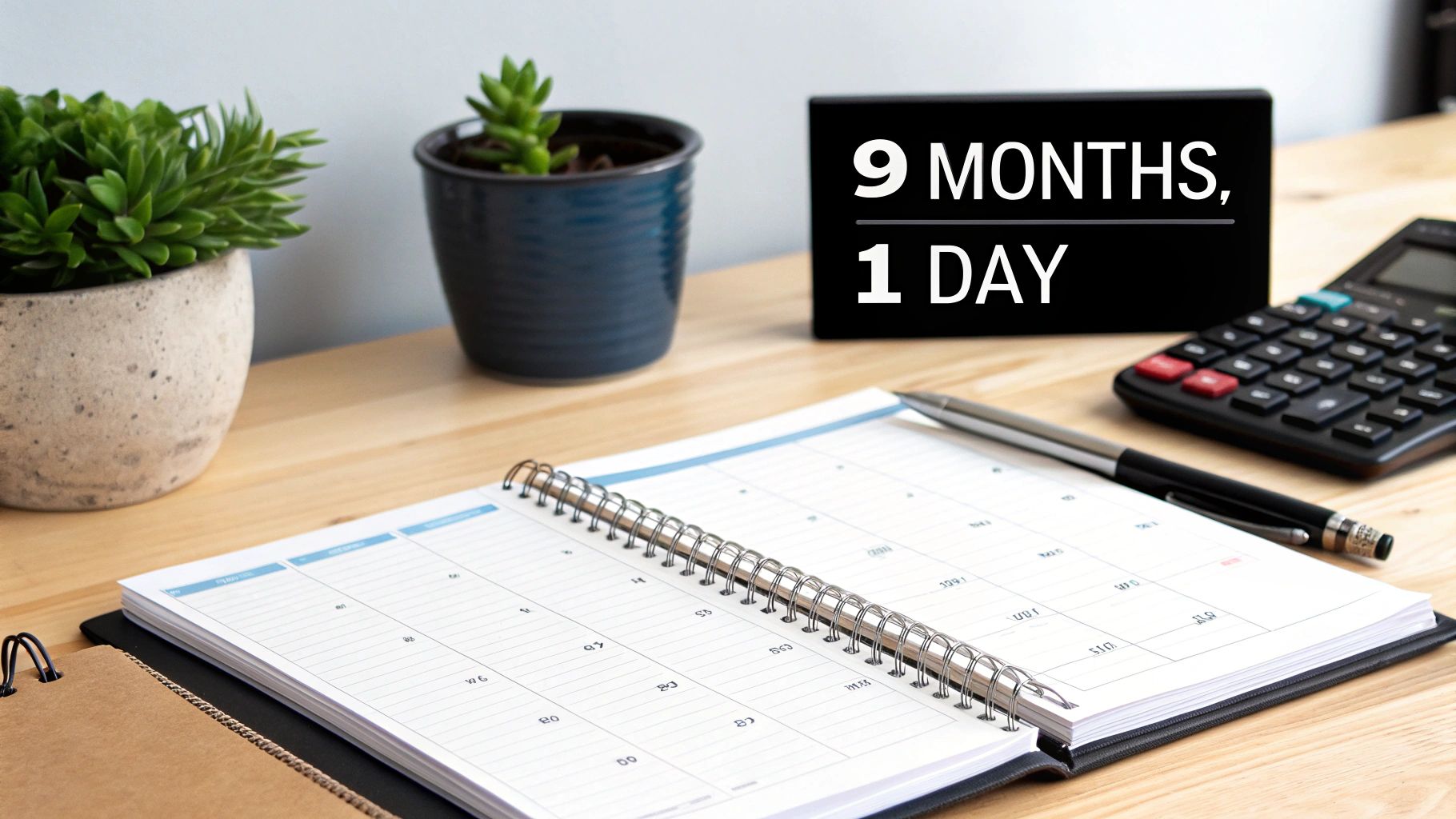
Getting to grips with your corporation tax payment date is the first step toward solid financial management. Think of it as a fixed, non-negotiable appointment in your business’s annual cycle.
Let’s take a common example. If your company’s accounting year wraps up on 31 March, your deadline to pay any corporation tax you owe is 1 January of the next year. This date is set in stone for all limited companies, no matter their size or what industry they’re in.
Payment Deadline vs Filing Deadline
Here’s where many business owners trip up: they mix up the deadline to pay the tax with the deadline to file the return. They are two completely different dates, and it’s vital to understand the distinction.
You have to pay your corporation tax 9 months and 1 day after your financial year ends. However, you have longer – 12 months after the year-end – to actually submit your Company Tax Return (the CT600 form).
What this means in practice is that you often have to pay your tax bill before you’ve officially filed the paperwork with HMRC. The system is set up this way to ensure a steady flow of tax revenue to the government. You’re essentially paying based on a very solid estimate from your year-end accounts.
For instance, if your company’s accounting period ends on 31 March 2025, the tax is due by 1 January 2026. But the final tax return doesn’t need to be filed until 31 March 2026. You can read more on this in our guide to the https://stewartaccounting.co.uk/limited-company-tax-return-deadline/.
Keeping these two dates separate in your mind is crucial. Missing the payment deadline leads to interest charges piling up, while filing your return late triggers immediate penalties. Getting both right is key to avoiding unnecessary costs and keeping your company in good standing with HMRC.
Defining Your Company Accounting Period
Before you can circle a date on the calendar for your tax payment, you first have to know exactly which period HMRC is looking at. This is your company’s Corporation Tax accounting period.
Think of it as the financial “year” for your business in the eyes of the taxman. It’s the specific timeframe over which your profits are measured to figure out the tax bill.
For most businesses that have been running for a while, this is usually quite simple. The accounting period lines up neatly with the financial year covered by your annual accounts. So, if your company accounts run from 1 April to 31 March, that’s your accounting period. Simple.
But it’s not always that straightforward, particularly if your company is brand new or you’ve recently changed your year-end date. Getting a handle on these details is the essential first step to understanding when your Corporation Tax is due.
Your First Accounting Period
When you set up a new limited company, your first accounting period is automatically determined. It begins on the very day your company officially exists (your incorporation date) and usually ends on the last day of that month in the following year.
Let’s say you registered your company on 10 June 2024. Your first accounting reference date will be set to 30 June 2025. This means your first set of company accounts will cover a period slightly longer than a year.
Here’s a crucial rule from HMRC: a Corporation Tax accounting period cannot be longer than 12 months. If your first accounts cover, say, 13 months, you have to split it for tax purposes.
This is a common source of confusion for new directors. It means you’ll need to prepare and file two tax returns:
- First Tax Return: Covering the first 12 months from your start date.
- Second Tax Return: Covering the short remaining period (often just a few days or weeks).
And yes, that means two separate payment deadlines. Each is calculated as 9 months and 1 day after the end of its own distinct period.
Changing Your Accounting Period
What happens if you decide to change your company’s year-end? You might want to do this to better align with your industry’s busy season or just to make admin easier. Changing the length of your financial year directly affects your Corporation Tax accounting period.
If you make your accounting year longer than 12 months, you’ll again fall into the “two tax returns” rule. One for the first 12 months, and a second for the remainder. If you shorten it, things are a bit simpler – you just end up with one shorter accounting period and a single deadline for it.
Nailing down your correct accounting period is the foundation of getting your Corporation Tax right. It doesn’t just set your payment deadline; it also determines how many tax returns you need to file. A misunderstanding here can easily lead to missed deadlines and unwelcome penalties from day one.
Working Out and Paying Your Tax Bill
Once you’ve got your head around your accounting period and you know your deadline, it’s time to tackle the actual tax calculation and get the bill paid. This is where the theory meets reality. It’s a two-stage process: first, figuring out the exact amount you owe HMRC, and second, making sure the payment gets to them correctly and on time.
The starting point is to work out your company’s profit for tax purposes. This is rarely the same as the profit figure you see on your management accounts. You’ll need to make a few specific adjustments to get to the number HMRC is interested in. A big part of this is knowing how to calculate net income and maximize profits, as this figure is the foundation for everything that follows.
From Your Books to HMRC’s Books
To get from your accounting profit to your taxable profit, you begin with the pre-tax profit shown in your annual accounts. Then, you have to ‘add back’ any business expenses that HMRC doesn’t allow for tax relief. These are genuine costs to your business, but for tax purposes, they don’t count.
Some of the most common non-allowable expenses include:
- Costs for entertaining clients
- Depreciation of assets (HMRC has its own system for this)
- Any personal costs put through the business
After adding those back to your profit, you can then deduct any tax reliefs you’re entitled to, like capital allowances. This is HMRC’s way of letting you get tax relief on significant assets you buy for the business, such as machinery, equipment, or vehicles. The final number you get is your taxable profit, and that’s what the Corporation Tax rate is applied to.
How to Pay HMRC
With the final tax figure calculated, the last step is to actually pay it. You’ve got a few different options here, but the key thing to watch is the processing time for each one. You need to pick a method that guarantees the money will land in HMRC’s account by the deadline.
Here are the most popular ways to pay:
- Online or Telephone Banking (Faster Payments): This is usually the fastest and easiest option. Payments often clear on the same day.
- CHAPS: This is another same-day service, but it’s typically used for very large, high-value payments.
- Direct Debit: A good ‘set and forget’ option, but you need to be organised. You have to set it up at least five working days before the payment is due.
- At your bank or building society: You can still pay with cash or a cheque in person, but you’ll need a specific paying-in slip from HMRC to do it.
Crucial Reminder: No matter which method you use, you absolutely MUST use the correct payment reference. For Corporation Tax, this is a unique 17-character reference number that is specific to the accounting period you’re paying for.
Getting this reference wrong is one of the easiest and most common mistakes to make. It can cause your payment to get lost in the system, which often leads to late payment penalties and interest charges—even if you sent the money on time. For a full breakdown of your options, take a look at our guide on how to pay Corporation Tax online. Always, always double-check that reference before you hit send.
Navigating Instalment Payments for Larger Companies
As your business grows, so does its relationship with HMRC. For most companies, the rule for paying Corporation Tax is nice and simple: the full amount is due nine months and one day after your accounting period ends. But once your profits cross a certain line, the game changes. You’ll find yourself moving from a single annual payment to a much more frequent schedule.
This shift kicks in when HMRC classifies your business as a ‘large’ company. For tax purposes, that means you have annual profits of £1.5 million or more. Hitting this milestone is great for business, but it means you can no longer wait until your year is over to settle your tax bill. Instead, you’ll need to start paying your estimated Corporation Tax in four quarterly instalments.
This system is designed to ensure that more profitable companies contribute to the public purse throughout the year, rather than in one big lump sum. Getting to grips with these rules is crucial for managing your cash flow effectively and staying on the right side of HMRC as your company scales.
The basic process of calculating and paying tax remains the same, but the deadlines become much more pressing.
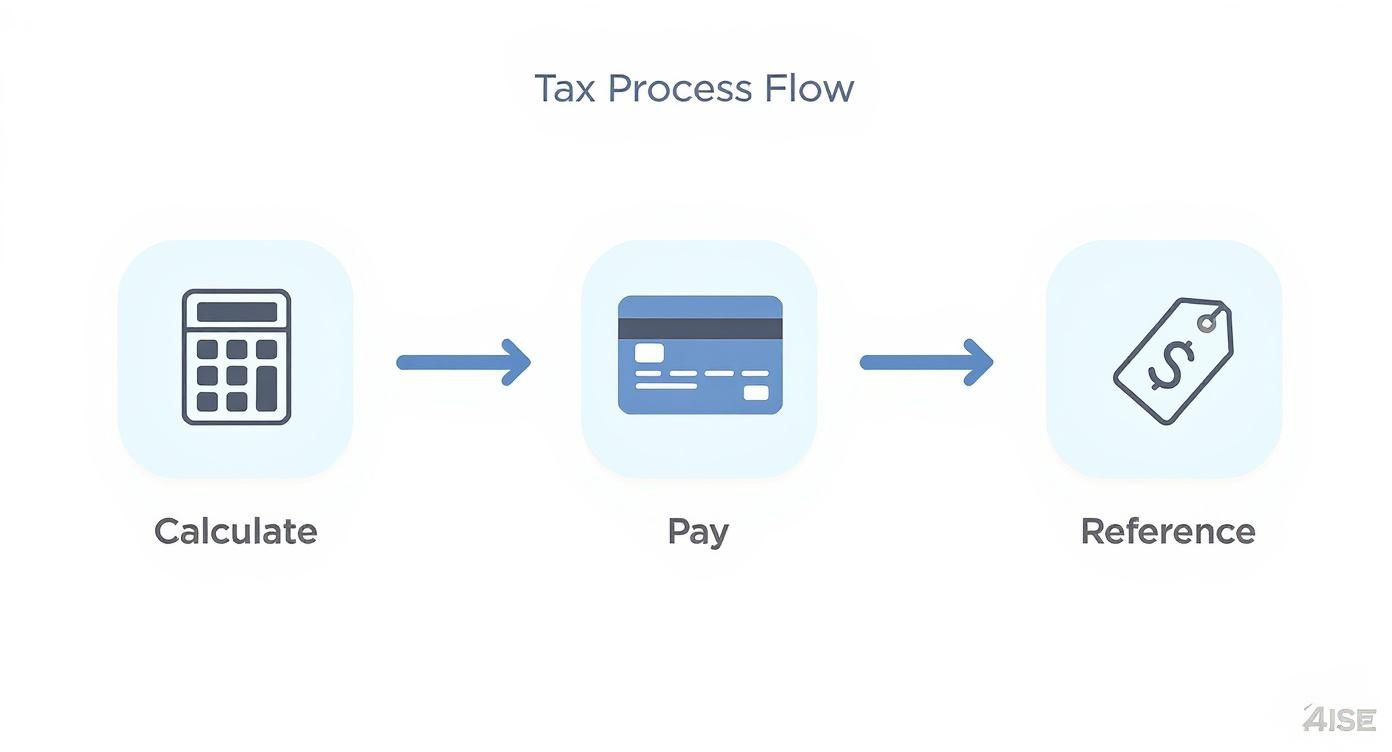
Whether you’re paying once a year or four times, getting the calculation right, paying on time, and using the correct reference number are absolutely fundamental.
Understanding the Instalment Schedule
For large companies, the tax clock starts ticking much, much earlier. The four payments, known as quarterly instalment payments (QIPs), are spread across your financial year. This requires some serious financial forecasting because you’re essentially paying tax on profits you haven’t even finalised yet.
Here’s what a typical QIPs schedule looks like for a 12-month accounting period:
- Payment 1: Due 6 months and 13 days after the first day of your accounting period.
- Payment 2: Due 3 months after the first payment.
- Payment 3: Due 3 months after the second payment.
- Payment 4: Due 3 months and 14 days after the last day of your accounting period.
You’ll notice the final payment is still due well before your actual tax return needs to be filed. This system really demands a tight grip on your finances to make sure you have the cash available for each deadline. If you anticipate any difficulties, it’s always wise to explore options like a formal Corporation Tax payment plan with HMRC sooner rather than later.
Worked Example for a Large Company
Let’s bring this to life with an example. Imagine a successful business whose accounting period runs from 1 April 2024 to 31 March 2025. They’ve had a great year and are forecasting profits of around £2 million.
Because their profits are over the £1.5 million threshold, they must pay in instalments. Here’s when their payments would be due:
- First Payment: 14 October 2024 (6 months and 13 days from 1 April 2024).
- Second Payment: 14 January 2025 (3 months later).
- Third Payment: 14 April 2025 (another 3 months later).
- Fourth Payment: 14 July 2025 (3 months and 14 days from 31 March 2025).
Key Takeaway: The company has to make its first tax payment just over halfway through its financial year, based entirely on estimated profits. If they get their estimate wrong and underpay, HMRC will charge interest.
It’s also crucial to know that the £1.5 million threshold is adjusted if you’re part of a corporate group. If your company has associated companies, the threshold is divided by the total number of active companies in that group. For a group of three companies, for instance, the threshold plummets to just £500,000 each, pulling many more growing businesses into the instalment payment regime.
The Real Cost of Missing Your Deadline
Knowing your payment deadline is one thing, but truly understanding the consequences of missing it is what keeps a business on the straight and narrow. If you pay your Corporation Tax late, HMRC doesn’t just send a polite nudge; it starts adding costs to your bill from day one.
The very moment you pass the payment deadline, HMRC begins charging interest on the outstanding amount. This isn’t a one-off slap on the wrist. It’s calculated daily, so the longer the bill goes unpaid, the more you end up owing. The interest rate is set at the Bank of England base rate plus 2.5%, and it can add up surprisingly fast.
Think of it like leaving a tap dripping. A single drop seems harmless, but leave it for long enough and you’ve got a serious water bill. In the same way, those daily interest charges might seem small at first, but they accumulate relentlessly, making your original tax liability much more expensive.
Interest Is Not the Same as a Penalty
This is a really important distinction that catches many business owners out. There are two separate consequences for being late: one for paying late, and another for filing your tax return late.
- Late Payment Interest: This is the daily charge added directly to the tax you haven’t paid.
- Late Filing Penalties: These are fixed fines for not submitting your CT600 tax return by its deadline (which is 12 months after your accounting period ends).
You could pay your tax bill perfectly on time but file the return late, and you’ll still get a penalty. On the flip side, you can file your return on time but pay the tax late, which triggers interest charges. If you mess up both, you’ll be hit with interest and penalties – a painful and expensive combination.
Penalties for filing late are automatic and escalate quickly. You get an instant £100 penalty the moment you miss the filing deadline. If you’re still late after three months, another £100 is added on top.
What to Do If You Cannot Pay on Time
If you know you’re going to struggle to meet the payment deadline, burying your head in the sand is the worst thing you can do. From my experience, HMRC is far more likely to be reasonable if you’re proactive and get in touch with them before the deadline passes.
Your best move is to contact them to arrange a ‘Time to Pay’ plan. This is a formal agreement that lets you pay what you owe in instalments over an agreed-upon period. While interest will still be charged on the outstanding balance, a plan can help you avoid more severe penalty action and manage your company’s cash flow without the stress of a huge bill you simply can’t afford. Being upfront shows responsibility and helps keep your relationship with HMRC on solid ground.
How Stewart Accounting Services Can Help
Let’s be honest, getting your head around corporation tax deadlines, calculations, and the risk of penalties can easily become a major headache. It’s a huge drain on your time and energy—time you’d much rather spend running your business. This is where getting the right professional support can completely change the game, turning a daunting task into a smooth, managed process.
At Stewart Accounting Services, we specialise in cutting through the complexity of tax compliance for you. Our work covers the entire process, from pinpointing your exact accounting period to managing instalment payments if you’re a larger company, and making sure you sidestep those costly late submission penalties.
Our job is to worry about the financial details so you don’t have to. You can get back to focusing on what you do best—growing your business with complete peace of mind.
We offer proactive tax planning, expert return preparation, and full support in dealing with HMRC, ensuring every detail is managed correctly and on time.
In the 2024-2025 financial year, HMRC brought in a massive £97.2 billion in corporation tax, which was a £3.5 billion jump from the year before. These figures, available in the latest government statistics on corporation tax, show just how many UK businesses are navigating these rules.
Our expertise ensures you’re one of the ones who gets it right. Let us help you stay compliant and clear the path for your company’s future success.
Frequently Asked Questions
Even when you’ve got a handle on the main rules, real-world situations can throw up some tricky questions about Corporation Tax. Let’s tackle some of the most common ones we hear from business owners.
What Happens If My Company Makes a Loss?
If your limited company ends up with a loss for the year instead of a profit, the good news is you won’t have any Corporation Tax to pay. Simple as that.
However, you’re not completely off the hook. You still have to prepare and file a Company Tax Return (CT600) to officially report the loss to HMRC. Don’t skip this step! Declaring the loss is actually a smart move, as you can often carry it forward to reduce your tax bill in a future, more profitable year. Sometimes, you can even carry it back to get a refund on tax you paid last year.
Can I Pay My Corporation Tax Bill Early?
Absolutely. There’s no rule saying you have to wait until the last minute. As soon as your accounts are finalised and you know the exact figure, you can pay your Corporation Tax.
Paying early is a great way to get it off your to-do list and avoid any last-minute stress or technical glitches. It just helps with managing your cash flow. Just be aware that HMRC won’t pay you interest for settling up ahead of schedule – the real benefit is simply peace of mind and staying well ahead of the deadline.
What Do I Do If My Company Is Dormant?
If your company is officially registered with HMRC as ‘dormant’ for Corporation Tax, you don’t have to pay anything or file a Company Tax Return. A company is usually considered dormant if it’s not actively trading and has had no significant transactions.
The key here is that you must tell HMRC your company is dormant. If you don’t, they’ll still be expecting a tax return. You’ll then start receiving automatic penalties for not filing, even though there was never any tax to pay in the first place.
Getting Corporation Tax right is a non-negotiable part of keeping your company financially healthy. At Stewart Accounting Services, we navigate the complexities of tax compliance so you can get back to what you do best: running your business. Contact us today for expert support.