

Year End Accounts Preparation UK: A Complete Guide for Small Businesses

Does the thought of your financial year-end bring a familiar sense of dread? For many small business owners, the annual task of year end accounts preparation UK can feel incredibly overwhelming. Between deciphering confusing jargon like ‘balance sheets’, worrying about strict deadlines from HMRC and Companies House, and the constant fear of making a costly mistake, it’s a process that often causes more stress than it should.
But it doesn’t have to be this way. This comprehensive guide is designed to take the complexity and worry out of your year-end. We will walk you through the entire process step-by-step, in plain English, helping you understand your legal obligations with clarity. By the end, you’ll have the knowledge and confidence to prepare and file your accounts correctly and on time, giving you the peace of mind that your business finances are in perfect order. Let’s get you ready to close the books with confidence.
What Are Year End Accounts? The Essentials for UK Businesses
Think of your year-end accounts as your business’s annual financial report card. At their core, these accounts (also known as statutory accounts) are a set of formal documents that summarise your company’s financial performance over a 12-month period. For many directors, the process of year end accounts preparation UK can feel like a major hurdle, but understanding their purpose is the first step to simplifying it.
These reports serve a dual purpose: they must be filed with Companies House to remain on the public record, and a version is sent to HMRC alongside your Company Tax Return to calculate your corporation tax liability. Understanding the key components of your annual accounts, like the balance sheet and profit and loss statement, is crucial. Depending on your company’s size, you may be able to file simpler versions, such as micro-entity, abridged, or small company accounts, which helps to ease the burden.
Who Needs to Prepare and File Annual Accounts?
If you operate a private limited company in the UK, preparing and filing annual accounts is a legal requirement. This obligation also extends to other incorporated structures like Limited Liability Partnerships (LLPs) and Community Interest Companies (CICs). It’s important to note that sole traders have different requirements; instead of filing statutory accounts, they report their business income through an annual Self Assessment tax return.
Why Year End Accounts Are More Than Just a Legal Chore
While compliance is non-negotiable, viewing your accounts merely as a task to be ticked off is a missed opportunity. They are a powerful tool that provides significant value for your business. Here’s why they matter:
- Avoiding Penalties: Filing correctly and on time with Companies House and HMRC helps you avoid automatic late filing penalties, which can be substantial. We help you take this worry off your hands.
- Accurate Tax Calculation: Your accounts form the foundation for your Company Tax Return. Getting them right ensures you pay the correct amount of corporation tax and don’t overpay.
- Valuable Business Insight: These reports provide a clear, objective snapshot of your company’s financial health. They help you understand profitability, cash flow, and areas for improvement, enabling smarter business decisions.
- Securing Finance: Whether you’re applying for a business loan, a mortgage, or seeking investment, your annual accounts are one of the first documents lenders and investors will ask for. Well-prepared accounts build credibility and trust.
The Key Components of Your Annual Accounts Explained
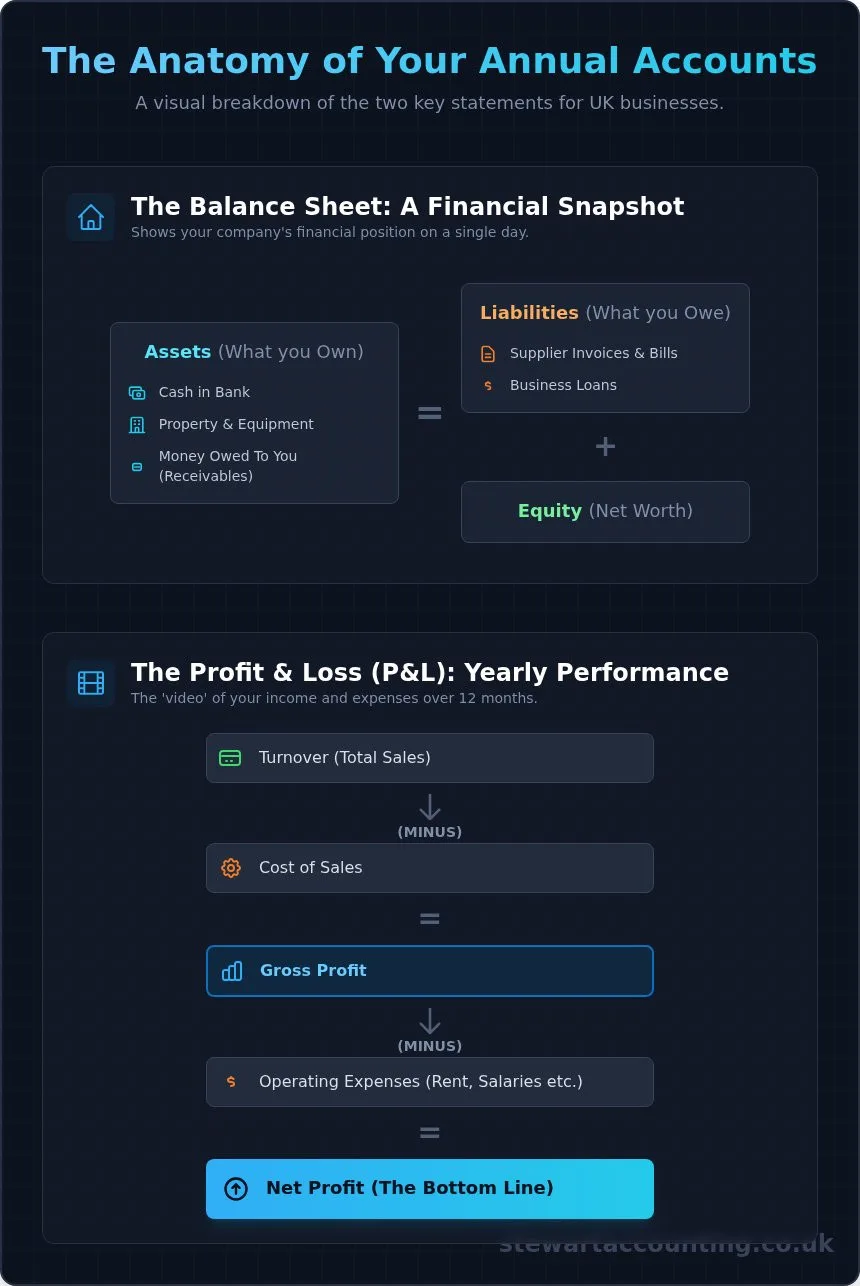
Think of your annual accounts as the financial story of your business year. They aren’t just a compliance headache; they are a set of crucial documents that, when understood, provide powerful insights into your performance. For a smooth year end accounts preparation UK process, it helps to see the Profit and Loss account as a video of your year’s trading, and the Balance Sheet as a final snapshot of your financial position. Getting these components right is vital, as accuracy is the foundation of a reliable financial story.
The Balance Sheet: A Snapshot of Your Business
This statement shows your company’s financial health on a single day-your year-end date. It provides a clear summary of what your business owns (Assets) and what it owes (Liabilities). The difference between these is your business’s net worth, known as Equity or capital. For example, a key asset could be the £10,000 cash in your business bank account, while a liability might be a £2,000 bill you owe to a supplier.
The Profit and Loss (P&L) Account: Your Yearly Performance
If the Balance Sheet is a photo, the P&L (also called an Income Statement) is the video. It details your financial performance over the entire 12-month period, showing whether you made a profit or a loss. It starts with your total sales (Turnover), subtracts the direct costs of those sales (Cost of Sales) to find your Gross Profit, and then deducts all other running costs-like rent and salaries-to arrive at your final Net Profit. This is the ultimate measure of your profitability.
Notes to the Accounts and the Director’s Report
These final sections provide essential context. The ‘Notes’ add important detail to the figures in the main statements, explaining the accounting policies used and breaking down complex numbers. The Director’s Report is a narrative overview from the company directors, though it’s important to know this isn’t required for micro-entities in the UK. Together, these components provide a complete and transparent view for HMRC and Companies House, answering the crucial question of what are annual accounts and their purpose.
A Step-by-Step Guide to Preparing Your Financial Records
Think of this section as your practical checklist for a smooth and stress-free year end. While consistent bookkeeping throughout the year is the best foundation, this structured approach ensures nothing gets missed when it matters most. This is precisely the information your accountant needs to complete the year end accounts preparation UK process efficiently.
By getting organised now, you can avoid that last-minute panic and ensure your final figures are accurate and compliant.
Gathering Your Financial Information
The first step is to bring all your core financial documents together in one place. Creating this complete file makes every subsequent step much simpler. Be sure to collect the following for the entire financial year:
- All Business Bank Statements: Collate the statements for every business bank and credit card account you use.
- Sales Invoices and Income Records: Gather a complete record of every sale you made and any other income the business received.
- Purchase Invoices and Expense Receipts: Organise all receipts for things the business has paid for, from stock and materials to software subscriptions and travel costs.
Reconciling Your Accounts
Bank reconciliation is the vital process of matching the transactions in your accounting software or records against your bank statements. This is a crucial health check for your business finances. It confirms your records are accurate, helps you spot any bank errors, and identifies missing invoices or payments. At this stage, you should also review who owes your business money (accounts receivable) and which suppliers you still need to pay (accounts payable).
Reviewing Key Figures and Assets
Finally, you need to account for other important financial elements that provide a complete picture of your company’s value and obligations. This ensures your balance sheet is correct.
- Company Assets: Make a list of significant assets the business owns (e.g., computers, vehicles, machinery) and their purchase value.
- Stock Levels: If your business holds inventory, you will need to count and value the stock you have on hand at your year-end date.
- Directors, Loans & Dividends: Confirm the accuracy of your payroll records, any outstanding director’s loans, and all dividend payments made during the year.
If this checklist feels like a mountain to climb, remember you don’t have to do it alone. Feeling overwhelmed? Let us take this off your hands.
Filing Deadlines and Penalties: What Every Director MUST Know
When you run a limited company, meeting statutory deadlines isn’t optional-it’s a legal responsibility. A key part of the year end accounts preparation UK process is understanding these dates to avoid automatic, non-negotiable penalties. The two key bodies you must report to are Companies House and HMRC, and they have different deadlines. Getting this wrong can be stressful and costly, so let’s break it down to make it simple and clear.
Companies House Filing Deadline
This is the deadline for filing your statutory accounts, which become part of the public record. The rule is straightforward: your accounts must be filed with Companies House within 9 months of your company’s financial year end. For example, if your year end is 31st December, your filing deadline is 30th September of the following year. It’s important to note that for your very first set of accounts, the rules are slightly different, so it’s always best to check or seek professional advice.
HMRC Filing Deadline (Company Tax Return)
This deadline is for your Company Tax Return, also known as the CT600, which is used to calculate your Corporation Tax. You have a bit more time here: the deadline to file is 12 months after your financial year end. However, there’s a crucial catch that trips many directors up: the deadline to pay your Corporation Tax bill is much earlier, typically 9 months and 1 day after your year end. Your final accounts must be included with your CT600, making timely preparation essential for both compliance and tax planning.
The Cost of Late Filing: Automatic Penalties
Both government bodies issue penalties automatically if you miss your deadline. There are very few acceptable excuses, so being prepared is vital to protect your business finances.
For Companies House, the penalties for a private limited company are:
- Up to 1 month late: £150
- 1 to 3 months late: £375
- 3 to 6 months late: £750
- More than 6 months late: £1,500
Crucially, these penalties are doubled if you file your accounts late two years in a row. For HMRC, you’ll receive an initial £100 penalty for a late tax return, with further penalties and interest on unpaid tax the longer it’s left outstanding.
These deadlines are firm, but they don’t have to be a source of worry. With a smooth and efficient process for your year end accounts preparation, you can ensure everything is filed correctly and on time. If you’d rather have an expert take it completely off your hands and gain peace of mind, we’re here to help.
DIY vs. Hiring a Chartered Accountant: Making the Smart Choice
Deciding how to handle your year-end accounts is more than just a line item on your budget; it’s a strategic choice that impacts your time, finances, and peace of mind. For many small business owners, this boils down to one key question: should you tackle it yourself or partner with a professional? Let’s look at both options objectively to help you make the smart choice for your business.
The DIY Route: When It Might Work (and the Risks)
Handling your own accounts can seem appealing, offering initial cost savings of a few hundred pounds and giving you direct control. However, this route is often a false economy. The process is incredibly time-consuming and carries a high risk of errors, which can lead to costly HMRC penalties. You might also miss out on legitimate tax-saving opportunities that a professional would spot. This approach is only really suitable for the simplest of businesses with minimal transactions.
The Value of a Chartered Accountant
Partnering with a Chartered Accountant transforms your year end accounts preparation UK from a stressful chore into a valuable business asset. It’s about more than just compliance; it’s about unlocking the three freedoms every business owner deserves:
- More Peace of Mind: We guarantee your accounts are accurate, compliant with UK regulations, and filed on time. No more worrying about deadlines or complex rules. We take the stress completely off your hands.
- More Time: Your time is best spent growing your business, not buried in spreadsheets. Handing over your accounts frees you up to focus on what you do best – serving your customers and driving growth.
- More Money: An expert accountant doesn’t just record history; they help shape your future. We provide proactive tax planning to ensure you operate in the most efficient way possible, identifying savings you might have missed.
How to Choose the Right Accountant for Your Business
Finding the right partner is crucial. Look for a fully qualified Chartered Accountant who understands your specific industry and the challenges small businesses face. Ensure their pricing is transparent and that you feel a good rapport – they should be someone you can trust for straightforward advice. The right professional makes the entire process feel smooth and supportive. If you’re ready to see how we can help, we’d love to talk. Book a free, no-obligation chat.
Take the Stress Out of Your Year End Accounts
Navigating the end of the financial year doesn’t have to be a source of stress. As this guide has shown, understanding your obligations and meeting deadlines are fundamental, but how you get there makes all the difference. The process of year end accounts preparation UK demands precision, and for many small business owners, partnering with an expert is the smartest path to compliance and peace of mind.
Let us take the burden off your hands. At Stewart Accounting Services, our Fully Qualified Chartered Accountants are dedicated to helping small businesses across Central Scotland. From our local offices in Alloa, Stirling, and Falkirk, we provide the expert support that gives you more time to focus on what you do best. Make this your most organised and stress-free year-end yet.
Ready to get more time, more money, and less stress? Let our Chartered Accountants handle your year-end accounts.
Frequently Asked Questions About Year End Accounts
How much does an accountant charge for year-end accounts preparation in the UK?
The cost for year-end accounts preparation in the UK can vary based on your business’s complexity, turnover, and the quality of your bookkeeping records. For a small limited company, fees often range from £600 to over £1,500. It’s best to see this as an investment, not just a cost. A good accountant can help identify tax savings that outweigh their fee, giving you valuable peace of mind and ensuring full compliance.
Can I prepare and file my own limited company accounts?
While it is legally possible to prepare and file your own accounts, it comes with significant risks. The process is complex, and errors can lead to penalties from HMRC or Companies House. More importantly, you could miss out on legitimate tax-saving opportunities. Using a qualified accountant ensures accuracy and compliance, taking the stress and complexity of year-end accounts completely off your hands so you can focus on your business.
What is the difference between financial year and tax year?
Your company’s financial year is the 12-month period covered by your statutory accounts, and you choose this date when you set up your company. The tax year, on the other hand, is fixed by the government and runs from 6th April to 5th April. It is used for personal taxes, like your Self Assessment tax return. While they are different, your Corporation Tax period is usually aligned with your company’s financial year.
Do I need an audit for my small company accounts?
For the vast majority of small UK limited companies, a formal audit is not required. You are typically exempt if your business meets at least two of the following criteria: an annual turnover of no more than £10.2 million, a balance sheet total of no more than £5.1 million, and 50 or fewer employees on average. This exemption saves significant time and expense, but you must still prepare and file accurate annual accounts.
What happens if I find a mistake in my accounts after they’ve been filed?
Don’t panic; it is possible to correct mistakes. You can file amended accounts with Companies House to replace the original submission. For HMRC, you can amend your Company Tax Return online, usually up to 12 months after the original filing deadline. It’s crucial to act quickly to correct any errors to ensure you remain compliant and avoid potential penalties. We can help you navigate this process smoothly and efficiently.
What is the difference between the accounts filed at Companies House and HMRC?
The accounts you file with Companies House are for the public record, showing your company’s financial health. Small companies can often file ‘abridged’ accounts, which contain less detail. The accounts submitted to HMRC, alongside your Company Tax Return, are much more detailed. Their purpose is specifically to calculate your Corporation Tax liability. While they are based on the same data, their format and level of detail differ significantly.
Can accounting software like Xero or QuickBooks prepare my year-end accounts for me?
Software like Xero and QuickBooks are powerful tools for day-to-day bookkeeping, which makes the year-end process much smoother. However, they cannot prepare and file the final statutory accounts on their own. An accountant is still needed to make crucial year-end adjustments, check for accuracy, ensure compliance with accounting standards, and provide strategic tax advice before submitting the final documents to Companies House and HMRC.
Recent Posts
22 Oct, 2026
21 Oct, 2026