

Sole Trader or Limited Company UK Guide
At its heart, the difference is straightforward. As a sole trader, you are the business. There’s no legal distinction, which makes getting started a breeze but leaves your personal assets on the line. A limited company, on the other hand, is a completely separate legal entity. This gives you protection but comes with more administrative hoops to jump through.
The right choice really boils down to what you prioritise: simplicity and low costs, or legal protection and tax efficiency.
Choosing Your UK Business Structure
Deciding whether to set up as a sole trader or a limited company is one of the first, and most important, crossroads any UK entrepreneur will face. This isn't just a box-ticking exercise; it fundamentally shapes how you’re taxed, how much personal risk you’re exposed to, and even how your business can grow.
For many, starting as a sole trader is the path of least resistance. It's the quickest and easiest way to get up and running in the UK, with minimal paperwork to worry about.
But as a business finds its feet and starts to grow, the limited company structure often starts to look a lot more appealing. Creating a formal legal entity puts a protective wall between your business and personal finances—a crucial safety net. It can also give your business a more professional image, which often helps when you're trying to win bigger contracts or attract investment.
Sole Trader vs Limited Company At a Glance
Before we get into the nitty-gritty, let's start with a high-level summary. Getting a clear picture of these core differences is the first step to making the right call for your situation. If you're leaning towards the simpler route initially, our guide on structuring a business as a sole trader is a great place to get more detail.
The table below gives you a quick snapshot of the key distinctions.
| Feature | Sole Trader | Limited Company |
|---|---|---|
| Legal Status | You and the business are one legal entity. | A separate legal entity from its owners. |
| Personal Liability | Unlimited – personal assets are at risk. | Limited to the value of shares owned. |
| Setup & Admin | Simple registration with HMRC; minimal admin. | More complex: register with Companies House. |
| Tax Treatment | Pay Income Tax and National Insurance on profits. | Pays Corporation Tax; directors taxed separately. |
| Public Record | Business details are largely private. | Director and company details are public. |
| Credibility | Often viewed as smaller or less established. | Can appear more professional and credible. |
This table lays out the fundamental trade-offs. Now, let’s explore what each of these points really means for you and your business in practice.
How Legal Liability and Personal Risk Differ
When you're weighing up whether to be a sole trader or a limited company, this is the single most important factor to get your head around: personal liability. This isn't just dry accounting jargon; it directly defines how much personal financial risk you're prepared to take on. The two structures couldn't be more different on this front.
As a sole trader, you and your business are one and the same in the eyes of the law. There’s no legal distinction, which means you have unlimited liability. This creates a direct, unbroken line between your business finances and your personal wealth.
If your business runs into trouble and can't pay its debts, creditors can come after your personal assets. We’re talking about your home, your car, your personal savings – anything of value. The risk isn't just about debt, either; it covers legal claims too, like a client suing for professional negligence.
The Corporate Veil of a Limited Company
A limited company, on the other hand, offers a powerful layer of protection known as the 'corporate veil'. By incorporating, you create a completely separate legal entity. This legal separation is the foundation of limited liability.
The company itself can sign contracts, own property, and take on debt. If the business fails or gets sued, your personal assets are generally safe. Your financial exposure is typically limited to the amount you've invested in the company, which is often just the nominal value of your shares.
This legal separation is a game-changer for managing risk. For anyone in higher-risk sectors like construction or consulting, operating as a limited company provides an essential safety net that the sole trader structure simply can't match.
Put simply, a sole trader is legally indistinguishable from their business, making them personally liable for all its debts. In contrast, a limited company, governed by the Companies Act 2006, shields personal assets because a shareholder's liability is typically limited to any amount unpaid on their shares.
Real-World Scenarios
To see how this plays out in practice, let’s imagine a web developer who accidentally causes a major data breach for a client, resulting in a £50,000 legal claim.
- As a Sole Trader: The developer is sued personally. If they can’t cover the £50,000 from the business account, the client’s lawyers can pursue their personal savings, force the sale of their car, or even put a charge on their house.
- As a Limited Company Director: The client sues the limited company, not the director. The company is liable for the £50,000. If the business doesn't have enough assets to pay, it might have to cease trading, but the director's personal home, car, and savings remain protected.
Of course, this protection isn't a get-out-of-jail-free card. Directors have legal duties, and in instances of fraud or wrongful trading, a court can 'pierce the corporate veil' and hold them personally liable. Failing to meet these duties can lead to serious consequences, including potential company director disqualification. Part of this responsibility also involves making sure your business follows key regulations, which means having things like a solid GDPR compliance checklist in place.
Ultimately, the choice boils down to your appetite for risk. The beautiful simplicity of being a sole trader comes at the price of complete personal exposure, whereas the limited company route trades a bit more admin for invaluable financial protection.
A Practical Comparison of Tax Obligations
Getting to grips with how your business will be taxed is arguably the most critical part of deciding whether to operate as a sole trader or a limited company. The two structures are worlds apart in how they handle profits and tax, which can lead to vastly different financial outcomes—especially as your business grows.
For a sole trader, the setup is beautifully simple. Your business profits are your personal income; there’s no legal or financial distinction between you and the business. This straightforward approach is a huge plus for anyone just starting out.
A limited company, on the other hand, is a completely separate legal entity. It pays its own taxes on its profits. You, as the director, are then taxed on the money you decide to take out. This two-step process means more paperwork, but it also unlocks some serious opportunities for smart tax planning.
The Sole Trader Tax Framework
When you’re a sole trader, you add up all your business income, subtract your allowable expenses, and the profit that's left over is what you’ll be taxed on. This profit gets bundled with any other personal income you might have (like from a side gig) and is taxed through the Self-Assessment system.
You're on the hook for:
- Income Tax on any profits that push you over your personal allowance.
- Class 2 National Insurance Contributions (NICs), which is a small, flat weekly rate.
- Class 4 National Insurance Contributions (NICs), a percentage-based charge on profits above a certain level.
Because there's no separation, as your business profits climb, so does your personal tax bill. It's easy to find yourself pushed into higher tax brackets much faster than you might expect.
A key takeaway for sole traders is that every pound of profit is subject to personal tax rates in the year it's earned. You can't leave profits in the business to be taxed at a later date or at a different rate.
Crucially, the business structure you choose has a massive impact on your tax position. For new ventures, figuring out how to maximise startup tax credit benefits is vital.
The Limited Company Tax Structure
A limited company works on a more sophisticated, two-layer tax system. First, the company itself is taxed on its profits. Then, you, the owner, are taxed on the money you take out of it.
This infographic neatly illustrates how a limited company separates your personal liability and assets from the business—a core principle that extends to its tax obligations.
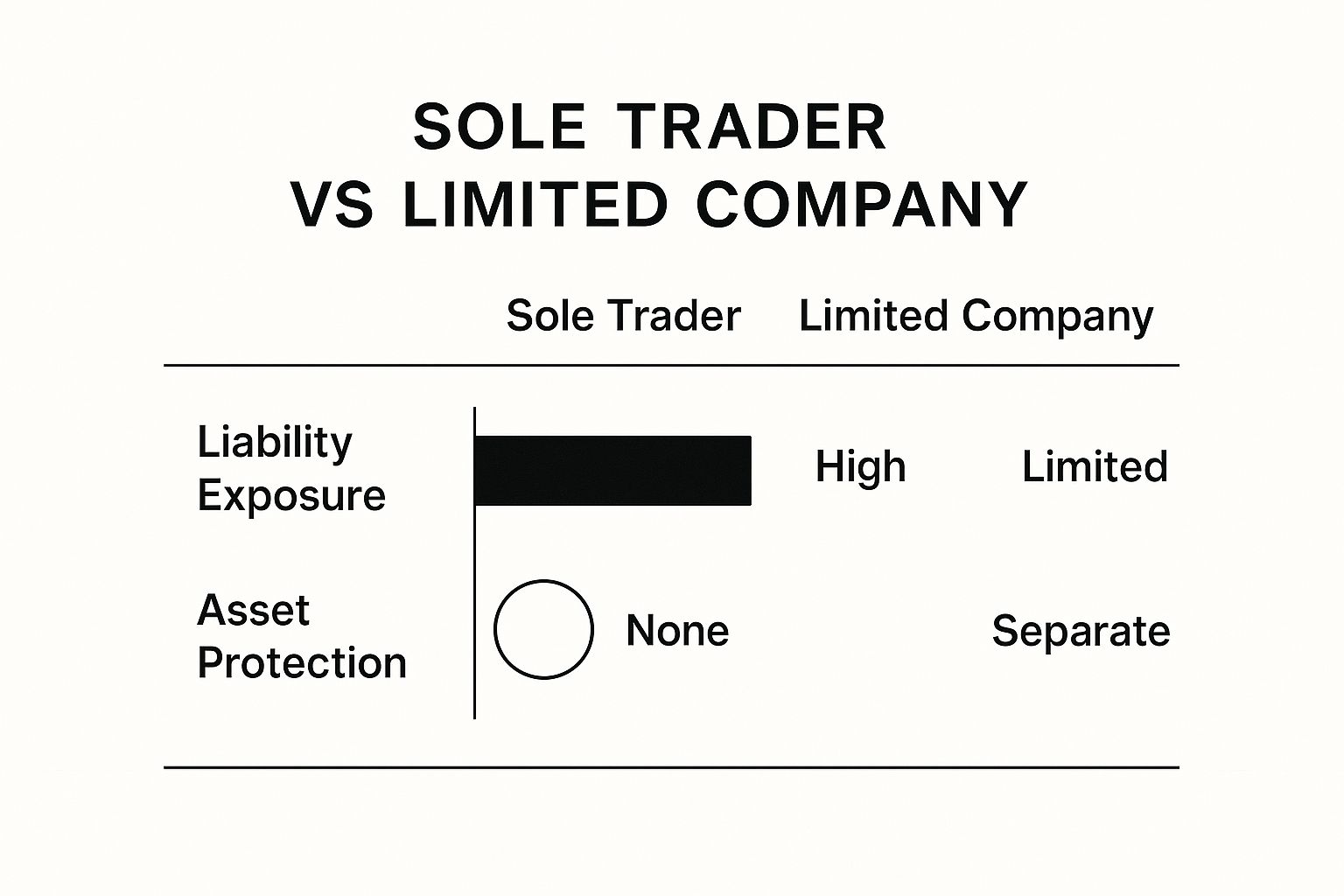
As you can see, the limited company creates a protective barrier, and this is mirrored in how it's treated as a separate taxpayer from its owners.
Here’s a breakdown of how the money flows:
- Corporation Tax: The company calculates its profits and pays Corporation Tax on that figure directly to HMRC. This is a flat-rate tax, which is often lower than the higher rates of personal Income Tax. To get into the nitty-gritty, you can read our guide on what Corporation Tax is and how it is calculated.
- Personal Tax on Extraction: As the director, you then have to decide how to pay yourself from the profits that are left. The usual route is a combination of a small salary and dividends, and each is taxed differently.
This separation is where the real potential for tax efficiency comes from. In the UK, sole traders pay Income Tax on all business profits over the personal allowance (£12,570) at rates of 20%, 40%, and 45%, plus Class 2 and Class 4 National Insurance. By contrast, limited companies pay Corporation Tax on their profits—19% for profits under £50,000 and 25% for profits over £250,000. You then pay tax on your salary and dividend income, a structure that offers much more room for careful planning.
Tax Efficiency in Practice
So, when does it make sense to make the switch? The tipping point where a limited company usually becomes more tax-efficient is when your annual profits start to consistently hit the £30,000-£40,000 mark. At this level, the combined bill for Corporation Tax and dividend tax often works out lower than the Income Tax and National Insurance a sole trader would pay on the same profit.
Let’s look at a quick example with a profit of £60,000:
- As a Sole Trader: The entire £60,000 (less your personal allowance) would be hit by higher-rate Income Tax (40%) and National Insurance.
- As a Limited Company: The company first pays Corporation Tax on the £60,000 profit. You could then draw the remaining funds out through a tax-smart mix of a small salary (often set just below the NI threshold) and dividends, which are taxed at much friendlier rates than salary income.
This structure also gives you a major strategic advantage: profit retention. You can leave profits in the company to reinvest in growth or to draw down in a future tax year when your personal tax situation might be more favourable. That kind of control is simply off the table for a sole trader, making the limited company a far more strategic option for an ambitious, growing business.
Getting to Grips with Daily Admin and Compliance
Beyond the big-picture issues of tax and liability, there’s the day-to-day reality of running your business. How much time will you spend on paperwork? What are your legal filing duties? This is where the sheer simplicity of being a sole trader really stands out. But the robust protection you get from a limited company comes with a significant, non-negotiable step up in compliance.
This operational difference is a huge part of the sole trader or limited company decision. One path is built for ease and minimal fuss, while the other demands more structure and formal record-keeping in exchange for its legal benefits.
The Sole Trader Experience: Keeping it Simple
If you’re a sole trader, the admin side of things is refreshingly straightforward. Your main legal duty is to keep a clear record of your income and business expenses. You need this to complete your annual Self-Assessment tax return, but there's no set format you have to follow or official filings to worry about during the year.
Most of your admin will boil down to these tasks:
- Good Record-Keeping: Simply tracking all your sales invoices and purchase receipts. A basic spreadsheet or simple accounting software is usually all you need.
- The Annual Self-Assessment: Each year, you file one tax return with HMRC. This single form covers your business profits and any other personal income you have.
- VAT Registration (If Needed): You only have to register for VAT and start submitting returns if your turnover crosses the £90,000 threshold.
This streamlined approach means less time bogged down in compliance and lower accountancy fees. It’s a perfect setup for new businesses, freelancers, and consultants who need to pour every ounce of energy into finding clients and getting the work done.
The Limited Company Framework: More Rules, More Protection
Running a limited company involves a much more structured and demanding administrative routine. Because the company is its own legal entity, it has formal reporting duties to two separate government bodies: HMRC and Companies House. These aren’t optional—miss a deadline, and you’ll face an automatic penalty.
A key part of a limited company's credibility is its transparency. But this comes at the cost of privacy and more admin. All your director details, annual accounts, and confirmation statements are put on the public record for anyone to see.
This structure forces you to be more organised with your finances. While a good accountant can handle most of these tasks for you, the ultimate legal responsibility for getting it right and filing on time always lies with the company directors.
A Head-to-Head Look at Your Duties
The real difference in the daily grind becomes obvious when you put the mandatory tasks side-by-side.
| Administrative Task | Sole Trader Requirement | Limited Company Requirement |
|---|---|---|
| Annual Filing | Just one Self-Assessment tax return to HMRC. | 1. Annual Accounts to Companies House. 2. Company Tax Return to HMRC. 3. A personal Self-Assessment tax return for each director. |
| Official Records | None required. | Must keep official records, known as statutory registers (e.g., list of directors, shareholders). |
| Public Information | Your business finances are private. | Company details, director info, and accounts are all public on the Companies House website. |
| Banking | A separate bank account is highly recommended but not a legal must. | A dedicated business bank account is mandatory. |
As you can see, the workload for a limited company director is substantially heavier. The requirement to prepare and file statutory accounts, a Company Tax Return, and an annual Confirmation Statement all add up to a real commitment of time and professional fees. This trade-off between simplicity and protection is one of the most important things to weigh up when choosing your business structure.
Thinking Ahead: Growth, Perception, and Your Exit Strategy
Once you get past the immediate concerns of tax and liability, your choice of business structure starts to touch on the very future of your enterprise. It's about more than just admin; it’s a strategic decision that shapes how you get paid, how clients see you, and how big your business can realistically get.
These aren't just details to sort out later. The structure you choose today can either pave the way for your ambitions or become a roadblock. What’s perfect for a freelance writer might completely hold back a software startup hunting for investment.
How You Get Paid: Drawings vs. Dividends
One of the first practical differences you'll bump into is how you actually take money out of the business. As a sole trader, it couldn't be simpler.
Because you and the business are legally the same entity, any profit is your money. You can just move cash from your business account to your personal one whenever you like. This is called taking drawings, and it’s gloriously free of paperwork or formal declarations.
A limited company is a different beast entirely. It’s a separate legal person, so you can't just dip into its bank account. Taking money out has to be done by the book, usually in one of three ways:
- Salary: You can put yourself on the payroll as an employee and draw a regular salary through a PAYE (Pay As You Earn) scheme.
- Dividends: This is the most common route. After the company pays its Corporation Tax, the remaining profits can be paid out to shareholders (that's you!) as dividends. It's often the most tax-efficient way to pay yourself.
- Director's Loan: The company can lend you money, but this is a tricky area with strict rules and potential tax headaches if you don’t pay it back on time.
The limited company route is less flexible on a day-to-day basis, but it forces a healthy separation between your business and personal finances. This discipline is invaluable and opens up far more sophisticated tax planning opportunities.
It's All About Perception
Never underestimate how your business structure looks to the outside world. It can directly affect your ability to land bigger contracts, secure loans, and build trust. While being a sole trader is ideal for many, that little 'Ltd' after your name often carries serious commercial weight.
Operating as a limited company tends to project an image of credibility and permanence. Because every limited company is registered at Companies House, its details—from directors to annual accounts—are on the public record. For potential clients, that transparency is a huge trust signal. Many larger corporations even have policies that prevent them from working with unincorporated businesses.
For anyone wanting to work with big corporate clients, becoming a limited company isn't really a choice—it's a requirement. It tells them you're a serious, established player, which can be the one thing that gets your proposal over the line.
And if you ever plan to seek investment, the limited company structure is non-negotiable. It's the only way you can legally issue shares to bring investors on board in exchange for equity. A sole trader simply can't do this, making the limited company the only path for startups with ambitions fuelled by venture capital or angel investment.
Building a Business That Can Grow
Think about your long-term plans. Are you happy staying as a one-person operation, or do you dream of building a team? Your structure directly impacts how easily you can scale.
A limited company is built for growth. The framework of shares and directors makes it incredibly straightforward to bring in new people. You can issue different classes of shares to define ownership, appoint new directors to share the workload, and sell equity to raise cash for expansion—all without turning the business upside down.
This is a world away from the sole trader model, which is fundamentally tied to you as an individual. If you want to bring in a partner, you technically have to dissolve your sole tradership and form an entirely new partnership, which means a lot more hassle with legal and tax registrations.
Let's look at a couple of scenarios:
- Bringing a Partner on Board: A limited company just needs to appoint the new person as a director and issue them some shares. A sole trader has to end their business and start a new partnership from scratch.
- Planning Your Exit: A limited company can exist forever. The founder can retire, sell their shares, or pass it on, and the business continues. When a sole trader stops trading, the business legally vanishes with them.
Ultimately, this decision forces you to look beyond next month's invoices and think about your five-year plan. The beautiful simplicity of being a sole trader is perfect for getting started quickly. But the robust, scalable framework of a limited company is what you need to build a business that can outgrow you.
Which Business Structure Is Right for You?
So, after weighing all the pros and cons, how do you actually decide? The truth is, there’s no single "best" choice. The right answer for you comes down to your personal circumstances—your income, your appetite for risk, and what you want your business to become.
It’s about more than just tax. This decision shapes how your business operates, how it’s perceived, and how well it can grow. Let's look at a few real-world examples to see how this plays out.
Finding Your Fit: From Freelancer to Founder
To make this tangible, let’s walk through three common business profiles. Each one has different priorities, leading them to very different conclusions about whether to be a sole trader or form a limited company.
Scenario 1: The Freelance Creative Just Starting Out
Picture a graphic designer launching their freelance career. They’re earning a modest income to begin with, maybe under £30,000 a year, and their business risks are pretty low. Day-to-day, they’re just dealing with design software and clients, so the chances of racking up huge debts or facing legal action are slim.
- Our recommendation: Stick with being a sole trader. The simplicity at this stage is a massive advantage. Paperwork is minimal, allowing them to pour all their energy into finding clients and doing great work. The costs are virtually zero, and the tax is straightforward. A limited company would just be an unnecessary headache.
Scenario 2: The Tradesperson with a Growing Team
Now, think about a plumber who has been a sole trader for a few years. Business is good, and profits are now tipping over £50,000. The big change, though, is that they’ve just hired their first employee and started taking on bigger commercial jobs. This brings a whole new level of financial and liability risk.
- Our recommendation: It's time to become a limited company. The main reason is liability. With an employee and larger contracts, the potential for a costly accident or legal claim is much higher. Incorporating creates a legal barrier, protecting their personal assets—like their family home—from any business debts or lawsuits. Plus, the ‘Ltd’ after their name adds a layer of professionalism that helps land those bigger contracts.
Scenario 3: The Tech Startup Looking for Investment
Imagine two founders building a new software app. Their goal isn’t just to make a profit; they plan to scale fast by bringing in outside funding from angel investors or venture capitalists in the next 18 months.
- Our recommendation: A limited company is the only real option here. To get investment, you need to be able to issue shares, and that’s something only a limited company can do. Investors need to take an equity stake in a formal, legal entity. Trying to raise serious funding as a sole trader is practically impossible, so incorporating is one of the very first steps they need to take.
Your business structure isn't just a box-ticking exercise; it's a strategic tool. Getting it right gives you a solid foundation for today and a clear path for your future ambitions.
A Final Checklist for Your Decision
Use this table to map out your own situation. Be honest about where your business is now and where you genuinely see it heading in the next couple of years.
| Key Factor | Go for SOLE TRADER if… | Go for LIMITED COMPANY if… |
|---|---|---|
| Annual Profit | You're earning less than £30,000-£40,000. | Your profits are consistently above £40,000. |
| Personal Risk | The risk of business debt or being sued is low. | You have employees, high-value contracts, or rent a commercial space. |
| Growth Plans | You're happy staying as a one-person operation. | You want to seek investment, issue shares, or bring on partners. |
| Client Base | You mostly work with individuals or small businesses. | You’re aiming to win contracts with large corporations or the public sector. |
Ultimately, the best structure is the one that supports your journey. By thinking through these scenarios and factors, you can make a confident choice between the straightforward simplicity of a sole tradership and the robust protection of a limited company.
Frequently Asked Questions
When you're weighing up whether to be a sole trader or a limited company, a lot of practical questions pop up. Here are some straightforward answers to the ones we hear most often.
Can I Switch From a Sole Trader to a Limited Company Later?
Absolutely. This is a very common and logical step for a growing business. The process, called 'incorporation', just means you're officially registering a new limited company with Companies House.
Once that's done, you'll transfer your existing sole trader business—its assets, operations, and goodwill—over to the new company. It's smart to get an accountant involved here. They can help you navigate the tax side of things, like potential Capital Gains Tax, and make the switch seamless. Most people make this move when profits are climbing, they're looking to take on staff, or they need the added protection a limited company provides.
Is It More Expensive to Run a Limited Company?
In a word, yes. The initial setup fee is small, but the ongoing running costs are definitely higher than for a sole trader.
You'll need to budget for a few extra things:
- Accountancy Fees: You'll almost certainly need an accountant for your annual accounts and company tax return. This can range from a few hundred to over a thousand pounds a year, depending on complexity.
- Business Bank Account: A limited company legally needs its own bank account, separate from your personal one, and many of these come with monthly fees.
- Confirmation Statement: There's a small annual fee to file this statement with Companies House to confirm your company's details are up to date.
A sole trader, on the other hand, can often file their own Self-Assessment tax return with very little professional cost.
Do I Need a Limited Company to Hire Employees?
No, not at all. Sole traders can register as an employer with HMRC and run a PAYE (Pay As You Earn) scheme to pay their staff perfectly legally.
That said, hiring is often the trigger for business owners to incorporate. Once you're responsible for staff, you're also responsible for their pensions and face the risk of employment tribunals. The legal separation that a limited company offers puts a protective wall between your business liabilities and your personal assets, which brings a huge amount of peace of mind.
Choosing the right structure is one of the most important first steps for any business. If you need expert guidance on setting up as a sole trader or a limited company, get in touch with Stewart Accounting Services today. We’ll help you build the solid financial foundation your business needs to grow. Find out more at https://stewartaccounting.co.uk.