
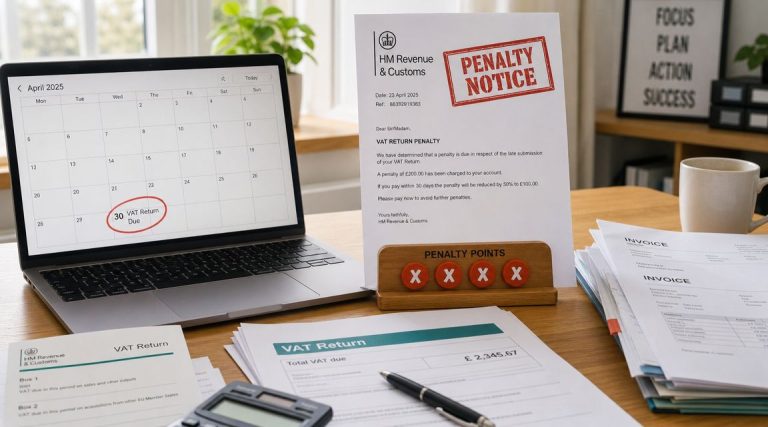
You open the post, see an HMRC message, and your stomach drops. You know the VAT return was late, or maybe you filed it but couldn't pay the bill on time, and now you're trying to work out what damage has been done.
You're not overreacting. VAT penalties have changed, and plenty of small business owners still mix up late filing with late payment. They aren't the same thing. They don't trigger in the same way. And if you misunderstand that split, you can make a bad situation worse.
The good news is this isn't random. HMRC's current system is structured, and once you understand it, you can control it. If you've received a penalty notice, you're trying to avoid one, or you're worried because cash flow is tight this quarter, the key is to stop guessing and deal with the right problem first.
Introduction
You file the VAT return a day late, or you file it on time and realise the money is not there to pay HMRC in full. Those are two different problems, and HMRC treats them differently. If you mix them up, you risk fixing the wrong issue first.
Since 1 January 2023, HMRC has moved away from the old default surcharge approach for late VAT submissions and brought in a points-based system for late filing. Each late return adds 1 penalty point. If the points keep building and you reach HMRC's threshold for your filing frequency, you get a £200 penalty.
This change is significant because HMRC now separates one-off mistakes from repeat behaviour more clearly. One missed deadline is a warning sign. Repeated late filing becomes a penalty issue.
Practical rule: Treat VAT deadlines like payroll. Set a process for them and stick to it, even when the quarter gets messy.
The part many small business owners worry about most is cash flow, and rightly so. Filing on time does not stop HMRC charging you if the VAT is paid late. Late filing and late payment sit under separate penalty rules, and late payment can also bring interest.
So if you are short on cash, the first priority is still to file the return on time. Then deal with payment as quickly as you can. That one decision can stop a filing point being added, even if you cannot clear the VAT bill on the same day.
The New VAT Penalty Points System Explained
HMRC now deals with late VAT returns through a points system. Each time you file a return after the deadline, you get 1 penalty point. The first late return does not usually trigger a fine. The problem starts when late filing becomes a pattern.

How points build up
The number of points you can build up before HMRC charges a penalty depends on how often you submit returns. HMRC's late filing points guidance for VAT returns sets the thresholds as follows:
- Monthly returns: 5 points
- Quarterly returns: 4 points
- Annual returns: 2 points
That structure is straightforward. Businesses that file more often get a higher threshold. Businesses that file less often get less room for error.
For most small businesses on quarterly VAT returns, the danger line is 4 points.
When the £200 penalty starts
The key point is simple. HMRC charges the £200 late filing penalty when you reach the threshold for your filing frequency, not for the first isolated mistake.
Once you are at that threshold, another late return can trigger another £200 penalty each time. That is why repeated admin slippage becomes expensive quite quickly. One late return is recoverable. A weak filing process is what causes the actual cost.
If your records are always being finished at the last minute, the VAT return late filing penalty can turn into a regular overhead.
How points are cleared
Paying a penalty does not wipe the slate clean. HMRC clears points only when you meet both conditions. You submit all outstanding VAT returns, and you then file on time for a set compliance period.
For many VAT-registered businesses, that compliance period is 12 months. The exact period depends on how often you file, but the practical message is the same. You need a run of clean, on-time submissions before the points drop off.
For this reason, I advise clients to focus on the filing habit first. If cash is tight, still get the return in on time. That stops a late filing point being added and leaves you with one problem to deal with instead of two.
Late Filing vs Late Payment What Is the Difference
Many business owners frequently trip up. They ask about a VAT return late filing penalty when the underlying issue is that they filed on time but couldn't pay the VAT bill. HMRC treats those as two separate compliance failures.

Filing is one obligation, paying is another
Submitting the VAT return is about telling HMRC what you owe. Paying VAT is about settling that amount by the deadline. You can fail one, the other, or both.
If you're unsure when your VAT bill has to be paid, review the VAT payment due date rules and check that your payment method gives HMRC the funds in time.
Here's the practical comparison:
| Issue | What you've missed | Main consequence |
|---|---|---|
| Late filing | The VAT return submission deadline | Penalty points, then fixed penalties once threshold is reached |
| Late payment | The VAT payment deadline | Separate late payment penalties and interest |
That split matters because filing on time is still worth doing even if you can't pay immediately. It won't remove the payment problem, but it can stop you creating a filing problem as well.
What happens if you file on time but pay late
HMRC states that late payment penalties are independent of the late filing points system. A first late payment penalty starts when VAT is 16+ days overdue, and a second starts when it is 31+ days overdue. HMRC also charges interest from the day after the due date until payment in full, according to HMRC's guidance on how late payment penalties work if you pay VAT late.
So if cash flow is tight, the answer is not to delay the return because you can't afford the payment. File the return anyway. Then deal with the payment issue directly.
What this means for a cash-strained SME
If you've filed on time but can't pay in full, you're in a difficult position, but you're still better off than a business that misses both deadlines. You've contained one side of the damage.
Use that breathing space properly:
- Submit the return by the deadline: That protects you from the filing points system.
- Check the amount due immediately: Don't leave it vague in your head. Know the bill.
- Act early if payment is a problem: Waiting in silence is usually the worst option.
- Keep records of what happened: If there was a genuine disruption, that evidence matters later.
File first. Then tackle the payment. Don't roll two problems into one.
A Worked Example of VAT Penalty Calculation
You file your VAT return a few days late once. Annoying, but no bill arrives. You do it again later in the year. Still no penalty notice. Then the fourth late return lands, and HMRC charges £200. That catches a lot of small business owners off guard.
Here is a simple example.
Crafty Creations Ltd files quarterly VAT returns. The director does the bookkeeping and tends to leave VAT until the deadline week. There is no fraud and no dispute over the figures. The problem is repeated late filing, which is exactly what the points system is designed to punish.
How the points build up
A quarterly filer gets a penalty point each time a VAT return is filed late. Once the business reaches 4 points, HMRC issues a £200 fixed penalty. If the business files late again while still at that threshold, HMRC can charge another £200.
That means the first few late returns can create a false sense of safety. The money pain starts later.
| VAT Period | Filing Status | Penalty Points Awarded | Cumulative Points | Financial Penalty Issued |
|---|---|---|---|---|
| Quarter 1 | Late | 1 | 1 | None |
| Quarter 2 | Late | 1 | 2 | None |
| Quarter 3 | Late | 1 | 3 | None |
| Quarter 4 | Late | 1 | 4 | £200 |
| Next Quarter | Late | 1 | At threshold | £200 |
The fourth late return is the tipping point. That is where missed deadlines stop being a warning issue and become a cost issue.
What this example means in real life
This system is stricter than many owners expect because the penalty is driven by filing behaviour, not by how much VAT you owe. A return can still be late even if the quarter was quiet. A nil return still needs to be filed. If you miss that deadline, the point still counts.
That matters for cash-strained SMEs. If money is tight, the practical answer is still to file on time, even if you cannot pay in full that day. Filing late adds points. Paying late is a separate problem with its own penalties and interest. Mixing the two turns one manageable issue into two.
I tell clients the same thing every time. Protect the filing position first.
The lesson from the example
If you are already sitting on points, do not treat it as background admin. Treat it as a live compliance risk.
Your next steps are straightforward:
- Check how many VAT penalty points you already have
- File any outstanding returns immediately
- Put the next deadline in your diary now
- Stop assuming a nil quarter is harmless
A VAT penalty problem usually starts with poor deadline control. Left alone, it turns into repeated £200 charges that should have been easy to avoid.
How to Appeal a VAT Late Filing Penalty
Sometimes the penalty is fair. Sometimes it isn't. If you had a genuine reason for filing late, don't just pay and move on without checking whether an appeal is justified.
What counts as a reasonable excuse
HMRC will usually want to see that something outside your control stopped you from filing on time. A serious illness, an unexpected bereavement, or a major systems failure outside your control can be the sort of situation that supports an appeal.
What usually doesn't work is the everyday mess of business life. Running out of funds, being too busy, relying on someone else who let you down, or not understanding the rules often won't carry much weight on their own.
That may sound strict, but it's better to be realistic. A weak appeal wastes time. A focused appeal with evidence gives you a proper chance.
How to approach the appeal
If you think the penalty was wrong, keep your explanation tight and factual. HMRC wants dates, circumstances, and evidence. They don't want a frustrated essay.
A sensible appeal pack should include:
- The exact deadline you missed: Be clear about which VAT period is involved.
- What stopped you filing on time: State the event plainly.
- Why it was outside your control: This is the centre of the argument.
- What evidence supports your position: Keep copies of emails, medical evidence, IT issue records, or anything else relevant.
- What you did once the issue passed: Show that you acted promptly.
Where the appeal goes
In practice, the first step is usually to challenge the decision with HMRC directly and ask for a review. If HMRC doesn't change its decision and you still believe you're right, the next route is an appeal to the independent tax tribunal.
That doesn't mean every case should go that far. Many shouldn't. But if you have a genuine excuse and proper evidence, don't assume the first "no" is the end of it.
Good appeals are specific. "We were dealing with a serious illness from this date to this date, and we filed as soon as we could" is far stronger than "we had a difficult month."
When to get help
If the penalty is part of a wider mess, late returns, missing bookkeeping, unclear VAT treatment, multiple notices, get advice before you send anything rushed. One bad letter to HMRC can make the situation look weaker than it really is.
An appeal is not just about being upset with the outcome. It's about showing that the late filing happened for a defensible reason.
Proactive Steps to Avoid VAT Penalties

A lot of small business owners only think about VAT when the deadline is close and cash is tight. That is usually when mistakes happen. If you want to stay away from penalty points, you need a routine that works even when you're busy, short-staffed, or distracted by day-to-day trading.
Under the current system, even a nil return filed late can add a penalty point. That matters because the filing side and the payment side are separate. If money is tight, file the return on time anyway. You can then deal with the late payment position. Missing the filing deadline as well only makes a bad month more expensive.
Build a deadline process that survives real life
If VAT depends on memory, sticky notes, or one person's inbox, the system is weak.
Set up a process you can repeat every quarter or every month:
- Add more than one reminder: Put the filing deadline in the calendar, then add earlier dates for bookkeeping cut-off, review, and submission.
- Bring the records up to date early: Chasing receipts and sorting invoices in filing week is how returns get missed.
- Give one person clear responsibility: Several people can help, but one person must own the submission.
- Keep proof of filing: Save the submission receipt, return copy, and payment reference.
If your records are often behind, a practical checklist can help tighten things up. These steps for stress-free tax preparation are a useful starting point for getting paperwork and deadlines under control.
Use software as part of a system
Cloud accounting software helps, but only if the records are kept current. If the bank feed is unreconciled, invoices are misposted, and receipts are still sitting in a drawer, the software has not solved the problem.
Used properly, it does make VAT much easier. It keeps transactions flowing into the books, makes reviews quicker, and reduces the last-minute scramble. If you want a better routine for records, reconciliations, and filing prep, this guide on how to prepare VAT returns explains the process clearly.
The goal is not to buy software and hope for the best. You need a setup that leaves the VAT return mostly ready before the deadline arrives.
Here's a useful refresher on the practical side of staying organised with VAT:
Know when to get help
Some businesses can manage VAT in-house. Others keep trying long after it has stopped being sensible.
Get support if any of these are true:
- The books only get attention near the deadline
- One overloaded team member holds the whole process together
- Cash flow is regularly tight at VAT dates
- Your sales, purchases, or VAT treatment are getting more complicated
- You already have penalty points on the account
That last point matters. Once points start building up, you need control, not optimism.
For some businesses, outsourcing is a practical solution. Stewart Accounting Services can manage VAT returns and bookkeeping for SMEs.
The habit that prevents most trouble
Prepare early. File on time, even if payment will be difficult.
That is the key distinction many businesses miss. A return filed on time avoids late filing points. If you cannot pay immediately, you are then dealing with late payment penalties and interest instead of adding a filing problem on top. From a cash flow point of view, that is the better position every time.
Most VAT penalties come from avoidable admin failures. Late records. Unclear ownership. Last-minute panic. Fix those, and the risk drops fast.
Conclusion
The current VAT return late filing penalty system is built around consistency. Miss a filing deadline, and HMRC records it. Keep missing them, and the cost becomes real. That's the part many businesses underestimate.
The second point is just as important. Late filing and late payment are separate problems. You can file on time and still face late payment penalties and interest. If cash flow is tight, file the return anyway and deal with the payment issue directly.
Good processes beat panic every time. Clean records, proper reminders, reliable software, and support when you need it are what stop VAT penalties before they start.
If your VAT deadlines are becoming stressful, if you've received a penalty notice, or if you're not sure whether your issue is late filing or late payment, speak to a qualified accountant before it escalates. A short conversation now can save a lot of cost and aggravation later.