

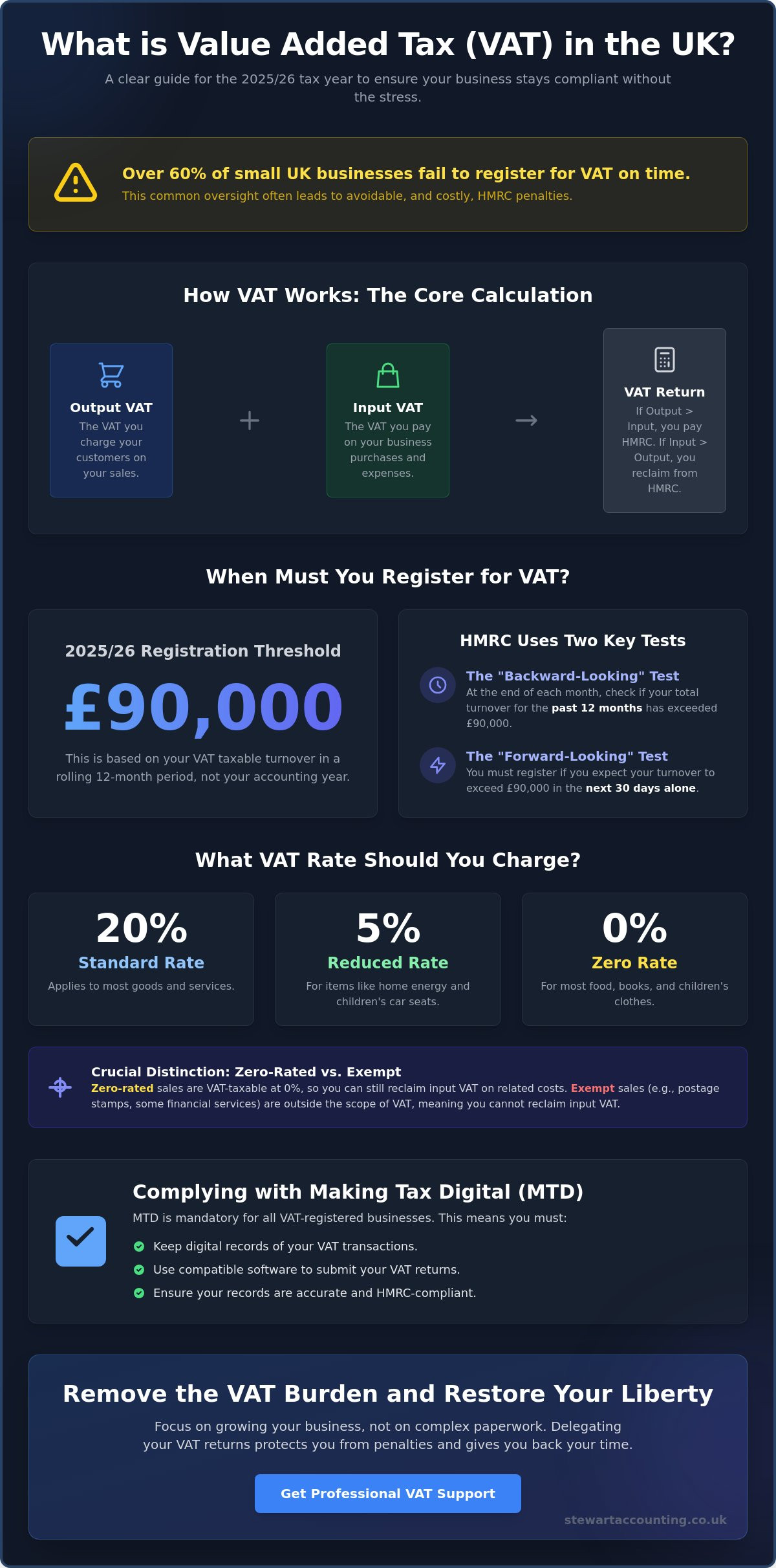
Did you know that over 60% of small UK businesses fail to register for VAT on time, often leading to avoidable HMRC penalties? It is completely normal to feel a sense of dread as your turnover approaches that critical limit. You’ve worked hard to grow your business, yet the reward often feels like a mountain of complex paperwork and the confusing question of exactly what is value added tax UK and how it applies to your specific sales. Whether you are worried about missing a deadline or simply feel overwhelmed by technical jargon, you are not alone in seeking a simpler way forward.
We believe that tax compliance shouldn’t cost you your peace of mind or your professional liberty. This guide provides a clear roadmap for the 2025/26 tax year, including the current £90,000 registration threshold and how to manage Making Tax Digital requirements without the stress. We will walk you through the rates you need to charge and explain how delegating your VAT return services to a dependable partner can restore your time. By the end of this article, you’ll have a pragmatic plan to handle your bookkeeping with total confidence, leaving the heavy lifting to experts who understand your local business challenges.
Key Takeaways
- Understanding what is value added tax UK is the first step in mastering the balance between the tax you charge customers and the tax you reclaim from suppliers.
- Identify exactly when your business must register by understanding the 2026 threshold of £90,000 and the specific tests HMRC uses to measure your turnover.
- Learn the vital distinction between zero-rated and exempt goods to ensure you are accurately calculating your reclaimable input tax.
- Simplify your transition to Making Tax Digital (MTD) by adopting the right digital tools to keep your records accurate and HMRC-compliant.
- Discover how total delegation of your paperwork to a professional can restore your personal liberty and protect your business from costly penalties.
Defining Value Added Tax and How it Impacts Your UK Business
Value Added Tax is a consumption tax charged on taxable supplies of goods and services. When you ask what is value added tax UK, you’re looking at a system where your business serves as a vital intermediary for the government. You aren’t just a business owner; you’re effectively an unpaid tax collector for HMRC. You charge tax to your customers and hold those funds until it’s time to file your return. This role often creates a state of high anxiety and confusion for those just starting out. Our goal is to help you transition from that initial stress to a liberated state where your financial records are handled with professional expertise, giving you back your time and mental energy.
The structure of Value-added tax in the United Kingdom has changed significantly since its introduction in 1973. Today, it represents a major portion of government revenue and a significant administrative task for small firms. Understanding the history of these rates helps clarify why the system is built around the “value added” at each stage of production and distribution. While the theory is straightforward, the daily reality of record-keeping often feels far more complex for the average business owner.
The Difference Between Input and Output VAT
Mastering your compliance starts with distinguishing between two core concepts. Output VAT is the tax you add to your sales invoices when a customer buys from you. This money is never truly yours; it’s held in trust. Conversely, Input VAT is the tax you pay on your own business expenses, such as stock, equipment, or software subscriptions. The “Value Added” is the difference between these two figures. If your output is higher than your input, you pay the balance to HMRC. If you’ve spent more than you’ve collected, you can often reclaim the difference. Understanding what is value added tax UK involves more than just knowing the rates; it’s about tracking every penny with precision to ensure you never pay more than you owe.
Why VAT Matters for Small Businesses and Sole Traders
VAT registration has a profound impact on your business’s cash flow and public perception. Because you’re holding tax money in your account, your bank balance can be deceptive. We recommend a pragmatic approach: set your VAT funds aside in a separate account immediately. This prevents the stress of a surprise bill at the end of the quarter. Beyond the numbers, being registered can boost your professional image. Many larger clients prefer working with VAT-registered partners, as it signals that your turnover has reached a certain level of maturity. However, the manual work involved can lead to burnout. Delegating this burden to a professional ensures your finances are secure while you focus on your growth and well-being.
The 2026 VAT Registration Threshold: When Must You Register?
Understanding the exact moment you need to step into the VAT system is crucial for avoiding unexpected HMRC penalties. For the 2025/26 tax year, the VAT registration threshold is £90,000. This isn’t based on your fixed accounting year or the standard tax year; it’s measured on a rolling 12-month period. These constant shifts can cause significant anxiety for business owners who are already stretched thin. You shouldn’t have to spend your weekends tallying up spreadsheets just to stay compliant. A professional partner can provide VAT return services that include monitoring these limits for you, effectively removing that mental weight from your shoulders.
HMRC uses two specific tests to determine if you must register. The “backward-looking” test requires you to check at the end of every month if your total taxable turnover for the previous 12 months exceeded the £90,000 limit. The “forward-looking” test applies if you expect your turnover to go over that same limit in the next 30 days alone. If you miss these triggers, the financial impact can be severe. You’ll be liable for the tax you should have charged from the date you ought to have registered, even if you didn’t collect it from customers. For a detailed breakdown of these rules, you can consult the official guide on How VAT Works (GOV.UK).
Mandatory vs. Voluntary VAT Registration
Do you have to wait until you hit the threshold? Not necessarily. While mandatory registration is triggered by the £90,000 limit, many businesses choose voluntary registration earlier. This can be a strategic move if you sell primarily to other VAT-registered businesses, as it allows you to reclaim VAT on your start-up costs and equipment. However, it does come with an administrative overhead. You’ll need to keep digital records and might have to increase prices for customers who aren’t VAT-registered. Balancing these pros and cons is a key part of understanding what is value added tax UK and how it fits into your long-term business plan.
Calculating Your VAT Taxable Turnover
Knowing what to include in your calculations is where many people feel confused. Your taxable turnover includes everything you sell that isn’t exempt from VAT. This means you must count sales that are standard rated (20%), reduced rated (5%), and even zero-rated (0%). It’s a common misconception that zero-rated items don’t count, but they are still “taxable supplies.” You only exclude truly exempt items, like insurance or certain educational services, and non-business income. Keeping accurate, real-time records is the only way to track this effectively. When you delegate your bookkeeping, you gain the clarity needed to make informed decisions without the fear of a surprise HMRC investigation.
Standard, Reduced, and Zero Rates: What Should You Charge?
Determining what is value added tax UK for your specific products can feel like navigating a maze. While most items fall under the standard rate, getting the classification wrong can lead to significant HMRC underpayments and unwanted stress. There are three primary rates you must understand to stay compliant. The standard rate is 20%, which applies to most goods and services. A reduced rate of 5% covers specific items like domestic energy, while the zero rate is 0% for essentials like books and children’s clothes. Accurately categorising your sales is a fundamental requirement under the Making Tax Digital for VAT rules, which mandate precise digital record-keeping for every transaction.
It’s vital to distinguish between zero-rated and exempt items. While both result in a 0% tax charge to your customer, the impact on your business is very different. If you sell zero-rated goods, you can still reclaim the Input VAT on your business expenses. However, if your sales are “Exempt,” you generally cannot reclaim any VAT on the costs related to those sales. This subtle distinction often causes confusion for small business owners, but mastering it is key to protecting your cash flow and ensuring your finances remain secure.
Common Examples of VAT Rates in 2026
Most business activities in the UK are standard-rated. You’ll charge 20% on things like professional fees, electronics, and taxi fares. The 5% reduced rate is more specific, applying to domestic fuel, mobility aids, and certain property renovations. Zero-rated items include most basic groceries, newspapers, and public transport. Because these categories can overlap, we recommend a pragmatic approach to your bookkeeping to ensure every invoice is correct from day one. This level of precision helps restore your mental well-being by removing the fear of a future audit.
Exempt vs. Outside the Scope
Some items sit entirely outside the standard VAT framework. Exempt items include insurance, postage stamps, and specific health or educational services. You don’t charge VAT on these, and they don’t count toward your £90,000 registration threshold. Other transactions are “outside the scope” of VAT altogether. This category includes statutory fees, like MOT tests, or voluntary donations to charity. Understanding these differences allows you to delegate the paperwork to a professional with confidence, knowing that your compliance is being handled by a dependable expert. This total transfer of responsibility is the most efficient way to reclaim your time and focus on growing your enterprise.
Making Tax Digital (MTD) and Filing Your VAT Returns
Making Tax Digital is no longer optional. Since April 2022, HMRC has required every VAT-registered business to maintain digital records and submit returns through compatible software. This shift aims to reduce manual errors, yet for many, it simply adds another layer of technical worry. Understanding what is value added tax UK now requires a firm grasp of digital compliance. You can’t simply log into a portal and type in your figures anymore; your software must communicate directly with HMRC’s systems via a digital link. This ensures that the data you’ve recorded is exactly what the government receives, minimizing the risk of costly transcription mistakes.
While the government’s own guidance focuses heavily on the legal requirements, it often fails to explain the practical reality of setting up these systems. This is where a professional partner becomes invaluable. We act as your bridge to compliance, ensuring your software is configured correctly and your data is secure. This digital transition is a significant part of your broader financial health, which we discuss in detail in our Year End Accounts guide. By integrating your VAT records with your overall bookkeeping, you gain a clearer picture of your business’s performance without the usual administrative burnout.
The Steps to Filing a VAT Return
Filing doesn’t have to be a quarterly crisis. By following a methodical process, you can maintain your mental well-being and keep your finances on track. Most businesses follow a standard quarterly cycle, which involves four key stages:
- Maintain accurate digital records: Record every sale and purchase as it happens throughout the quarter to avoid a stressful last-minute rush.
- Reconcile your bank accounts: Verify that your software balances match your actual bank statements and check that you’ve applied the correct VAT rates to every invoice.
- Submit the return: Use MTD-compliant software to send your finalized figures to HMRC before the deadline.
- Pay the balance: Clear your tax liability by the deadline, which is usually one month and seven days after the end of your VAT period.
VAT Accounting Schemes: Flat Rate, Cash, and Annual
HMRC offers several schemes designed to help small businesses manage their cash flow more effectively. The Cash Accounting Scheme is particularly helpful; you only pay VAT to HMRC once your customers have actually paid you. This prevents you from being out of pocket if a client is slow to settle an invoice. Alternatively, the Flat Rate Scheme simplifies your bookkeeping by allowing you to pay a fixed percentage of your turnover rather than calculating the difference between every single purchase and sale. For those who prefer a single yearly task, the Annual Accounting Scheme requires only one return per year, though you still make interim payments. Choosing the right scheme is a pragmatic way to reduce your administrative burden. If you’re feeling overwhelmed by these choices, our VAT return services can help you identify the most efficient path for your specific business.
Removing the VAT Burden: Professional Accounting Support in Central Scotland
Understanding what is value added tax UK is a vital first step, but the actual management of these records often remains a source of constant stress. You shouldn’t have to spend your evenings worrying about whether you’ve correctly categorised a receipt or if you’re about to miss an HMRC deadline. At Stewart Accounting Services, we believe in a total delegation model. This means we take the physical and mental burden of VAT away from you entirely. By allowing us to handle your compliance, you can focus on the three core promises of our thematic triad: reclaiming your valuable time, securing your business finances, and significantly improving your overall well-being. It’s about restoring your personal liberty so you can lead your business rather than being managed by its paperwork.
Why Delegate Your VAT to a Chartered Accountant?
Choosing to delegate your VAT return services to a chartered accountant provides a level of security that software alone cannot offer. We don’t just file your numbers; we scrutinise them to ensure your business is protected. This structured approach breaks down complex tax rules into simple, actionable benefits for your firm:
- Avoid costly HMRC penalties and the “late submission” points system that can lead to automatic financial hits.
- Ensure you’re reclaiming every single penny of Input VAT you’re entitled to, from initial start-up costs to ongoing equipment purchases.
- Receive proactive advice on which VAT accounting scheme is the most tax-efficient for your specific turnover and cash flow needs.
Accessible Support in Alloa, Stirling, and Falkirk
We take pride in being a dependable regional expert for firms across Central Scotland. While we offer remote support to clients throughout the UK, our physical presence in the Alloa Business Centre allows for face-to-face support that many small business owners find reassuring. If you’re based in Alloa, Stirling, or Falkirk, you have access to a partner who understands the local business landscape and the specific challenges Scottish SMEs face. Our goal is to provide a helpful, client-focused persona that makes complex financial matters feel manageable.
To make the transition to digital record-keeping seamless, we provide comprehensive Xero training and support. This ensures your data is always accurate and your Making Tax Digital obligations are met without the typical technical headaches. Our approach is grounded in real-world business challenges and a pragmatic desire to see your enterprise grow. If you’re ready to move from anxiety to action, we encourage you to reach out for a free consultation. Let us show you how a reliable partner can transform your financial management from a burden into a streamlined part of your success.
Master Your VAT Compliance with Confidence
Managing your tax obligations shouldn’t be a source of constant anxiety that keeps you away from your family or your core business goals. By keeping a close eye on the £90,000 registration threshold and accurately applying the correct rates to your sales, you’ve already taken the first steps toward professional financial management. Gaining a clear understanding of what is value added tax UK and how it impacts your daily cash flow allows you to make smarter, more pragmatic decisions for your firm’s future. Whether you’re navigating Making Tax Digital for the first time or looking to switch to a more efficient accounting scheme, the right knowledge is your best defense against HMRC penalties.
As Chartered Accountants with local offices in Alloa, Stirling, and Falkirk, we’re experts in MTD compliance and Xero cloud accounting. We’re dedicated to liberating small business owners from financial stress through total delegation of the paperwork. Let us handle your VAT; contact Stewart Accounting Services today to start your journey toward a secure and balanced professional life. You’ve worked hard to build your business; let us help you protect its success and restore your peace of mind.
Frequently Asked Questions
What happens if I forget to register for VAT on time?
You’ll be liable for the VAT you should have paid from the date you were supposed to register. HMRC may also issue a “failure to notify” penalty, which is calculated as a percentage of the tax due. This can be a significant financial blow to your cash flow. It’s much safer to have a professional monitor your rolling turnover to avoid these unexpected costs and the associated stress.
Can I reclaim VAT on expenses I had before I registered?
Yes, you can generally reclaim VAT on goods bought up to four years before registration and services bought up to six months before. You must still have the goods in your possession or have used the services for the business. You’ll need the original VAT invoices to make a valid claim. This is a great way to recover some of your initial start-up costs and secure your finances.
How often do I need to send a VAT return to HMRC?
Most businesses submit a VAT return every three months, which is known as a quarterly return. Each return covers a specific three-month period and must be submitted through MTD-compliant software. If you’re using the Annual Accounting Scheme, you’ll only file once a year, though you’ll still make interim payments. Choosing the right cycle depends on your specific business needs and your preference for managing paperwork.
What is the current VAT threshold for 2025/2026?
The VAT registration threshold for the 2025/26 tax year is £90,000. This limit is measured on a rolling 12-month basis, meaning you must check your turnover at the end of every month. If your taxable sales exceed this amount, registration is mandatory. Understanding what is value added tax UK and tracking this threshold is vital for any growing business that wants to stay on the right side of HMRC.
Do sole traders have to pay VAT in the UK?
Sole traders must register and pay VAT if their taxable turnover goes above the £90,000 threshold. VAT isn’t exclusive to limited companies; it applies to any individual or entity making taxable supplies. If you’re a sole trader, you have the same digital record-keeping responsibilities as a larger firm. Delegating this task can help you focus on your work while ensuring your tax returns are handled with professional expertise.
Is it better to be VAT registered or not for a small business?
It depends entirely on who your customers are and what your business costs look like. If you sell primarily to other VAT-registered businesses, registration lets you reclaim tax on your expenses without making your services more expensive for them. However, if you sell to the general public, you might have to increase your prices by 20% to cover the tax. It’s a pragmatic decision that impacts both your competitiveness and your profit margins.
What is the difference between zero-rated and exempt VAT?
Zero-rated items are taxable supplies with a 0% rate, which allows you to still reclaim the VAT on your own business purchases. Exempt items are not taxable at all, so you generally can’t reclaim any VAT on the costs related to those sales. This distinction is one of the most confusing parts of what is value added tax UK, yet it’s crucial for ensuring you’re reclaiming every penny you’re entitled to.