
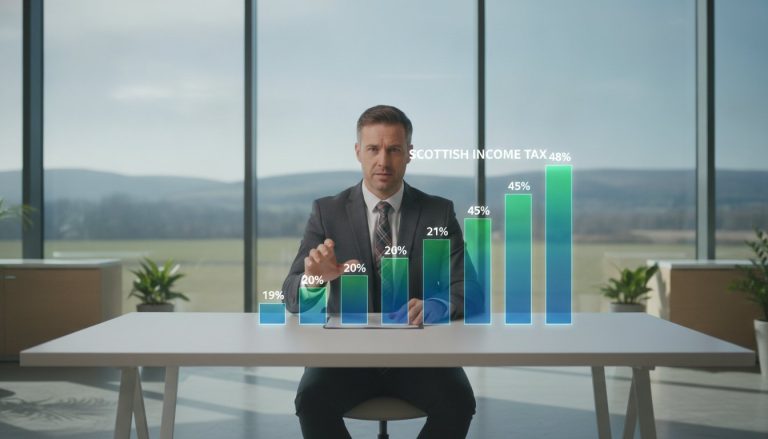
Did you know that 55% of Scottish taxpayers are projected to pay less income tax in 2026/27 than they would in the rest of the UK? While that sounds like a win, the reality for many business owners and professionals is a bit more complex. With six distinct tiers to monitor, having the Scottish income tax bands 2026 explained is essential for anyone looking to maintain HMRC compliance and protect their take-home pay. It’s common to feel frustrated by the higher rates in Scotland, especially since you start paying more than your English counterparts once your income exceeds roughly £28,000.
We know that managing these thresholds can feel like a heavy burden on your time and mental well-being. Our team is here to offer the professional expertise you need to regain your financial liberty. In this article, we’ll break down the official 2026/27 rates, including the starter, intermediate, and advanced bands. You’ll gain a clear understanding of how these changes affect your payroll and self-assessment planning, giving you the confidence to manage your business without the fear of underpaying tax.
Key Takeaways
- Understand the nuances of the six-tier system with our Scottish income tax bands 2026 explained, helping you identify the exact rates applicable to your income.
- Identify how the 7.4% threshold increases for the Basic and Intermediate rates could reduce the tax burden for many lower-earning individuals in Scotland.
- Learn the essential steps to update your payroll compliance and prepare for the 2026 introduction of Making Tax Digital (MTD) for Income Tax.
- Compare the Scottish and English systems to find the specific crossover income level where your tax bill starts to differ from the rest of the UK.
- Discover how professional tax planning can liberate your time and mental well-being by ensuring your business remains fully compliant with HMRC.
Understanding the Scottish Income Tax System in 2026
The Scottish Government holds the power to set the rates and thresholds for everyone living in Scotland. While some taxes remain consistent across the UK, the way your salary or business profits are taxed depends entirely on your residency status. Having the Scottish income tax bands 2026 explained helps you see that this isn’t just about how much you earn, but where you call home. This system is designed to fund local public services; it’s why the thresholds often differ from those in England or Wales.
Who is classed as a Scottish taxpayer?
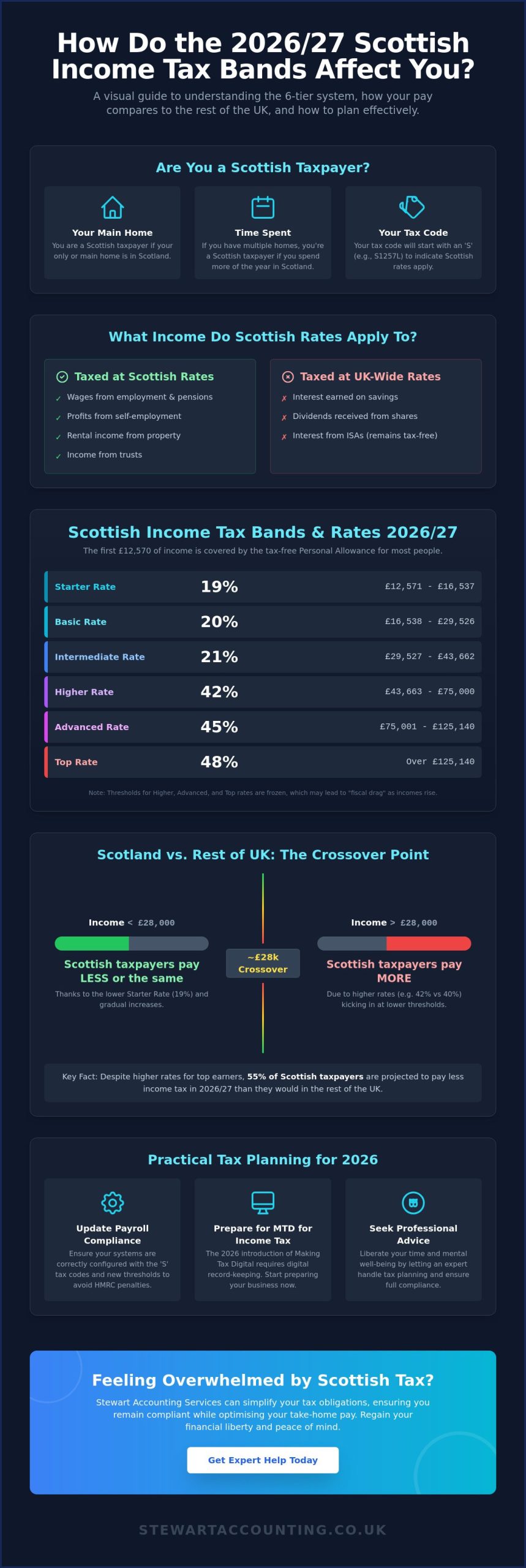
HMRC identifies you through your tax code. If you’re a Scottish resident, your code will start with the letter ‘S’. We often see clients who are anxious about whether they’re paying the right amount after a move. Checking that ‘S’ prefix is the first step to ensuring your payroll or self-assessment is accurate. It’s a simple marker that tells your employer or the tax office which rules to follow.
Which types of income do these bands apply to?
The Scottish income tax system only applies to “non-savings and non-dividend” income. This sounds technical, but it essentially covers:
- Wages from employment or a pension.
- Profits you make if you’re self-employed.
- Rental income from property.
- Trust income.
Other types of income follow UK-wide rules regardless of where you live. For example, the interest you earn on your savings or the dividends you receive from shares are taxed at the same rates as the rest of the UK. Your ISA interest remains completely tax-free under these same national rules. This distinction is a common source of confusion, but it’s a vital part of effective tax planning. When we provide the Scottish income tax bands 2026 explained, we focus on these nuances to help you avoid any unexpected bills from HMRC. It’s about giving you back your mental well-being by removing the guesswork from your finances.
The 2026/27 Scottish Income Tax Bands and Thresholds
The 2026/27 tax year introduces a specific shift in how your earnings are partitioned. While the Scottish Government has increased the lower thresholds to provide some breathing room for residents, the higher tiers remain static. Having the Scottish income tax bands 2026 explained clearly is the best way to avoid surprises when you check your payslip or prepare your self-assessment. For many, the 7.4% rise in the Starter and Basic rate thresholds offers a modest level of relief against inflation, but those earning above £43,663 will find their tax burden remains unchanged due to frozen thresholds.
Understanding these levels is vital for accurate financial forecasting. If you’re feeling overwhelmed by the math, seeking professional tax planning can help restore your peace of mind and ensure your business remains on the right side of HMRC. You can also find more technical details in the official UK government guidance on Scottish income tax.
2026/27 Scottish Tax Table
The current system uses six different bands to determine your liability. For the tax year starting April 6, 2026, the rates are as follows:
- Starter Rate (19%): Income between £12,571 and £16,537.
- Basic Rate (20%): Income between £16,538 and £29,526.
- Intermediate Rate (21%): Income between £29,527 and £43,662.
- Higher Rate (42%): Income between £43,663 and £75,000.
- Advanced Rate (45%): Income between £75,001 and £125,140.
- Top Rate (48%): All income over £125,140.
The decision to freeze the Higher, Advanced, and Top rate thresholds means that as your business grows or your salary increases, you may find yourself pushed into a higher bracket sooner than you’d like. This “fiscal drag” is a key consideration for anyone managing a small to medium enterprise in Scotland.
The Personal Allowance and the £100,000 “Cliff Edge”
Most individuals benefit from a standard Personal Allowance of £12,570, which is the amount you can earn before paying any income tax. This allowance is consistent across the UK. However, it’s not guaranteed for everyone. Once your adjusted net income reaches £100,000, this allowance begins to taper off. It reduces by £1 for every £2 you earn over that six-figure mark.
This tapering creates what many call a “tax trap.” Between £100,000 and £125,140, your effective tax rate can climb to 60% because you’re losing your tax-free allowance while simultaneously paying the Advanced rate of 45%. We focus on helping our clients navigate these specific “cliff edges” to ensure they don’t lose more of their hard-earned money than necessary. Knowing these Scottish income tax bands 2026 explained gives you the tools to plan effectively and protect your take-home pay.
Scotland vs. Rest of UK: Why Your Tax Bill Differs
How does your tax bill in Scotland actually compare to a colleague doing the same job in Newcastle or Manchester? While the rest of the UK operates on a simple three-band system, the Scottish income tax bands 2026 explained reveal a much more granular six-tier approach. This divergence is a deliberate policy choice by the Scottish Government to create a more progressive system. For lower earners, this is often good news. Data shows that 55% of Scottish taxpayers are projected to pay less income tax in 2026/27 than they would elsewhere in Britain. If you earn under £29,000, you’ll likely see a small benefit because of the 19% Starter Rate, which doesn’t exist south of the border.
However, the narrative shifts quickly for those in the middle and higher income brackets. The “crossover point” where Scottish residents begin paying more than their English counterparts typically falls between £28,000 and £30,318. For a professional like a teacher in Falkirk or a nurse in Stirling, this can result in a noticeably higher tax bill despite having the same gross salary as someone in England. This gap widens significantly as you move up the pay scale, making proactive tax planning essential to protect your take-home pay and restore your financial liberty.
The Intermediate Rate (21%) Discrepancy
The first major point of difference is the Intermediate Rate. In England, Wales, and Northern Ireland, the basic rate of 20% applies to all income from the Personal Allowance up to £50,270. In Scotland, that 20% rate stops at £29,526. Once you earn £29,527, you move into the 21% Intermediate Rate. While a 1% difference might seem minor, it applies to every pound earned above that threshold. For many SME employees, this extra charge is the first step toward a higher overall tax burden. It’s a subtle change that can cause anxiety if you aren’t prepared for the impact on your monthly budget.
The Higher Rate (42%) and Advanced Rate (45%)
The most striking differences appear in the higher tiers. In the rest of the UK, the 40% higher rate only kicks in at £50,270. In Scotland, you hit a 42% rate at just £43,663. This means you’re paying a higher percentage of tax on a larger portion of your income. Additionally, Scotland has a unique “Advanced Rate” of 45% starting at £75,001. In the rest of the UK, you wouldn’t pay 45% until your income exceeds £125,140.
For business owners, these differences require a strategic approach to how you extract profits. Since dividend tax rates are set by the UK government and remain consistent across the country, balancing salary and dividends can be a powerful way to manage your overall liability. We focus on helping you delegate these complex calculations to us, removing the burden of tax management so you can focus on growing your business. Understanding these Scottish income tax bands 2026 explained is the first step toward regaining control over your finances.
Practical Tax Planning for the 2026 Changes
Moving from understanding the rates to taking action is the only way to ensure your business remains resilient. With the Scottish income tax bands 2026 explained, you can now focus on the practical steps required to protect your cash flow. If you employ staff in Stirling or Falkirk, your first priority is ensuring your payroll software is correctly configured for the new April 2026 thresholds. Failing to update these settings can lead to incorrect deductions, causing unnecessary stress for your team and potential headaches with HMRC during year-end reconciliations.
Self Assessment and MTD for 2026
A significant shift is coming for sole traders and landlords. Starting in April 2026, Making Tax Digital (MTD) for Income Tax will require many individuals to keep digital records and provide quarterly updates to HMRC. This move away from a single annual return can feel daunting if you’re used to traditional paper-based methods. We specialize in helping local business owners transition their records to Xero, ensuring you’re fully compliant well before the deadline. Aligning your digital tools now gives you back your time and removes the anxiety of a last-minute scramble. It’s also worth choosing a financial year end for your UK business that simplifies this new reporting cycle.
Reducing Your Taxable Income Legally
One of the most effective ways to manage your tax bill is to lower your “adjusted net income.” This is particularly useful if you’re nearing one of the “cliff edges” mentioned earlier, such as the £100,000 threshold where your Personal Allowance begins to taper. Having the Scottish income tax bands 2026 explained helps you identify exactly when these thresholds hit. You might consider several pragmatic strategies to manage your exposure:
- Increase pension contributions to stay below the Higher or Advanced rate thresholds.
- Utilize salary sacrifice for electric vehicles or specialized equipment.
- Claim all legitimate business expenses to reduce your total taxable profit.
Accurate bookkeeping is the foundation of all these strategies. Without clear, real-time data, you’re essentially flying blind. By maintaining precise records, you can identify opportunities for maximizing capital allowances or claiming legitimate business expenses before the tax year closes. You can find more advice on this in our guide to year end accounts: a simple guide for UK small businesses. If you want to delegate these complexities to experts who understand the local landscape, our tax planning services are designed to provide the total support you need to thrive.
How Stewart Accounting Services Simplifies Your Taxes
Do you feel like the weight of tax compliance is pulling your focus away from growing your business? The complexity of a six-tier system, combined with the upcoming digital reporting changes, can easily become a source of constant anxiety. Our mission is built around a simple three-part promise: we liberate your time, your finances, and your mental well-being. By having the Scottish income tax bands 2026 explained, you’ve taken the first step toward clarity. The next step is delegating the technical burden to a partner you can trust.
A Reassuring Partner for Your Business
Why is a Chartered Accountant so vital when navigating these specific bands? With six different rates to monitor, the margin for error is much higher than in other parts of the UK. A proactive approach is the only way to identify tax-saving opportunities before the year ends. We don’t just file your returns; we look ahead to see how salary sacrifice, pension contributions, or capital allowances can protect your hard-earned profits.
Our team works to ensure your business remains efficient and compliant, removing the fear of underpaying tax or missing a deadline. You can get started by booking an initial consultation to discuss your specific needs. We’ll review your current setup and show you exactly how our tailored assistance can make your financial life smoother and more predictable. It’s about moving from a state of frustration to a position of total confidence.
Contact Your Local Scottish Tax Experts
We provide specialized support for limited companies, contractors, and landlords who need more than just a standard bookkeeping service. Our regional grounding in Central Scotland means we understand the local business landscape and the challenges you face. We’re here to provide face-to-face support that builds a foundation of competence and trust. If you’re ready to remove the burden of tax management from your shoulders, we invite you to take action today. You can book a consultation with Stewart Accounting Services to explore how we can help you regain your time and peace of mind.
Secure Your Financial Future for 2026
Navigating a six-tier tax system doesn’t have to be a source of constant stress for your business. With the Scottish income tax bands 2026 explained, you now have the essential foundation to plan your finances with clarity. It is important to remember that while the 7.4% increase in lower thresholds provides some relief, the frozen higher rates and the introduction of new digital reporting requirements mean that proactive management is more vital than ever before.
Our team of Chartered Accountants in Alloa, Stirling, and Falkirk is ready to support you. We specialize in Scottish SME tax compliance and can guide you through the MTD transition with ease. We believe in restoring your personal liberty by taking the weight of HMRC off your shoulders. We will handle the technical details so you can focus on what you do best: running your company.
Let Stewart Accounting handle your 2026 tax planning; contact us today. We look forward to helping you achieve total peace of mind regarding your finances and your future.
Frequently Asked Questions
Do I pay more tax in Scotland than in England in 2026?
Yes, but only if your income exceeds approximately £28,000 per year. For those earning below this crossover threshold, 55% of Scottish taxpayers are actually projected to pay less income tax than they would in the rest of the UK. This is due to the 19% Starter Rate, which provides a small benefit for lower earners that doesn’t exist south of the border.
What is the “S” tax code and how do I know if I have one?
The “S” prefix in your tax code tells HMRC and your employer to apply the Scottish rates of income tax to your earnings. You can find this code on your monthly payslip or within your personal tax account online. It’s based on your residency, so if your main home is in Scotland, your code should always begin with this letter.
How do the 2026 Scottish tax bands affect my pension contributions?
Your pension contributions are highly efficient because you receive tax relief at the highest rate you pay. Having the Scottish income tax bands 2026 explained shows that if you’re in the 42% Higher Rate or 45% Advanced Rate, your contributions effectively cost you much less. This strategy is an excellent way to manage your taxable income and stay below expensive threshold “cliff edges.”
Is the Personal Allowance the same in Scotland as the rest of the UK?
Yes, the standard Personal Allowance for the 2026/27 tax year is £12,570 across the entire UK. This is the amount you can earn before you start paying any income tax at all. While the Scottish Government has the power to set its own tax bands and rates, the initial tax-free allowance remains a UK-wide figure set by the UK Government.
What happens if I earn over £100,000 in Scotland?
Earning over £100,000 triggers a tapering of your Personal Allowance, which reduces by £1 for every £2 you earn above that mark. This creates a significant tax trap where your effective rate can reach 60% on income between £100,000 and £125,140. Professional tax planning is essential at this level to ensure you aren’t losing more of your take-home pay than necessary.
Do Scottish tax bands apply to my savings interest or dividends?
No, the Scottish income tax rates only apply to your “earned” income, such as your salary, business profits, or pension drawdowns. Your savings interest and dividend income are taxed using the UK-wide rates and allowances. This means that even if you live in Scotland, your ISA interest and dividend tax brackets remain the same as someone living in England.
When do the new 2026/27 Scottish tax rates come into effect?
The new 2026/27 rates and thresholds come into effect on April 6, 2026, and run until April 5, 2027. You must ensure your payroll systems are updated by this date to reflect the 7.4% rise in the Basic and Intermediate thresholds. Accurate preparation ensures that your business stays compliant and your employees receive the correct take-home pay from the very first payslip.
How can a Chartered Accountant help me with the 2026 tax changes?
A Chartered Accountant provides the high-level expertise needed to navigate a complex six-band tax system and the transition to Making Tax Digital (MTD). We handle the technical details of your self-assessment and payroll, which restores your personal and professional liberty. By delegating these tasks to us, you can focus on running your business with the peace of mind that your tax affairs are in expert hands.