

Have you ever looked at your bank balance and felt a pang of anxiety, wondering if you can truly afford to hire a new team member or if an upcoming tax bill will leave you short? Many directors find themselves overwhelmed by complex spreadsheets that only seem to provide a backwards glance at their finances. This is why understanding what are management accounts for a small business is a vital step for any owner who wants to move beyond guesswork. Unlike the statutory filings you send to Companies House each year, these regular reports provide a live pulse on your company’s health.
It’s exhausting to feel like you’re flying blind while trying to scale your business. You deserve to feel in control of your cash flow and certain about your next strategic move. In this guide, you’ll learn how management accounts provide the real-time financial clarity you need to grow and make confident decisions. We’ll explore how these reports work, why they’re different from your year-end filings, and how delegating this oversight to an expert can finally restore your professional liberty and peace of mind.
Key Takeaways
- Identify exactly what are management accounts for a small business and why they’re for your eyes only, rather than for HMRC or Companies House.
- Master the core components of a management pack, including Profit and Loss statements that show how you’re performing against your monthly budget.
- Learn how real-time data helps you spot which products drive profit and which ones are draining your cash flow before it’s too late.
- Discover how regular reporting provides the professional evidence banks and investors require when you’re looking to secure a business loan or funding.
- Understand the benefits of delegating your financial oversight to a virtual Finance Director to gain expert insights without the cost of a full-time hire.
What are Management Accounts for a Small Business?
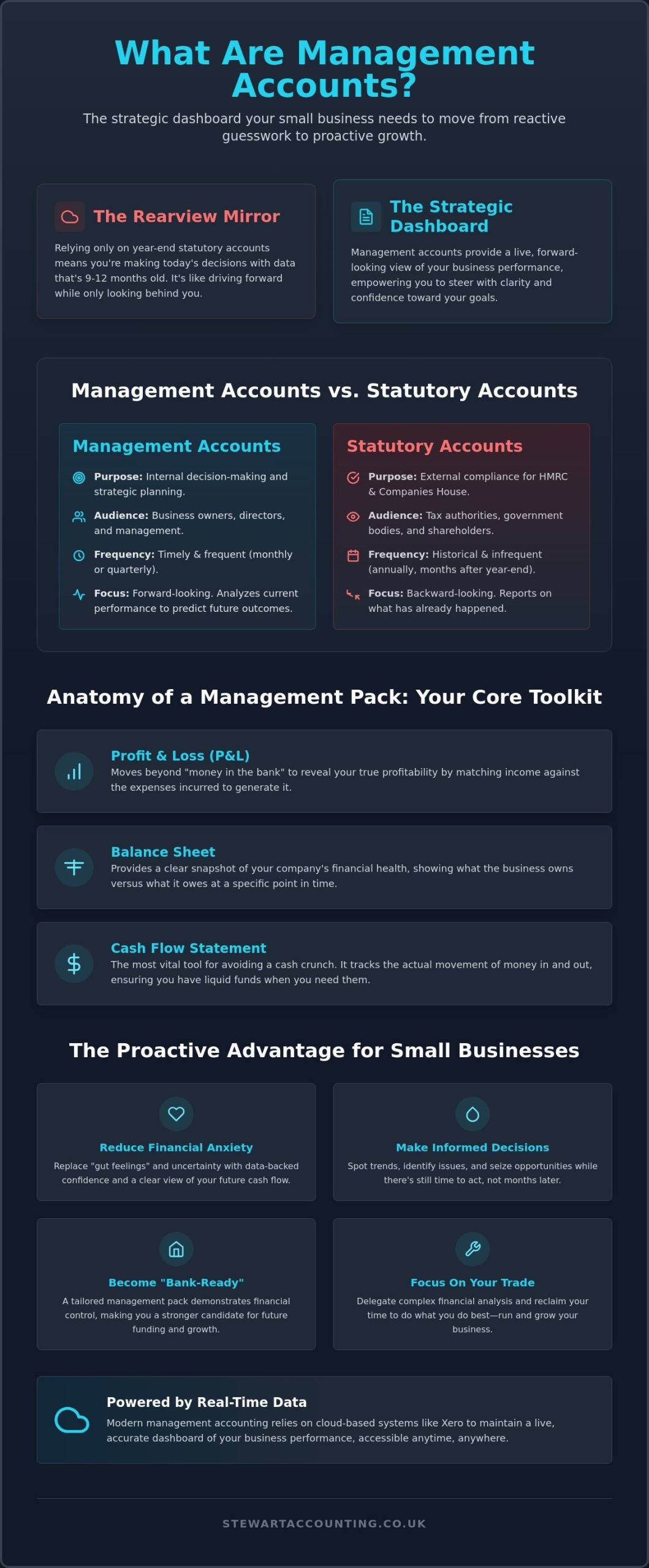
When you run a company, you shouldn’t have to wait until nine months after your year-end to know if you’ve made a profit. This is the primary reason why so many directors ask: what are management accounts for a small business? Simply put, they are regular financial reports produced monthly or quarterly that allow you to track your performance as it happens. Unlike statutory accounts, these are not filed with Companies House or HMRC. They remain strictly confidential and serve as a live pulse on your financial health, rather than a post-mortem of the previous year.
By definition, Management accounting is a strategic tool for informed decision-making and performance monitoring. It provides the clarity you need to stop guessing and start growing with confidence. By having this information at your fingertips, you can move away from the anxiety of the unknown and step into a role of professional and personal liberty.
The Forward-Looking Nature of Management Information
Relying solely on historical data is a bit like trying to drive a car while only looking in the rear-view mirror. While annual accounts satisfy your legal compliance obligations, they don’t help you navigate the future. Management accounts allow you to shift your focus from being compliance-led to being strategy-led. This approach helps you spot emerging trends, such as a sudden rise in overheads or a dip in a specific revenue stream, long before they turn into a crisis. It’s about having the foresight to adjust your sails while the wind is still behind you.
Who Needs Management Accounts?
You don’t need to be a massive corporation to benefit from regular reporting. Sole traders, limited companies, and growing SMEs all find that these insights reduce the daily stress of business ownership. Every company eventually hits a tipping point where it becomes too complex to manage by gut instinct alone. If you find yourself unsure if you can afford a new hire or a new piece of equipment, you’ve likely reached that point. For multi-director companies, understanding what are management accounts for a small business is even more vital. These reports provide essential transparency, ensuring every director is aligned on the company’s financial position and long-term objectives.
Management Accounts vs. Statutory Accounts: What Is the Difference?
It’s easy to feel confused by the different types of financial reporting required for your company. Statutory accounts are a legal requirement for all limited companies in the UK. In contrast, management accounts are entirely optional. While you must file your year-end figures with Companies House and HMRC, management reports remain strictly confidential within your business. The primary audience for statutory filings is the taxman and the public record. Management reports serve you, the owner, as a private roadmap. Statutory accounts report on the past, while management accounts help you navigate the future.
Understanding what are management accounts for a small business helps you see why they’re the missing piece in your financial strategy. To help clarify the differences, consider these three key areas:
- Legal Obligation: Statutory accounts must be filed by law; management accounts are a choice made by proactive owners.
- Accessibility: Anyone can view your statutory accounts on the Companies House website. Management accounts are for your eyes only.
- Focus: Statutory accounts are about compliance and tax. Management accounts are about growth and performance.
Frequency and Timing
Waiting up to nine months after your year-end to see your final profit figures is a significant risk to your cash flow. By the time you spot a problem in your annual filings, the damage might have been done nearly a year ago. Monthly or quarterly reporting cycles are essential for fast-moving industries where costs can fluctuate wildly. Our team ensures that your year end accounts and management accounts work together seamlessly. This dual approach gives you the compliance peace of mind you need while providing the agility to react to market changes in real time. If you want to take the weight off your shoulders, our management accounting services provide the regular oversight you need to stay on track.
Level of Detail and Flexibility
Statutory accounts typically use a standardised, condensed format. While this is efficient for filing, it often hides the operational detail you need to run a profitable business. Management reports offer total flexibility. You can customise them to track specific departments, individual projects, or different business locations. Instead of just looking at the final bottom line, you can focus on your Gross Margin and Operational Expenses. This level of granularity helps you identify exactly which parts of your business are performing well and which need more attention. You can ditch the products that lose money and double down on the ones that drive your success.
What Should Be Included in Your Management Reports?
A standard management pack isn’t just a pile of data. It’s a curated selection of insights tailored to your specific goals. When considering what are management accounts for a small business, you should expect a pack that includes four core elements. First is the Profit and Loss (P&L) statement. This doesn’t just show your income; it compares your actual performance against your pre-set budget. Next, a Balance Sheet monitors your business assets, liabilities, and overall equity. This gives you a clear view of what you own and what you owe at any given moment.
The third essential component is a Cash Flow Statement. This is vital for ensuring you have enough liquidity to meet upcoming obligations like payroll or VAT bills. Finally, we include Key Performance Indicators (KPIs) tailored to your industry. For a retailer, this might be the average sale value. For a service-based firm, it could be the customer acquisition cost. These metrics provide a quick health check without needing to dive deep into every single transaction.
Budget vs. Actual Variance Analysis
Understanding why you spent more or earned less than planned is where the real value lies. Variance analysis acts as an early warning system for your business. If your material costs have spiked by 15% compared to your budget, you need to know immediately so you can adjust your pricing or find new suppliers. These insights allow you to adjust your business plan mid-year rather than waiting for a year-end surprise. It’s about being proactive and staying in control of your financial destiny.
The Role of Cloud Accounting Software
Why Management Accounts Are Essential for SME Growth
Scaling a company requires more than just hard work; it requires hard evidence. When you understand what are management accounts for a small business, you stop relying on intuition and start using data to drive your expansion. These reports allow you to identify your most profitable products or services and ditch the ones that are quietly draining your resources. By keeping your records up to date throughout the year, you also eliminate the dreaded “Year-End Panic” that often leaves directors feeling frazzled and overwhelmed.
Ultimately, management accounts liberate your time, money, and mental well-being by providing a clear financial path forward. This three-part promise of restoration is at the heart of our service. We believe that by delegating these complex tasks to experts, you can focus on what you do best while we handle the technical oversight.
Securing Funding and Investment
If you plan to approach banks in Scotland, such as RBS or Bank of Scotland, they will want to see more than just your last set of filed accounts. Lenders look for up to date management figures to prove that you have professional financial control over your operations. Demonstrating this level of detail to potential investors or buyers can significantly increase the valuation of your company. Regular reporting also helps you maintain a healthy business credit rating, as it ensures you never miss a payment or overlook a liability. If you’re ready to secure the capital you need for growth, our management accounts service provides the professional edge you need.
Tax Planning and Dividend Management
One of the biggest anxieties for limited company directors is the surprise Corporation Tax bill. Management accounts allow you to estimate your tax liability throughout the year, so you can set aside the correct amount month by month. This proactive approach ensures you always have sufficient “distributable profits” before you declare dividends. Withdrawing money that the company hasn’t actually earned can lead to serious tax issues and personal liability. By using mid-year data, you can implement tax planning strategies that simply aren’t possible if you only look at your figures once a year. This level of foresight protects your personal finances and ensures your business remains on a solid legal footing.
How Stewart Accounting Services Supports Scottish Businesses
Understanding what are management accounts for a small business is the first step toward better control, but implementing them correctly requires expert guidance. We provide tailored management accounting services for businesses in Alloa, Stirling, Falkirk, and across the UK. Our team doesn’t just hand you a report and leave you to figure it out. We act as your virtual Finance Director, offering the high-level insights you need to grow without the hefty cost of a full-time executive hire. Our Chartered Accountants help you interpret the numbers, turning raw data into actionable business advice that moves the needle on your profit margins.
By choosing to work with us, you benefit from a service focused on the total delegation of financial tasks. We physically remove the burden of complex reporting from your shoulders. This allows you to stop worrying about whether your spreadsheets are accurate and start focusing on the vision you have for your company. Our approach is designed to be smooth and efficient, ensuring your financial engine runs perfectly in the background. This allows you to move away from the anxiety of the unknown and into a position of professional strength.
Local Expertise in Central Scotland
There is a distinct advantage to working with an accounting firm that understands the local economic landscape. Our roots in Alloa give us a unique perspective on the challenges faced by businesses in Stirling and Falkirk. We understand the regional market conditions and the specific opportunities available to Scottish SMEs. Whether you prefer to meet us in person at our local offices or utilise our remote services for your UK-wide operations, we build long-term partnerships based on trust. This regional anchoring ensures you have a dependable partner who is always accessible when you need strategic support. We know what are management accounts for a small business in the context of the Scottish economy, and we use that knowledge to your advantage.
Restoring Your Personal Liberty
Our core mission is to restore your personal and professional liberty. When you delegate your management reporting to us, you gain more time to spend working on your business rather than being stuck in the spreadsheets. This shift is essential for any owner who wants to transition from a reactive state to a proactive one. The peace of mind that comes from knowing your financial compliance and strategy are in expert hands is invaluable. It liberates your time, secures your finances, and protects your mental well-being.
If you’re ready to gain real-time visibility of your profit and loss, we can help. Contact Stewart Accounting Services today for a consultation on your management reporting needs. Let us show you how professional oversight can transform your business from surviving to thriving.
Take Control of Your Business Future Today
Running a company shouldn’t feel like a constant battle with the unknown. By moving beyond annual compliance and embracing regular reporting, you gain the real-time visibility needed to manage cash flow and invest with absolute certainty. We’ve explored how these insights allow you to identify your most profitable services and ensure your tax planning is always one step ahead. Truly understanding what are management accounts for a small business is the first step toward reclaiming your personal liberty and mental well-being.
Our team of Chartered Accountants in Alloa, Stirling, and Falkirk is ready to act as your virtual Finance Director. We specialise in Xero and cloud-based financial reporting to ensure your data is always accurate and accessible. By delegating these complex tasks to our experts, you physically remove the burden of financial oversight from your own shoulders. This allows you to focus on leading your team while we safeguard your company’s health.
Get the financial clarity you deserve with expert management accounts from Stewart Accounting Services. Your journey toward a more profitable and stress-free business starts here.
Frequently Asked Questions
Are management accounts a legal requirement for UK small businesses?
No, management accounts aren’t a legal requirement in the United Kingdom. While statutory accounts are mandated by Companies House and HMRC, these internal reports are a choice made by proactive owners. They serve as a private management tool to help you lead your company rather than a public filing for the authorities.
How often should a small business produce management accounts?
Most companies choose to produce them on a monthly or quarterly basis. If you’re managing tight margins or rapid growth, monthly reports are essential to catch financial fluctuations early. This regular rhythm ensures you aren’t surprised by cash flow gaps later in the year, giving you the peace of mind to plan ahead.
Can I produce my own management accounts using Xero?
You can use Xero to generate basic reports, but the real value lies in professional interpretation. Software provides the raw data, but a Chartered Accountant ensures the figures are reconciled and adjusted for accruals or prepayments. This expert oversight is what truly defines what are management accounts for a small business, as it turns raw numbers into a reliable strategy.
What is the difference between bookkeeping and management accounting?
Bookkeeping is the daily recording of transactions, while management accounting is the strategic analysis of that data. Bookkeeping ensures your records are accurate for your basic compliance needs. Management accounting uses those records to create forward-looking reports that help you make better decisions about hiring, investing, and scaling.
How much do management accounts typically cost for an SME?
The cost varies depending on the complexity of your business and how frequently you need the reports. We offer tailored packages that scale alongside your company’s specific needs. Investing in these insights typically pays for itself by identifying hidden waste and highlighting your most profitable revenue streams, ultimately increasing your bottom line.
Do I need management accounts if I am a sole trader?
Sole traders aren’t legally required to have them, but they are highly beneficial for proactive tax planning. Having a clear view of your profits throughout the year helps you set aside the right amount for your Self Assessment bill. It also makes the transition to a limited company structure much smoother if your business continues to grow.
Why do banks ask for management accounts when I apply for a loan?
Lenders want to see your current financial health, not just how you performed eighteen months ago. Banks like RBS or Bank of Scotland require up-to-date figures to assess your ability to repay a loan today. Management accounts provide the professional evidence that you have total control over your finances, making you a safer prospect for funding.
What is the most important KPI to include in management reports?
Gross profit margin is often the most critical KPI for small enterprises. It reveals the true profitability of your products or services before your fixed overheads are considered. Monitoring this metric helps you understand what are management accounts for a small business in a practical sense, as it directly impacts your pricing strategy and long-term sustainability.