

Does your current accounting data tell you where your business is going, or just where it’s been? Most UK founders spend their evenings staring at historical spreadsheets, feeling a deep sense of burn rate anxiety as they wonder if they’ll survive the next quarter. We know that the complexity of 3-statement models can feel overwhelming, often creating a disconnect between your daily software data and your future predictions. Mastering financial forecasting for startups isn’t just a technical requirement; it’s the key to bridging that gap and gaining absolute clarity over your runway.
You deserve the mental freedom that comes from knowing your finances are secure. In this article, you’ll discover how to build a robust financial model that secures funding, manages cash flow, and gives you total control over your startup’s future. We’ll provide a clear roadmap for the next 12 to 24 months, giving you the confidence to speak with lenders and investors. By following this pragmatic approach, you can finally delegate the stress of financial uncertainty and focus on leading your business with a steady hand.
Key Takeaways
- Learn the crucial distinction between a static budget and a dynamic forecast to better predict your startup’s actual trajectory.
- Compare top-down and bottom-up modeling techniques to find the most accurate approach for your specific growth stage.
- Master the essential steps of financial forecasting for startups by identifying your key business drivers and ensuring your baseline data is accurate.
- Identify why the cash flow statement is the single most critical document for Scottish SMEs looking to manage their runway effectively.
- Discover how moving from a DIY approach to expert delegation can help you secure funding and restore your professional liberty.
What is financial forecasting for startups and why is it essential?
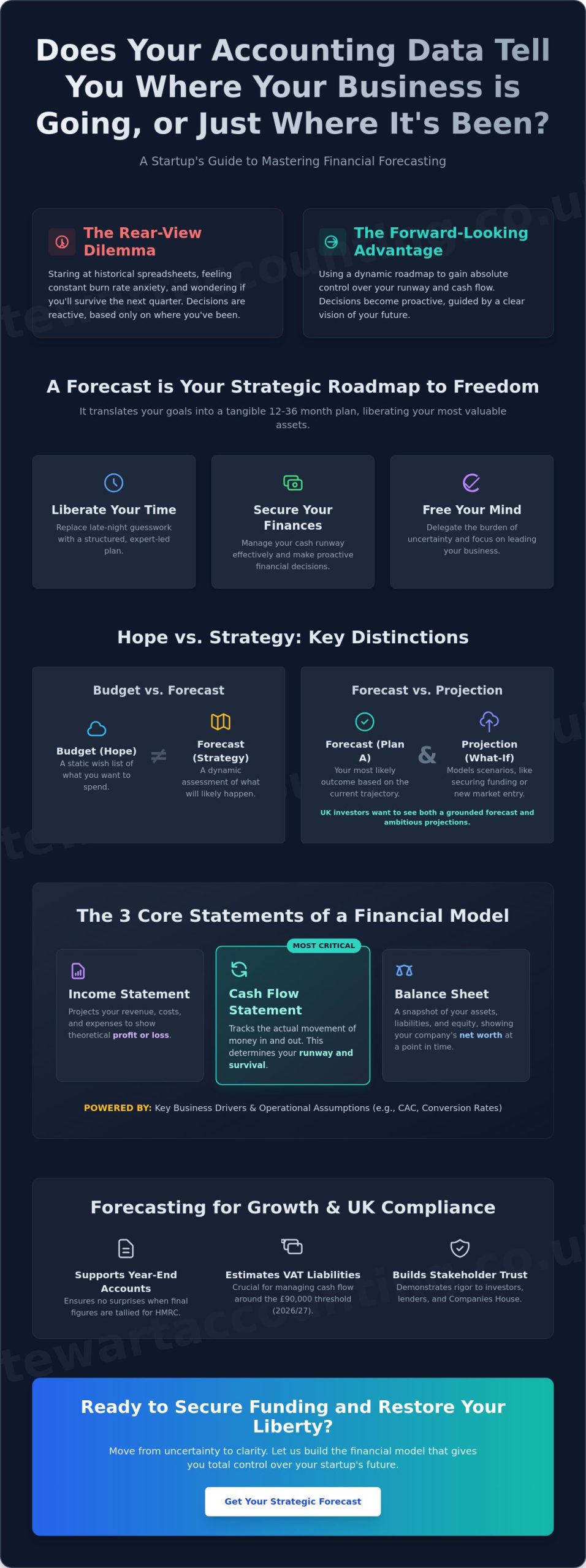
What exactly is a financial forecast? Think of it as a strategic roadmap that maps out your startup’s financial journey for the next 12 to 36 months. It isn’t just a static spreadsheet. It’s a living document that translates your high-level business goals into tangible, trackable numbers. For many founders, the confusion starts with the difference between a budget and a forecast. A budget is essentially your wish list. It outlines what you want to spend to reach your goals. A forecast, however, is a grounded assessment of what is likely to happen based on actual market trends and internal performance. It’s the difference between hope and strategy.
In 2026, UK startups must prioritize their cash runway over simple profit and loss metrics. While being profitable is the ultimate goal, running out of liquid cash is the most common reason startups fail. A professional approach to financial forecasting for startups removes the guesswork. It replaces late-night anxiety with what we call the Thematic Triad: the liberation of your time, your finances, and your mental well-being. By having a clear view of your future cash position, you can physically remove the burden of uncertainty from your shoulders and delegate it to a structured, expert-led plan.
This process isn’t about being 100% right every single time. It’s about having a framework that allows you to react quickly when things change. When you know your burn rate and your runway, you aren’t just reacting to the bank balance; you’re making proactive decisions about hiring, marketing, and expansion. Effective financial forecasting for startups gives you the power to pivot before a crisis occurs. This level of control is what separates a struggling venture from a scalable business.
Forecast vs. Projection: Which one does your startup need?
A forecast represents the most likely outcome based on your current trajectory. It’s your “Plan A” for daily operations. Projections are slightly different. They model “what-if” scenarios, such as what happens if you secure a specific seed round or scale into a new territory. In the UK market, investors often want to see a hybrid approach. They need the grounded reality of a forecast to trust your management; however, they also want the ambitious projections that show how their capital will accelerate growth. We often help clients build both to ensure they’re prepared for every conversation.
The role of forecasting in UK startup compliance
Forecasting isn’t just for growth; it’s vital for staying on the right side of HMRC. A reliable forecast directly supports your year end accounts preparation by ensuring there are no surprises when the final figures are tallied. It helps you estimate future VAT liabilities, which is crucial since the VAT registration threshold remains at £90,000 for the 2026/27 tax year. Aligning your forecast with Companies House filing requirements demonstrates to lenders and stakeholders that your business is managed with professional rigor and foresight. It’s about building a foundation of trust with the authorities and your investors alike.
What are the core components of a startup financial model?
Building a robust model requires more than just a list of expected sales. It involves integrating three primary financial statements that work together to show your business’s health. The core components of a financial model include the Income Statement, the Cash Flow Statement, and the Balance Sheet. While the Income Statement projects your revenue and direct costs to show theoretical profit, the Cash Flow Statement is often the most critical document for Scottish SMEs. It tracks the actual movement of money, ensuring you don’t run out of cash while waiting for invoices to be paid. Finally, the Balance Sheet tracks your assets, liabilities, and equity over time, providing a snapshot of your startup’s net worth.
Reliable financial forecasting for startups also relies on operational assumptions. These are the “drivers” behind your numbers, such as customer acquisition cost (CAC) or lead conversion rates. Without these drivers, your spreadsheet is just a collection of guesses. By identifying the specific actions that lead to revenue, you can create a model that responds to reality rather than one that just looks good on paper. If you find this process daunting, our team can help you build a professional Cashflow Forecast that brings these components together seamlessly.
Projecting revenue in a pre-revenue or early-stage environment
How do you predict sales when you haven’t sold anything yet? You start by using market research and competitor analysis to ground your goals in reality. It’s helpful to distinguish between recurring revenue models, which offer long-term stability, and one-off sales that require constant effort to maintain. Don’t forget to factor in seasonality. Many UK sectors experience specific economic cycles, such as the pre-Christmas surge or the post-tax-year lull in April. Understanding these patterns makes your financial forecasting for startups much more believable to potential lenders.
Estimating startup expenses and the “Burn Rate”
Expenses generally fall into two buckets: fixed and variable. Fixed costs like rent and software subscriptions stay the same regardless of your sales volume. Variable costs, such as marketing spend or raw materials, fluctuate as you grow. A common pitfall for UK founders is underestimating “hidden” costs like employer National Insurance contributions or mandatory pension payments. These can significantly impact your “Burn Rate,” which is the rate at which your business spends its venture capital to cover overhead before generating positive cash flow. Your “Runway” is the number of months your startup can continue to operate before running out of cash based on your current burn rate and bank balance.
Top-down vs. Bottom-up forecasting: Which is better for growth?
When you sit down to plan your growth, you’ll generally encounter two different philosophies. Top-down forecasting starts with the big picture. You look at the total addressable market and estimate what percentage you can realistically capture. While this is great for showing your ambition, it often falls victim to “optimism bias,” especially in Scottish market projections. Claiming you’ll capture 1% of a billion-pound industry sounds easy on paper, but it rarely accounts for the daily friction of running a business. In contrast, bottom-up financial forecasting for startups builds your revenue from the ground up, starting with individual units of sale, lead times, and specific marketing efforts.
By 2026, investors have become much more skeptical of high-level market share claims. They now prioritize bottom-up models because they offer granular accuracy. This approach proves you understand the mechanics of your business. It isn’t just about the final number; it’s about the logic used to get there. When you can show exactly how many phone calls, clicks, or meetings lead to a single sale, your forecast becomes a credible tool for decision-making rather than just a decorative piece of your pitch deck. Effective financial forecasting for startups balances these two views to create a plan that is both inspiring and grounded in reality.
The Bottom-up approach: The gold standard for startups
This method is widely considered the gold standard because it’s built on your actual sales funnel and conversion rates. It forces you to ask hard questions: How much does it cost to acquire one customer? How long does it take for a lead to become a paying client? This makes your financial plan highly defensible during an audit or a high-stakes investor pitch. Additionally, you can integrate your current bookkeeping data into a bottom-up model. This allows for real-time adjustments, so if your conversion rate drops by 5% in June, you’ll immediately see the impact on your cash position in December. It’s about turning data into a protective shield for your runway.
When to use Top-down modeling as a secondary check
While bottom-up is the priority, top-down modeling still serves a valuable purpose as a secondary check. It helps you validate if your bottom-up goals are too conservative or perhaps too ambitious for your industry. For example, if you’re targeting “unclaimed” market share in Central Scotland towns like Alloa, Stirling, or Falkirk, a top-down view helps you see the total capacity of those regional economies. It ensures your “boots on the ground” reality aligns with the “big picture” vision. Using market data to sense-check your numbers prevents you from building a plan that ignores wider economic trends or regional limitations. This balanced perspective gives you the mental freedom to lead with confidence, knowing your targets are both challenging and achievable.
How to build your first 12-month startup forecast without the stress
Building a map for your first year shouldn’t be a source of anxiety. It’s a structured process that provides immense clarity when followed logically. Many founders feel overwhelmed because they try to predict every variable at once. Instead, you should start with a solid baseline and build your model in stages. This methodical approach allows you to physically remove the burden of uncertainty and replace it with a pragmatic plan for growth. By focusing on the immediate 12-month horizon, financial forecasting for startups becomes a series of manageable, actionable steps.
- Step 1: Clean up your current records. You can’t build a reliable future on messy data. Ensure your bookkeeping services are up to date to provide a solid baseline.
- Step 2: Define your key business drivers. Identify the specific metrics that move the needle, such as your price per unit, lead times, and customer acquisition costs.
- Step 3: Map out your monthly projections. Break down your expected sales and expenses month by month to identify potential cash gaps before they happen.
- Step 4: Stress-test your model. Create a “worst-case” scenario where revenue is 30% lower than expected. This helps you understand your true resilience.
- Step 5: Review and iterate. A forecast is a living document. Meet with your advisor monthly to compare your actual performance against your predictions.
Leveraging Xero and cloud accounting for accuracy
Manual Excel sheets often fail as a startup begins to scale. Formulas break, and version control becomes a nightmare that adds unnecessary stress to your day. We find that effective financial forecasting for startups requires the data integrity provided by modern cloud platforms. Stewart Accounting Services’ Xero training and support ensures you can maintain a clean ledger, which is the essential fuel for any accurate forecast. By utilizing management accounts, you get a monthly pulse check that shows exactly how your business is performing against your roadmap. This transition from DIY spreadsheets to professional cloud systems is a vital step in reclaiming your time and mental well-being.
Accounting for UK-specific tax and employment costs
Your forecast must integrate current UK tax rates to avoid year-end surprises that can drain your cash reserves. For the financial year beginning April 1, 2026, the main rate of Corporation Tax is 25% for companies with profits over £250,000, while a small profits rate of 19% applies to those earning £50,000 or less. Additionally, calculating the true cost of Scottish employees involves more than just salaries. You must account for employer National Insurance contributions and pension compliance. Integrating professional tax planning into your forecast ensures you’re utilizing allowances like the £1 million Annual Investment Allowance (AIA) to optimize your resources. For expert help navigating these complexities, you can rely on the team at Stewart Accounting Services to guide you.
Why delegating your financial forecasting to a Chartered Accountant is a strategic move
Transitioning from a DIY mindset to a delegated model is a pivotal moment for any founder. While you might have managed the initial numbers yourself, the complexity of scaling requires a level of precision that only a qualified expert can provide. Delegating financial forecasting for startups to Stewart Accounting Services is about more than just accuracy; it’s about gaining a strategic advantage. An expert advisor transforms a static set of numbers into a dynamic tool for growth, helping you anticipate challenges before they impact your bank balance. This professional oversight ensures your model isn’t just a prediction but a defensible plan for success.
Having a local partner in Alloa, Stirling, or Falkirk means you have an advisor who truly understands the economic landscape of Central Scotland. This regional insight, combined with formal professional credentials, builds instant trust with lenders and investors. When they see a forecast backed by a Chartered Accountant, they see a business managed with professional rigor. It physically removes the burden of proof from your shoulders and places the weight of your financial credibility on our established expertise. This level of trustworthiness is often the deciding factor in securing the funding needed to extend your runway.
The Stewart Accounting Services approach: Reclaiming your time and mental well-being
Our business advisory and financial planning services are designed to restore your personal and professional liberty. We focus on the “Thematic Triad,” which is the restoration of your time, finances, and mental well-being. We physically remove the burden of forecasting from your workload, handling the technical intricacies so you can focus on your product and your team. Unlike remote-only firms, our regional presence ensures we’re an accessible partner you can meet with to discuss your long-term objectives. We take over the heavy lifting of data modeling, giving you the mental freedom to lead with absolute clarity.
Ready to take control of your startup’s future?
The best time to start this conversation is now, well before your first year-end filing. Early planning allows us to identify gaps in your current strategy and implement resource optimization that protects your cash flow from the start. A free consultation is the first step toward total delegation and financial freedom. It’s an opportunity to see how a professional roadmap can alleviate the stress of uncertainty. Contact Stewart Accounting Services today for expert financial forecasting support and discover how we can help you lead your startup with absolute confidence.
Take the Lead on Your Startup’s Growth
You’ve now seen how building a robust model isn’t just about spreadsheets; it’s about reclaiming your professional liberty. By prioritizing granular, bottom-up data and integrating cloud-based bookkeeping, you ensure your financial forecasting for startups is both accurate and defensible. The transition from managing these complexities yourself to delegating them to experts is the final step in securing your startup’s future. Stewart Accounting Services provides the high-level expertise needed to navigate the UK’s shifting tax landscape while giving you the mental freedom to focus on your vision.
As Chartered Accountants with physical offices in Alloa, Stirling, and Falkirk, we’re specialists in SME growth and business advisory. Our status as Xero silver partners ensures a seamless cloud integration that keeps your data clean and your roadmap clear. Don’t let the fear of running out of cash dictate your decisions. Instead, choose a partner who understands the Scottish business landscape and is committed to your long-term success. Your vision deserves a foundation of professional reliability and absolute clarity.
Book a free consultation with Stewart Accounting Services to build your startup forecast
Frequently Asked Questions
How long should a startup financial forecast be?
A reliable forecast typically covers a period of 12 to 36 months. The first 12 months should be highly detailed, focusing on monthly cash flow and operational expenses to manage your immediate runway. The subsequent 24 months provide a broader strategic outlook for potential investors or lenders. This timeline ensures you have enough visibility to make informed decisions while remaining flexible enough to adapt to the fast-moving Scottish business landscape.
What is the most common mistake in startup financial forecasting?
The most frequent error is “optimism bias,” where founders overestimate sales speed and underestimate hidden operational costs. Many UK startups forget to account for the true cost of employment, such as employer National Insurance or pension contributions. Failing to include these figures can lead to a sudden cash crunch. Accurate financial forecasting for startups requires a pragmatic look at both your best-case and worst-case scenarios to protect your mental well-being.
Do I need a financial forecast if I am not looking for investors?
Yes, because a forecast is primarily a tool for internal control and cash management. Even without investors, you need to know when you’ll reach break-even or when you can afford your next hire in Stirling or Falkirk. It provides the mental freedom to make decisions based on data rather than guesswork. Having this roadmap in place allows you to delegate financial stress and focus on your core business product.
How often should I update my startup’s financial forecast?
You should review and update your forecast at least once a month. This process involves comparing your “actuals” from your bookkeeping against your original predictions. If you notice a consistent gap, you can adjust your strategy before it becomes a crisis. Regular updates ensure your financial forecasting for startups remains a living document that reflects the current reality of your local business and prevents HMRC surprises.
Can I use accounting software like Xero to create a forecast?
Xero is an excellent foundation for forecasting because it holds all your historical data and current ledger information. While the software itself provides basic reports, the real value comes from integrating that data with a strategic advisory model. We use Xero as a silver partner to ensure your baseline figures are accurate. This allows us to build a more robust, defensible forecast that helps you regain professional liberty and control.
What is the difference between a budget and a financial forecast?
A budget is a plan that outlines what you intend to spend to achieve specific goals over a set period. In contrast, a forecast is a realistic prediction of what will actually happen based on current trends and actual market data. Think of the budget as your target and the forecast as your current trajectory. Understanding this difference is vital for maintaining a healthy cash runway and ensuring your business stays solvent.
How much does it cost to have an accountant prepare a financial forecast?
Fees for professional forecasting vary depending on the complexity of your business model and the depth of advisory required. A simple cash flow projection for a micro-business will differ from a full 3-statement model for a scaling tech firm. We recommend speaking with a local expert in Central Scotland to get a tailored quote that reflects your specific startup needs, desires, and long-term objectives.
What happens if my startup does not meet its forecasted targets?
Missing a target isn’t a failure; it’s a critical data point for your next strategic decision. If you don’t meet your forecasted goals, you should analyze your business drivers to see where the gap occurred. Perhaps your lead time was longer than expected or your customer acquisition costs were higher. Use this insight to pivot your marketing or adjust your spending to protect your remaining cash runway and restore confidence.