
Could staying a sole trader in 2026 actually cost you more in administrative stress than it saves you in tax? Understanding the sole trader vs limited company tax implications is becoming more urgent as we approach major regulatory shifts. It’s completely natural to feel anxious about the looming Making Tax Digital (MTD) changes or the complexity of Scottish income tax bands. You want to focus on your business, not spend your weekends drowning in HMRC paperwork or worrying if you’ve missed a new compliance deadline.
We understand that these financial decisions are about more than just numbers; they’re about your peace of mind and professional liberty. This article promises to break down the specific 2026 rates, including the frozen £12,570 personal allowance and the reduced £500 dividend limit. We’ll help you identify the exact “tipping point” where switching to a limited company could legally reduce your tax bill and simplify your reporting obligations.
We will preview how the new £50,000 MTD threshold impacts your quarterly reporting, compare take-home pay for both structures, and explain how to navigate the unique tax considerations for business owners in Scotland. Our goal is to provide a clear, pragmatic roadmap that helps you make the best choice for your future while ensuring you stay fully compliant with HMRC.
Key Takeaways
- Understand why the legal distinction between you and your business is the foundation of all your future tax planning.
- Compare the 2026 sole trader vs limited company tax implications to see how frozen thresholds and Corporation Tax rates affect your bottom line.
- Learn to navigate the specific challenges of Scottish income tax bands and the upcoming Making Tax Digital (MTD) reporting requirements.
- Pinpoint the “tipping point” profit level where switching structures provides the best balance of tax efficiency and administrative ease.
- Discover how delegating your financial management to a regional expert can liberate your time and reduce your mental burden.
What are the core tax differences between a sole trader and a limited company?
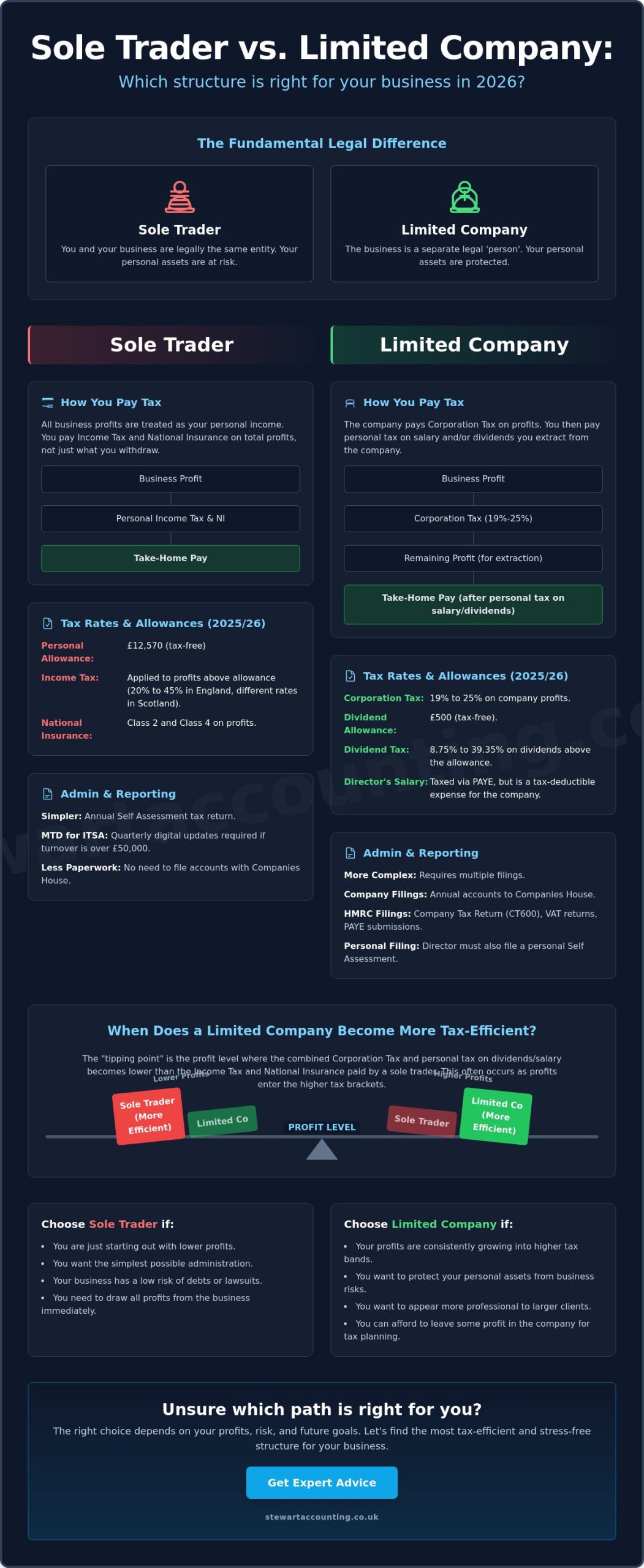
Have you ever wondered why your tax bill looks so different from a fellow business owner’s? The answer usually lies in your business structure. When evaluating sole trader vs limited company tax implications, the most important thing to grasp is that the law treats these two setups very differently. A sole trader and their business are legally the same person. This means every penny of profit your business makes is considered your personal income from the moment it’s earned.
If you are looking for a foundational definition of what a sole trader is, it’s essentially an individual who runs their own business as an unincorporated entity. In contrast, a limited company is a separate legal person. This separation creates a distinct tax barrier. The company owns the profits, pays its own taxes, and then you decide how to pay yourself from what remains. Here are the three fundamental differences:
- Legal Identity: You are the business as a sole trader, whereas a limited company is its own legal “person.”
- Tax Ownership: Sole trader profits are personal income immediately. Company profits belong to the business until extracted.
- Liability: Sole traders face unlimited personal liability for business debts. Company directors generally have protected personal assets.
This separation leads to the concept of “double taxation” for companies. First, the business pays Corporation Tax on its profits. Then, when you take those profits out as dividends, you pay personal tax on that money. While this sounds complex, it often provides opportunities for tax planning that aren’t available to sole traders.
How sole traders pay tax
Sole traders operate under a straightforward but rigid system. You pay tax on your total business profits, regardless of how much cash you actually take out of the business bank account. You report this through the annual Self Assessment process. The January 31st deadline remains the most important date in your calendar for settling your 2026 tax liabilities. For the 2025/26 tax year, the first £12,570 of your income is typically covered by your Personal Allowance, meaning you only pay tax on profits above this amount.
How limited companies pay tax
Operating as a limited company offers more control over your personal tax bill. The company pays Corporation Tax on all taxable profits first. As a director, you only pay personal income tax on the specific salary or dividends you extract. This allows you to leave money in the company to manage your tax brackets effectively. However, this flexibility comes with more paperwork. You’ll need to ensure the professional preparation of year end accounts to stay compliant with both Companies House and HMRC regulations.
How do Income Tax and Corporation Tax impact your take-home pay?
When you look at your bank balance at the end of the month, the figure you see is heavily dictated by how HMRC views your business structure. For a sole trader, the process is an “all-in” approach. Every pound of profit above your £12,570 personal allowance is subject to income tax, regardless of whether you spend that money or leave it in your business account. This simplicity is often what leads people to begin by registering for Self Assessment, but it can become expensive as your profits grow.
Limited company directors have more moving parts to consider when evaluating sole trader vs limited company tax implications. Most choose a “Salary and Dividend” strategy. You take a small, tax-efficient salary that counts as a business expense, reducing your Corporation Tax. The remaining profit is then taxed at company level before you take it as a dividend. It’s vital to remember that the tax-free dividend allowance has shrunk significantly, sitting at just £500 for the 2026/27 tax year. This makes precise tax planning essential to ensure you aren’t overpaying on your personal extraction.
The Scottish Factor: Income Tax bands in Scotland
If your business is based in Stirling, Alloa, or Falkirk, your tax landscape looks different from a business in London. Scotland utilizes its own income tax bands, which often feature more tiers and higher rates for middle and high earners. A sole trader in Scotland might find themselves paying a higher percentage of their profit in tax compared to a sole trader elsewhere in the UK. However, limited company dividends are currently taxed at UK-wide rates. This creates a “Scottish tax hedge,” where a director might pay less overall tax by taking dividends rather than a high salary or operating as a sole trader.
The 2026 Corporation Tax landscape
The Corporation Tax system is no longer a “one size fits all” rate. For the financial year beginning April 2026, companies with profits of £50,000 or less benefit from the 19% Small Profits Rate. Once your profits exceed £250,000, you hit the 25% Main Rate. If your profits fall between these two figures, you pay a tapered rate known as marginal relief. You must also be careful with “associated companies” rules. If you run multiple limited companies, these profit thresholds are shared between them, which can push you into a higher tax bracket sooner than you expect. Professional advice is the best way to navigate these tiers and keep your business efficient.
What are the National Insurance and reporting implications for each?
While income tax often takes the spotlight, National Insurance (NI) is the silent partner that significantly shapes your take-home pay. It’s one of the most complex areas when you sole trader vs limited company tax implications because the rules for how you contribute to the state are entirely different for each structure. You might find the sole trader route simpler to start, but the lack of flexibility in NI can lead to higher costs as your profits climb. To get a better grasp of these structural choices, you can Compare the differences between a sole trader and a limited company on the official government portal.
Operating as a limited company introduces a “hidden cost” of administration. You’ll need to manage payroll for yourself as a director and handle more frequent filings with Companies House. However, this extra paperwork often buys you the freedom to choose how much NI you pay. By delegating these tasks to a professional, you can focus on growth while we ensure your reporting is accurate and timely. This removes the administrative weight from your desk and restores your professional liberty.
National Insurance: The sole trader vs director split
Sole traders pay Class 4 National Insurance on their profits. For the 2026/27 tax year, this is 6% on profits between £12,570 and £50,270, dropping to 2% on anything above that. It’s a straightforward but mandatory cost. Company directors, however, pay Class 1 NI on their salary. Most directors choose to keep their salary just below the Primary Threshold to avoid paying NI altogether, while still earning “credits” toward their future State Pension. Since dividends don’t attract National Insurance at all, this split is a major reason why many business owners in Stirling and Falkirk find the limited company structure more efficient. If you have employees, your company might also claim the Employment Allowance, which can offset thousands of pounds in employer NI costs.
MTD 2026: The new reporting burden
The reporting landscape is shifting dramatically on April 6, 2026. Under the new Making Tax Digital for Income Tax (MTD ITSA) rules, sole traders with a qualifying income over £50,000 face a significant change. You’ll move from filing one annual Self Assessment return to sending four quarterly updates plus a final declaration. This means five interactions with HMRC every year. Many sole traders feel overwhelmed by this prospect, as it requires digital record keeping and compatible software. Interestingly, limited companies aren’t yet required to follow this specific quarterly MTD path for Corporation Tax, which might actually make the company structure feel less burdensome for high earners from 2026 onwards.
At what profit level does a limited company become more tax-efficient?
Is there a magic number that tells you when to incorporate? For years, many business owners in Central Scotland were told that once profits hit £30,000, it was time to go limited. However, the 2026 landscape has shifted the goalposts significantly. Due to the rise in Corporation Tax rates and the reduction of the tax-free dividend allowance, the new “tipping point” for sole trader vs limited company tax implications is now estimated to be between £45,000 and £50,000. Below this level, the tax savings often don’t justify the additional costs of running a company.
Your personal spending habits play a massive role in this calculation. If you need to withdraw every pound of profit to cover your household bills, the tax benefits of a limited company are minimized. Conversely, if you can leave money in the business account, you can defer personal tax and grow your company’s wealth. One of the most effective ways to lower your company’s tax bill is through employer pension contributions. Unlike sole trader pension payments, these are a direct business expense. They reduce your taxable profit before Corporation Tax is even calculated, providing a powerful incentive for directors to save for the future.
Calculating your personal “Tipping Point”
Several factors can lower your specific threshold for incorporation. If you have a spouse who can become a shareholder, you might be able to utilize their basic rate tax band to pay out dividends, which makes the company structure much more efficient. If your business has high equipment costs or you plan to retain profits for future expansion, a company usually wins. On the other hand, if you have very low overheads and high personal income needs, you might find staying as a sole trader more practical for longer, especially when considering the reporting requirements we discussed earlier.
The “Admin Tax”: Factoring in the cost of compliance
If you’re unsure if you’ve reached the stage where incorporation makes sense, we can help you run the numbers. Contact us for a personalized business advisory session to find your specific tipping point.
How can Stewart Accounting Services help you choose the right structure?
Are you feeling the weight of the upcoming 2026 reporting changes or the complexity of the Scottish tax system? Deciding between the sole trader vs limited company tax implications isn’t just a mathematical exercise; it’s a decision that affects your daily life and your business’s future. At Stewart Accounting Services, we specialize in helping small and medium-sized enterprises navigate these waters with ease. We don’t just provide a service; we act as a reliable partner to ensure your structure is optimized for the current financial climate while reducing the anxiety that often comes with HMRC compliance.
Our core promise is built around the “Thematic Triad”: liberating your time, your finances, and your mental well-being. We achieve this through our signature approach to delegation. Instead of you spending your weekends worrying about quarterly MTD updates or the intricacies of dividend extraction, we physically remove those burdens from your desk. By moving the tax weight to our experts, you gain the freedom to focus on growing your business and enjoying your personal life. We provide a bespoke tax-efficiency review that looks at your specific profit levels and personal needs to find your unique tipping point, ensuring you never pay more than you legally owe.
Regional expertise for Central Scotland
Based in the Alloa Business Centre, we are perfectly positioned to support business owners in Alloa, Stirling, and Falkirk. Having a regional expert who truly understands the nuances of Scottish income tax is vital. As we’ve discussed, the divergence between Scottish and UK tax rates can make a significant difference in your take-home pay. While we are grounded in Central Scotland, we also utilize cloud technology to support clients across the UK. We offer specialized Xero training and support to ensure your digital record-keeping is seamless, preparing you fully for the 2026 MTD requirements without the typical stress of a digital transition.
Your next steps toward tax efficiency
If you decide that moving to a limited company is the right path, we manage the entire transition for you. This includes professional company formation, HMRC registration and authorization, and setting up your payroll services. We don’t just set you up and leave you; we provide ongoing support through management accounts and VAT return services. We can also assist with cashflow forecasts and business plans to help you scale effectively. Our goal is to make the transition as smooth as possible, ensuring you never feel lost in the paperwork. We invite you to a consultation to discuss how we can help you take control of your business future and reduce your tax bill legally. Let us help you restore your professional liberty today.
Ready to optimize your business structure for 2026?
You now have a clearer picture of the sole trader vs limited company tax implications that will define the 2026 financial year. We’ve explored how the “tipping point” for incorporation has moved toward the £45,000 to £50,000 range and why the upcoming MTD for ITSA changes represent a significant shift in reporting for sole traders. Whether you’re navigating the unique Scottish tax bands or looking for ways to lower your bill through corporate pension contributions, the right structure is about more than just tax rates; it’s about your peace of mind.
As Chartered Accountants in Alloa, Stirling, and Falkirk, we specialize in Scottish small business tax. We’re also Xero Gold Partners, ready to ensure you’re fully compliant for the MTD 2026 transition. Our goal is to physically remove the administrative burden from your desk, allowing you to reclaim your time and focus on what you love. Book a free consultation with our Chartered Accountants today to start your journey toward professional liberty. You don’t have to face these complex changes alone. We’re here to help you build a more efficient, stress-free business for the years ahead.
Frequently Asked Questions
Is it cheaper to be a sole trader or a limited company in 2026?
The answer depends on your profit level, but the tax efficiency tipping point is now generally around £45,000 to £50,000. While companies offer lower tax rates on dividends, you must factor in higher accountancy fees and the reduced £500 dividend allowance. For those with profits under £30,000, the simplicity and lower administrative costs of being a sole trader usually make it the cheaper option overall.
How much can I save in tax by going limited in Scotland?
Savings vary based on your earnings, but the Scottish tax hedge can be significant for middle and top rate earners. Because dividends are taxed at UK wide rates rather than higher Scottish Income Tax bands, directors often take home a larger percentage of their profit. We provide a bespoke review to calculate your exact savings, ensuring your structure aligns with local regulations in Stirling, Alloa, and Falkirk.
What are the main tax disadvantages of being a sole trader?
The primary disadvantage is the lack of flexibility, as you are taxed on all business profits regardless of how much you draw. You also face unlimited personal liability, meaning your personal assets aren’t protected from business debts. Additionally, the sole trader vs limited company tax implications include higher mandatory National Insurance contributions on profits compared to the tax efficient salary and dividend split available to directors.
Do I need a separate bank account as a sole trader vs a limited company?
You must have a separate business bank account for a limited company because it is a separate legal entity. While it is not a legal requirement for sole traders, we highly recommend it to keep your bookkeeping clear and your Self Assessment straightforward. Using a dedicated account makes it much easier to track deductible expenses and reduces the time spent on your year end accounts preparation.
Can I switch from a sole trader to a limited company mid-year?
Yes, you can incorporate your business at any point during the tax year. However, doing so mid-year creates two distinct tax periods: one for your sole trader income and one for your company. This requires careful management of your accounts to avoid overlapping liabilities. We often suggest aligning the switch with the start of a new tax year on April 6th to simplify your reporting and compliance.
How does MTD for Income Tax in 2026 affect my choice of business structure?
From April 6, 2026, sole traders with income over £50,000 must file quarterly updates, which significantly increases their administrative burden. This new requirement might make a limited company more attractive, as companies aren’t yet subject to the same quarterly reporting rules for Corporation Tax. If you are anxious about these changes, our Xero Gold Partners can help you transition to digital record keeping smoothly and accurately.
What expenses can I claim to reduce my tax bill in either structure?
You can generally claim any costs that are wholly and exclusively for the purpose of your business. This includes office rent, professional insurance, marketing, and software like Xero. Limited companies have the added advantage of treating employer pension contributions as a tax deductible expense. This reduces your taxable profit before Corporation Tax is applied, providing a benefit that isn’t available in the same way to sole traders.
Do limited company directors have to pay Scottish Income Tax on dividends?
No, dividend income is currently subject to UK wide tax rates rather than the specific Scottish Income Tax bands. This remains true even if you live in Alloa or Stirling. While your salary as a director is subject to Scottish rates, the dividend portion of your income benefits from the UK’s lower tax thresholds. This distinction is a key part of the sole trader vs limited company tax implications for Scottish business owners.