

Accountant for Businesses in Stirling Enterprise Park

Strong financial records give you a clearer view of your business and make reporting and compliance easier to manage. An accountant for businesses in Stirling Enterprise Park can support you with bookkeeping, year-end accounts, management reporting and tax responsibilities, helping you make informed decisions and take routine finance work off your hands.
It’s understandable if keeping records up to date and meeting filing requirements takes attention away from running your business. Compliance also includes newer requirements: according to Companies House, from 18 November 2025, identity verification became a legal requirement for registered UK companies, including newly appointed directors and People with Significant Control.
This article explains how accounting support can help with bookkeeping, annual reporting, Companies House and HMRC compliance, and the information an accountant may need from you. You’ll also see how different services fit together, so you can understand the support your business needs and work towards more time, more money, more mind.
Key Takeaways
- Understand how annual reporting helps present a clear picture of your business and supports its reporting responsibilities.
- See how organised bookkeeping and accounting records can make financial information easier to use in business decisions.
- Know that Companies House identity verification became a legal requirement from 18 November 2025 for registered UK companies, including newly appointed directors and People with Significant Control.
- Assess accountancy support by matching the services you need with your business structure, reporting requirements and preferred way of working.
- Learn how bookkeeping, payroll and year-end accounts support can take routine finance tasks off your hands.
Annual and statutory reporting
Annual reporting turns a business’s financial activity into accounts for a completed accounting period. An accountant for businesses in Stirling Enterprise Park can bring together income, costs, assets and liabilities, then explain how the figures fit. Supporting documents link reported totals to invoices, bank activity and other records.
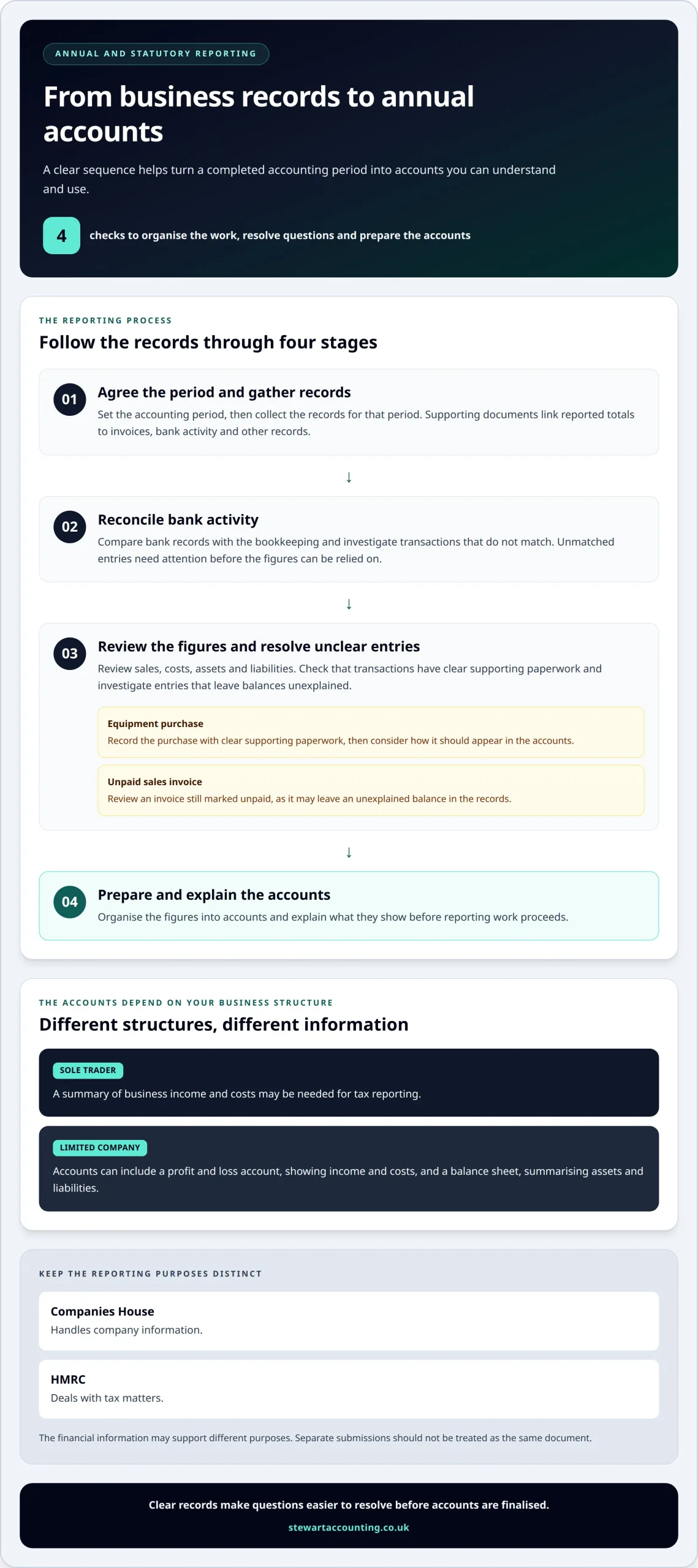
The information included depends on your business structure and reporting needs. A sole trader may need a summary of business income and costs for tax reporting. A limited company’s accounts can include a profit and loss account, showing income and costs, and a balance sheet, summarising assets and liabilities. An accountant can organise these figures and explain what they show.
What UK accounting and tax deadlines must businesses in Stirling meet? There is no single deadline for every business. Relevant dates depend on your business structure, accounting period and reporting obligations. An accountant can map the applicable Companies House and HMRC deadlines to your circumstances.
Preparing annual accounts involves a sequence of checks. An accountant can organise the work by:
- Agreeing the accounting period and gathering records for that period.
- Reconciling bank activity and investigating unmatched transactions.
- Reviewing sales, costs, assets and liabilities, then resolving unclear entries.
- Preparing the accounts and explaining the figures before reporting work proceeds.
For example, when a business buys equipment, the purchase needs to be recorded with clear supporting paperwork. The accountant considers how the transaction should appear in the accounts. A sales invoice still marked unpaid may also need attention, as it can leave an unexplained balance in the records.
Companies House and HMRC have different roles. Companies House handles company information, while HMRC deals with tax matters. An accountant identifies which financial information supports each purpose. This helps a limited company understand how its accounts relate to company reporting and tax work, without treating separate submissions as the same document.
Timing affects account preparation. Providing complete records in an organised format gives the accountant more opportunity to resolve questions before finalising the accounts. Missing invoices, unclear expense descriptions or unreconciled transactions can require follow-up. A consistent record trail makes these checks easier.
Year-end accounts also help you review a completed period. Comparing income and costs with your budgets or earlier records can highlight changes worth investigating. Annual reporting records past activity, while management accounts can provide more frequent information for planning. Keeping each report’s purpose clear helps you use the figures appropriately.
Bookkeeping and accounting
Bookkeeping records business transactions; accounting uses those records for reports and decisions. The right support depends on your business structure, transaction types and the work you want an accountant to manage.
Accountancy firms serving the park
Businesses in Stirling Enterprise Park can use local accounting support or work remotely with an accountant. When choosing a firm, look beyond its location and consider how its services fit your day-to-day needs. For example, ask how records are received, how queries are handled and whether reports are explained in a useful way.
To arrange an initial discussion, describe your business structure, current bookkeeping process and the tasks you want handled. You can also explain whether you prefer in-person meetings or remote communication. This helps establish the scope of the work and gives you a practical basis for discussing how the accountant can support your business.
Services for Stirling businesses
Accounting support can include recording transactions, reconciling bank records, preparing VAT returns, managing payroll and producing year-end accounts. Each task serves a different purpose. Bookkeeping keeps financial entries organised, while accounting turns those records into reports for tax work or business decisions.
For example, a retailer may need sales, supplier bills and card payments recorded consistently. A consultancy may need client invoices tracked alongside project costs. A business with employees may also need payroll handled as part of its financial administration. The right combination depends on how the business trades and what work you want to delegate.
Clarify how the accountant handles missing receipts, unusual transactions and regular reporting. If keeping transaction records organised is a priority, bookkeeping support for your business may be relevant to your needs.
Specialist support for business types
Small businesses, startups and limited companies can need different accounting approaches. A startup may need help setting up an organised process for recording sales and costs. A limited company may need accounts prepared to reflect its company structure, while an established small business may value regular financial reports.
Ask how the accountant’s work will reflect your business model. A firm supporting small businesses should be able to explain how it records owner transactions, income and costs. For a limited company, discuss how the accounting process reflects its activity. Clear answers help you judge whether the support fits your circumstances.
Before choosing support, outline your business structure, the accounting tasks you want handled and how you prefer to communicate. If you’re ready to discuss your requirements, get in touch.
Companies House and HMRC compliance
Companies House and HMRC handle different parts of UK business compliance. Companies House maintains company information, while HMRC deals with tax matters. Records and submissions depend on your business structure and activities. Accounting support can help separate these responsibilities and organise the financial information needed for each process.
From 18 November 2025, identity verification became a legal requirement for registered UK companies, including newly appointed directors and People with Significant Control, according to Companies House. Businesses need to account for this requirement when managing company roles. For example, appointing a new director involves considering identity verification alongside the company’s other administrative records.
Identity verification concerns people connected with a registered company. It is separate from preparing accounts or providing tax information to HMRC. Keeping these tasks distinct clarifies who needs verification and which financial records support tax or accounts work. Tell the people handling your records about relevant company changes so information stays aligned.
Compliance support can involve organising financial information, identifying missing details and explaining which tasks relate to Companies House or HMRC. An accountant can also clarify what information is needed for the accounting work. Your business remains responsible for supplying accurate records and details about changes, such as a director appointment or altered trading activity.
A clear process helps keep responsibilities visible. Useful steps include:
- Separating company administration from tax reporting, so each task is handled for its proper purpose.
- Keeping invoices and other records connected to the transactions they support.
- Recording company changes promptly, including appointments that bring identity verification into view.
- Resolving unclear transactions before financial information is finalised.
For example, when a company appoints a director, it needs to consider identity verification and maintain accurate company information. Separately, its accountant may organise sales and expense records for tax work. Treating these as distinct workstreams helps clarify which information supports each task and who needs to provide it.
How can you verify an accountant’s qualifications and professional membership in the UK? Ask for the exact qualification or membership, then check it with the relevant professional body. For example, if an accountant claims membership of the Institute of Certified Bookkeepers, contact that organisation or use its membership register to verify the claim.
Before work starts, agree who handles each accounting task, what information is needed and how company changes will be communicated. A new appointment and an unclear transaction require different records and actions. Assigning responsibility for each task helps coordinate company administration and tax reporting without confusing their separate purposes.
Which accountancy firms serve businesses in Stirling Enterprise Park?
Businesses in Stirling Enterprise Park can consider nearby accountancy firms or firms that work remotely across the UK. An address alone doesn’t show whether a firm’s support fits your business. Start by matching the work you need with its services, such as bookkeeping, payroll, accounts preparation or tax support.
For example, a company needing regular transaction processing and year-end accounts requires a different service mix from a startup seeking help setting up its financial records. Write down the tasks you want handled, then use that list to assess whether a firm’s services match. This keeps your decision focused on practical support rather than proximity alone.
Location can still matter. A nearby office may suit you if you prefer in-person meetings or need to discuss paperwork face to face. Remote working may suit businesses that share records digitally and prefer online meetings. For a business in Stirling Enterprise Park, the key distinction is how the firm communicates and handles records, not simply how close its office appears on a map.
Compare the working arrangements as well as the service categories. Useful points to clarify include:
- Which records the accountant prepares and which information your business supplies.
- How often financial updates are provided, and what those reports cover.
- How questions about unusual transactions or missing paperwork are handled.
- Whether the firm supports your business structure, such as a sole trader or limited company.
These details help distinguish one-off accounts preparation from ongoing support. For instance, a limited company with employees may need help coordinating bookkeeping, payroll and year-end accounts. A sole trader may need a different mix, centred on organised income and expense records.
Professional membership and qualifications can also help you understand an accountant’s background. Identify the exact qualification or membership claimed, then check it with the relevant professional body. This is separate from the firm’s location and does not, by itself, explain which tasks its service covers.
Make the initial conversation specific. Describe your business activity, structure, current records and the accounting tasks you want handled. A retailer might explain that sales come through several channels, while a consultancy might need invoices and project costs organised. These examples help establish the work involved and the information the accountant needs.
Rather than relying on a firm’s postcode or a broad description of its services, compare its responsibilities, reporting process and communication methods. For a business in Stirling Enterprise Park, this approach helps identify support that fits how the business operates, whether the work is done locally or remotely.
Which accountants have an office in or near Stirling Enterprise Park?
A listed accountancy address in Stirling is 21 Munnoch Way, Stirling, Scotland, FK7 8GA. That gives you a local location to consider, but an address alone doesn’t explain how an accountant works with your business. Check whether meetings are available in person, online or through a mix of both, and how records are shared.
For a business in Stirling Enterprise Park, travel convenience may matter if you prefer face-to-face discussions. It may matter less if you send records digitally and meet remotely. For example, a business owner who reviews management information regularly might value scheduled conversations, while another may mainly need organised year-end support.
Use the first conversation to establish practical arrangements rather than judging a firm by its postcode. Ask how the accountant receives invoices and bank records, who answers questions and how progress is communicated. A clear process is useful whether the office is close to your workplace or your records are handled remotely.
Before deciding, consider these points:
- Location: Check the full office address and whether it suits your preferred meeting arrangements.
- Access: Clarify whether discussions take place in person, online or by phone.
- Record sharing: Ask how the accountant receives and returns business information.
- Continuity: Find out who handles your work and how you raise follow-up questions.
These details help you compare the working experience, not just the distance from Stirling Enterprise Park. An in-person meeting, for example, may help when you need to talk through unfamiliar financial reports. A remote meeting may be more practical when your records are already digital and you need to discuss a specific query.
Also consider how the office location fits your business routine. If staff work across different sites, a single local meeting point may not suit every discussion. Agreeing how documents are shared and meetings arranged can reduce unnecessary travel while keeping the accountant informed about business changes.
Use a short list of current needs when you speak with an accountant. Include your business structure, the records you maintain, the work you want handled and your preferred contact method. A limited company, for example, may want to discuss year-end reporting, while a sole trader may focus on organising business records. Specific examples make the conversation more useful.
If you’re looking for accounting support connected to your Stirling business, discuss your business’s accounting needs and the working arrangements that suit you.
Stewart Accounting Services
Stewart Accounting Services supports businesses in Stirling Enterprise Park with accounting work and routine financial tasks. Services include bookkeeping, payroll, Self Assessment Tax Returns and Year-End Accounts. Bringing these tasks together can make records easier to follow and give you more time to focus on running your business.
Consider this support if bookkeeping is falling behind, payroll needs attention or you want help preparing year-end accounts. You can discuss your business structure, current records and the work you would like to hand over. That gives the conversation a practical starting point without assuming every business needs the same support.
To discuss accounting support for your business, contact Stewart Accounting Services.
Make your next accounting decision with confidence
Choosing an accountant for businesses in Stirling Enterprise Park is a practical decision about how financial work should fit around your business. Consider which tasks you want to hand over, what information you need to understand and how you prefer to work with your accountant. A clear starting point can turn an open-ended search into a focused conversation.
Stewart Accounting Services offers Year-End Accounts, Self-Assessment Tax Returns and Bookkeeping. These services can help organise records, prepare annual accounts and handle personal tax reporting connected to your business. The right starting point depends on where you need support, whether that’s keeping records in order or preparing for year-end work.
Take the next step at a pace that feels right for your business. Share the accounting tasks you’re considering and the way your business currently manages its records. Discuss your accounting needs with Stewart Accounting Services, and move towards more time, more money, more mind.
Frequently Asked Questions
What should a business consider when choosing an accountant in Stirling?
Choose an accountant whose experience and working approach fit your business structure and plans. For example, a company with seasonal income may value regular cash-flow discussions, while a new business may need help setting up its accounting process. Ask what work is covered and agree the fees before work begins. Stewart Accounting Services offers a free initial consultation, in person or remotely, and responds promptly to client communications.
Recent Posts
27 Nov, 2026
25 Nov, 2026