

Mastering Your Cashflow Management Strategies
Effective cashflow management strategies are all about keeping a close eye on the money coming in and going out of your business. It’s about more than just turning a profit; it’s about having the actual cash in the bank to pay your bills, your staff, and your suppliers on time, while still having enough left over to invest in growth.
Think of it as the lifeblood of your company. Profit is one thing, but liquidity is what keeps the doors open.
Why Strong Cashflow Management Is Your Business Lifeline
Let's cut to the chase—profit on paper means nothing if you can't pay your bills. For most UK SMEs, getting a grip on cashflow is the single biggest factor that determines whether they survive and thrive. It's the difference between navigating a lean month confidently and lying awake at night worrying about making payroll.
This isn't just theory. I see it all the time with my clients. Take a successful creative agency I worked with. On paper, they were flying—winning big projects, and their accounts showed fantastic revenue. But the owner was constantly stressed. The problem? Their big-name clients insisted on 60 or even 90-day payment terms, while their team, rent, and software bills all needed paying every 30 days.
This is the classic, dangerous gap between profit and cash. A business can look incredibly profitable but still fail because it runs out of money. Your ability to manage the timing of money in versus money out is what really builds financial stability.
The Real Impact on Your Business
When cash is tight, the problems snowball. It's not just a number on a spreadsheet; it directly cripples your ability to run the business and seize opportunities. You might find yourself:
- Paying suppliers late, which can seriously damage key relationships and tarnish your reputation.
- Missing out on growth, like the chance to bulk-buy stock at a discount or invest in new equipment that could boost efficiency.
- Struggling to make payroll, a nightmare scenario that demolishes team morale and can cause you to lose your best people.
- Racking up extra costs from bank overdraft fees or being forced into expensive, last-minute loans.
These aren't hypothetical problems. Rising operational costs are squeezing UK SMEs hard right now, with 57% of small and medium-sized businesses flagging escalating expenses as a major concern. For nearly half of them, this pressure translates directly into cashflow challenges driven by inflation and supply chain headaches.
This guide is your practical playbook, not a dry lecture. By putting solid cashflow strategies in place, you can shift from being reactive and stressed to proactive and in control. We'll give you the tools and insights you need, and you can dive deeper into the basics in our complete guide to cash flow management for small business. The end game? Less stress, smarter decisions, and a much healthier, more sustainable business.
Forecasting Your Financial Future
Tired of being caught off guard by financial surprises? It's time to stop reacting and start anticipating. Think of a cash flow forecast as your business's financial satnav; it helps you see the road ahead, moving you from a defensive crouch to a confident, forward-thinking stance. It's essentially a living document that maps out all the money you expect to come in and go out, giving you the clarity to make smarter decisions.
This isn’t about gazing into a crystal ball. It’s about creating an educated, data-driven picture of at least the next 12 months. The process itself is incredibly valuable because it forces you to think critically about every single pound, which is one of the most powerful cashflow management strategies you can have in your toolkit.
Building Your 12-Month Cash Flow Forecast
First things first, you need to map out your expected income. Pull up your sales pipeline, look at historical sales data, and don't forget to account for any seasonal patterns you've noticed over the years. My advice? Be realistic. It's always better to forecast conservatively and be pleasantly surprised than to be overly optimistic and find yourself scrambling to cover a shortfall.
Next up, list all your fixed costs. These are the bills that show up like clockwork every month, regardless of how much you sell. Things like:
- Rent for your shop or office
- Salaries and National Insurance contributions
- Insurance premiums
- Software subscriptions (your Xero or CRM, for example)
Finally, it’s time to project your variable expenses—the costs that go up and down with your business activity. If you run a retail business, this is your cost of goods sold. If you’re in a service-based industry, it might be contractor fees or project-specific materials. This can feel like the trickiest part, but looking at past data as a percentage of your revenue usually provides a solid starting point.
A forecast is not just a budget in a different outfit. A budget sets targets for what you plan to spend. A cash flow forecast predicts the actual timing of cash moving in and out of your bank account. That distinction is absolutely crucial for managing day-to-day liquidity.
From Static Document to Strategic Tool
A forecast sitting in a folder is useless. Its real power is unlocked when you start using it for scenario planning. Business is never a straight line, and stress-testing your finances is how you prepare for the inevitable bumps in the road.
This is where you start asking the tough "what if" questions:
- What happens if our biggest client pays 30 days late?
- How would a 15% price hike from a key supplier hit our cash position in three months?
- What’s the damage if sales dip by 20% during our slow quarter?
Modelling these scenarios shows you exactly where your financial weak points are. It means you can build contingency plans before you need them, whether that’s arranging a line of credit or simply building up a bigger cash reserve. To get this right, it helps to understand the different cash flow forecasting methods available.
A Real-World Retail Example
Picture a small UK boutique bracing for the classic post-Christmas slump in January and February. By forecasting, the owner sees a potential cash gap looming. Armed with this foresight, she models two scenarios:
- Best Case: A New Year's marketing campaign drives a 10% sales boost.
- Worst Case: A large supplier payment is due right when revenue hits rock bottom.
This simple exercise reveals that even in the best-case scenario, cash will be tight. With this knowledge, she gets on the phone and negotiates extended payment terms with the supplier and reschedules her marketing spend for maximum impact. The result? She navigates the slow season without a cash crisis.
Using Technology to Your Advantage
You could absolutely manage this on a spreadsheet, but it’s fiddly, time-consuming, and prone to human error. This is where modern cloud accounting software like Xero really comes into its own, turning forecasting from a chore into a seamless part of your routine.
Profit on paper can mask serious cash flow problems, a trap many small businesses fall into.
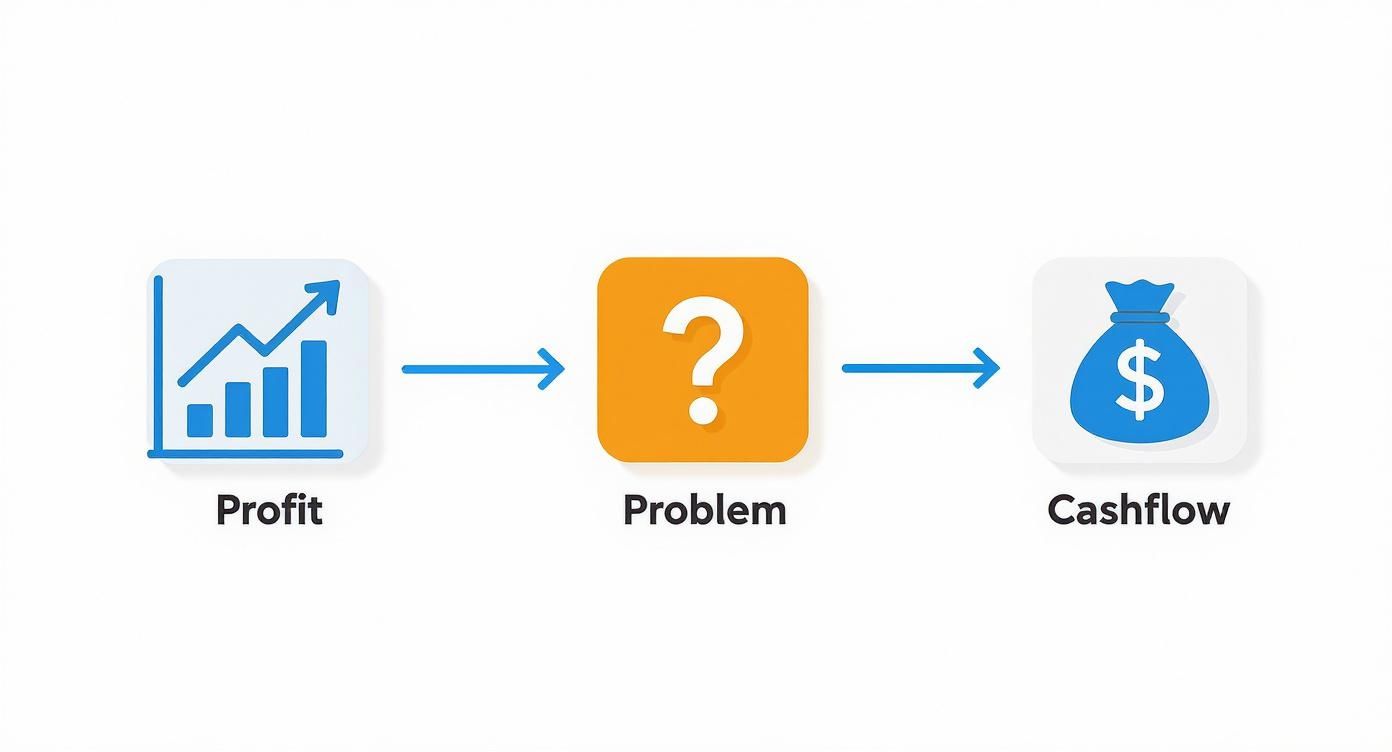
This diagram shows perfectly why profit doesn't automatically equal cash in the bank, making an accurate forecast essential.
Tools like Xero link directly to your bank accounts, pulling in real-time data that makes your forecast incredibly accurate. You can create different scenarios, track how you’re doing against your projections, and generate reports with a few clicks. This frees you up to spend less time punching in numbers and more time on actual strategic thinking. For a deeper dive, our detailed guide can walk you through creating a cash flow forecast for your small business using these powerful tools.
Speeding Up Your Accounts Receivable
Getting paid faster is one of the most direct and powerful ways to get a grip on your cashflow. When you shorten the time it takes for money to travel from your client’s bank account to yours, you immediately improve your cash position. This gives you the breathing room you need for payroll, supplier payments, and investing in growth.
This isn’t just about chasing overdue invoices; it's about building a proactive system that encourages prompt payment right from the start.
The reality for many UK businesses is pretty stark. Payment delays are a massive problem, with a staggering 90% of UK firms experiencing them – that’s quite a bit higher than France (85%) or Germany (81%). For lots of small businesses, the problem is getting worse, not better. Tackling this isn't just a 'nice to have'; it's absolutely essential for survival. You can read the full research on UK payment delays from Coface to see the full scale of the challenge.
Set Crystal-Clear Payment Terms From Day One
Vague payment terms are the enemy of getting paid on time. Make sure your terms are spelled out on every single quote, contract, and invoice, leaving zero room for doubt. Don’t just put "Net 30" and hope for the best.
Be specific and clearly outline:
- The Due Date: The exact date the payment is due.
- Accepted Payment Methods: List all the ways clients can pay you (BACS, card, Direct Debit).
- Late Payment Consequences: State clearly what interest or fees will be applied to overdue invoices. You can even reference the Late Payment of Commercial Debts Act for extra weight.
This clarity sets a professional tone from the get-go and gives you solid ground to stand on if you have to chase things up later. It's one of several ways you can improve cash flow with smarter invoicing habits.
Incentivise Early Payments and Automate Reminders
While penalties for late payments are a necessary stick, a discount for paying early can be a very effective carrot. Offering a small discount, maybe 2% off for payment within 10 days on a 30-day invoice, can be just the nudge a client needs to pay your bill first. That small hit on your margin is often a price well worth paying for having cash in the bank sooner.
Beyond discounts, a simple, automated reminder sequence works wonders without you having to lift a finger. A single reminder on the due date is rarely enough. A better, non-aggressive schedule looks something like this:
- Friendly Pre-Reminder: Sent 3-5 days before the due date.
- Due Date Reminder: Sent on the day payment is due.
- Gentle Overdue Notice: Sent 3 days after the due date.
- Firmer Follow-Up: Sent 7-10 days after the due date.
Modern accounting software like Xero makes setting up these automated email sequences incredibly simple, ensuring nothing slips through the cracks.
Real-World Example: A consulting firm we work with was constantly struggling with an average collection time of 48 days, which was putting immense pressure on their cashflow. By setting up automated invoice reminders in Xero and adding a prominent "Pay Now" button linked to Stripe on every invoice, they slashed their average collection time to just 22 days. This one change completely transformed their cash position.
Reduce Friction With Modern Payment Gateways
The easier you make it for people to pay you, the faster you’ll get paid. It's that simple. If a client has to dig out a chequebook or manually set you up as a new BACS payee, you're just adding hurdles they can put off until later.
Integrating payment gateways like Stripe or GoCardless directly into your invoicing is a game-changer. These tools let clients pay with a credit or debit card in a few clicks, right from the digital invoice. It not only speeds up payment but also cuts down on the admin for everyone.
Getting Invoices Paid: A Quick Guide
To make sure you're covering all your bases, it helps to think about your collection tactics in two stages: the proactive things you do before an invoice is due, and the reactive steps you take after it's late. Here’s a quick breakdown of some effective tactics.
| Tactic | When to Use | Potential Impact |
|---|---|---|
| Clear Payment Terms | On every quote & invoice | Sets expectations, reduces disputes, and forms a legal basis for collections. |
| Early Payment Discount | Before the due date | Motivates prompt payment, significantly improving cash-in-hand speed. |
| Automated Reminders | Before and after the due date | Prevents invoices from being forgotten and prompts action without manual effort. |
| "Pay Now" Buttons | On every digital invoice | Drastically reduces payment friction, often leading to immediate payment. |
| Follow-Up Phone Call | 7-14 days overdue | A personal touch that's harder to ignore than an email; confirms receipt of invoice. |
| Late Payment Fees | 14-30+ days overdue | A stronger deterrent that compensates you for the delay, as per your terms. |
| Formal Debt Collection | After all other attempts fail | A last resort to recover funds, though it can impact client relationships. |
Having a clear process like this in place means you and your team know exactly what to do and when, turning a stressful, chaotic task into a routine part of your business operations.
Consider Invoice Financing Strategically
Sometimes, even with the best systems, you can hit a cash gap because of a large, slow-paying client. In these situations, invoice financing can be a really useful tool. It lets you borrow against the value of your outstanding invoices, giving you access to up to 90% of the invoice value almost immediately.
This isn’t a long-term fix, but it's a great strategic option to bridge a temporary shortfall. It ensures you can meet your own commitments, like payroll, without waiting weeks or months for a client to pay. It’s a powerful way to unlock the cash that is rightfully yours but is currently locked up in your accounts receivable.
Optimising Your Outgoings and Supplier Terms
Getting paid faster is fantastic, but it’s only half the story. The other, often overlooked, piece of the puzzle is controlling your outgoings. This isn't about being cheap or squeezing suppliers until they drop you. It’s about being smart with your money and making every pound work hard for you before it leaves your account.
Most business owners are laser-focused on sales, and for good reason. But even a small, clever reduction in your costs goes straight to your bottom line and gives your cash position an immediate boost.
Renegotiate Your Supplier Payment Terms
One of the most powerful moves you can make is to align what you pay out with what you bring in. If you’re paying suppliers in 30 days but your customers are taking 60 days to pay you, you’ve created a 30-day cash gap you have to fund out of your own pocket. Closing that gap is a game-changer.
Start by looking at your biggest and most long-standing suppliers. These are the partners who know and trust you, and they'll likely be more open to a chat. Your mission is to see if you can extend your payment terms.
- Don't wait for a crisis. The best time to ask is when business is good.
- Frame it as a partnership. Explain that better terms will help you grow, which means you’ll be placing bigger, more regular orders with them down the line.
- Be specific. Don’t just ask for "better terms." Ask to move from 30 to 45 days, or 45 to 60.
We worked with a local restaurant that was feeling a serious cash crunch every month. It turned out their main food supplier demanded payment in 15 days, but their lucrative corporate bookings paid on 30-45 day terms. Once they showed the supplier their perfect payment history and explained the mismatch, they negotiated 30-day terms. That simple change completely eased their monthly cash pressure.
Conduct a Ruthless Cost Audit
It's not just about suppliers; you need to regularly audit all your overheads. These are the sneaky recurring costs that creep up over time, often without you even noticing. Think of it as a financial spring clean.
Grab your last three months of bank and credit card statements. Go through them line by line, highlighter in hand, and question everything. You're hunting for:
- Software Subscriptions: Are you actually using all those apps you signed up for? It’s amazing how many forgotten subscriptions are quietly draining your account.
- Insurance Policies: When did you last shop around for your business insurance? Loyalty rarely pays here, and a good broker can almost always find you a better deal.
- Utilities and Telecoms: Are you on the best tariff? A quick phone call or online comparison could save you hundreds.
The cumulative effect of trimming these small, recurring costs can be massive. Saving £50 here and £100 there might not feel like much, but over a year, these small adjustments can free up thousands of pounds in cash.
Embrace Strategic Consolidation
How many different places do you buy from? One for stationery, another for cleaning supplies, and a third for the coffee machine pods? Consolidating your buying with fewer suppliers gives you much more leverage.
When you become a bigger fish in their smaller pond, you’re in a far better position to ask for volume discounts, better payment terms, and even better service. It also simplifies your admin, which saves you time and money.
Of course, managing outgoings is one part of a bigger picture. Exploring strategies to improve your gross profit margin through smarter pricing and cost management will give your cashflow an even bigger boost.
Getting into a Rhythm: Your Action Plan and Key Metrics
Alright, we’ve covered the theory and tactics. Now for the most important part: turning all that good intention into consistent, real-world action. A great cashflow strategy is useless if it just sits in a document; it needs to become a habit.
This isn’t about adding hours of admin to your week. It's about building a simple, repeatable rhythm for keeping your finger on the financial pulse of your business. Think of it as creating an early-warning system that spots trouble long before it becomes a full-blown crisis.
Creating a Sustainable Cashflow Rhythm
The best way to think about this is like a fitness routine for your business finances. Consistency beats intensity every time. A few key checks done regularly will keep your company in far better shape than one frantic, painful review at the end of the year.
Your Weekly Check-In (15-20 Minutes)
This is just a quick pulse check to make sure the week ahead looks solid.
- Glance at bank balances: Where does your cash stand right now across all accounts?
- Scan overdue invoices: Who’s just tipped into the ‘overdue’ column? Send them a polite first nudge.
- Approve upcoming payments: Look at what’s due in the next 7 days. Do you have the funds ready to go?
Your Monthly Review (1-2 Hours)
Time for a slightly deeper dive to see how you performed and what’s coming next.
- Update your cashflow forecast: Drop in last month’s actuals and sharpen your projections for the next three months. This is non-negotiable.
- Analyse aged receivables: Who are your consistent slow payers? Is there a pattern emerging you need to address?
- Review monthly spending: How did your spending stack up against your budget? Any surprises or overspends that need explaining?
Your Quarterly Strategy Session (Half a Day)
This is where you zoom out and look at the bigger picture.
- Assess key performance indicators (KPIs): We’ll get to these next. Are the trends heading in the right direction?
- Review supplier terms: Based on your payment history, could you renegotiate better terms with any key suppliers?
- Model a few scenarios: Time to stress-test your forecast. What happens if that big project is delayed by a month? What if you land that new contract you’re pitching for?
What to Measure: Your Key Performance Indicators (KPIs)
To really get a handle on your cashflow, you need to track a few key numbers. These are your Key Performance Indicators (KPIs), and they tell the real story of how money moves through your business. Forget complex formulas; here’s what they actually mean.
Think of your KPIs as the vital signs of your business's financial health. Tracking them is like a doctor monitoring a patient's blood pressure and heart rate—it tells you what's really going on beneath the surface, beyond just the profit and loss statement.
The good news is that modern accounting software like Xero can calculate most of these for you. Your job is to understand what they’re telling you.
To keep things clear, here are the essential KPIs you should be watching. They give you a powerful, at-a-glance view of your cashflow health.
Cashflow Management KPI Tracking
| KPI | What It Measures | Healthy Business Target |
|---|---|---|
| Days Sales Outstanding (DSO) | The average number of days it takes for your customers to pay you. | Below your stated payment terms (e.g., < 30 days) |
| Days Payables Outstanding (DPO) | The average number of days it takes for you to pay your suppliers. | Aligned with or slightly longer than your DSO |
| Cash Conversion Cycle (CCC) | The time it takes to turn your investment in stock/services back into cash. | As short as possible; a negative number is excellent |
| Working Capital Ratio | Your ability to cover short-term debts with short-term assets. | Between 1.5 and 2.0 |
| Cash Runway | How many months you can operate before running out of money. | At least 6-12 months |
Tracking these numbers moves you from reacting to problems to proactively managing your financial position. Let’s quickly break down the most critical ones.
Days Sales Outstanding (DSO)
This simply measures the average time it takes for customers to pay your invoices.
A high DSO is a red flag—it means cash that you've earned is stuck in your customers' bank accounts, not yours. A low DSO, on the other hand, is a sign of a very healthy collections process. For instance, a DSO of 45 days means it takes you, on average, a month and a half to get paid. If you can get that down to 30, you’ve just freed up 15 days worth of cash.
Days Payables Outstanding (DPO)
This is the flip side: it measures the average time it takes you to pay your suppliers.
A high DPO means you’re holding onto your cash for longer, which can be a smart way to manage your outflows. The trick is to not push it so far that you damage relationships with key suppliers. A great goal is to get your DPO to match or slightly exceed your DSO, effectively closing the gap in your cash cycle.
The Cash Conversion Cycle (CCC)
This one brings it all together. The CCC measures the total time, in days, it takes for a pound you invest in your business (e.g., in stock or staff time) to find its way back into your bank account from a customer payment.
It’s calculated by taking your DSO, adding the time it takes to sell your inventory (if you have any), and then subtracting your DPO. The shorter this cycle, the better. It’s the ultimate metric for measuring the efficiency of your cashflow management strategies.
By building these checks and KPIs into your routine, you shift from just running your business to actively directing its financial future. This is how you stay in control and build a company that’s truly built to last.
Your Cashflow Questions Answered
When you're running a business, managing your cashflow can throw up some tricky questions. Let's tackle a few of the most common ones we hear from our clients, with some practical, no-nonsense advice.
How Often Should I Be Looking at My Cashflow Forecast?
For most SMEs, a solid monthly review is the sweet spot. It's the right rhythm to catch developing trends and potential problems before they become full-blown crises, without getting bogged down in daily minutiae. This monthly check-in is your chance to see how reality stacked up against your plan and make any necessary tweaks.
That said, your review schedule shouldn't be rigid.
If your business is in a period of rapid growth, facing big seasonal swings, or just navigating a tight spot, you need to tighten up that schedule. In those situations, a weekly review is non-negotiable. It acts as an early warning system, giving you the time you need to react to a shortfall before it cripples your operations.
Thankfully, with modern tools like Xero, these check-ins don't have to be a major chore. They can pull live data right from your bank feeds, making the process much quicker.
What's the Quickest Way to Fix a Sudden Cashflow Crisis?
When you’re hit with an unexpected cash crunch, you need to act fast and focus on what makes the biggest impact. It's about taking immediate, decisive steps to get things stable again.
Here’s an emergency action plan we've seen work time and again:
- Hit the Phones on Collections: Your first job is to chase your money. Forget sending another email reminder. Pick up the phone and personally call your largest and most overdue accounts. A real conversation is much harder to ignore.
- Look at Short-Term Funding Now: While you're chasing debt, start exploring options like invoice financing. This lets you access the cash that’s locked up in your unpaid invoices, often getting funds into your account within a few days.
- Talk to Your Suppliers: Get in touch with your key suppliers. Be open about the situation and ask if they can offer a temporary extension on your payments. Most good suppliers value the relationship and would rather help you through a tough patch than lose your business.
- Freeze All Non-Essential Spending: Put an immediate hold on any spending that isn't absolutely critical to your core operations. That means new projects, equipment upgrades, and other discretionary costs are on ice until your cash position has recovered.
Remember, these are fire-fighting tactics, not a long-term strategy. They're designed to buy you the breathing space you need to put more permanent cashflow solutions in place.
I'm Profitable, So Why Do I Have Cashflow Problems?
Ah, the classic question. This is probably the most common and frustrating situation a business owner can face, and it perfectly highlights the crucial difference between profit and cash.
Profit is simply an accounting measure on paper—your revenue minus your expenses over a certain period. Cashflow, however, is the real money moving in and out of your bank account. It's the lifeblood of your business.
You can be hugely profitable but find yourself constantly short on cash if your payment cycles are out of sync. For instance, imagine you complete a project and book a £50,000 profit. That's fantastic! But if your client is on 90-day payment terms and you have to pay your team and suppliers every 30 days, you've created a massive cash gap. This timing mismatch is exactly how a profitable business can end up in a financial bind.
Proper cashflow management is all about closing that gap.
At Stewart Accounting Services, our job is to help business owners across Central Scotland and the rest of the UK move from financial stress to financial clarity. If you're ready to build a robust cashflow strategy and win back more time, more money, and your peace of mind, our team is here to help. Find out how we can support your growth by visiting us at https://stewartaccounting.co.uk.
Recent Posts
10 Oct, 2026
09 Oct, 2026
09 Oct, 2026