

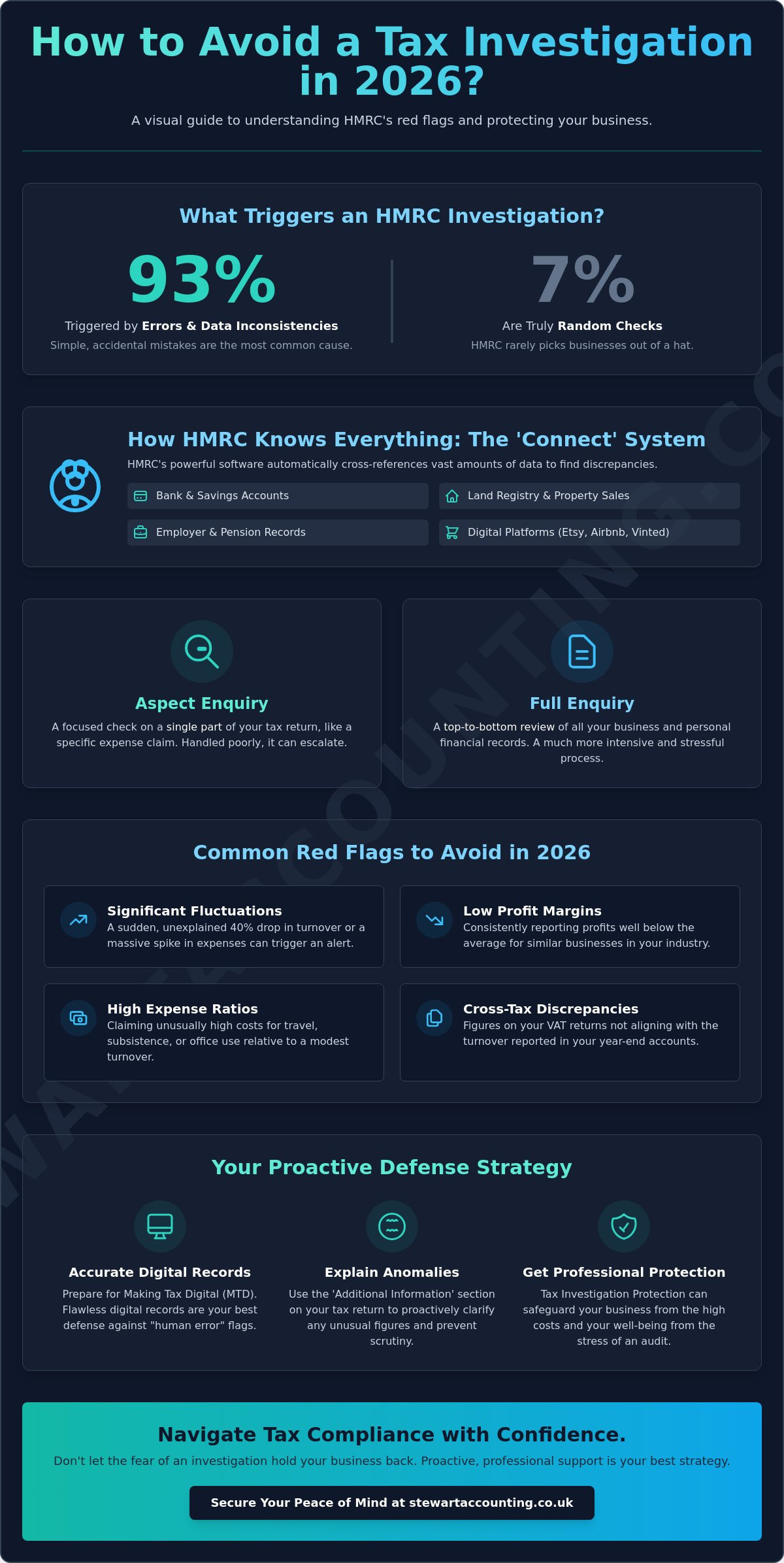
Did you know that a staggering 93% of HMRC investigations are triggered by simple errors or data inconsistencies, while only 7% are actually random? If you’re wondering how to avoid a tax investigation in 2026, you aren’t alone. Many business owners feel a deep sense of anxiety that a small, accidental mistake might be flagged as fraud, especially with the new Making Tax Digital (MTD) rules coming into force this April for those with income over £50,000. It’s natural to feel stressed about the potential costs and the complexity of keeping digital records perfectly accurate.
We understand these pressures and want to help you navigate them with confidence. This guide is designed to replace your worry with professional clarity by highlighting the specific red flags the HMRC ‘Connect’ system looks for. You’ll learn the proactive steps required to keep your business records compliant and audit-free. We’ll outline actionable ways to improve your record accuracy, giving you back your time and providing the peace of mind you deserve.
Key Takeaways
- Understand how the HMRC ‘Connect’ system works to cross-reference your data and identify potential discrepancies before they lead to an enquiry.
- Identify common financial red flags, such as significant profit fluctuations, to learn how to avoid a tax investigation through consistent and accurate reporting.
- Prepare for the April 2026 transition to Making Tax Digital for Income Tax and learn why digital record-keeping is your best defense against “human error” flags.
- Discover proactive steps for your tax return, including how to use the ‘Additional Information’ section to clarify anomalies and prevent unnecessary scrutiny.
- Explore the benefits of professional representation and Tax Investigation Protection to safeguard your business and your mental well-being from the stress of an audit.
Understanding what triggers an HMRC tax investigation
Many business owners live in fear of a random audit. However, the reality is that HMRC rarely picks names out of a hat. Approximately 93% of compliance checks are triggered by specific discrepancies or errors, with only 7% being truly random. Understanding these triggers is the first step in learning how to avoid a tax investigation. When HMRC decides to look closer at your affairs, it’s usually because their systems have spotted something that doesn’t add up.
A formal tax investigation can be a draining experience, both financially and emotionally. It often starts when HMRC’s software identifies a mismatch between the figures you’ve reported and the data they’ve collected from third parties. By staying informed about how these triggers work, you can take proactive steps to ensure your records remain beyond reproach and avoid unnecessary stress.
The HMRC Connect system: How they know everything
The backbone of HMRC’s enforcement strategy is a powerful piece of software called ‘Connect’. Connect is a multi-source data-matching engine that flags discrepancies automatically. It doesn’t just look at your tax return; it pulls information from banks, the Land Registry, employers, and even digital platforms. If you’ve sold a property or earned significant interest on savings that wasn’t declared, Connect will likely spot the omission. It even analyzes lifestyle indicators to see if your declared income matches your actual spending habits. This level of automation means that even minor inconsistencies can lead to a letter through your door.
Full Enquiry vs Aspect Enquiry: What is the difference?
Not all investigations are the same. An aspect enquiry is typically focused on one specific part of your tax return, such as a particular set of expenses or a single capital gain. It’s often a request for more information to clarify a specific point. In contrast, a full enquiry is a top-to-bottom review of all your financial records, including personal bank statements. This is a much more intensive process that looks at the heart of your business.
It’s vital to handle an aspect enquiry with care. If HMRC finds significant errors during a limited check, they have the power to escalate it into a full enquiry. This is why accuracy from the outset is so important when considering how to avoid a tax investigation. Ensuring every detail is correct prevents a small query from snowballing into a comprehensive audit of your entire business history.
The most common red flags to avoid in 2026
While the Connect system works silently in the background, the specific data points on your return act as the final trigger for an enquiry. If you want to know how to avoid a tax investigation, you must look at your business through HMRC’s eyes. They don’t just look at your numbers in isolation; they compare them against previous years and industry peers. Any anomaly that suggests under-declared income or inflated expenses will likely lead to HMRC compliance checks to verify your position.
Consistency is your best defense. HMRC looks for specific patterns that indicate potential non-compliance, including:
- Significant fluctuations: A sudden 40% drop in turnover or a massive spike in repairs and renewals without a clear business reason.
- Low margins: Consistently reporting profit margins that fall well below the average for similar businesses in Scotland.
- Expense ratios: Claiming high “travel and subsistence” or “office costs” relative to a modest turnover.
- Cross-tax discrepancies: Figures on your VAT returns that don’t align with the turnover reported in your year-end accounts.
If these patterns emerge, it’s often worth seeking professional tax planning to ensure your figures are both accurate and defensible before you submit them.
Digital platform data sharing: Vinted, Airbnb, and Etsy
The “side hustle” is no longer invisible to the taxman. Since 2024, digital selling platforms have been required to share seller data directly with HMRC. By 2026, this data matching is fully mature. If you’re earning income from Airbnb, Etsy, or Vinted, HMRC already has a digital footprint of your transactions. The flag isn’t just about failing to declare; it’s about the discrepancy between what the platform reports and what you’ve put on your Self Assessment. Reconciling these figures is essential to keep your record-keeping compliant.
Lifestyle vs Declared Income discrepancies
HMRC’s “Personal Expenditure” crackdown is a major focus for 2026. They use Land Registry data to monitor new property purchases and compare them against your declared earnings. If you’re buying a high-value home in a local area like East Kilbride or Hamilton while declaring a minimal profit, the system flags a “lifestyle mismatch.” This is particularly risky for cash-heavy businesses. HMRC uses sophisticated benchmarking to estimate what a business in your sector should be making. If your declared income doesn’t support your visible lifestyle, an investigation is almost inevitable.
How accurate record-keeping prevents unwanted scrutiny
Reliable record-keeping is more than just a statutory obligation; it’s your most effective shield. When your books are tidy and your receipts are digitised, you remove the “low-hanging fruit” that often triggers an enquiry. HMRC’s systems are designed to spot anomalies and missing data. By maintaining a clear, real-time view of your finances, you can ensure that your filings are consistent and defensible. This level of organisation is the foundation of how to avoid a tax investigation and provides the peace of mind you need to focus on running your business.
One of the simplest ways to improve clarity is to separate your business and personal bank accounts. Mixing these finances is a common mistake that creates a “human error” flag. When personal spending is intertwined with business transactions, it becomes difficult to justify expenses during what to expect from a tax compliance check. A dedicated business account provides a clean trail for every pound earned and spent, making it much easier for an accountant to verify your figures.
MTD for ITSA: The 2026 compliance landscape
From April 6, 2026, the compliance landscape shifts significantly. Self-employed individuals and landlords with a qualifying income over £50,000 must comply with Making Tax Digital (MTD) for Income Tax Self Assessment (ITSA). This transition requires you to send quarterly digital updates to HMRC instead of a single annual return. These frequent touchpoints mean HMRC identifies risks much faster than before. MTD is not just a filing change but a transparency tool for HMRC. Under this new system, a points-based penalty framework will apply, where reaching four penalty points for late quarterly submissions results in a £200 fine.
The audit trail: Why “nearly right” isn’t enough
In a digital-first tax system, “nearly right” can lead to expensive complications. HMRC expects a digital audit trail that links every transaction to a specific invoice or receipt. Using cloud accounting software like Xero allows you to capture digital receipts instantly and categorise expenses accurately. This removes the stress of the “shoebox of receipts” at the end of the year. At Stewart Accounting Services, we provide Xero training and support to help you implement these robust systems. If you’re unsure how your daily bookkeeping impacts your final submissions, our Year End Accounts guide offers a simple breakdown of the process. Establishing these habits now ensures you stay ahead of the 2026 requirements and keep your business off HMRC’s radar.
Proactive steps to take before filing your tax return
Before you hit the submit button on your tax return, a final moment of reflection can save you months of future stress. Many business owners rush the filing process just to get it off their to-do list, but this is often when simple, avoidable errors creep in. If you want to understand how to avoid a tax investigation, you must treat your submission as a formal narrative of your business year. A pragmatic “pre-flight” check involves comparing your current figures against the previous year’s data. If there are massive swings in your profit or specific expense categories, you need a clear, documented reason for them.
Filing on time is equally critical for your risk profile. HMRC views late filers with increased suspicion, and missing the 31 January 2027 deadline for the 2025/26 tax year carries an immediate £100 fixed penalty. Beyond the fine, habitual lateness suggests poor record-keeping, which can move you up the priority list for a compliance check. Ensure every income source is accounted for, including P11D benefits and interest from savings, to present a complete and honest picture of your finances.
The power of the “White Space”
The “Additional Information” box on your tax return is one of your most powerful tools, yet it’s frequently left blank. This “white space” allows you to provide context that the Connect system’s algorithms might otherwise flag as a discrepancy. If your profits dropped because of a long-term illness or a major contract loss, say so. If you made a large capital asset purchase that significantly increased your expense claims, explain it. This proactive disclosure often satisfies a human officer’s curiosity before they feel the need to open a formal enquiry. It’s a simple way to provide clarity and maintain your professional liberty.
Reconciling your VAT and Payroll data
HMRC doesn’t look at your tax return in a vacuum. Their systems automatically cross-reference your Self Assessment with your Real Time Information (RTI) payroll submissions and your VAT returns. If the turnover on your annual accounts doesn’t align with what you’ve reported for VAT throughout the year, it creates an immediate red flag. Consistency across all tax heads is vital. Our Payroll Services help ensure that your employee data and director’s salary figures match exactly what HMRC expects to see. If you’re feeling overwhelmed by these moving parts, we can help you align your records for total peace of mind. Our team at Stewart Accounting Services works to ensure that your figures are audit-ready and consistent across every platform. Get in touch today to ensure your next filing is beyond reproach.
How Stewart Accounting Services protects your business and well-being
While understanding technical triggers is a vital part of your strategy, the most effective way to manage your risk is through professional partnership. HMRC treats represented taxpayers with a different level of professional respect because they know your figures have been scrutinised by experts before submission. When you delegate your tax affairs to us, you aren’t just hiring a service; you’re securing a partner dedicated to your professional liberty. Our goal is to ensure you never have to worry about how to avoid a tax investigation because your records are robust, compliant, and defensible from the start.
We focus on a specific three-part promise to our clients: the liberation of your time, your finances, and your mental well-being. By removing the burden of complex tax calculations and digital record-keeping, we allow you to focus on what you do best. Whether you’re a small business owner or a landlord, our pragmatic approach ensures that your tax position is optimised and your stress levels are minimised. This combination of professional authority and empathetic support creates a voice that is both trustworthy and comforting.
Tax Investigation Protection: Your safety net
Even with perfect records, HMRC can still select a business for a random check. This is where our Tax Investigation Protection becomes an essential safety net. A full enquiry can last for months and result in thousands of pounds in professional fees, even if no extra tax is found to be due. This service removes that financial burden entirely by covering the costs of our time to defend you. We handle all correspondence, attend meetings, and manage the entire process with HMRC on your behalf. This complete transfer of responsibility ensures that an enquiry doesn’t drain your bank account or your energy.
The benefit of a Chartered Accountant in Central Scotland
Regional knowledge is a powerful asset when it comes to tax compliance. As a firm with deep roots in Alloa, Stirling, and Falkirk, we understand the specific challenges facing Scottish businesses. From navigating distinct Scottish tax bands to understanding local industry benchmarks, our expertise is grounded in the real-world environment where you operate. This geographically grounded perspective allows us to provide a client-centric service that a distant, corporate entity simply cannot match.
We pride ourselves on being a dependable and supportive partner for SMEs across Central Scotland. Our approach is practical, grounded, and focused on delivering tangible results for your business. If you want to secure your tax position and enjoy total peace of mind, we invite you to take the first step toward a more secure future. Contact Stewart Accounting Services for a free consultation to discuss your requirements and discover how we can protect your business from unwanted scrutiny.
Take control of your tax compliance today
Navigating the complexities of HMRC doesn’t have to be a source of constant anxiety. We’ve seen how the Connect system identifies discrepancies and why 93% of investigations are triggered by preventable errors. By adopting digital record-keeping and staying ahead of the MTD for ITSA 2026 requirements, you’re taking the most important steps toward a secure future. Learning how to avoid a tax investigation is ultimately about transparency and proactive management of your financial data.
As Chartered Accountants with offices in Alloa, Stirling, and Falkirk, we specialise in protecting local businesses from the stress of an audit. Our comprehensive Tax Investigation Protection service removes the financial burden of an enquiry, allowing you to focus on your long-term goals. We’re ready to help you implement the systems you need for total peace of mind. Secure your business with Tax Investigation Protection from Stewart Accounting. You’ve built something great; let’s work together to keep it protected and compliant.
Frequently Asked Questions
How far back can HMRC go in a tax investigation?
HMRC can go back four years for simple, innocent errors and up to six years if they believe a mistake was result of carelessness. If they suspect deliberate tax evasion or fraud, they have the legal power to investigate your records as far back as 20 years. Maintaining organised digital records is a vital part of your strategy for how to avoid a tax investigation and ensures you’re always prepared.
Does HMRC do random tax checks on small businesses?
HMRC does conduct random checks, though they represent a small minority of cases. Most enquiries are the result of specific risk indicators identified by their data-matching software. While you can’t choose to avoid a random selection, keeping your records accurate and consistent ensures that if you are selected, the process remains straightforward and is resolved without unnecessary stress or financial surprises.
What should I do if I receive an HMRC enquiry letter?
You should contact your accountant immediately before responding to the letter. It’s vital to stay calm and verify exactly what HMRC is asking for. Providing more information than requested can inadvertently widen the scope of the enquiry. We handle all correspondence for our clients, removing the burden of the investigation and ensuring that your professional interests are defended at every stage of the process.
Can HMRC check my personal bank account?
HMRC has the legal power to request personal bank statements if they have reason to believe business income is being hidden in personal accounts. This often happens during a full enquiry where they look for lifestyle mismatches or unexplained deposits. Separating your business and personal finances is a pragmatic step that reduces the risk of HMRC needing to look into your private spending habits.
How long does a typical HMRC tax investigation take?
The duration varies significantly depending on the complexity of the case and the type of enquiry. A simple aspect enquiry focusing on a single issue might be resolved within three to six months. However, a full enquiry into a business’s entire financial history can often last a year or longer. Having professional representation helps to speed up the process and ensures a smoother, more efficient resolution.
Will having an accountant prevent a tax investigation?
Having a professional accountant doesn’t technically stop a random check, but it significantly lowers the risk of being flagged for errors. HMRC’s systems are less likely to find discrepancies when your returns are prepared by qualified experts. An accountant provides the professional oversight needed to understand how to avoid a tax investigation by ensuring your filings are technically sound and fully compliant with current regulations.
What is the penalty for mistakes on a tax return?
Penalties are based on the nature of the error and whether you took “reasonable care” with your records. If a mistake was careless, the penalty can be up to 30% of the extra tax due. For deliberate errors, this can rise to 70% or even 100% if the error was intentionally concealed. Making an unprompted disclosure of an error usually results in significantly lower penalties from HMRC.
Is side hustle income from Vinted or eBay always taxed?
Not necessarily, as it depends on whether you’re “trading” or just selling personal items. You have a £1,000 tax-free Trading Allowance for side hustle income each year. If you sell goods for more than this and you’re buying items specifically to resell for profit, you must declare it. HMRC now receives automated reports from these platforms, so declaring this income correctly is essential for maintaining a clean record.