
Are you paying your accountant to be a historian who records the past, or a navigator who maps your future? If you only hear from your advisor once a year when a surprise tax bill arrives, you aren’t alone. Many local business owners feel like just another number in a large firm’s database, particularly as the April 2026 Making Tax Digital (MTD) deadline for those earning over £50,000 approaches. Learning how to get the most from my accountant starts with moving beyond basic compliance. It’s about shifting the weight of manual bookkeeping and tax anxiety onto a dependable partner who understands your specific goals.
We understand that your time is better spent on your actual work rather than wrestling with spreadsheets. This article will show you how to transform your financial data into a strategic asset that saves you money and restores your professional liberty. You’ll discover how delegating tasks like payroll, VAT, and tax planning can lower your liabilities while providing the peace of mind that your compliance is handled perfectly. We’ll explore the practical ways to bridge the gap between simple year-end accounts and expert business advisory.
Key Takeaways
- Learn why moving from a ‘historian’ accountant to a ‘navigator’ is the first step in using your financial data to map out future growth.
- Discover how to get the most from my accountant by maintaining organized bookkeeping that allows for real-time tax planning and accurate cashflow forecasting.
- Understand why replacing the annual tax marathon with scheduled quarterly check-ins ensures your professional and personal goals stay on track.
- Prepare for the 2026 Making Tax Digital (MTD) transition by leveraging cloud technology like Xero to automate manual tasks and reduce stress.
- See how delegating your financial burdens to a local expert in Central Scotland can restore your time and mental well-being.
Shifting Your Mindset: Is Your Accountant a Historian or a Navigator?
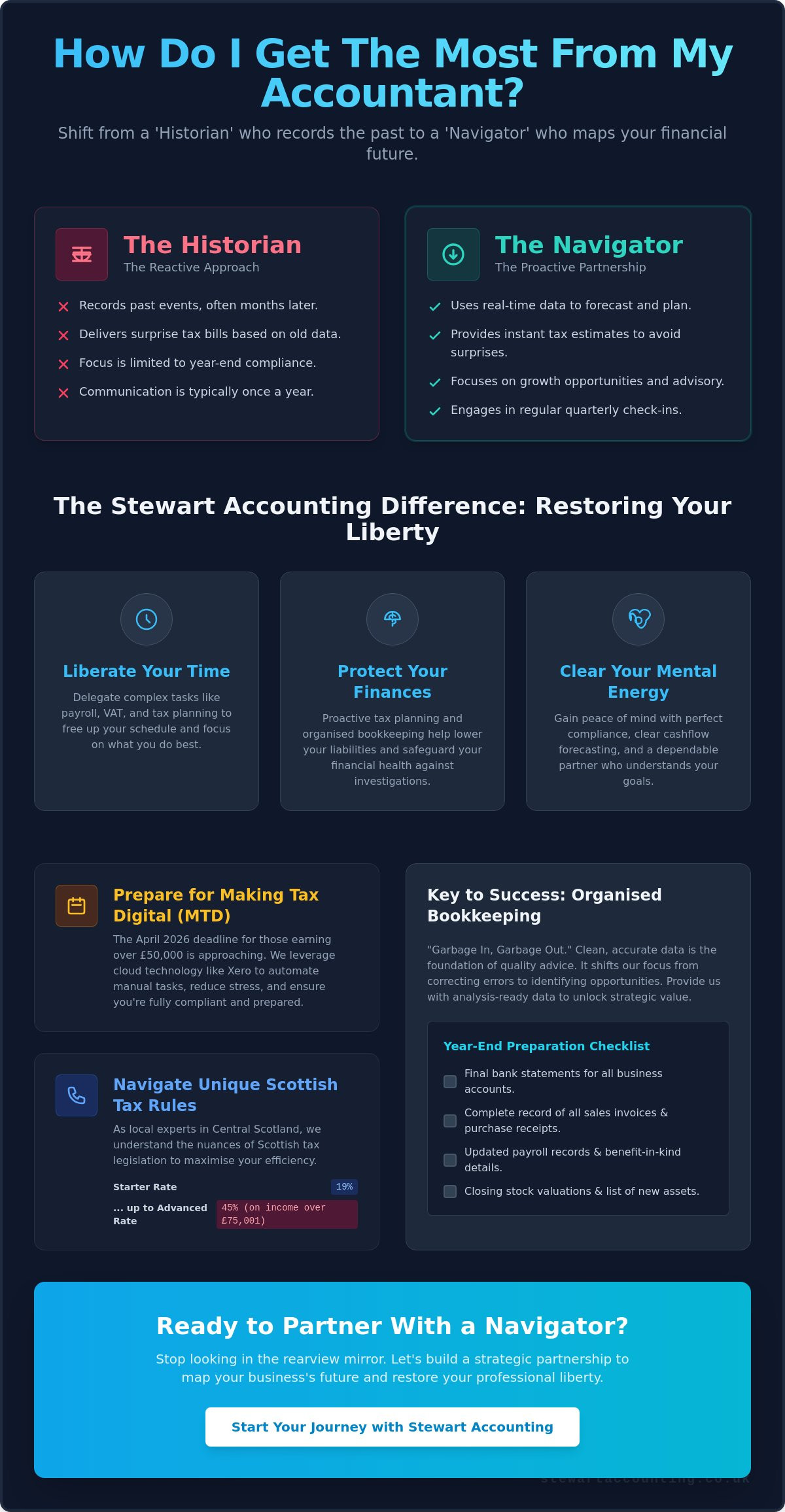
Do you view your accountant as a necessary expense or a strategic partner? Most business owners fall into the trap of hiring a “historian.” These are traditional practitioners who spend their time looking at the past. They record what happened six months ago and present you with a tax bill you didn’t expect. If you want to understand how to get the most from my accountant, you have to look for a “navigator.” A navigator uses real-time data to forecast your cash flow and identify growth opportunities before they pass you by.
Compliance is the floor of accounting service, not the ceiling. While filing a Self Assessment Tax Return is essential, it doesn’t help you scale. We focus on a Thematic Triad that prioritises your personal and professional liberty. By delegating the complex weight of financial management to Stewart Accounting Services, you liberate your time, protect your finances, and clear your mental energy. This shift allows you to stop being a data-entry clerk for your own business and start being the leader your company needs.
Moving Beyond the Annual Tax Return
Waiting until the end of the financial year to check your numbers is a recipe for stagnation. Reactive accounting often leads to missed tax-saving opportunities and cash flow bottlenecks. Proactive planning relies on regular Management Accounts. These reports provide a clear snapshot of your business health every month or quarter. When you have Organised Bookkeeping as your foundation, your accountant can spot trends and advise on investment decisions while there’s still time to act.
The Role of a Chartered Accountant in Scotland
For the 2026/27 tax year, Scottish taxpayers face a different structure than the rest of the UK. With rates ranging from the 19% starter rate to the 45% advanced rate for those earning over £75,001, your take-home pay depends on precise Tax Planning. Learning how to get the most from my accountant in this context means ensuring your advisor is navigating these specific regional rules to maximise your efficiency. This local focus ensures you aren’t just a number in a distant city firm; you’re a valued partner in our local community.
How Organised Bookkeeping Unlocks Strategic Value
Many business owners view bookkeeping as a tedious administrative chore. However, the quality of your records dictates the quality of the advice you receive. If your records are messy or incomplete, your accountant is forced to act as a high-priced data-entry clerk just to make sense of the numbers. This is the “Garbage In, Garbage Out” principle in action. When you provide clean, accurate data, you shift the focus from correcting errors to identifying opportunities. This transition is essential for anyone wondering how to get the most from my accountant to drive growth.
Clean data provides the visibility needed for instant tax estimates and proactive dividend planning. Instead of guessing how much to set aside for HMRC, you can see your exact liability in real-time. This level of clarity significantly reduces the risk of HMRC tax investigations, as consistent and accurate records are your best defence. One of the most effective ways of building a strong relationship with your accountant is to provide data that is ready for analysis rather than reconstruction. It allows us to focus on the Thematic Triad: saving you money, protecting your time, and reducing your stress.
The Year-End Preparation Checklist
Preparing for your final accounts doesn’t have to be a stressful marathon. Having the right documents ready ensures a smooth process and keeps your accounting fees from inflating due to avoidable back-and-forth communication. Before your meeting, ensure you have gathered:
- Final bank statements for all business accounts.
- A complete record of all sales invoices and purchase receipts.
- Updated payroll records and any benefit-in-kind details.
- Closing stock valuations and a list of any significant new assets purchased.
Common errors, such as missing receipts or unreconciled bank transactions, waste valuable time. For a deeper dive into this process, read our Year End Accounts: A Simple Guide for UK Small Businesses. By mastering these basics, you ensure your year-end meeting focuses on the future of your company rather than fixing the past.
Real-Time Data for Real-Time Decisions
In the 2026 business environment, relying on six-month-old data is a liability. Real-time bookkeeping allows you to make informed decisions about hiring, equipment purchases, or expansion. This accuracy is also vital when applying for funding or regional grants in Central Scotland. Lenders and grant bodies in Stirling and Falkirk require up-to-date figures to assess your viability. Furthermore, precise records ensure your VAT returns are submitted correctly and on time, avoiding the new points-based penalty system. If you find the daily recording of transactions overwhelming, delegating this task to our Bookkeeping Services can provide the professional liberty you need to focus on your actual work.
Communication Strategies for Maximum ROI
Effective communication is the bridge between a simple tax service and a high-value strategic partnership. If you are looking for how to get the most from my accountant, the answer often lies in the frequency of your conversations. Many business owners only speak to their advisor once a year during the tax season rush. This approach is reactive and often leads to missed opportunities. A quarterly check-in, however, allows you to review your figures while there is still time to influence them. It transforms a stressful annual marathon into a calm, methodical review of your progress toward your long-term goals.
Sharing your personal objectives is equally vital. Are you working toward an early retirement, preparing the business for a future sale, or simply looking to maintain a comfortable lifestyle? When we understand your “why”, we can tailor our Business Advisory and Tax Planning services to match. This alignment ensures every financial decision supports your ultimate destination, providing the professional liberty you deserve.
Involving Your Accountant in Big Decisions
You should never sign a new lease or purchase a business vehicle without a quick consultation. Major capital expenditures have significant tax implications that are difficult to fix after the fact. For example, the timing of a purchase can drastically change your tax relief for the current period. We can also help you evaluate your business structure. As your profits grow, the transition from a Sole Trader to a Limited Company through Company Formation might offer better tax efficiency and asset protection. Calling us before you commit prevents expensive mistakes and ensures you maximise every available allowance.
Transparency and Trust
Total honesty is the foundation of a successful partnership. Your accountant should be a trusted sounding board for your most difficult business challenges, not just a recipient of receipts. Whether you are facing a cash flow dip or considering a risky expansion, transparency allows us to provide pragmatic solutions. We use a problem-solution framework in every meeting to address your anxieties head-on. By being open about your income and expenses, you allow us to handle the compliance perfectly, giving you the peace of mind to focus entirely on your work. This level of trust is a core part of learning how to get the most from my accountant.
Leveraging Cloud Technology and MTD in 2026
How does a modern business owner stay ahead of shifting regulations? The answer lies in the cloud. By adopting digital tools, you allow your advisor to move from annual data entry to providing live tax advice throughout the year. This technological shift is the most practical way to understand how to get the most from my accountant. Cloud platforms like Xero provide a real-time window into your finances. This visibility allows us to spot potential tax issues or cash flow bottlenecks before they become expensive problems. It moves the relationship away from a once-a-year chore and into a continuous, supportive partnership that restores your professional liberty.
Making Tax Digital (MTD) for Income Tax 2026
From 6th April 2026, Making Tax Digital (MTD) for Income Tax Self Assessment (ITSA) becomes mandatory for self-employed individuals and landlords with a total annual gross income over £50,000. This is a significant change to the UK tax system. It replaces the traditional annual tax return with a requirement for digital record-keeping and quarterly updates to HMRC. For those earning over £30,000, the same rules will apply from 6th April 2027. By preparing for these changes now, you eliminate the “January panic” that often plagues business owners at the end of the tax year. Stewart Accounting Services helps you manage this transition smoothly. We ensure you remain compliant with the new points-based penalty system while protecting your mental well-being.
Xero Training and Support
Xero has become the preferred platform for Scottish SMEs, holding 64.55% of the UK cloud accounting market share as of April 2026. Its popularity stems from its ability to automate the heavy lifting of daily finance. Features like automated bank feeds connect directly to your business bank account, categorising transactions as they happen. When combined with receipt scanning tools like Dext, the need for paper files and manual typing disappears. You simply snap a photo of a receipt, and the data is pushed directly into your accounts.
However, software is only as good as the person using it. Professional training ensures your dashboard is customised to show the metrics that actually matter to your growth, such as real-time profit margins or aged debtors. You can automate recurring invoices and payroll, saving hours of administrative work every week. If you’re ready to digitise your business and reclaim your time, explore our Xero training and support to get started. By delegating the technical setup to experts, you gain the peace of mind that your digital records are handled perfectly.
The Stewart Accounting Services Difference: Restoring Your Liberty
Why settle for a distant corporate firm when you can have a dedicated local partner? At Stewart Accounting Services, we believe that understanding how to get the most from my accountant means finding a firm that values your personal liberty as much as your balance sheet. We apply our Thematic Triad to every client across Alloa, Stirling, and Falkirk. This approach is designed to liberate your time, protect your finances, and improve your mental well-being. By physically removing the burden of complex financial tasks from your shoulders, we allow you to return to the work you actually love.
Our regional grounding in Central Scotland provides a distinct advantage that goes beyond simply knowing the tax bands. We don’t just process numbers; we understand the local economic landscape and the specific challenges facing businesses in our community. We are committed to removing the mental weight of HMRC compliance, ensuring that you never have to lose sleep over a deadline again. When you discover how to get the most from my accountant, you stop worrying about paperwork and start focusing on your long-term legacy.
A Tailored Approach for Small Businesses
We specialise in serving the backbone of the Scottish economy: sole traders, landlords, and limited companies. Our services are not one-size-fits-all. Stewart Accounting Services structures support to scale as your business grows, ensuring you always have the right level of advice at every stage. You deserve a dedicated contact who knows your business name and your personal goals, not just your UTR number. This personal connection allows us to provide pragmatic, real-world solutions to your specific challenges. Whether you need Payroll Services for a growing team or Estate Planning to protect your family’s future, we are here to support you.
Next Steps: Your Journey to Financial Freedom
Ready to move from a historian to a navigator? Your journey begins with a free consultation to review your current accounting setup and identify areas for improvement. In your first “Navigator” session, we will look beyond the basic tax return to map out a strategy that aligns with your lifestyle and retirement goals. We will help you implement the tools and communication habits discussed in this article to ensure you are getting maximum value for your investment. Take back control of your time and finances today.
Take the Next Step Toward Professional Liberty
Transforming your relationship with your finances starts with a single decision. By moving away from once-a-year compliance and toward a proactive “Navigator” partnership, you unlock the strategic value hidden in your data. We have explored how organized bookkeeping and clear communication strategies reduce stress and lower tax liabilities. As the 2026 Making Tax Digital transition approaches, having a local partner who understands the Central Scotland landscape is more important than ever. Understanding how to get the most from my accountant is the key to reclaiming your time and growing your business with confidence.
Our team of Chartered Accountants in Alloa, Stirling, and Falkirk is ready to help you navigate these changes. We combine high-level expertise in Xero with a commitment to your long-term personal and professional goals. Whether you are a sole trader or a limited company, we remove the mental burden of HMRC compliance so you can focus on your actual work. Book a Free Consultation with our Chartered Accountants in Alloa today. Let’s work together to restore your liberty and build a more profitable future.
Frequently Asked Questions
How often should I really be talking to my accountant?
Quarterly check-ins are the gold standard for businesses looking to scale. While an annual meeting is enough for basic compliance, it doesn’t allow for the proactive adjustments needed to grow. Regular contact ensures you can refine your tax planning throughout the year. This consistent approach is a key part of how to get the most from my accountant to avoid year-end stress and surprise bills.
What is the difference between a bookkeeper and an accountant?
A bookkeeper handles the daily recording of financial transactions and bank reconciliations. An accountant takes that data to prepare year-end accounts, provide high-level business advisory, and handle complex tax planning. While bookkeeping is the essential foundation, accounting provides the strategic navigation needed to scale your business and reduce overall tax liabilities.
Will an accountant actually save me more money than they cost?
Yes, a skilled advisor usually identifies savings and efficiencies that far outweigh their service fees. By identifying tax-efficient structures and maximizing capital allowances, we help you keep more of your hard-earned profit. Beyond direct tax savings, the professional liberty you reclaim by delegating these tasks allows you to focus entirely on revenue-generating work.
How do I know if my current accountant is doing a good job?
Look for proactive communication rather than just reactive filing. A good accountant should offer advice before you ask for it and ensure you have a clear picture of your future tax liabilities. If you feel like just a number or only hear from your firm once a year, you aren’t receiving the strategic partnership required to grow a modern business.
What are the new MTD rules starting in April 2026?
From 6th April 2026, Making Tax Digital (MTD) for Income Tax becomes mandatory for the self-employed and landlords earning over £50,000. You must keep digital records and submit quarterly updates of income and expenses to HMRC using compatible software. This replaces the traditional annual self-assessment process with a more frequent, digital-first reporting system designed to reduce errors.
Can an accountant help me with business growth, or just tax?
Accountants are vital growth partners who provide services like cashflow forecasts and business plans. We help you understand your profit margins and identify which areas of your business are the most lucrative. This data-driven approach allows you to make confident, pragmatic decisions about expansion, hiring, or significant capital investments.
What specific records do I need to keep for my small business?
You must keep all records of sales, expenses, and bank statements for at least six years. This includes purchase receipts, sales invoices, payroll data, and VAT records if you are registered. Using cloud software makes this easier by allowing you to digitize these documents instantly, which is a requirement for the upcoming MTD transition.
How do I switch accountants if I’m not happy with my current one?
Switching is a simple, professional process that we manage entirely on your behalf. Once you decide to move, we contact your previous firm to request “professional clearance” and all your historical financial data. You don’t need to worry about awkward conversations; we handle the handover to ensure a smooth transition without any gaps in your compliance.