
What if the secret to sleeping better at night isn’t more sales, but a clearer map of where every penny is going? Many entrepreneurs feel a constant underlying anxiety regarding their cash flow, often mistaking a busy schedule for a profitable one. You might find yourself staring at your turnover figures and wondering why your personal bank account doesn’t reflect all that hard work. When you’re busy managing daily operations, setting financial goals for my business often slips to the bottom of the to-do list. However, without these targets, you’re essentially steering a ship without a compass.
We understand that the pressure of meeting the April 15, 2026, tax deadline or managing a 21% corporate tax rate can feel overwhelming when you lack a structured plan. It’s common to feel trapped by the data rather than empowered by it. This guide is designed to change that by providing a comprehensive roadmap to help you reclaim your time and mental well-being. We will explore how to use expert accounting strategies, from management accounts to cashflow forecasts, to transform your vision into measurable financial targets. By the end, you’ll have a clear path to improved profitability and the professional liberty you deserve.
Key Takeaways
- Understand the vital difference between a broad business vision and concrete financial objectives to create a reliable bridge to your long-term success.
- Learn why prioritizing cash flow and immediate stability in the next 12 months is a foundational step when setting financial goals for my business.
- Discover how to use your year-end accounts as a powerful diagnostic tool to identify whether your current efforts are actually improving your profit margins.
- Identify the three to five core Key Performance Indicators (KPIs) you must monitor monthly to keep your business growth on a predictable track.
- Explore how a strategic advisory partnership can help you delegate complex tasks, ultimately liberating your time, finances, and mental well-being.
What Does Setting Financial Goals Actually Mean for Your Business?
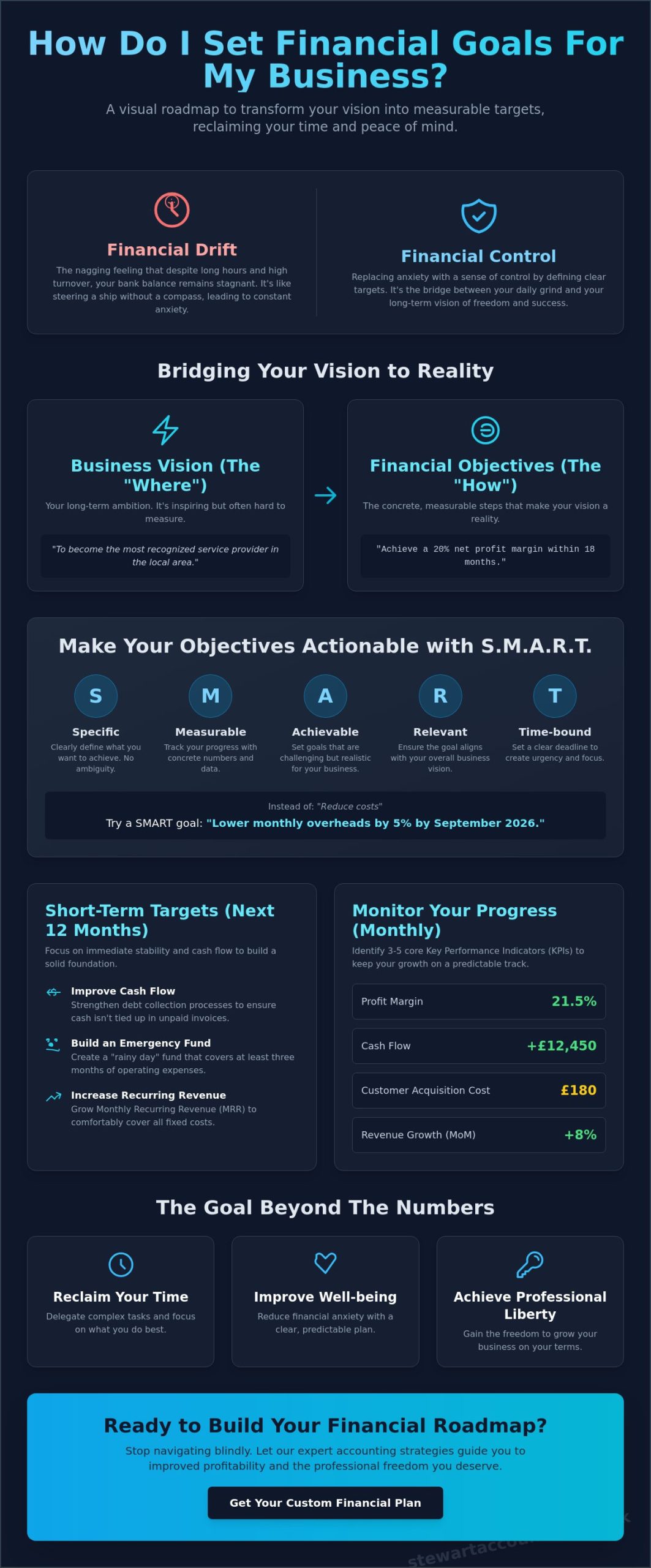
How often do you feel like you are working for your business rather than your business working for you? Many owners experience “financial drift,” which is that nagging feeling that despite long hours, the bank balance remains stagnant. Setting financial goals for my business isn’t just a spreadsheet exercise. It’s the bridge between your current daily grind and your long-term vision of freedom. By defining clear targets, you replace anxiety with a sense of control and professional liberty. This process is the first step in reclaiming your time and mental well-being.
Beyond your daily peace of mind, financial goals serve a pragmatic purpose for your company’s future. If you ever plan to apply for funding or eventually sell your company, lenders and buyers will look for a history of hitting specific milestones. Effective Financial Management demonstrates that your success is intentional rather than accidental. It significantly increases your business valuation because it proves the venture is a reliable, predictable asset. Without these targets, you are essentially steering a ship without a compass, making it nearly impossible to secure the investment you might need for expansion.
The Difference Between Business Goals and Financial Objectives
Why Scottish SMEs Need a Tailored Financial Roadmap
Small businesses in Alloa, Stirling, and Falkirk operate in a distinct economic environment. Regional costs and local competition mean a generic template won’t work for your firm. Setting financial goals for my business requires a deep understanding of these local nuances, including Scottish-specific regulations and tax implications. When your roadmap is grounded in regional reality, it becomes a practical tool for resource optimization rather than a theoretical burden. This local expertise helps you remove the weight of financial complexity from your shoulders, allowing you to focus on growth while we handle the intricate details of your accounts.
What Are the Different Types of Financial Objectives to Consider?
How do you decide which numbers to track first? When you are setting financial goals for my business, it helps to categorize them by when you want to achieve them. This structured approach prevents you from feeling overwhelmed by the “big picture” while you’re still managing daily operations. By splitting your focus between immediate stability and future growth, you can protect your mental well-being while making steady progress toward professional liberty.
To keep your objectives actionable, they should follow the SMART framework. This means every goal is Specific, Measurable, Achievable, Relevant, and Time-bound. For instance, rather than saying you want to “reduce costs,” a SMART goal would be to “lower monthly overheads by 5% by September 2026.” This level of clarity removes the guesswork. It allows you to delegate specific tasks to your team or your accountant with total confidence, physically removing those burdens from your own shoulders.
Short-Term Financial Targets for Immediate Stability
Short-term goals cover the next 12 months and focus primarily on cash flow and immediate liquidity. In an environment where the Prime Rate is 6.75% as of May 2026, managing your immediate capital is essential for survival. Your targets might include:
- Increasing Monthly Recurring Revenue (MRR) to comfortably cover all fixed costs.
- Building an emergency “rainy day” fund that covers at least three months of operating expenses.
- Improving debt collection processes to ensure your cash isn’t tied up in unpaid invoices.
Focusing on these areas reduces the anxiety of meeting your quarterly estimated tax deadlines, such as the June 15 or September 15 dates. For more on the basics of keeping your books in order, you can consult the SBA’s guide to managing finances. If your current system feels chaotic, our team can help you design a tailored financial plan that restores your personal and professional liberty.
Long-Term Vision: Scaling and Sustainability
Long-term goals look one to five years into the future. These objectives are about building a legacy and ensuring your business can thrive without your constant presence. Common long-term targets involve:
- Planning for capital expenditure, like new machinery or property, perhaps utilizing SBA 504 loans which have fixed rates around 6.5% to 7.5% in 2026.
- Reducing long-term debt to improve the overall valuation of your limited company.
- Maximizing director pension contributions to secure your personal wealth outside of the business.
Scalability often requires navigating complex tax structures, such as the 21% corporate tax rate for C corporations. By setting these targets early, you ensure your business remains a valuable asset rather than just a demanding job. This long-term planning is a core part of strategic business advisory, helping you align your company’s success with your personal lifestyle goals and mental peace.
How Can I Use Past Performance to Inform Future Growth?
Why do many business owners only look at their numbers once a year when the tax deadline looms? Your year end accounts are far more than a compliance burden; they are the ultimate diagnostic tool for your company’s health. By looking back at the previous twelve months, you can identify exactly where your resources were optimized and where they were wasted. This historical data provides the evidence you need to stop guessing and start making informed decisions that lead to professional liberty.
Analysing your profit margins is a critical part of this review process. You might discover that while your turnover has increased, your actual profit has remained flat or even declined. This usually indicates that you are working harder for less reward, which is a primary source of owner anxiety. A deep dive into Financial Literacy for Small Business Owners helps you evaluate the return on investment (ROI) of your previous spending. When you know which activities drive profit, setting financial goals for my business becomes a precise exercise rather than a hopeful wish.
We also look for seasonal trends that are specific to the Stirling and Falkirk business cycles. For example, if your data shows a consistent dip in trade every February, you can set a goal to build a cash reserve specifically for that period. This proactive approach smooths out the peaks and troughs of your cash flow, significantly reducing the stress of managing daily operations. It allows you to delegate the tracking of these trends to us, freeing up your mental energy for growth.
The Power of Management Accounts
While year-end data is vital, regular management accounts provide a real-time view of your progress. These reports allow you to compare your actual performance against your set budget every month. By spotting variances early, you can make proactive adjustments to your strategy before a small issue becomes a major crisis. This consistent monitoring ensures you stay on track toward your long-term vision without the typical end-of-year surprises.
Scottish Tax Planning as a Goal-Setting Tool
Setting financial goals for my business requires a clear understanding of the unique tax landscape in Scotland. Scottish income tax bands differ from those in the rest of the UK, which directly affects your take-home pay and director drawings. Your goals should include targets for tax efficiency and reclaiming any overpaid VAT. Additionally, we consider regional grants and funding support available in Central Scotland, which can provide a significant boost to your available capital for expansion.
What Practical Steps Should I Take to Stay on Track?
How do you ensure your new objectives don’t simply gather dust on a shelf? Moving from the theory of setting financial goals for my business to daily execution requires a methodical approach. It’s about building a system that alerts you to diversions before they become disasters. This structure allows you to maintain your focus on growth while we handle the intricate details of your financial compliance. By following a clear sequence of steps, you can transform your bookkeeping from a chore into a strategic advantage.
First, conduct a thorough audit of your current health using your latest balance sheet. This document provides a snapshot of what you own and what you owe at a specific point in time. Next, choose three to five core Key Performance Indicators (KPIs) to monitor monthly. These might include your gross profit margin, average debtor days, or current ratio. By narrowing your focus, you avoid data overload and gain clarity on what truly drives your profitability. Regular reviews are also essential for staying agile. With the Prime Rate holding at 6.75% as of May 2026, the cost of borrowing and market conditions can shift quickly. Scheduling monthly or quarterly check-ins allows you to adjust your targets in response to these external pressures.
The most effective step you can take is to delegate the heavy lifting to a Chartered Accountant. Physically removing these complex tasks from your to-do list is the fastest way to reclaim your time and mental peace. If you’re ready to move from survival mode to strategic growth, you can book a business advisory session with our team today.
Leveraging Technology for Financial Clarity
Cloud accounting software like Xero provides the real-time visibility you need to make fast decisions. Through our Xero training and support, you’ll learn how to automate your goal tracking and integrate bank feeds for instant cash flow updates. Using software to generate automated reports on your chosen KPIs means you’ll always know exactly where you stand against your budget without spending hours in a spreadsheet.
The Importance of a Realistic Budget
Building a budget that accounts for Scottish business rates and local costs in Central Scotland ensures your goals remain grounded in reality. You should differentiate between “fixed” costs, like rent, and “variable” costs, such as raw materials, to find potential savings. A business budget is a living document that guides daily spending. By treating it as a flexible tool rather than a rigid rulebook, you can navigate the 2026 economic landscape with total confidence.
How Can Professional Accounting Support Help You Reach Your Targets?
Why carry the heavy weight of financial administration alone when you could have a dedicated partner by your side? Many business owners try to manage every detail of their accounts, only to find themselves drowning in spreadsheets and complex tax requirements. This DIY approach often leads to burnout and missed opportunities for growth. By partnering with a professional, you move from a “compliance only” mindset to a strategic business advisory relationship. This shift is the most effective way of setting financial goals for my business that actually produce tangible results without sacrificing your personal life.
Setting financial goals for my business is easier when you have a partner who monitors your progress in real-time. We don’t just file your returns; we act as a sounding board for your biggest commercial decisions. This proactive support ensures that your daily actions always align with your long-term vision of professional liberty. You’ll no longer feel the anxiety of “financial drift” because you’ll have a clear, expert-backed roadmap guiding every step toward your milestones.
A Local Partner in Alloa, Stirling, and Falkirk
We are firmly grounded in the Central Scotland economy. Our offices in Alloa, Stirling, and Falkirk allow us to provide accessible, face-to-face support that a national firm simply cannot match. We understand the local market conditions and regional costs that impact your specific targets. While we value our local connections, we also combine this regional knowledge with robust remote capabilities. This allows us to serve UK-wide contractors who need a dependable, expert partner they can trust to manage their accounts with precision.
Your Next Steps Toward Financial Freedom
The transition from a stressed owner to a strategic leader begins with a single decision to let go of the administrative weight. Having a Chartered Accountant handle your HMRC and Companies House filings ensures you never have to worry about compliance deadlines or penalties again. This allows you to focus entirely on resource optimization and scaling your venture. Ready to transform your business vision into measurable targets? Contact Stewart Accounting Services for a free consultation to set your 2026 goals.
Take the Next Step Toward Your Business Vision
Transforming your business vision into a clear financial roadmap is the most effective way to eliminate uncertainty. By setting financial goals for my business, you move away from reactive management and start making proactive decisions based on real-time data. We’ve explored how your year-end accounts and regular management reports act as diagnostic tools to improve profit margins and stabilize cash flow. These steps are essential for anyone wanting to move from surviving to thriving.
As Chartered Accountants in Alloa, Stirling, and Falkirk, we’ve spent over 20 years supporting Scottish businesses. We specialize in SME growth and tax planning, helping you navigate the unique Central Scotland landscape with total confidence. Our team is dedicated to removing the administrative burden from your shoulders so you can focus on the strategic leadership your company requires.
Book your free financial goal-setting consultation with our expert team and take the first step toward a more profitable future.
You deserve a business that provides both professional success and personal liberty. We’re here to help you achieve it.
Frequently Asked Questions
What are the most important financial KPIs for a small business?
The most important KPIs include gross profit margin, net profit margin, and the current ratio. These metrics tell you how much money you keep after direct costs and whether you can meet your immediate liabilities. Monitoring these monthly prevents financial drift and ensures you aren’t just busy but actually profitable. We help you identify which specific indicators are most relevant to your sector in Central Scotland.
How often should I review my business financial goals?
You should review your KPIs monthly and your broader strategic goals every quarter. Monthly reviews allow you to catch variances early while quarterly check-ins help you adjust for larger market shifts. This consistent rhythm is essential when setting financial goals for my business. It ensures your targets remain realistic and aligned with your long-term vision of professional liberty and mental peace.
Can I set financial goals if my business is currently struggling with cash flow?
Yes, setting specific financial goals is actually most critical when cash flow is tight. In this scenario, your immediate targets should focus on improving liquidity and reducing overheads. By defining clear short-term milestones, you can reduce the anxiety of daily operations and build a rainy day fund. This structured approach helps move your business from survival mode toward a position of long-term stability.
What is the difference between a financial goal and a business budget?
A financial goal represents the destination you want to reach while a budget is the detailed map that guides your daily spending. For example, a goal might be to achieve a 25% net profit margin. Your budget then outlines the specific expenditure limits required to hit that target. Both tools are necessary to ensure your business vision remains grounded in real-world financial limits and requirements.
How do I set realistic profit margin targets for my industry?
You can set realistic targets by analyzing your past performance and comparing it to regional industry averages. We look at your year-end accounts to see where your current margins sit and identify areas for resource optimization. Factors like local business rates in Stirling or Falkirk will impact these figures. A tailored approach ensures your profit targets are ambitious yet achievable for your specific location and market.
Should I change my financial goals if the economy changes?
You must be prepared to adjust your goals when external factors like interest rates or tax laws shift. For instance, with the Prime Rate at 6.75% in May 2026, your cost of borrowing might impact your expansion targets. Flexibility is a strength, not a failure. We provide the external perspective needed to challenge your assumptions and pivot your strategy when the economic landscape changes unexpectedly.
How does a Chartered Accountant help with goal setting compared to a bookkeeper?
A bookkeeper focuses on accurately recording your daily transactions while a Chartered Accountant provides the high-level analysis needed for strategic goal setting. While bookkeeping is the foundation, our business advisory services use that data to drive growth and tax efficiency. We don’t just tell you what happened; we help you decide what should happen next to restore your personal and professional liberty through expert guidance.
Is it better to focus on turnover or profit when setting goals?
It is almost always better to focus on profit rather than turnover when setting long-term goals. High turnover can often mask underlying inefficiencies and a lack of actual cash in the bank. Profit is what allows you to reinvest in growth, pay yourself properly, and build a sustainable legacy. Prioritizing net profit ensures you are building a valuable asset rather than just a demanding and stressful job.