

First things first, let's figure out if you actually need to register for CIS. It all boils down to your role on a project: are you the one paying subcontractors, or are you the one getting paid for the work? Getting this right from the start is absolutely crucial.
Do You Need to Register for CIS?

The Construction Industry Scheme (CIS) is a big deal in our industry, impacting an estimated 1.2 million of us across the UK. Whether you’re a contractor or a subcontractor, getting to grips with the registration rules is essential for staying on the right side of HMRC.
If you're a contractor paying others for construction work, you must register with HMRC before you pay them a single penny. The good news is that registration is free and typically takes about 10 working days to process through the Government Gateway.
Registration for Contractors
For contractors, CIS registration isn't a choice—it's a legal obligation. HMRC considers you a contractor if your business pays others to do construction work. This obviously covers property developers and building firms, but it can also catch other businesses that aren't primarily in construction if their annual spending on this type of work tops £3 million.
Don't skip this. Failing to register can lead to immediate and hefty penalties from HMRC. Once you’re set up, your main responsibilities are:
- Verifying every single subcontractor with HMRC before you pay them.
- Deducting the right amount of tax from their payments (20% for registered subs, a painful 30% for unregistered ones).
- Filing monthly CIS returns that detail all payments you've made.
Managing these duties effectively is much easier with a solid contractor management system in place.
Registration for Subcontractors
Now, if you’re a subcontractor, the situation is a bit different. You aren't legally forced to register for CIS, but honestly, choosing not to is a major financial mistake. Any unregistered subcontractor gets hit with a high 30% tax deduction from their payments.
Registering as a subcontractor is a smart business move. It instantly drops the tax deducted from your pay from 30% down to a much more manageable 20%. That’s a huge boost to your cash flow.
By registering, you keep more of your hard-earned money with every payment you receive. It also shows contractors you're a professional, compliant business, which can make you a more appealing choice for future jobs. It’s a simple step with a direct, positive impact on your bottom line. If you're still fuzzy on what work qualifies, our guide on the definition of a building sub-contractor can clear things up.
The roles of contractor and subcontractor might seem similar, but their CIS registration duties are worlds apart. Here’s a quick breakdown to help you see the key differences at a glance.
Contractor vs Subcontractor CIS Registration At a Glance
| Aspect | Contractor | Subcontractor |
|---|---|---|
| Is Registration Mandatory? | Yes, it is a legal requirement. You must register before paying any subcontractors. | No, it is optional. However, not registering results in higher tax deductions. |
| Primary Responsibility | Verify subs, deduct the correct tax, and file monthly CIS returns with HMRC. | Provide correct details to the contractor to ensure the right tax rate is applied. |
| Tax Deduction Rate | N/A (You are the one making the deductions from others' payments). | 20% if registered. 30% if unregistered. 0% if you hold Gross Payment Status. |
| Key Benefit of Registration | Ensures legal compliance and avoids significant penalties from HMRC. | Improves cash flow by reducing the tax deduction rate from 30% to 20%. |
As you can see, while both parties are involved in the CIS process, their obligations and the direct financial impact of registration are quite distinct. Understanding your specific role is the first step to getting it right.
Get Your Ducks in a Row Before You Start
Before you even head over to the HMRC website or pick up the phone, a bit of prep work will save you a world of hassle. Honestly, the single biggest reason CIS registrations go wrong or take forever is not having the right details to hand from the get-go.
Think of it like prepping a job on-site. You wouldn’t start cutting timber without your tape measure, and you shouldn't start this process without your key information lined up. It’s the difference between a ten-minute job and one that gets dragged out, causing delays and frustration.
The Essentials for Everyone
No matter how you’re set up – sole trader, partnership, or limited company – HMRC needs to know exactly who you are and a bit about your business. The good news is the core information they ask for is pretty much the same for everyone.
Here’s a quick checklist of what you'll absolutely need:
- Unique Taxpayer Reference (UTR): Your 10-digit UTR is the main identifier HMRC uses for your tax affairs. You can't register without it.
- National Insurance (NI) Number: Another non-negotiable piece of personal identification for anyone working in the UK.
- VAT Registration Number: If you're VAT registered, have this ready. It's a required field if it applies to you.
- Legal Business Name: This needs to be the exact name HMRC has on file for you or your business, not necessarily your trading name.
- Business Address: Your official registered address.
One of the most common trip-ups we see is a mismatch in names. For instance, your company might be officially registered as "Robert Jones & Sons Building Ltd," but you trade as "Jones Builders." You must use the official name during registration. HMRC's systems are incredibly specific and will flag any inconsistencies.
Key Takeaway: Having this information correct and ready is crucial. It’s what makes registration a quick, painless task rather than a drawn-out process that could hold up your payments for days.
Extra Bits for Limited Companies
If you’re running a limited company, you’ve got a couple of extra details to provide on top of the basics we just covered.
You’ll need your Company Registration Number (CRN). This is the unique code given to you by Companies House when you first incorporated.
Crucially, you'll also need the company's own UTR, which is separate from the personal UTRs of the directors. Make sure you use the one assigned to the business entity itself. This is vital for making sure your CIS account is correctly linked to your company’s corporation tax records.
Navigating the HMRC Registration Process
Right, you’ve gathered your documents, and now it’s time for the main event: getting registered with HMRC. This is the crucial step where you officially declare you’re working under the Construction Industry Scheme. The good news? You’ve got options.
Whether you're a subcontractor who prefers to get things done quickly online or a busy contractor who’d rather an expert handle it, there's a registration method that will suit you down to the ground. Let's break down the main ways to get it sorted.
Getting Registered Online with the Government Gateway
By far the quickest and most popular route is registering online using the Government Gateway. This is HMRC’s secure hub for all things tax. If you're not already set up with an account for Self Assessment or Corporation Tax, you'll need to create one first. It doesn't take long.
Once you’re logged in, find your way to the CIS section. The online form is pretty clear, but double-check every detail you enter. You’ll be asked to provide:
- Your trading status (sole trader, partnership, or limited company).
- Your personal and business details (UTR, National Insurance number, business name, and address).
- Whether you're registering as a contractor, subcontractor, or both.
Here’s a common trip-up: many people don't realise you can register for both roles at once. If you hire subcontractors yourself and do work for other contractors, just tick both boxes. It’ll save you a headache and the hassle of amending your registration down the line.
This visual sums up the key bits of information you'll need to have ready, whichever way you decide to register.
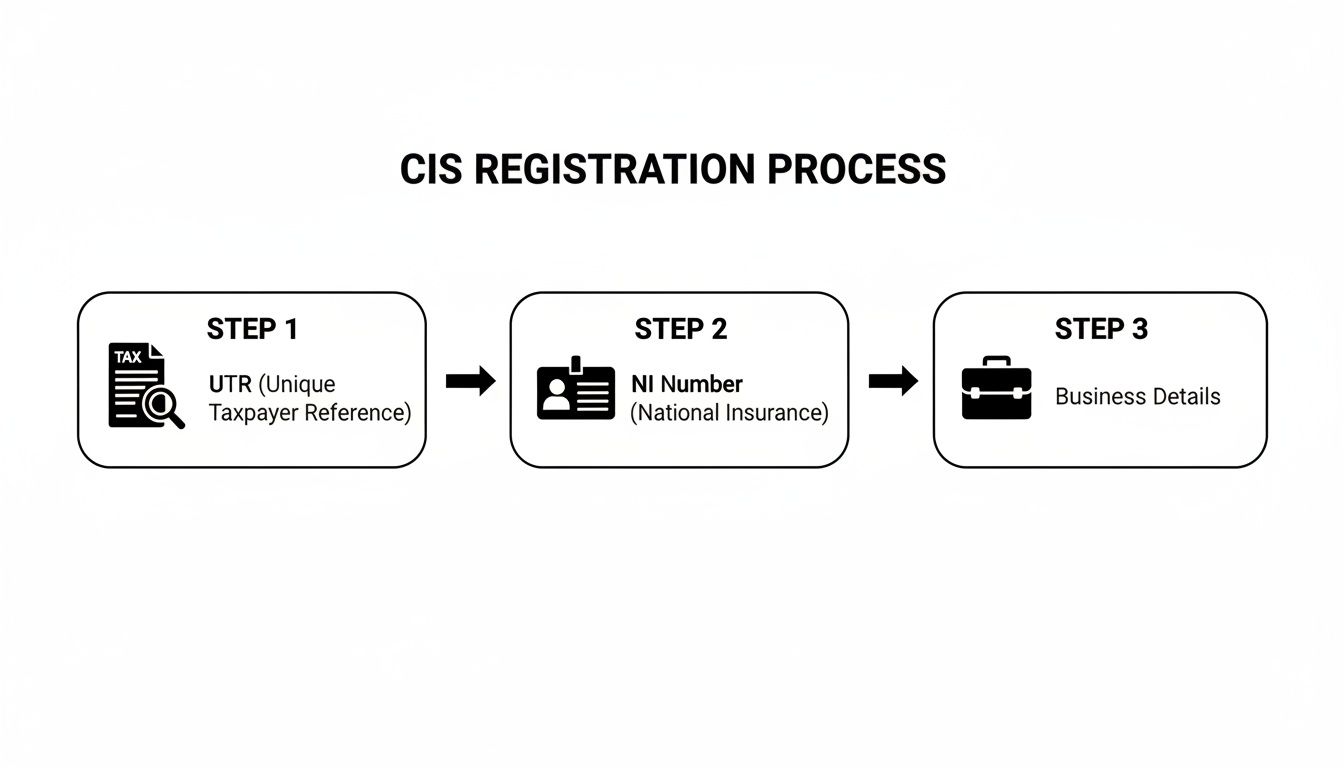
Essentially, it all boils down to your Unique Taxpayer Reference (UTR), National Insurance number, and your business details. Get these right, and you're well on your way.
Registering Over the Phone or Through Your Accountant
If wrestling with websites isn't your thing or you hit a technical snag, you can always just call the dedicated CIS helpline. An advisor from HMRC will talk you through the same questions as the online form and fill it all in for you.
Expert Tip: Before you pick up the phone, have every single piece of required information written down and in front of you. Trust me, it makes the call much quicker and dramatically cuts down the risk of making a mistake.
Another very common option, especially for busy tradespeople, is to let an accountant or tax agent handle the whole thing. This is usually the most straightforward and stress-free way to go. A professional who knows the system inside-out, like our team here at Stewart Accounting Services, can manage the entire registration. We make sure every detail is spot on and deal with HMRC on your behalf, giving you peace of mind that it’s been done properly from the start.
For a more detailed look at how the scheme works once you're up and running, check out our comprehensive guide to the Construction Industry Scheme.
No matter which path you choose, the core information needed is the same. The trick is to pick the method that you're most comfortable with to ensure your registration is completed accurately, setting you up for smooth sailing with CIS.
So, You're Registered for CIS. What Happens Now?
Getting your CIS registration sorted is a massive tick in the box, but it’s really just the beginning. Think of it less like crossing the finish line and more like getting the keys to the van. Now the real work of staying compliant starts, whether you're a contractor, a subcontractor, or wearing both hats.
If you’re a subcontractor, the good news hits your bank account almost immediately. Your deduction rate plummets from a hefty 30% down to a much more palatable 20%. That’s a straight-up, instant improvement to your cash flow on every single invoice.
For contractors, though, registration is when your main responsibilities kick in. Top of the list? You absolutely must verify every subcontractor with HMRC before you pay them for the first time. This isn’t optional; it’s a cornerstone of the whole scheme.
The Contractor's Duty: Always Verify
Verification is simply the official process of checking a subcontractor’s status with HMRC to find out which tax rate to apply. You can't just take their word for it or rely on a UTR number they give you. You need to use HMRC's online service or a compatible payroll software to get the official confirmation.
When you do, HMRC will give you one of three answers:
- Gross Payment Status: This means you pay them in full, deducting 0% for CIS tax.
- Standard Rate: They’re registered, so you need to deduct tax at 20%.
- Higher Rate: They are not registered. You must deduct tax at the higher rate of 30%.
Making a mistake here can be costly. If you get it wrong, HMRC will hold you, the contractor, liable for any tax that should have been deducted. Let's say you pay someone at 20% when they should have been on 30% – you're on the hook for that missing 10%.
My Two Cents: Never assume, always verify. The buck stops with the contractor when it comes to applying the right deduction rate. It's the single most important habit to get into to avoid nasty surprises and penalties from HMRC.
Why the Deduction Rates Matter So Much
That gap between 20% and 30% is huge, and it has a real-world impact on cash flow for everyone involved. It’s the main reason subcontractors ask "how do I register for CIS?"—it's a direct financial incentive. For contractors, it's a critical compliance task.
And HMRC is processing these applications efficiently. Recent figures show they handled 31,201 new registrations in a single quarter, hitting their 15-day target every time. The path to getting on that lower rate is well-trodden. You can see more details in the latest Construction Forum minutes.
Once a subbie is verified and paid, your job isn't done. You also have to issue a monthly payment and deduction statement to every subcontractor you've paid within the CIS scheme. This paperwork is essential for their own tax returns, so getting it right and sending it out on time is non-negotiable. Juggling these monthly returns and verifications is simply part of life as a CIS contractor.
Qualifying for Gross Payment Status
For subcontractors, getting paid without the standard 20% CIS deduction is a massive win for cash flow. This is what Gross Payment Status (GPS) is all about—it allows contractors to pay you in full, with zero tax held back. Think of it as reaching the premier league of the CIS scheme.
But getting there isn't automatic. You have to apply and prove to HMRC that your business ticks all the right boxes. They have a strict set of criteria, and passing their assessment can genuinely transform your ability to manage day-to-day costs and fuel your business's growth.
The Three Key Tests for Gross Payment
To get the green light for GPS, your business has to pass three specific tests: the business test, the turnover test, and the compliance test. You need to clear all three hurdles, so it’s essential to know what HMRC is looking for before you even start the application.
-
The Business Test: First, HMRC needs to see that you're a legitimate construction business operating mainly in the UK. A crucial piece of evidence here is having a dedicated business bank account. They want proof that your construction income is handled professionally, not just bundled in with personal funds.
-
The Turnover Test: This one is all about the numbers. Your business needs to demonstrate that your income from construction work has hit a minimum threshold over the past 12 months. This figure is based on your labour-only turnover, so you exclude VAT and the cost of materials.
-
The Compliance Test: This is often the trickiest part. HMRC will take a close look at your tax history. They need to see a spotless record of filing returns and paying your tax on time, covering everything from Self Assessment and Corporation Tax to PAYE and VAT.
Expert Tip: The compliance test is where most applications come unstuck. A single late return or an overdue tax bill can be all it takes for HMRC to reject your application. They are looking for total consistency and reliability.
Understanding the Turnover Thresholds
The turnover test isn't one-size-fits-all; the target you need to hit depends on how your business is structured. Remember, these figures are your net construction turnover—the income for your labour after subtracting material costs.
Here are the specific thresholds:
- £30,000 for a sole trader.
- £30,000 for each partner in a partnership, or at least £100,000 for the partnership as a whole.
- £30,000 for each director in a limited company, or at least £100,000 for the company itself.
Passing these tests is a major milestone. If you want to dive deeper into the requirements, our guide on the specific criteria for qualifying for gross payment status breaks it all down. Achieving GPS is a clear sign that your business is not only well-established but also trusted by HMRC.
When Should You Get Professional Help with CIS?
Let's be honest, managing CIS registration and all the ongoing compliance that comes with it can feel like a full-time job. Between verifying subcontractors, calculating the right deductions, and filing those monthly returns, it’s a huge administrative headache that pulls you away from what you actually do: running your construction business.
This is often the point where bringing in a specialist firm like Stewart Accounting Services makes perfect sense. Think of it as a strategic decision to get that time back. We can step in and manage the whole process, making sure it’s done right from day one.
Free Up Your Time and Cut Down on Stress
Handing over these fiddly tasks can feel like a massive weight has been lifted. You can stop worrying about HMRC deadlines and the ever-changing rules and get back to focusing on your projects and bringing in new clients.
Here’s what we typically handle for our clients:
- Your initial CIS registration, whether you’re a contractor or a subcontractor.
- Verifying every single one of your subcontractors with HMRC to apply the correct deduction rate.
- Processing your monthly CIS returns accurately and, crucially, on time.
- Issuing clear payment and deduction statements to all your subcontractors.
Letting a professional manage your CIS isn't just about saving time; it's about gaining peace of mind. You can be confident that you are fully compliant, avoiding the risk of costly penalties for errors or late submissions.
As the UK construction sector continues to expand, you can bet that HMRC's focus on compliance is only getting sharper, especially when it comes to employment status. Stricter enforcement is definitely on the cards, which makes having an expert in your corner more important than ever. If you're planning to grow your business, solid CIS management isn't a 'nice-to-have'—it's essential.
You can learn more about what's coming down the line by reading up on future CIS compliance rules and what they mean for your business.
Your CIS Registration Questions, Answered
Even with the best guide, there are always a few lingering questions when it's time to actually register for CIS. I've pulled together some of the most common ones I hear from clients to give you the clear, straightforward answers you need.
How Long Does CIS Registration Take?
Applying online through your Government Gateway account is hands down the fastest way to get it done. HMRC officially says to allow up to 15 working days, but in my experience, it's often much quicker than that when you go the online route.
If you decide to register by post, be prepared to wait a lot longer. The real trick is to get registered well before you need to make that first payment to a subcontractor. Don't leave it to the last minute and risk getting caught out.
What Happens If a Contractor Fails to Register?
Ignoring your duty to register as a contractor is a serious misstep, and HMRC doesn't take it lightly. You're opening yourself up to some hefty penalties, including fines for every monthly return you should have filed but didn't.
It gets worse. You could be held personally liable for all the tax that should have been deducted from your subcontractors' pay. That's a massive financial risk and a compliance nightmare you really want to sidestep.
Can I Register If My Business Isn’t UK-Based?
Absolutely. The scheme is about where the work happens, not where your head office is. If your company is based overseas but you're carrying out construction work in the UK, CIS rules apply to you.
You'll need to register with HMRC just like any UK business. You might have to supply different ID documents, but the fundamental obligations—verifying subcontractors and deducting tax—are exactly the same.
Trying to get your head around CIS registration and staying on top of the rules can be a real drain on your time. Stewart Accounting Services can take the entire process off your plate, making sure you're set up correctly from day one and stay compliant. It frees you up to focus on running your business. Find out how we can help at https://stewartaccounting.co.uk.