

How do you create an effective succession plan for a family business?

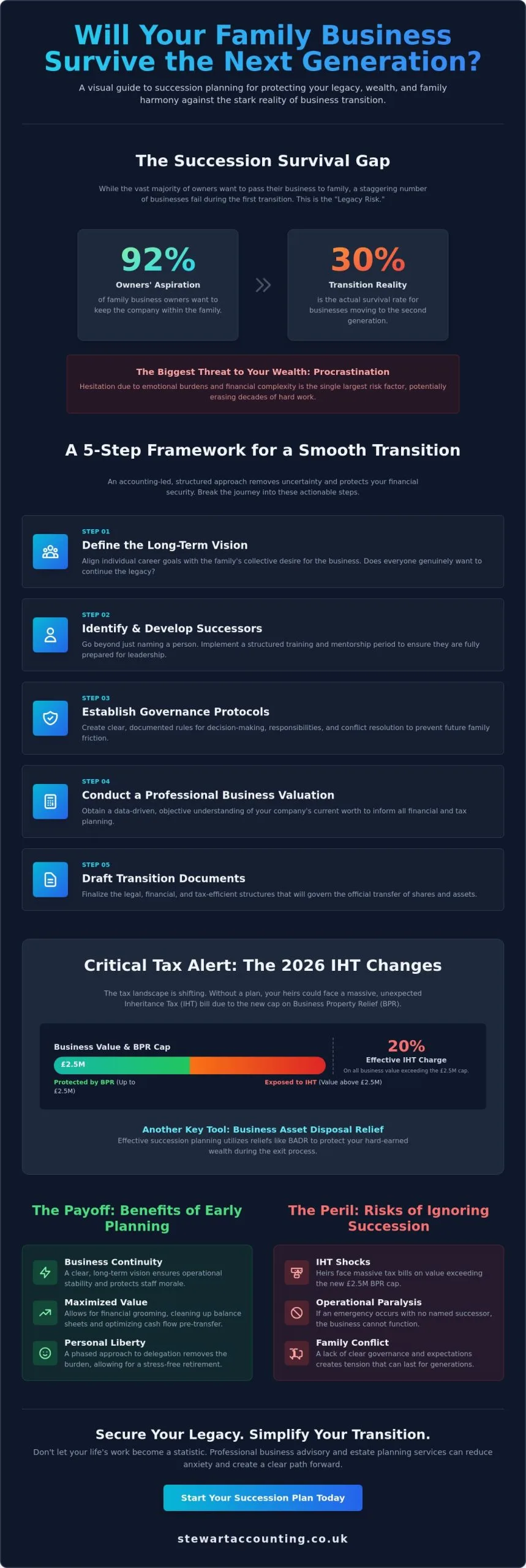
Did you know that while 92% of family business owners want to keep their company in the family, only 30% actually survive the transition to the second generation? This stark reality often stems from a lack of proactive succession planning for family business leaders who are understandably focused on daily operations. It’s difficult to think about stepping away from something you’ve built with your own hands, especially when the process feels clouded by the threat of family disputes or complex tax changes.
We understand that your primary goal is to protect your legacy and ensure your loved ones are provided for. It’s normal to feel anxious about the 2026 changes to Inheritance Tax, including the £2.5 million cap on Business Property Relief. This guide provides a comprehensive roadmap to help you transition leadership smoothly while shielding your wealth from unnecessary burdens. We’ll walk you through identifying a clear successor, utilizing effective tax planning to minimize your liabilities, and establishing a solid financial plan for your retirement. By the end of this article, you’ll have a clear path forward to secure both your family’s harmony and your business’s future.
Key Takeaways
- Learn how to define a long-term family vision and identify the right successor to ensure your firm’s operational future.
- Compare the benefits of keeping the business in the family against alternative exit strategies like a Management Buy-Out.
- Discover how effective succession planning for family business owners utilizes Business Asset Disposal Relief to protect your hard-earned wealth.
- Understand the role of objective company valuations and tax-efficient structures in creating a smooth transition of shares and assets.
- See how dedicated business advisory and estate planning services can reduce your anxiety and restore your personal liberty during retirement.
Why is succession planning essential for family-run firms in Central Scotland?
At its core, Succession planning is the strategic process of transferring leadership and ownership from one generation to the next. It’s much more than a simple retirement exit. It’s a deliberate method of de-risking your firm’s operational future. In communities across Stirling and Falkirk, family businesses are the lifeblood of the local economy. These enterprises contribute to the 4.8 million family firms that employ nearly 14 million people across the UK. Despite this impact, many owners feel a deep sense of anxiety when considering the future. This hesitation often leads to what we call the “Legacy Risk.”
Statistics reveal that only 30% of family businesses survive the transition to a second generation. This means a significant 70% fail to navigate that first leadership change successfully. While market shifts play a role, the primary threat is often internal. The emotional burden of choosing a successor, combined with the financial complexity of current tax laws, can lead to total procrastination. Procrastination is the single biggest threat to your wealth. Without a clear roadmap, the legacy you’ve spent decades building can vanish in a matter of months.
The benefits of starting your plan early
Beginning your journey early ensures business continuity and protects staff morale. When your team sees a stable, long-term vision, they feel secure in their roles. Early succession planning for family business owners also allows for long-term financial grooming. This process maximizes the value of your company by cleaning up balance sheets and optimizing cash flow well before a transfer occurs. It also supports your mental well-being. By using a phased approach to delegation, you can slowly transfer responsibilities. This removes the heavy lifting from your shoulders and restores your personal liberty, allowing for a stress-free transition into your next chapter.
Common risks of ignoring succession
Ignoring your exit strategy invites significant financial danger. The tax landscape changed dramatically in April 2026, and many owners haven’t yet adjusted. Without a plan, your heirs could face massive Inheritance Tax (IHT) shocks. The new £2.5 million cap on Business Property Relief means that any value exceeding this limit now faces an effective 20% IHT charge. Beyond taxes, a lack of succession planning for family business leads to operational paralysis. If an emergency occurs and there’s no named successor, the business can’t function. This vacuum often triggers family conflict, as a lack of clear governance and expectations creates tension that can last for generations.
What are the core steps in building a robust succession framework?
Creating a transition plan isn’t a one-off event. It’s a methodical, accounting-led process designed to remove the burden of uncertainty from your shoulders. While many corporate firms focus solely on board structures, we know that for SMEs in Central Scotland, the process often starts around the kitchen table. A robust framework ensures that your personal and professional liberty remains intact throughout the change. This structured approach breaks down a complex, emotional journey into simple, actionable points.
- Define the long-term vision: Begin by aligning individual career goals with the family’s collective desires. Does everyone actually want to stay in the business?
- Identify and develop successors: This involves more than just naming a person. It requires a structured training period to ensure they’re ready for the responsibility.
- Establish governance protocols: You need clear rules for how decisions are made to prevent future friction.
- Conduct a professional business valuation: You can’t plan for the future without a data-driven understanding of what the company is worth today.
- Draft transition documents: Finalise the financial and tax-efficient structures that will govern the actual transfer of assets.
By focusing on tangible results rather than vague promises, you can protect your financial security for retirement. If you feel overwhelmed by the technicalities, our team can help you through professional business advisory services tailored to your specific needs.
Identifying the right successor
How do you choose who leads next? It’s vital to evaluate potential candidates based on merit rather than birthright. This ensures the company remains competitive. Sometimes, the best path involves non-family management taking the lead while the family retains ownership. If there’s no clear internal successor, we can help you explore external exit strategies, such as a Management Buy-Out (MBO), to secure the firm’s future. Successful succession planning for family business owners often involves grooming talent years before the planned exit.
Establishing family governance
Managing expectations is the key to avoiding disputes. A “Family Constitution” serves as a guiding document to resolve conflicts before they escalate. It’s helpful to set up regular board meetings to separate business life from family life. Using an independent perspective, like your accountant, provides an objective voice during difficult conversations. This professional oversight helps keep the focus on succession planning for family business goals rather than personal grievances. It provides a calm, measured rhythm to the transition process.
Should you choose a family successor or an external exit strategy?
Deciding how to step away from your business is one of the most significant choices you’ll ever make. It’s not just a financial transaction; it’s an emotional one. While many owners in Stirling and Falkirk dream of passing the torch to their children, it isn’t always the most pragmatic path for the firm’s survival. Effective succession planning for family business owners requires a cold, hard look at whether the next generation is both willing and able to lead. Sometimes, the most supportive thing you can do for your family is to choose an exit route that secures the company’s future without placing an unwanted burden on your heirs.
The Family Handover: Pros and Cons
Keeping the business “in the family” allows you to preserve your core values and long-term legacy. It provides a sense of continuity that local customers and suppliers appreciate. However, this route carries specific risks. You might face an “entitlement culture” where family members expect roles they haven’t earned. Handling siblings who aren’t active in the business is another common hurdle. If one child inherits shares while the other runs the company, it can lead to friction that spills over into personal life. Professional mediation and clear governance are essential to keep these dynamics healthy.
From a financial perspective, intergenerational transfers were historically the default choice due to unlimited tax reliefs. Since the April 2026 changes, the £2.5 million cap on Business Property Relief means you must be much more strategic. If your business is valued above this threshold, a family transfer could trigger a 20% effective tax charge on the excess. This makes early succession planning for family business even more critical. You don’t want to leave your children with a massive tax bill that forces them to sell assets just to keep the doors open.
External Exit Options for Scottish SMEs
If a family handover isn’t viable, an external exit might be the best way to secure your financial security. A Management Buy-Out (MBO) is a popular alternative for SMEs. It allows you to reward loyal staff who already understand the business operations. This often results in a faster, smoother transition than selling to a complete stranger. It also ensures the business stays rooted in the local community.
We’re also seeing a significant rise in Employee Ownership Trusts (EOTs) across Scotland. This model involves selling a majority stake to a trust for the collective benefit of your employees. It’s a tax-efficient route that can preserve the local identity of your firm while providing you with a fair market value. Finally, a clean break via a third-party sale might be the right move if you want to maximize your net proceeds and walk away entirely. We can help you compare the net proceeds after tax for each exit route, ensuring your choice restores your personal liberty and funds the retirement you’ve worked so hard for.
How do tax and financial planning impact your succession outcome?
Tax planning isn’t just about ticking boxes for HMRC; it’s about ensuring your hard-earned wealth actually reaches the people you love. For many business owners in Stirling and Falkirk, the complexity of UK tax laws is a significant source of anxiety. However, a structured approach to succession planning for family business owners can turn these challenges into a clear path forward. By understanding the reliefs available, you can minimize the financial burden on the next generation and protect the lifestyle you’ve planned for your retirement.
Navigating UK Tax Reliefs
Business Asset Disposal Relief (BADR) remains a vital tool for those selling or transferring their business. From April 2026, gains that qualify for this relief are taxed at 18%. To benefit, you must meet specific conditions, such as owning at least 5% of the shares and being an employee or officer for at least two years. Staging your exit can also help you utilize your Capital Gains Tax (CGT) annual exempt amount, which is £3,000 for the 2026-2027 tax year. Your year end accounts provide the essential financial baseline that informs your company’s valuation and tax strategy. If you’re concerned about these liabilities, our tax planning experts can help you design a customized strategy that maximizes your net proceeds.
Protecting the Family Wealth
Inheritance Tax (IHT) is often the biggest worry for family firms. The landscape shifted significantly in April 2026 with the introduction of a £2.5 million cap on Business Property Relief (BPR). While the first £2.5 million of business assets remains eligible for 100% relief, any value above this threshold now only receives 50% relief. This results in an effective 20% IHT charge on the excess value. Using trusts can be an effective way to manage the transfer of control while maintaining financial security for the senior generation.
It’s also essential to have an up-to-date Will and Power of Attorney, particularly given the specifics of Scottish law. These documents ensure your wishes are respected if you’re no longer able to lead the firm. Finally, don’t overlook the role of your pension. A robust pension pot acts as a financial safety net. It allows you to fund your retirement without draining the company’s vital cash flow. This separation of personal and business finances is a cornerstone of successful succession planning for family business owners who want to enjoy their later years with total peace of mind.
How can a chartered accountant simplify your family business transition?
Transitioning leadership is a complex journey that requires more than just good intentions. While we’ve discussed the strategic and tax hurdles in previous sections, the actual implementation requires a professional hand to ensure no detail is overlooked. A chartered accountant acts as a bridge between your current operations and your future retirement. By delegating the technical complexities, you can focus on the personal aspects of your legacy while we secure the financial foundations. This professional oversight ensures that succession planning for family business owners remains a methodical process rather than a source of stress.
- Objective Company Valuation: We provide a clear, evidence-based figure that serves as the basis for all share transfers. This removes the emotional bias from the equation and gives every family member a fair starting point.
- Tax-Efficient Implementation: We build the actual structures that apply the reliefs discussed earlier. Our focus is on the practical architecture of the transfer to ensure your wealth is protected at every stage.
- Neutral Mediation: We provide an objective perspective during family meetings. Having a professional “neutral anchor” helps keep discussions focused on the firm’s long-term health rather than personal grievances.
- Seamless Compliance: We manage your ongoing obligations and year end accounts to ensure the business remains stable. This continuity is vital for maintaining the confidence of your bank, suppliers, and staff.
The Stewart Accounting Services approach to succession
Our method is built around a specific “Thematic Triad” designed to improve your quality of life. We aim to liberate your time, secure your finances, and protect your mental well-being throughout the exit process. We don’t believe in one-size-fits-all solutions. Instead, we provide localized expertise to business owners in Alloa, Stirling, and Falkirk. Our process is pragmatic and designed for busy owners who need results without the jargon. We understand the unique challenges of Scottish SMEs and work to ensure your transition is as smooth as possible.
Next steps for your family business
You’ve built a valuable asset, and it deserves a professional finish. Starting the conversation now is the best way to avoid the operational paralysis that can occur when a plan is left too late. We invite you to a free initial consultation to discuss your specific goals and timeline. This allows us to outline a roadmap tailored to your family dynamics and financial needs. Don’t let the complexity of the 2026 tax changes or the fear of family friction hold you back from your retirement freedom. Book your succession planning consultation with Stewart Accounting Services today and take the first step toward a secure future.
Take the first step toward a secure business legacy
Your business is the result of years of hard work and a vital part of the Central Scotland economy. Successful succession planning for family business owners requires balancing emotional family dynamics with the pragmatic realities of the current tax landscape. By identifying a clear successor early and utilizing strategic tax planning, you can shield your wealth from unnecessary burdens and ensure a smooth leadership transition.
At Stewart Accounting Services, we specialize in helping SMEs in Alloa, Stirling, and Falkirk navigate these complex financial shifts. Our Chartered Accountants provide a reassuring, stress-free approach that focuses on liberating your time and securing your mental well-being. We handle the heavy lifting, from company valuations to tax-efficient share transfers, so you can enjoy the retirement you’ve earned. Don’t leave your legacy to chance when expert support is just a conversation away.
Secure your family business legacy with expert succession planning from Stewart Accounting Services
We’re ready to help you build a roadmap that protects both your firm’s future and your family’s harmony. Let’s work together to make your transition a success.
Frequently Asked Questions
When is the best time to start succession planning for a family business?
Ideally, you should begin the process at least five to ten years before your intended retirement date. This long lead time allows you to identify a successor, provide necessary training, and implement tax-efficient strategies. Starting early reduces the mental load on you and ensures a smoother transition for your staff. It also provides the space to adjust your plans if family circumstances or market conditions change.
What is the difference between leadership succession and ownership succession?
Leadership succession focuses on who will manage the daily operations and strategic direction, while ownership succession determines who will legally own the company’s shares. These two paths don’t always involve the same people. You might decide to pass ownership to all your children while appointing only one to lead the firm. This distinction is a vital part of succession planning for family business owners who want to protect their legacy.
Do I have to pay Inheritance Tax when passing my business to my children?
You may face a tax bill if the business value exceeds the current relief thresholds set in April 2026. The first £2.5 million of qualifying business assets usually receives 100% relief from Inheritance Tax. However, any value above this £2.5 million cap only receives 50% relief, which leads to an effective 20% tax charge. Early planning helps you utilize lifetime transfers and other structures to minimize this financial burden on your heirs.
What happens if the next generation does not want to take over the business?
If your children aren’t interested in leading, you can explore external options like a Management Buy-Out or an Employee Ownership Trust. These routes allow you to exit the business while rewarding the team that helped you build it. You could also consider selling to a third party to maximize your financial security. Choosing the right exit strategy ensures the firm continues to support the local community in Stirling or Falkirk.
How much does a professional business valuation cost for a family firm?
The cost of a valuation depends on the size and complexity of your company’s assets and operations. Rather than focusing on a specific price, it’s better to view this as a necessary investment in your transition’s success. An objective, data-driven valuation provides a fair starting point for all family members and is essential for HMRC compliance. It removes guesswork and reduces the risk of future disputes regarding the fair distribution of wealth.
Can I still stay involved in the business after I have “retired”?
Yes, many owners transition into a consultancy or non-executive director role to provide guidance without the stress of daily management. This phased approach allows you to share your expertise while giving the new leader space to establish their authority. It’s important to define these boundaries clearly in your governance documents. This clarity protects your mental well-being and ensures the business continues to benefit from your long-term experience.
What is Business Asset Disposal Relief and how do I qualify?
Business Asset Disposal Relief is a tax incentive that reduces the Capital Gains Tax rate to 18% on qualifying business sales. To qualify under the 2026 rules, you must own at least 5% of the shares and be an employee or office holder for at least two years. This relief is a cornerstone of succession planning for family business owners. It significantly increases the net proceeds you receive, helping to fund a comfortable and secure retirement.
How do I handle family members who want shares but do not work in the business?
You can manage this by creating different classes of shares that separate voting rights from the right to receive dividends. This allows non-working family members to benefit from the business’s success without interfering in daily operational decisions. Using trusts is another effective way to manage these interests fairly. Clear communication about these structures is essential to prevent resentment and maintain family harmony during and after the leadership transition.
Recent Posts
22 Oct, 2026
21 Oct, 2026