

How Much Do Accountants Charge for Tax Returns in the UK

A standard one-off UK Self Assessment return typically costs between £126 and £400 from an accountant, and around 90% of surveyed accountants price inside that band. Many quotes are stated plus VAT, so the headline figure isn't always the figure you pay.
That range is the honest starting point. It's also where most fee guides stop, which is the problem. A £250 quote that covers filing only and a £380 quote that includes the computation, a query from HMRC and a payments-on-account review aren't the same product at different prices. They're different products, and the gap between them is where clients get surprised.
The number that matters is the total cost of the scope you need, plus the deadline risk you're handing over with it.
Typical Accountant Fees for a UK Tax Return
The benchmark most fee guides lean on is a 2024 survey of UK accountants carried out for IRIS Software Group: 90% of accountants charge between £126 and £400 for preparing a tax return. The more useful finding sits at the top of the distribution. About 9% of accountants charged £400 to £600, and 1% charged more than £600.
Those proportions give you a test. A quote above £600 for a return with one employment and a bit of bank interest isn't a market price. It's a scope question that needs answering line by line.
| Return type | Typical fee range | Who it usually suits |
|---|---|---|
| Standard one-off Self Assessment (90% of surveyed accountants) | £126–£400 | Employees with simple extra income such as bank interest |
| Higher-preparation returns (about 9% of accountants) | £400–£600 | Returns needing more schedules or checks |
| Highest-cost segment (about 1% of accountants) | Over £600 | Unusually complex or high-risk returns |
| Sole trader or landlord return | £250–£600 | Self-employment accounts, property income or partnership income |
| Complex case | £500 and above | Capital gains, foreign income or several properties |
Reading the ranges properly
The survey records what accountants reported charging. It doesn't settle whether VAT, bookkeeping, accounts preparation, tax advice or follow-up correspondence sits inside the number, and that caveat decides every comparison you'll make. A fee that excludes bookkeeping can look cheap next to one that includes it, even when the inclusive fee costs less for the same finished return.
The wide spread on sole trader and landlord rows tells its own story. A landlord with one flat, clean records and a simple mortgage statement sits near the £250 end. The same landlord with three properties, an incorporated portfolio decision and a shoebox of mixed receipts pushes toward £600, because the accountant is reconstructing the records before calculating the tax. Complexity rows climb past £500 for the same reason: each supplementary schedule adds calculations, checks and correspondence time.
Published fees are usually stated plus VAT, so convert every quote to the same basis before judging it. A figure quoted ex-VAT and a figure quoted inclusive are not comparable, and treating them as if they are is how people pick the wrong accountant.
Count the income sources on your last return, find the nearest row above, and use that range as your budget before requesting quotes. Then ask each firm what the fee covers.
Practical rule: the question isn't whether a quote sits above or below the market range. It's what work that quote buys.
What Pushes a Tax Return Fee Higher
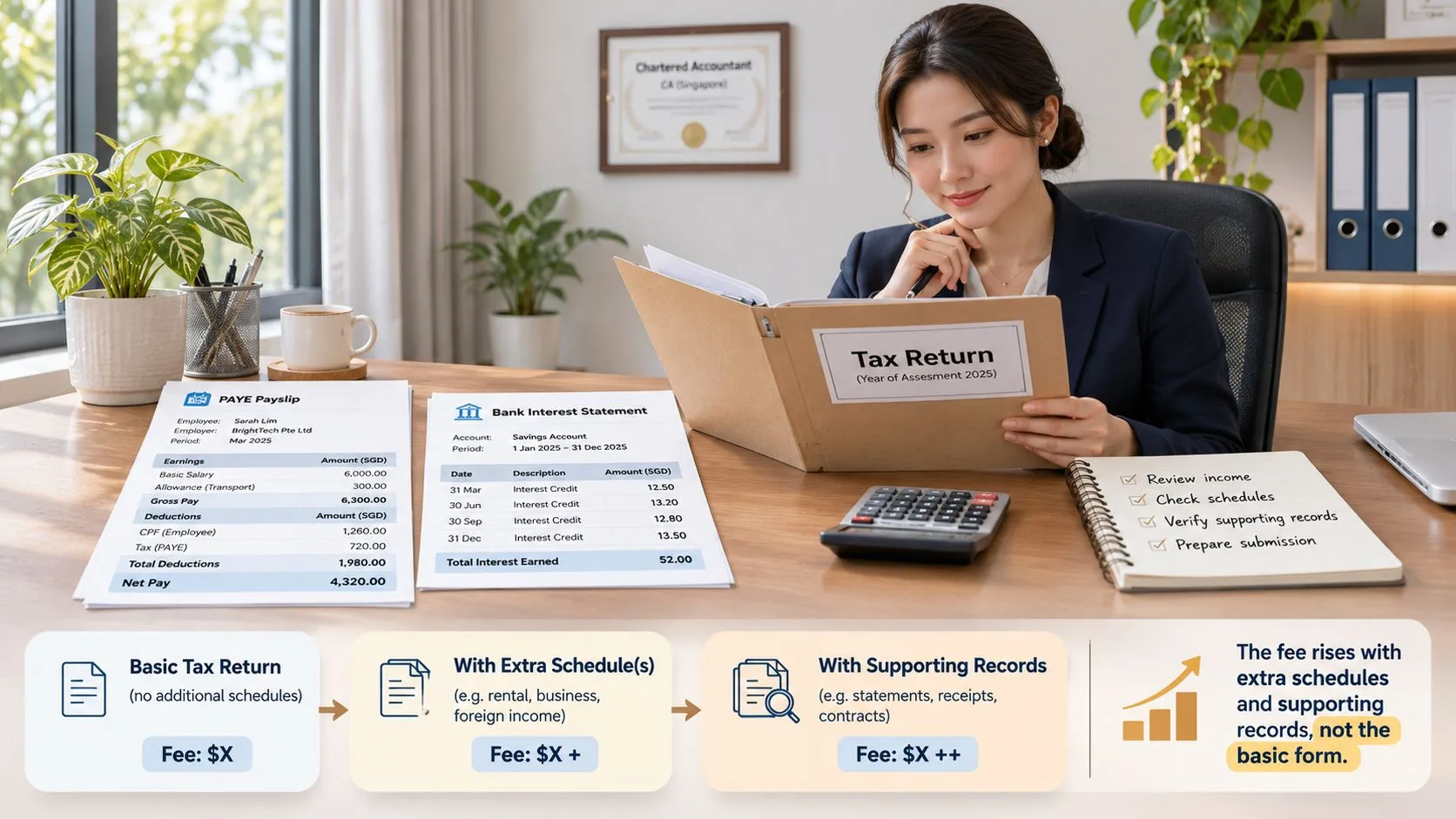
A fee follows the number of supplementary schedules on the return and the condition of the records behind them. A straightforward employment-only return needs fewer calculations and fewer supporting records than one carrying self-employment, property income, capital gains, foreign income, trusts or multiple relief claims, as the AccountingWEB analysis of IRIS survey data sets out. The label on the client matters far less than the schedules that label implies.
Two returns, side by side
Say an employee has PAYE income and £300 of bank interest. That's one employment page, one small savings figure, a handful of checks and a computation that takes minutes to review. The quote sits at the bottom of the standard band, and it should.
Now take a landlord with two rented flats who also runs a sole trader business. Two property pages with finance cost restrictions to apply, a self-employment account with expenses to classify and capital allowances to consider, plus payments on account to recalculate. Each added income source means reconciling records, checking allowable deductions, applying the right tax treatment and reviewing what's due next January and July. That work is what the higher band pays for.
Records cost money too
Missing receipts and bookkeeping that's a year behind change the job completely. Someone has to rebuild the records before the return can be prepared, and that reconstruction is normally priced as separate work rather than folded into the return fee. Clean, organised bookkeeping throughout the year is the cheapest way to keep a tax return fee at the bottom of its band, which is why organising your bookkeeping for tax returns before the year end pays for itself.
Before you ask for a quote, write down three things:
- Income sources: every one, including small amounts of interest, dividends and rental income.
- Schedule count: how many supplementary pages the return needs.
- Record condition: whether the figures are reconciled or still in a shoebox.
How Accountants Set Their Fees
Fixed fees are the most common approach, but not the only one. HMRC's research into tax administration for businesses found that 44% of businesses reported fixed fees as the pricing approach used, followed by time-based charges at 29% and tiered rates based on complexity at 20% (HMRC business tax administration research).
| Pricing method | Share of businesses using it | How it works | Best suited to |
|---|---|---|---|
| Fixed fee | 44% | One agreed price for a defined job | Simple, predictable returns |
| Time-based charge | 29% | Hourly or time-based billing | Open-ended or unusual work |
| Tiered by complexity | 20% | Price band set by the complexity of the return | Returns with several schedules |
The same research found that 74% of agents said their fees varied with the size of the business client, and 66% used more than one fee-setting method. So a single quotation may mix a fixed element for the return with a time-based element for tidying up the records.
What that means for a sole trader
A predictable return with tidy figures is the natural home of a fixed price. The accountant can see the whole job, price it, and both sides know where they stand. An open-ended job, where the records are incomplete or the income streams are unclear, is far more likely to be quoted by time or as a bespoke figure, because nobody can fix a price on work they can't yet see.
A bespoke quote for a landlord, a partnership or a company director is normal, not a warning sign. What matters is whether the quote lists what's included.
Ask this first: which pricing method is being used here, and what would trigger a change in the price?
What the Quoted Fee Covers and What Costs Extra
The lowest headline fee is rarely the cheapest job. Published market comparisons put simple returns at around £150 to £300, with complex cases involving capital gains, foreign income or multiple properties priced above the standard band, and many of those prices are explicitly quoted plus VAT (The Accountancy). The figure tells you nothing until you know what sits inside it.
Two quotes can differ by hundreds of pounds purely because of scope. One accountant prices the preparation and submission only. Another folds in HMRC correspondence, an amendment window and advice on payments on account. Both are quoted in good faith. Only one of them is the job you need done.
| Scope item | Why it adds cost if missing | What to confirm |
|---|---|---|
| Tax computation | Shows how the tax figure was reached | Is it itemised in the quote? |
| HMRC submission | Someone must file the return on time | Who files, and by what date? |
| Follow-up correspondence | HMRC queries can take hours to answer | Are queries covered, and at what rate? |
| Amendments after filing | Corrections can be charged separately | Is one amendment included? |
| Payments on account advice | Affects the amount due next year | Is advice included in the fee? |
| Record reconstruction | Missing records must be rebuilt before filing | Is bookkeeping priced separately? |
| VAT on the fee | Can add a fifth or more to the total | Are both quotes stated ex-VAT? |
Work through that table against any quote you receive. Every row you cannot tick is a cost you have not yet seen.
Two quotes, one comparison
Take a quote of £180 and another of £320 for what looks like the same return. The £180 quote excludes HMRC correspondence and is stated plus VAT. The £320 quote includes correspondence, one amendment and a review of payments on account, and is also plus VAT. Once you price in the risk of an HMRC letter arriving in June with nobody engaged to answer it, the gap narrows sharply, and it may close altogether.
Cheap quotes are fine when the return is simple and you can handle a query yourself. They cost money when the stripped-out items are the ones you end up needing.
The practical move is to compare the total cost of the scope you need rather than the number on the first line. We never undertake work without agreeing the fee in advance, precisely so that comparison is possible before anything starts, and our terms of business set out how the engagement and the fee are confirmed. Ask for the same clarity wherever you shop: a fixed price, in writing, with the inclusions and exclusions spelled out line by line.
When Paying an Accountant Costs Less Than a Late Filing
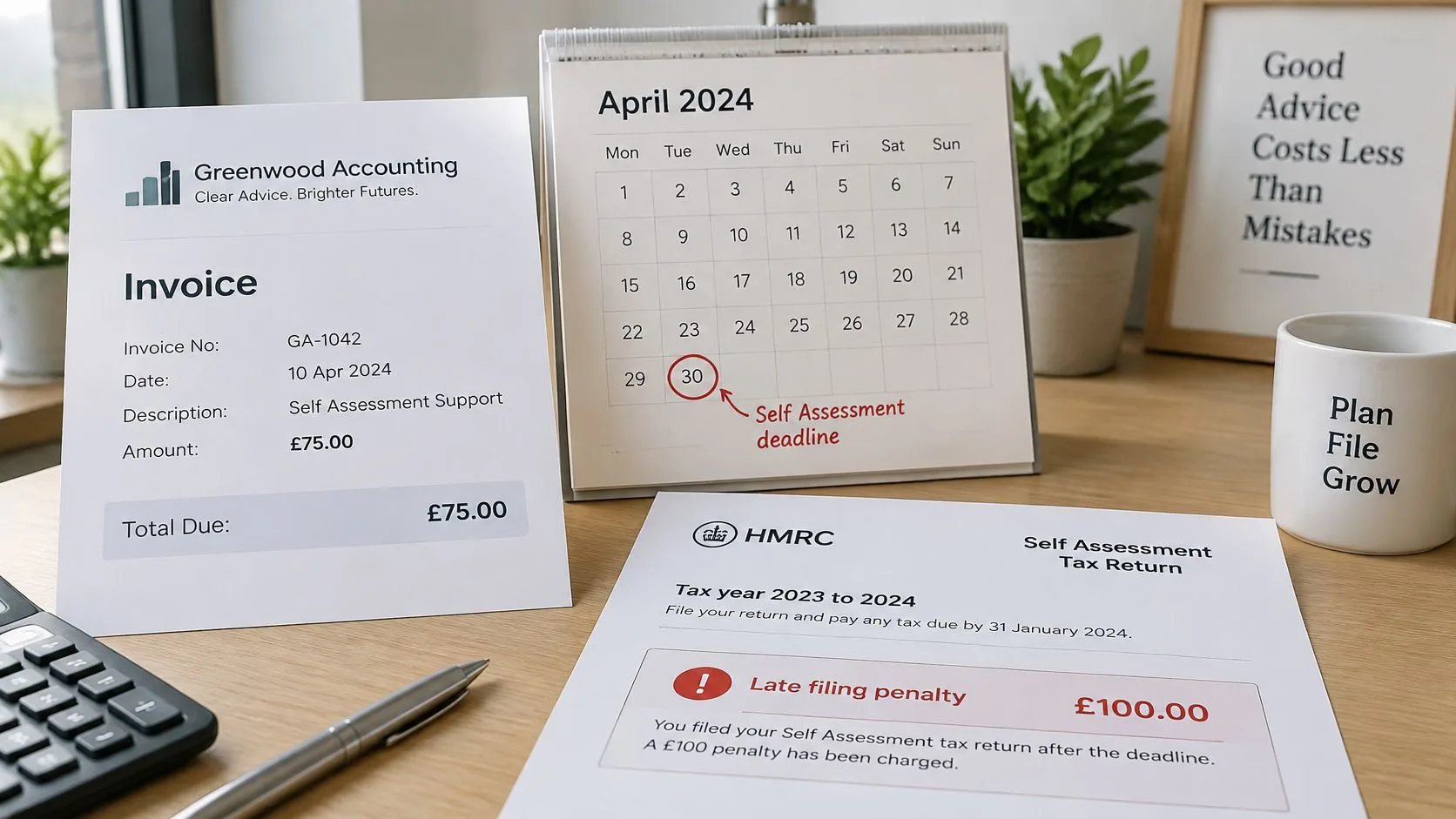
Filing Self Assessment with HMRC is free. Missing the deadline isn't. A late return triggers an immediate £100 penalty even where no tax is owed, and the HMRC deadline guidance says additional daily penalties can reach £900 after three months, followed by further penalties at six and twelve months. That means the headline fee for an accountant is only part of the calculation. A fairer comparison is between paying for a return that is prepared and filed properly, and carrying the risk of penalties, corrections and unanswered correspondence yourself.
The same HMRC update reported 11,489,825 returns received by 31 January 2026 against 12,029,168 expected, meaning about 539,000 expected returns were not in by the deadline. That is a snapshot of one deadline, but it shows how easily filing slips down the list when records, work and cash flow all compete for attention.
Where self-filing still makes sense
A simple return, filed from complete records, well before the deadline, by someone who understands payments on account, doesn't need a professional. Software handles it, and it's worth knowing how to compare top tax software options before you buy. In that situation, the fee is hard to justify if the only task is entering straightforward figures and submitting them on time.
Professional help earns its fee when the return carries landlords' property pages, several income streams, directorship dividends, capital gains or foreign income, or when the records are disorganised enough that the deadline becomes a genuine threat. The value sits in deadline management, error checking and knowing which figures need support. Expense and pension opportunities do get missed by some filers, but the benefit is case-dependent, never promised.
If a missed deadline costs £100 before you've even argued about the tax, the fee comparison changes shape.
The penalty regime itself is worth understanding before you decide, and self assessment late filing penalties explains what escalates and when.
How to Compare Quotes and Request a Fixed Written Price
Comparing quotes properly takes about twenty minutes and saves far more than that. Work through these in order.
- Get the scope in writing. Ask every firm for a written quote that lists each return and each schedule it covers. A verbal "about £300" isn't a quote.
- Put every figure on one basis. Either strip VAT out of all of them or add it to all of them. Mixed bases produce fake winners.
- Check the credentials. Ask which professional body regulates the firm. Chartered Accountants are regulated by their professional body and bound by a code of ethics and professional standards, which gives you a route to complain if something goes wrong.
- Ask what changes the price. Incomplete records and new income sources are the two usual triggers. Get the answer before you engage, not after.
- Ask whether support stops at submission. Filing is a moment. A query three months later is a service, and it's priced differently.
- Add up the full annual cost. Return, bookkeeping, any advisory work. Then check that total against the scope items above.
Red flags worth walking away from
A price described only as "from" with no written scope is the classic one. So is a fee that moves without explanation, or a firm that won't tell you who will prepare the return. Automated tools raise a fair question too, and it's worth asking whether can AI do my taxes handle your kind of return before you pay anyone for work software might manage.
Ask two firms to quote on exactly the same scope, using the income sources and schedule count you wrote down earlier. If the two quotes don't list the same items, you're not comparing prices, you're comparing brochures.
We work to guaranteed fixed fees linked to the value of what's provided, agreed before any work starts, because a fixed price you can plan around is worth more than a low estimate that grows.
Request a written fixed quote from Stewart Accounting Services well before the 31 January deadline, with your income sources and schedule count to hand, and you'll know the exact cost of your return before you commit to anything. Email mark@stewartaccounting.co.uk or book an initial consultation, which costs nothing, and we'll price the job on what your return contains.
Recent Posts
27 Nov, 2026