

Submitting dormant company accounts is a pretty simple affair. You'll just need to file a simplified balance sheet with Companies House, which you can do online or by post using Form AA02. You also have to give HMRC a separate nudge to let them know the company is dormant for Corporation Tax, which stops them from chasing you for tax returns.
The most important thing to get right? Making absolutely sure your company has had no significant accounting transactions all year.
Confirming Your Company Is Genuinely Dormant
Before you even think about filling out forms, you need to be crystal clear that your company actually qualifies as dormant. Getting this wrong and misclassifying an active company can land you with penalties and a real compliance headache later on.
The whole definition pivots on one crucial idea: the absence of 'significant accounting transactions'. This is where a lot of people get tripped up. Put simply, it means no money related to business activities has passed through the company's bank account. This includes obvious things like paying invoices, but also less obvious ones like paying bank charges, earning interest, or dishing out salaries and dividends.
What Counts as a Significant Transaction
It's vital to get your head around the specifics here, as some payments are actually allowed. The way to think about it is that transactions needed just to keep the company legally on the books are usually okay.
Here’s what you can pay for without breaking dormancy:
- Payment for shares: The money paid by the first shareholders when the company was set up.
- Companies House fees: This covers things like filing your confirmation statement or changing the company name.
- Late filing penalties: Any fines from Companies House for filing accounts late.
These get a pass because they're purely administrative costs, not trading. If your company's only outgoings fall into these categories, you're still in the clear to be considered dormant. For a more detailed look at the official steps, our guide on how to make a company dormant is a great resource.
Real-World Examples of Dormancy
Let’s make this practical. Say you've registered a limited company for a business idea you plan to launch next year, but for now, it’s just sitting there. You've paid for your initial shares and the annual confirmation statement fee to Companies House. That’s it. In this scenario, your company is dormant.
Now, imagine that same company's bank account earns just 5p in interest. Technically, that's a significant transaction. That single event means the company is no longer dormant for that financial year. The same goes for paying a small subscription for accounting software or buying a domain name through the company – those activities would make it active in the eyes of the law.
The rule of thumb is simple: if the transaction isn't on that short, specific list of statutory exceptions, it breaks your company's dormant status. This definition is incredibly strict, which is why you absolutely must check every line of your company bank statements before you file anything.
Filing Your Dormant Accounts with Companies House
So, you’ve confirmed your limited company is well and truly dormant. What’s next? The good news is that filing your accounts is a whole lot simpler than it is for a trading business. You've got a couple of ways to get this done with Companies House.
Your main choice boils down to filing online or going old-school with a paper form. For almost everyone I speak to, the online route is a no-brainer. It's faster, it's free, and it has some handy built-in checks that help you avoid common mistakes.
Choosing Your Filing Method
When it comes to deciding how to file, it really comes down to what you value most: speed and convenience, or a paper trail.
The Companies House online portal is designed to be straightforward, walking you through each step. It pulls in your company's information for you and will often flag if you've missed something obvious before you hit 'submit'. You don't need to be an accountant to use it.
The paper option, which is Form AA02 (also known as the DCA or 'Dormant Company Accounts' form), still exists. However, it’s slower, and let’s be honest, it’s far easier to make a simple mistake when you're filling something out by hand. It’s a solid backup if you prefer having a physical copy for your records or if your company isn't eligible for the web-filing service.
This flowchart gives you a quick visual on the process and the transactions that keep you in the 'dormant' lane.
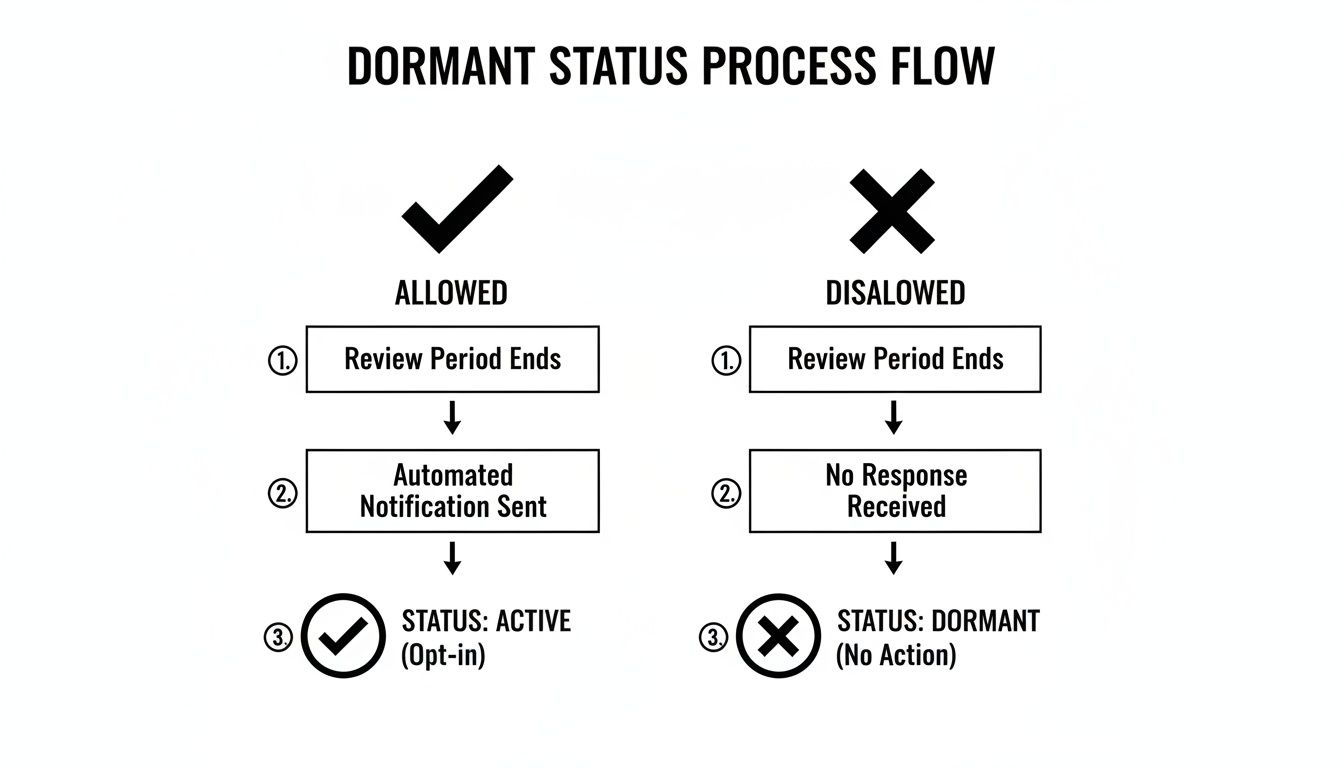
It’s a great little reminder of what is and isn't allowed before you actually start the filing process.
To help you decide which path is right for you, here’s a quick comparison of the two methods.
Online Web-Filing vs Paper Form AA02 Submission
This table breaks down the key differences to help you choose the best method for filing your dormant accounts, weighing up speed, ease of use, and the potential for errors.
| Feature | Online Web-Filing | Paper Form AA02 (DCA) |
|---|---|---|
| Speed | Instant email confirmation. Public record updated in minutes. | Can take over a week to be processed and appear on record. |
| Cost | Completely free. | Free to file, but you have to pay for postage. |
| Convenience | Accessible 24/7 from anywhere. Pre-fills company info. | Requires printing, manual completion, and posting. |
| Error Risk | Low. Built-in checks catch common mistakes. | Higher. Easy to make typos or miss a required field. |
| Record Keeping | Digital record (PDF) is available to download immediately. | You need to make a copy before you post it for your own records. |
| Best For | The vast majority of dormant limited companies. | Directors who prefer a physical paper trail or aren't online. |
Ultimately, for a quick and painless experience, the online service is almost always the way to go.
A Walkthrough of The Online Filing Process
Ready to file online? It’s surprisingly quick. Before you start, you’ll need just two things:
- Your company registration number (CRN)
- Your 6-digit authentication code
Think of the authentication code as your company's digital signature. Companies House sends it by post to your registered office address right after incorporation. If you can't find it, don't panic – you can easily request a new one on the Companies House website.
Once you have those, here’s what the process looks like:
- Head over to the portal: First, navigate to the Companies House web-filing service. You’ll be asked to find your company by its name or CRN.
- Enter your credentials: This is where you’ll pop in your authentication code to prove it’s really you.
- Check the figures: The system will show you a very basic balance sheet. For most dormant companies, it’s just a sea of zeros. Your job is to simply confirm it’s all correct.
- Tick the boxes: You must add a couple of mandatory legal statements. One confirms the company was dormant for the entire accounting period, and the other is a declaration of your responsibilities as a director under the Companies Act 2006.
One thing that sometimes trips people up is the balance sheet. If your company was set up but never traded, the only figure you're likely to see is the value of the initial shares. For example, you might see £1 next to 'Called up share capital not paid'. Every other box for assets and liabilities should be zero.
After a final review, you'll authorise the submission with your name. And that's it! You should get an email confirmation almost instantly, and the accounts will usually appear on the public register within minutes. It’s a world away from the anxious wait for paper forms to be processed.
For a wider perspective on filing in general, our guide on how to submit accounts to Companies House covers the process for all sorts of company situations. Just remember, staying on top of these deadlines is crucial for keeping your company in good standing and avoiding penalties, even when there's no money coming in or going out.
Managing Your HMRC Corporation Tax Obligations
Ticking the box with Companies House is a big part of the process, but don't fall into the trap of thinking you're all done. A very common—and potentially costly—mistake is assuming that Companies House and HM Revenue & Customs (HMRC) talk to each other. They don’t. You have to tell HMRC separately that your company is dormant for Corporation Tax.
If you skip this step, HMRC will carry on as if your company is actively trading. Before you know it, a ‘Notice to Deliver a Company Tax Return’ (form CT600) will land on your doormat. Ignoring these notices is a bad idea; it triggers automatic penalties and interest charges that just keep growing, even when there's no tax to pay.
How to Tell HMRC Your Company is Dormant
To avoid all that unnecessary stress, you need to be on the front foot. The moment your company stops trading, or if it has been dormant from the very beginning, get in touch with HMRC. You’ll need to contact your local Corporation Tax office.
When you call or write to them, have these details ready to go:
- Your Company's Name: The full, registered name.
- Unique Taxpayer Reference (UTR): This is the 10-digit number HMRC assigns to your company.
- Date of Dormancy: Be precise about the exact date trading stopped, or simply state that it has never traded.
This simple act gets your company's status updated on their system. It effectively presses 'pause' on your obligation to file a Company Tax Return, and they won't expect to hear from you again until you decide to start trading.
The crucial thing to remember is that you, the director, are responsible for keeping both government bodies in the loop. A quick, proactive call to HMRC now is far better than a frantic, reactive one after a penalty notice arrives.
What if You Receive a Tax Return Notice Anyway?
It’s a heart-sinking moment for many directors: you’ve correctly filed your dormant accounts, but that dreaded brown envelope from HMRC still arrives, demanding a CT600. Whatever you do, don't just ignore it. Even if your company owes nothing, the notice is a legal instruction, and you must respond.
Pick up the phone and call the Corporation Tax office that sent the letter straight away. Explain that the company is dormant and confirm the date it became inactive. As long as you act quickly, they will almost always withdraw the notice without any fuss or penalties.
Letting it slide, however, is a real gamble. The stakes are higher than you might think. GOV.UK statistics from the 12 months to May 2025 show the insolvency rate hit 53.0 per 10,000 companies—that's roughly one in every 189. Many of these issues start with simple compliance failures, like late filings. You can see more on this in this handy guide to dormant companies on rapidformations.co.uk.
Getting the timing right on these things is everything. For a deeper dive into how tax deadlines work for active businesses, take a look at our detailed guide on when you pay Corporation Tax. Staying organised is the key to making sure a simple dormant company filing doesn't spiral into a complicated tax headache.
Understanding Filing Deadlines and Penalties
When you're a company director, even for a business that isn't trading, knowing your deadlines is absolutely non-negotiable. Missing the date to file your dormant company accounts is a costly mistake, and honestly, one that’s completely avoidable. The whole system revolves around one critical date: your company's Accounting Reference Date (ARD).
Think of the ARD as your company’s financial year-end. If you've just incorporated, Companies House automatically sets this as the last day of the month you registered your company. This single date becomes the anchor for all your future filing deadlines.

Calculating Your Filing Deadline
Once you’ve got your ARD, working out the deadline is straightforward. You must file your dormant accounts with Companies House no later than nine months after your ARD. There's no wiggle room here; it’s a hard deadline.
Let's walk through a real-world example:
- Incorporation Date: Let's say you registered your company on 10th March 2024.
- First ARD: Your first accounting reference date will automatically be set for the end of that month, so 31st March 2025.
- Filing Deadline: Add nine months to that, and your deadline is 31st December 2025. Your accounts must be submitted by midnight on that day.
It’s a simple formula, but it’s amazing how many new directors get caught out. Do yourself a favour and set a calendar reminder a good month before it's due. It's one of the best habits to get into.
The Real Cost of Filing Late
Ignoring the deadline has immediate and escalating financial consequences. Companies House has a strict penalty system that kicks in automatically, the very day after your accounts were due. These penalties aren't linked to what your company owes—because a dormant company owes nothing in tax—they are based purely on how late the filing is.
The rules are black and white: you have 9 months after your ARD. Miss that, and you're looking at civil penalties that start at £150 if you're up to a month late. This climbs sharply to £1,500 for being over six months late and can even double to £3,000 if you file late for two years in a row. For a deeper dive into these obligations, you can find some great information in this useful guide on dormant company rules from rapidformations.co.uk.
The crucial thing to remember is that these penalties are issued per filing, not per company. If you're also late with your confirmation statement, you could face separate penalties for that too. Being proactive is the only way to shield both the company and yourself from these totally unnecessary costs.
Common Mistakes to Avoid When Filing
Filing dormant company accounts should be straightforward, but a few common pitfalls can easily trip you up. Getting it right the first time is key to avoiding rejected filings, surprise penalties, and a whole lot of unnecessary stress. Let's walk through the mistakes I see most often in practice.

The single biggest error is incorrectly claiming dormant status in the first place. You might file dormant accounts completely forgetting the company bank account earned a few pence in interest or that an old software subscription auto-renewed. Any transaction, no matter how small, that falls outside the very specific exceptions will break dormancy. This instantly makes your filing inaccurate.
Another classic mistake is assuming Companies House and HMRC talk to each other. They don't. You absolutely have to tell each of them your company is dormant separately. Simply filing dormant accounts at Companies House won’t stop HMRC from expecting a Corporation Tax return, and that can quickly lead to automatic late-filing penalties.
Overlooking Simple Administrative Details
Sometimes, it’s the small, seemingly insignificant details that create the biggest headaches, especially when you’re pushing a deadline. These administrative slips are surprisingly common but are also very easy to avoid with a bit of care.
- Losing Your Authentication Code: Think of this 6-digit code as your company's digital key. If you can’t find it when it's time to file, you’ll have to request a new one from Companies House. They only send it by post to the company's registered office, which can take several days to arrive and put you at risk of missing your deadline.
- Filing for the Wrong Period: It’s vital to double-check that the accounting period on your submission perfectly matches your company’s financial year. A simple typo here is one of the quickest ways to get your accounts rejected.
- Forgetting a Director's Signature: This is more of an issue with old-school paper forms, where a missing signature means guaranteed rejection. The modern online system prevents this, but the principle remains: you have to complete every single required field before you can submit.
So, what happens if you file and then realise you've accidentally broken dormancy? The right thing to do is file a set of amended, full accounts for an active company immediately. This corrects the public record and shows you're being proactive about compliance.
Ultimately, the best advice is to treat this filing with respect, even if it feels like a simple box-ticking job. Check your bank statements one last time for any stray transactions, confirm your deadlines, and keep that authentication code somewhere safe. A few minutes of prep work will save you hours of pain down the line.
When to Ask a Professional for Help
Learning how to file dormant company accounts yourself is a great skill to have. For a straightforward company that has never traded, it's often a pretty simple job. The online system is easy enough to navigate, and you can get it done quickly.
But there are definitely times when the DIY approach is a false economy. In some situations, calling in a professional accountant isn't just a convenience—it's the smarter, safer bet to avoid costly mistakes.
Think of it less as an expense and more as a bit of insurance. If you have even the slightest doubt about your company's status or what needs to be filed, getting an expert opinion is a small investment that can save you from big headaches down the line.
Scenarios That Warrant an Accountant's Help
Some situations really raise the stakes and make professional guidance a near necessity. If any of the following sound familiar, I’d strongly recommend getting an accountant involved to make sure everything is handled correctly.
-
You've Just Ceased Trading: This is a classic tripwire. Moving a company from active to dormant status has to be done carefully. An accountant will make sure all final trading activities are squared away properly and that both Companies House and HMRC know you've officially stopped. It’s about creating a clean break.
-
Uncertainty About Transactions: That small bank charge for keeping the account open—does it count? What about a late refund from a supplier that just landed? If you're not 100% sure whether a transaction breaks your company's dormant status, an accountant can give you a definitive answer before you make an incorrect filing.
-
Complex Company Structure: If your company has a bit of a history—maybe with different share classes, director's loans, or a more involved balance sheet from when it was trading—filing dormant accounts isn't just a case of putting zeros everywhere. An accountant ensures all those historical figures are carried forward correctly and compliantly.
-
You Simply Lack the Time or Confidence: Let's be honest, you have other things to do. The peace of mind that comes from knowing your compliance is in safe hands is often worth every penny. Handing it over to an accountant removes the stress, gets rid of that nagging deadline anxiety, and lets you focus your energy elsewhere.
Outsourcing isn't giving up; it's being strategic. When an accountant handles your filing, you're not just paying them to fill in a form. You’re buying their expertise and the assurance that it’s done right, on time, every single time. That’s what protects you from penalties and future problems.
A good accountancy firm will take the entire process off your plate. They'll confirm your company is genuinely dormant, prepare and submit all the right paperwork to Companies House, and make sure HMRC is properly updated. It makes the whole thing seamless and stress-free, with no room for error.
For complete peace of mind with your dormant company filings or any other accounting needs, Stewart Accounting Services offers expert support to keep your business compliant and stress-free. Let us handle the details so you can focus on what's next. Find out how we can help your business today.