

That old saying, "failing to prepare is preparing to fail," couldn't be more accurate when it comes to your tax return. Honestly, the secret to a stress-free Self Assessment isn't some clever tax loophole; it's getting all your paperwork in order before you even think about logging into the HMRC portal.
Taking the time to do this up front transforms the entire process. It stops being a frantic hunt for that one missing receipt and becomes a much calmer, more straightforward task of putting the right numbers in the right boxes.
Getting Your Documents Ready Before You Start
Knowing how to fill self assessment form correctly starts long before you see the first question on the screen. It all comes down to having your records organised. With every figure, invoice, and bank statement at your fingertips, you'll avoid constant interruptions and, more importantly, you won't forget to claim expenses you're entitled to.
The Absolute Essentials
First things first, you need your login details. You simply can't file your return without them, so make sure you know where they are.
- Unique Taxpayer Reference (UTR): This is your 10-digit number from HMRC, which they sent you when you first registered.
- National Insurance Number: You can find this on any old payslip, a P60, or other letters about tax or benefits.
Think of these as the keys to your HMRC account. Without them, you’re not getting in.
What Paperwork Do You Actually Need?
This is where it gets personal, as your checklist will look very different depending on what you do. A landlord’s financial life is worlds away from a freelance designer's.
For instance, if you're a freelance graphic designer, you’ll be looking for things like:
- Every invoice you sent out during the tax year.
- Business bank statements that show all your income and outgoings.
- Receipts for software you rely on, like your Adobe Creative Cloud subscription.
- Calculations for your home office costs, like a percentage of your utility bills.
On the other hand, a landlord's pile of paperwork will be all about the property:
- Rental income statements, whether from a letting agent or your own records.
- Invoices for any repairs and maintenance jobs.
- Records of letting agent fees and your landlord insurance policy.
- The mortgage interest statement for the relevant tax year.
The aim here is to build a complete and accurate financial picture of your business or rental activities for the tax year. A gap in your records usually leads to a gap on your tax return, which is how mistakes happen.
The Value of Good Bookkeeping
Trying to piece together a year's worth of transactions in January is a nightmare. This is exactly why keeping on top of your bookkeeping throughout the year is a game-changer. If you find this part a struggle, it might be worth looking into how to outsource bookkeeping for small business to take the pressure off.
Using accounting software like Xero can make this whole step almost effortless. Instead of digging through shoeboxes of receipts, your data is already organised. When filing time comes around, you just run a couple of reports to get the exact figures you need. It turns a job that could take days into something you can do in minutes.
For a really detailed list of everything you might need to pull together, our comprehensive self-assessment checklist is the perfect place to start. A little bit of preparation goes a long way, giving you the confidence that every number you enter is correct and accounted for.
A Walkthrough of the Self Assessment Form
Logging into the online Self Assessment for the first time can feel a bit overwhelming. But it’s not one giant, scary form. Think of it more as a series of building blocks – you only use the ones that apply to your own financial situation. The whole key to getting it right is understanding that you're customising the form to tell HMRC your story.
Right after you log in, the system kicks off a process called "Tailor your return". It's essentially a short questionnaire. It’ll ask things like, "Were you self-employed?", "Did you receive income from a rental property?", or "Did you sell an asset that might need Capital Gains Tax paid on it?". Your answers here are crucial because they automatically generate the specific sections (or 'supplementary pages') you need to fill in. No more, no less.
This whole process relies on having your documents in order from the get-go.
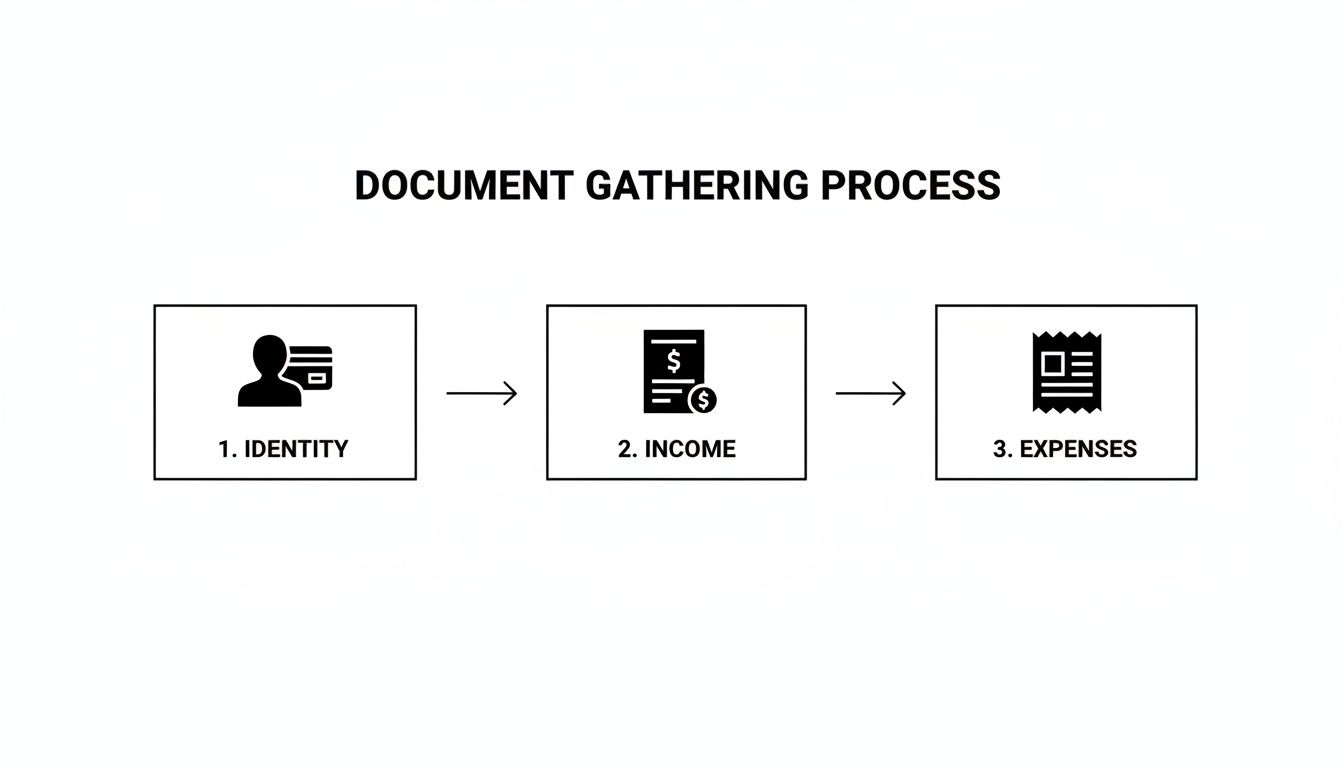
As the visual shows, a successful filing is really built on those three pillars: identity, income, and expenses. Get them sorted first and you'll avoid the last-minute panic so many people go through.
And it’s a massive annual task. HMRC is bracing for over 12 million people to file a return for the 2024/25 tax year. Despite this, come early January, it's not uncommon to see around 5.65 million people still haven't filed. This eleventh-hour dash puts a huge strain on HMRC’s systems and, frankly, creates a lot of unnecessary stress. You can dig into these filing statistics on the official government website.
Declaring Your Main Income Sources
Once you've tailored your return, it's time to get into the main event: inputting the numbers. This is where all that record-keeping pays off. Each type of income you earned has its own specific section, often identified by an official form code.
Let’s bring this to life with an example. Imagine a freelance photographer who's also the director of her own small limited company and rents out a flat she used to live in. Her tax return would need these key sections:
- SA103 (Self-employment): This is for her freelance photography income. She'd enter her total turnover (all the invoices she sent out) and then list all her allowable business costs, like camera gear, travel, and insurance.
- SA102 (Employment): As a company director, she pays herself a modest salary through PAYE. All the details for this come straight from her P60 form.
- SA105 (UK property): This is where she declares the total rent she received from her tenant. She can then deduct any relevant expenses – things like letting agent fees, essential repairs, or landlord insurance.
- SA106 (Foreign): If she happened to earn any income from abroad, say from dividends paid by overseas shares, that would be declared here.
The online system is pretty good at walking you through these one by one. The most critical part is making sure the figures from your records end up in the right boxes on the form. Take a moment to double-check each page before you click 'next'.
Handling Other Financial Details
Your return isn’t just about your main income streams. It also needs to capture other financial activities that can impact your final tax bill. These are often the bits that trip people up, but getting them right is essential for an accurate calculation.
Here are a few other common sections you might need to tackle:
- Dividends: For our photographer, any dividends she takes from her limited company must be entered here. You'll need the total gross dividend amount you received in the tax year.
- Capital Gains (SA108): Did you sell something significant, like a second property, a valuable antique, or a large chunk of shares? You'll have to complete this section to work out if any Capital Gains Tax is due.
- Student Loan Repayments: There’s a simple box to tick if you're currently repaying a student loan. This is important because it tells HMRC to calculate your repayment correctly based on your total income, not just your salary.
- Pension Contributions: If you've been paying into a private pension, declaring it here is a must-do. HMRC uses this information to apply the tax relief you're entitled to, which can make a real difference and lower your overall bill.
Working through these supplementary pages is the real substance of the task. It's a methodical process of taking the information from your organised records and slotting it into the right digital boxes. What looks like a mountain at the start quickly becomes a series of manageable steps.
Claiming Every Allowable Expense You Deserve

Let's be clear: getting your tax bill down isn't about finding secret loopholes. It's about methodically and confidently claiming every single legitimate business expense you're entitled to. This is precisely where so many people leave money on the table, usually because they're not sure what counts or they're worried about getting it wrong.
The heart of the matter is understanding what HMRC considers an "allowable expense." The golden rule is that any cost must be "wholly and exclusively" for your business. So, let’s get past the jargon and see what this actually means for you.
What This Looks Like for Sole Traders
Generic lists of expenses don't help much when you're trying to apply the rules to your own unique business. Let's say you're a freelance writer working from a home office. Your allowable expenses are part of your everyday operations.
- Your Home Office: No, you can't claim your whole mortgage. But you absolutely can claim a portion of your household bills like council tax, electricity, and heating. The easiest way is using HMRC's "simplified expenses"—a flat monthly rate based on how many hours you work from home.
- Software & Subscriptions: That Grammarly subscription? The fee for your website hosting? Your Microsoft 365 account? All of these are tools of the trade, making them perfectly legitimate expenses.
- Travel Costs: A train ticket to a client meeting in Manchester is a clear business expense. But be careful—your daily 'commute' from your bedroom to your home office (or even to a local co-working space) generally isn't claimable.
The trick is to be able to draw a straight line from every cost back to a business need. For a much deeper dive, have a look at our detailed guide on sole trader allowable expenses.
A classic mistake is ignoring the small costs that really add up. That £5 a month for cloud storage or the £20 you spent on a business book are just as valid as a new laptop. Keep track of everything—it's your money.
Navigating Expenses as a Landlord
If you're a landlord, the expense rules can feel especially murky, particularly around property maintenance. The biggest thing you need to get right is the difference between a repair and an improvement.
A repair simply restores something to its previous condition. Think fixing a leaking boiler or replacing a rotten wooden window frame with a modern uPVC one. These costs are almost always allowable and can be deducted directly from your rental income.
A capital improvement, however, is an upgrade. Building an extension or converting the loft makes the property better than it was before. You can't deduct these costs from your rental income, but they will help reduce your Capital Gains Tax bill when you eventually sell.
Getting to grips with specific rental property tax deductions is one of the most effective ways to manage your tax position as a landlord.
Also, remember that the rules for mortgage interest have changed. You no longer deduct the interest from your rental income. Instead, you receive a tax credit equivalent to 20% of your mortgage interest payments. It’s a subtle change in the calculation, but one with a big impact.
To give you a clearer picture, here's a rundown of some common expenses and what to watch out for.
Common Allowable Expenses for UK Businesses
| Expense Category | What You Can Claim | Key Consideration |
|---|---|---|
| Office Costs | Stationery, phone bills, postage, software subscriptions, and computer equipment. | You can claim the full cost of items used exclusively for business. For items used personally as well, you must calculate the business-use percentage. |
| Travel | Fuel, parking, train/bus tickets, and hotel accommodation for business trips. | Normal commuting to a permanent workplace is not an allowable expense. |
| Staff Costs | Salaries, bonuses, pensions, and employer’s National Insurance contributions. | These costs are fully deductible. |
| Marketing | Website hosting, online advertising, printed flyers, and professional directory listings. | "Entertaining" clients or suppliers is generally not an allowable expense. |
| Financial Costs | Bank charges on a business account, insurance, and professional fees (e.g., an accountant). | Legal fees are claimable for some things (like renewing a lease) but not for others (like buying property). |
This table is just a starting point. The key is to keep meticulous records and apply the "wholly and exclusively" rule to every single thing you claim.
Simplified Expenses vs. Actual Costs: Which Is for You?
HMRC gives you a choice for certain costs, most notably for vehicle use and working from home. You can either use a flat-rate "simplified expense" or track every penny of your "actual costs."
Simplified Expenses
- For Vehicles: A flat rate per business mile. It’s 45p for the first 10,000 miles, then 25p. Simple.
- For Home Office: A flat monthly amount that depends on the number of hours you work from home.
Actual Costs
- For Vehicles: You'd add up and claim a proportion of all your real running costs—fuel, insurance, repairs, MOT, and even the vehicle's depreciation (known as capital allowances).
- For Home Office: You’d calculate the exact business percentage of your real utility bills, council tax, and mortgage interest. This requires more maths but can be worth it.
So which is better? It completely depends on your situation. If you cover a lot of miles in a very fuel-efficient car, the simplified mileage rate could leave you better off. On the other hand, if you drive an older vehicle with high running costs, tracking actual expenses might save you more tax.
The most important rule is that you can't mix and match methods within the same tax year. You have to pick one and stick with it. This is where good record-keeping isn't just helpful; it’s what gives you the power to choose the best option and claim with confidence.
Navigating Deadlines to Avoid Costly Penalties

Getting your Self Assessment right isn’t just about the numbers; it’s about the clock. Missing a deadline isn't a minor slip-up in HMRC's eyes. It's the starting gun for an immediate and escalating series of penalties that can quickly become a serious financial headache.
Think of these key dates as non-negotiable. They’re the framework for your entire filing process, and ignoring them is the fastest way to add unnecessary costs and stress to your tax bill.
Key Dates You Cannot Forget
There are two primary deadlines that anyone filing a Self Assessment needs to have burned into their memory. The date you need to worry about depends entirely on how you submit your return.
-
31 October (Midnight): This is your final call for filing a paper tax return. It’s much earlier than the online deadline, which is a major reason why the vast majority of people now file digitally.
-
31 January (Midnight): This is the big one. It's the deadline for submitting your online tax return and, just as importantly, for paying any tax you owe.
Knowing these dates is one thing, but truly understanding the consequences of missing them is what provides the real motivation. For a full breakdown of important dates, our guide on UK tax deadlines you can't afford to miss is an essential read.
Understanding the Penalty System
HMRC's penalty structure is designed to be punishing for late filers. It's not a single fine but a layered system that gets progressively more expensive the longer you leave it.
The very second you miss the 31 January deadline, you’re hit with an instant £100 fixed penalty. This applies even if you have no tax to pay or if you've already paid what you owe but just haven't filed the form itself. It's a penalty purely for being late.
After three months, it gets much worse. HMRC can start charging a daily penalty of £10 per day, which can rack up to a maximum of £900. If your return is still outstanding after six months, you’ll face another penalty of 5% of the tax due or £300 (whichever is greater). This is repeated if you still haven't filed by the 12-month mark.
The real sting is that these are just the late filing penalties. There are separate penalties for late payment of your tax bill, which also stack up over time, plus interest. It's a financial double-whammy you want no part of.
This system shows just how seriously HMRC takes its deadlines. Don't be one of the millions who leave it to the last minute; it's a gamble that rarely pays off.
Proactive Steps to Stay on Track
Avoiding penalties comes down to simple, proactive planning—not last-minute heroics. Your single best defence is filing early.
-
Set Calendar Alerts: Don't just pop one reminder in for 30 January. Set a series of them. Put one in for early December to get your records finalised, another for the first week of January to actually fill out the form, and a final one a week before the deadline as a last chance saloon.
-
File Early: There's no prize for submitting your return at 11:59 PM on 31 January. I always advise clients to aim for December or early January. This gives you peace of mind and, crucially, plenty of time to sort out any unexpected issues that might crop up.
-
Use Software Reminders: If you use accounting software, make sure you've enabled notifications for tax deadlines. These tools are literally designed to keep you on the straight and narrow.
Treat the deadline as the finish line of a well-planned race, not the starting pistol for a frantic scramble. That way, you can file correctly, on time, and without any nasty, costly surprises.
When to Consider Hiring an Accountant
Look, tackling your own Self Assessment is completely doable, and for many people, it's the right choice. But there often comes a tipping point where going it alone stops being the most sensible option. Bringing an accountant on board isn't giving up; it’s a strategic move to save you time, stress, and, very often, a surprising amount of money.
The signs that you might need a professional are usually pretty clear. Your finances get more tangled, and with every new income stream or investment, the risk of a costly mistake starts to climb.
Signs You've Outgrown the DIY Approach
So, when have your finances become too complex for a DIY return? If any of the following situations ring a bell, it’s probably time to think seriously about getting an expert in your corner.
-
You're Juggling Multiple Income Streams: Trying to balance a director's salary with dividend payments and rental income from a buy-to-let property? Things can get messy, fast. An accountant will make sure every source is declared properly and that you're not paying a penny more in tax than you need to.
-
You've Sold a Major Asset: If you've recently sold a second home, a portfolio of shares, or another big-ticket item, you’ve wandered into the world of Capital Gains Tax. This is a notoriously tricky part of the tax system, and professional advice is crucial for calculating your gain correctly and claiming all the reliefs you're entitled to.
-
You Have Foreign Income: Earning money from outside the UK brings a whole new layer of complexity, with tax treaties and specific declaration rules to navigate. A simple mistake here could lead to being taxed twice or unwanted attention from HMRC.
Don't just think of an accountant's fee as a cost. It's an investment. Their knack for spotting every single allowable expense and tax relief often leads to savings that easily cover their fees—and that’s before you even count the value of the time you get back to focus on your actual work.
Getting Ready for the Future of Tax
The way we all handle tax is on the brink of a major change. HMRC is pushing forward with its Making Tax Digital (MTD) initiative, which will soon mean more frequent reporting for many sole traders and landlords.
Starting from April 2026, if your turnover is above £50,000, you'll be required to send HMRC quarterly digital updates on your income and expenses. This turns Self Assessment from a once-a-year headache into a continuous process. Good accountants are already getting their clients set up for this, making sure they have the right software and bookkeeping habits to make the switch seamless.
This shift really underscores the benefit of staying on top of your finances all year round. It's a habit that pays off. Just look at HMRC's own data—thousands of people now file their returns during quiet times like the Christmas holidays. A whopping 4,606 people even filed on Christmas Day last year. You can read more about these festive filing trends on the government's website. That kind of readiness only comes from having organised, up-to-date records.
Ultimately, hiring an accountant is about so much more than just ticking boxes for HMRC. It’s about having a partner who can help you plan ahead, make your tax position as efficient as possible, and give you the confidence that comes from knowing your finances are in safe hands.
Your Self Assessment Questions, Answered
Even when you think you’re done and dusted, it’s natural for a few last-minute questions to crop up. Hitting that 'submit' button can feel final, so it's smart to clear up any lingering doubts first. Let's run through some of the most common queries people have just before they file.
What If I’ve Already Submitted and Then Find a Mistake?
First off, don't panic. It happens to the best of us, and HMRC has a straightforward process for making corrections, especially if you filed online.
You generally have 12 months from the original filing deadline to amend your return. The fix is usually as simple as logging back into your Government Gateway account, finding the return for the right tax year, and selecting the option to "amend your return". From there, you can navigate to the wrong section and input the correct figures.
- Realised you owe more tax? Once you amend the return, HMRC will update your bill. Pay the extra amount as soon as you can to keep any interest charges to a minimum.
- Realised you paid too much? The system will calculate your refund. HMRC will process it and you'll typically get the money back within a few weeks.
If you spot an error more than a year after the deadline, the online amendment option disappears. At that point, you'll need to write to HMRC directly to explain the mistake and provide the right information.
I’m a Company Director Paid Only via PAYE. Do I Still Need to File?
This is a classic grey area that trips up many company directors. The short answer is: you might not have to, but it's highly likely you do, and it’s often a good idea anyway.
You have a legal obligation to file a Self Assessment return if certain triggers are met, even if you’re only taking a PAYE salary. This includes things like earning over £150,000 in a tax year, receiving untaxed income (like dividends that exceed the tax-free allowance), or if HMRC simply issues you a notice to file.
Even if you aren't legally required to, many directors register for Self Assessment voluntarily. Why? It's the only way to claim tax relief on personal expenses incurred for the business that the company hasn't paid you back for, like using your own car for work trips. For most directors, being in the Self Assessment system is simply the most practical way to stay compliant.
What Are These 'Payments on Account' and Do I Have to Pay Them?
Payments on account can feel like a nasty shock if you aren't expecting them. Think of them as advance payments towards your next tax bill, designed to spread the cost so you don't face one huge bill every January.
HMRC will ask you to make payments on account if your last Self Assessment tax bill was over £1,000, and less than 80% of your income was taxed at source (like through an employer's PAYE scheme).
Here’s the rhythm they follow:
- First Payment: Due by midnight on 31 January. This is 50% of your previous year's tax bill.
- Second Payment: Due by midnight on 31 July. This is the remaining 50% of your previous year's bill.
Let’s say your tax bill for the 2023/24 tax year came to £3,000. For the following year (2024/25), HMRC will ask you to pay £1,500 by 31 January 2025 and another £1,500 by 31 July 2025. These amounts are then credited against your final 2024/25 tax bill when you file it.
If you know your income has dropped and your next bill will be lower, don't just pay what HMRC asks for. You can log in to your account and formally apply to reduce your payments on account. It's a crucial step to avoid overpaying and having your cash tied up with the taxman unnecessarily.
Getting your head around the finer points of Self Assessment can be a real challenge, but you don’t have to figure it all out on your own. Stewart Accounting Services offers expert, friendly guidance to make sure your tax return is accurate, compliant, and filed on time. Learn more about our Self Assessment services and how we can help.