
When you're a sole trader, any money you spend on your business can potentially be an allowable expense. These are the costs you can subtract from your total income, which then lowers your taxable profit and, ultimately, your tax bill.
The most important thing to get your head around is HMRC’s golden rule: an expense must be 'wholly and exclusively' for your business. If you can master this one concept, you'll be able to manage your expenses with confidence.
The Golden Rule of Claiming Expenses
Trying to figure out what you can and can't claim can feel a bit daunting at first, but it all comes back to that one simple idea. Imagine your business is its own separate thing. Any cost that helps it run, operate, and make a profit is likely a legitimate expense.
The "wholly and exclusively" rule is basically HMRC's way of separating your business spending from your personal spending. It’s the test every cost has to pass.
For instance, buying a new laptop that you only use for work is a clear-cut business expense. On the other hand, your weekly food shop isn't, because that’s a personal living cost. Where it gets tricky is when a cost has a mix of business and personal use – something HMRC calls 'duality of purpose'.
Understanding Duality of Purpose
This is where a lot of sole traders trip up. A perfect example is your mobile phone. You probably use it for client calls, but you also use it to chat with friends and family. Because it has a dual purpose, you can't just claim the entire phone bill as a business expense.
Instead, you need to work out a reasonable split and claim only the portion that relates to your business.
The question you always need to ask is: "Did I spend this money only to help my business earn a profit?" If the answer is a straight 'yes', it's almost certainly an allowable expense. If there's a personal element, you have to separate it out.
This logic applies to all sorts of common expenses, like using your home as an office or running a car for work trips. For a more detailed breakdown of this critical rule, it’s worth reading up on how HMRC defines 'wholly and exclusively' for tax purposes to make sure you're getting it right. Nailing this concept is the best way to avoid making mistakes that could lead to problems with HMRC down the line.
Why This Rule Matters
Getting your head around this isn't just about ticking boxes for HMRC; it's about being smart with your money. Every single pound you claim as an allowable expense directly reduces your taxable profit. A lower profit means you pay less Income Tax and National Insurance. Simple as that.
When you master this rule, keeping track of your receipts stops feeling like a chore and becomes a key part of maximising what you actually take home. It’s the foundation for making sound financial decisions all year round.
Claiming Office, Property, and Equipment Costs
Your workspace is the engine room of your business. Whether that’s a rented commercial unit or a corner of your spare room, the costs to keep it running are a major category of sole trader allowable expenses. Getting to grips with what you can claim is crucial for keeping your tax bill down.
It might seem complicated, but it all comes down to one simple idea: if you're spending money to create a functional place to do business, HMRC lets you claim for it. For those with a dedicated commercial property, it's pretty straightforward – things like rent, business rates, and utilities are fully deductible. But for the vast majority of us working from home, the lines can get a little blurry.
The trick is to be fair and accurate when separating your business use from your personal living costs. Thankfully, HMRC gives us two clear methods to do just that.
This overview breaks down the common types of office expenses you'll likely come across.
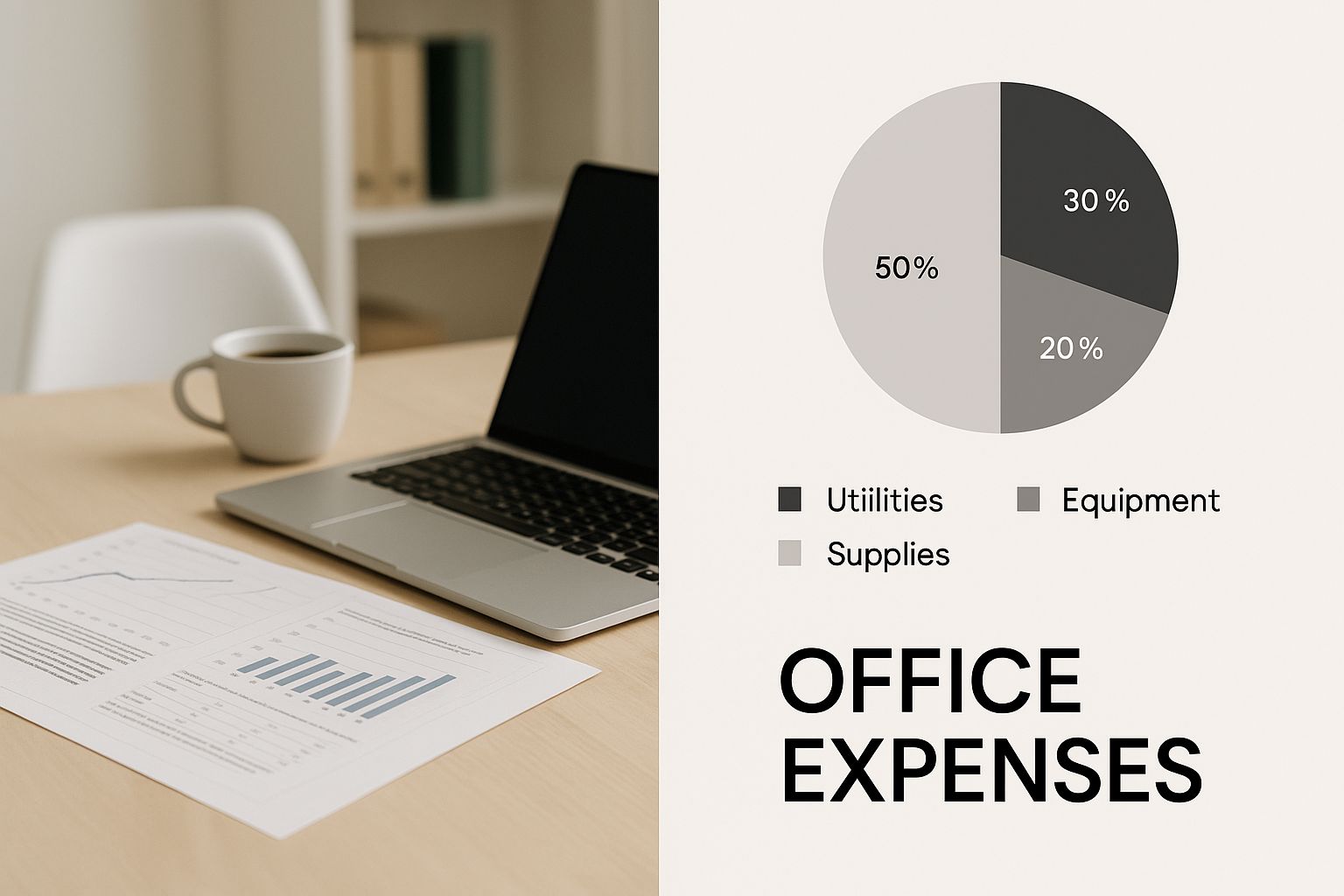
As you can see, these costs cover everything from the physical space you occupy to the digital tools that make modern business possible.
Working From Home Expenses: The Two Ways To Claim
When your home doubles as your office, you can't just claim your entire mortgage payment or the whole electricity bill. That wouldn't be fair. Instead, you need to work out the portion that’s genuinely for your business. Let’s break down the two approved ways to do this.
1. The Simplified Flat Rate Method
Think of this as the "quick and easy" option. It's designed to save you from tedious calculations. HMRC offers a set flat rate you can claim based purely on the number of hours you work from home each month.
- £10 a month: For working 25-50 hours from home.
- £18 a month: For working 51-100 hours from home.
- £26 a month: For working 101 or more hours from home.
It’s important to know what this covers. The flat rate is for your extra heat, light, and power. It does not include your business phone calls or internet usage – you'll still need to claim the business portion of those bills separately.
2. The Actual Cost Method
If the flat rate feels a bit low for your situation, you can roll up your sleeves and calculate a proportion of your actual household running costs. It takes a bit more effort, but it often leads to a larger, more accurate claim, especially if you have a dedicated room you use solely as an office.
To go down this route, you’ll need to figure out a reasonable percentage of your home that you use for business. A common method is to count the number of rooms (excluding bathrooms and hallways) and work from there. For instance, if you have five main rooms and use one exclusively as your office, you could argue that 20% of your home is for business use.
You can then apply that percentage to a range of household bills, including:
- Council Tax
- Mortgage interest (not the capital repayment part) or rent
- Electricity and gas
- Home insurance
- Water rates
This method can unlock significant tax relief, making it a popular choice for sole traders with higher running costs. Choosing the right approach is vital.
To help you decide which path is right for you, here’s a quick comparison of the two methods.
How to Claim Home Office Expenses: A Comparison
| Method | What It Covers | Best Suited For | Required Records |
|---|---|---|---|
| Simplified Flat Rate | A flat-rate allowance for heat, light, and power. Phone and internet are claimed separately. | Sole traders who work from home occasionally or want maximum simplicity without detailed record-keeping. | A simple log of the hours you work from home each month. |
| Actual Cost Method | A percentage of actual household bills (rent, mortgage interest, council tax, utilities, etc.). | Sole traders with a dedicated home office or higher running costs, who want to maximise their claim. | Detailed records of all household bills and a clear, justifiable calculation of your business use percentage. |
Ultimately, while the flat rate offers simplicity, taking the time to calculate your actual costs could save you more money on your tax return. For a much deeper dive, check out our full guide on how to claim home office expenses to help you make the best decision.
Claiming for Office Equipment and Software
Beyond the bills for your workspace, your business runs on tangible equipment and digital tools. These are also allowable expenses, and they generally fall into two different categories.
Everyday Office Supplies (Revenue Expenses)
These are the day-to-day, consumable items that keep your business ticking over. You can claim the full cost of these in the same tax year you buy them. It’s pretty straightforward.
- Stationery: Think pens, paper, printer ink, and postage.
- Software Subscriptions: Your monthly or annual fees for tools like Microsoft 365, accounting software, or project management apps.
- Business Phone Calls: The business-use percentage of your mobile or landline bill.
Larger Assets (Capital Allowances)
What about bigger purchases that you’ll be using for several years? For these, you’ll usually claim tax relief through capital allowances instead of as a simple expense. This system allows you to deduct a portion of the item's value from your profits over its useful life.
Examples of assets that fall into this category include:
- A new laptop or computer
- A printer or scanner
- Office furniture, like a proper ergonomic desk or chair
This distinction is important. While everyday supplies reduce your profit right away, capital assets provide tax relief more gradually, reflecting their long-term contribution to your business.
Getting to Grips with Travel and Vehicle Costs
Travel expenses often trip up sole traders, but getting them right is a huge part of claiming everything you’re entitled to. The first and most important rule to remember is this: your daily commute from home to your normal, permanent place of work is never an allowable expense. HMRC sees this as a personal choice and cost, not a business journey.
So, what can you claim? Think about journeys you make specifically for your business. This could be driving to a client's office for a meeting, visiting a supplier across the country, or travelling to a temporary workplace for a particular project. These trips are essential to running your business, which is what makes their costs tax-deductible.
If you use your own vehicle, HMRC gives you two ways to claim for the running costs. Which one you pick really depends on how much you drive and, frankly, how much paperwork you're willing to do.
The Easy Route: Simplified Mileage Allowance
For most sole traders, the simplified mileage allowance is the way to go. It’s wonderfully straightforward. Instead of hoarding receipts for fuel, insurance, and repairs, you just claim a flat rate for every business mile you cover.
HMRC’s approved mileage rate is designed to cover everything – fuel, insurance, road tax, servicing, even the wear and tear (depreciation) on your vehicle.
- For cars and vans: You claim 45p per mile for the first 10,000 business miles you drive in a tax year.
- After 10,000 miles: The rate for any further miles drops to 25p per mile.
- For motorcycles: It’s a simple flat rate of 24p per mile, no matter how far you ride.
To use this method, you absolutely must keep a mileage log. It doesn’t have to be fancy, but it needs to show the date of each trip, where you started and finished, the reason for the journey, and the number of miles. This log is your proof if HMRC ever has questions.
The Detailed Approach: Actual Vehicle Costs
The other option is to calculate and claim the actual costs of running your vehicle. This method is a lot more work as it involves meticulous record-keeping, but it can sometimes lead to a bigger tax deduction, especially if you have high running costs.
You'll need to add up every penny you spend on things like:
- Fuel and oil
- Vehicle insurance
- Repairs and servicing
- Road tax (Vehicle Excise Duty)
- MOT tests
Once you have a total for the year, you need to work out what percentage of the vehicle's use was for business. For example, if you figure out that 60% of your mileage was for work, you can claim 60% of your total vehicle running costs. With this method, you might also be able to claim capital allowances for the vehicle itself, which is a separate, more complex calculation.
Don't Forget Other Business Travel Expenses
Your travel claims aren't just about your car. Any travel you undertake "wholly and exclusively" for your business is fair game. The key is to be honest about separating the business part of any trip from the personal.
Here are some common examples of other travel expenses you can claim:
- Public transport: Fares for trains, buses, planes, and taxis for business trips are all allowable.
- Overnight stays: If a business trip requires you to stay away from home, the cost of your hotel or B&B is a valid expense.
- Food and drink: You can claim for reasonable meal costs when you’re on an overnight business trip.
Here's a good rule of thumb: if you wouldn't have spent the money if it weren't for that specific business trip, it's probably an allowable expense. Keeping this simple test in mind will help you stay on the right side of HMRC while making sure you lower your tax bill as much as legally possible.
Staff Training and Professional Fees

When your business grows beyond just you, your list of potential expenses naturally gets longer. Bringing on help, whether it’s your first employee or a specialist subcontractor, opens up a whole new set of costs you can claim. The same goes for investing in your own skills and paying for the professional services that protect your business.
From salaries to professional indemnity insurance, these are all perfectly legitimate deductions. Claiming them properly is a huge part of running a successful venture and can make a real difference to your final tax bill. Let's break down what you need to know about claiming for people, training, and professional fees.
Claiming for Staff and Subcontractors
Hiring your first employee or bringing in a freelancer is a massive milestone. The good news? The costs involved are some of the most straightforward sole trader allowable expenses you’ll come across. It makes sense, really – paying people to help you earn money is a fundamental cost of doing business.
For sole traders with a team, these costs are a major category. The tax rules let you deduct salaries, bonuses, and your contributions to pensions and National Insurance, provided they are all purely for the business. It’s more common than you might think; a 2023 study showed that nearly 31% of UK sole traders had at least one person on their payroll. You can find more details about staffing costs as a self-assessment expense over at creative.accountants.
Here’s a quick rundown of what you can claim:
- Employee salaries and any bonuses paid out.
- Employer’s National Insurance contributions that you have to pay.
- Employer pension contributions made into a workplace pension.
- The fees for hiring subcontractors or freelancers for specific jobs.
- Agency fees if you've used a recruitment agency to find staff.
Just remember to keep flawless payroll records. And a quick word of caution: if you employ a family member, their pay must be a reasonable market rate for the work they actually do. You can't just pay them a huge salary to try and lower your tax bill.
Investing in Your Professional Development
Keeping your skills sharp isn't just good for business – it's also a tax-deductible activity. HMRC lets you claim for training courses and professional development that helps you maintain or improve the skills you need for your current business.
Think of it as keeping your tools in top condition. If you’re a web developer, a course on a new coding language is a solid claim. If you’re a freelance writer, attending an SEO workshop to improve your online writing is also perfectly allowable.
Here’s the crucial bit: the training has to relate to your existing business. You can’t claim for a course that teaches you a completely new profession. HMRC sees that as setting up a new venture, not as an expense for your current one.
This rule keeps the claims directly tied to the income you’re already generating.
Essential Professional Fees and Subscriptions
Beyond your team and your training, there’s a whole host of professional services and subscriptions that are simply part of the cost of doing business safely and effectively. These absolutely count as sole trader allowable expenses.
- Professional Indemnity Insurance: An absolute must-have for many service-based businesses, this covers you if a client alleges your work was negligent.
- Accountant's Fees: The money you spend on an accountant to prepare your business accounts and Self Assessment tax return is fully claimable.
- Legal Fees: If you need a solicitor for something business-related, like drafting a client contract, you can claim for their time.
- Trade Subscriptions: Your membership fees for professional bodies or subscriptions to trade magazines relevant to what you do are also allowable.
Each of these is a cost that directly supports or protects your business, making them valid deductions when it’s time to work out your profit.
Marketing, Subscriptions, and Financial Costs
Getting your business name out there costs money, but the good news is that most of what you spend on promotion is a sole trader allowable expense. From Google ads to the cost of keeping your website live, these are all fundamental parts of generating income. That makes them a valid deduction against your profits.
This category, however, contains one of the most common tripwires for new business owners: business entertainment. It's crucial to know where HMRC draws the line between genuine marketing and simply treating a client, because their rules are crystal clear. Alongside marketing, we'll also untangle the essential financial costs that keep the wheels of your business turning.
What Marketing and Advertising Costs Can I Claim?
Think of it this way: if you're spending money specifically to attract customers, it’s almost certainly a claimable marketing cost. In this day and age, that covers a huge range of activities, both online and offline. Every pound you spend here directly lowers your profit, which in turn lowers your tax bill.
Here are some of the most common marketing expenses you can definitely claim:
- Digital Advertising: This is a big one. It includes all your pay-per-click (PPC) campaigns on platforms like Google Ads, as well as any advertising you run on social media like Facebook or Instagram.
- Website Expenses: You can absolutely claim for your annual domain name registration, website hosting fees, and any costs for professional themes or plugins that make your site work.
- Printed Materials: Old school still works! The cost of designing and printing your business cards, flyers, and brochures are all allowable.
- Professional Subscriptions: Any subscriptions to trade publications or journals that are directly relevant to your industry are deductible.
The Business Entertainment Trap
This is an area where so many sole traders trip up. Taking a client out for lunch might feel like a core part of building a business relationship, but HMRC does not see it that way. Business entertainment is not an allowable expense.
That includes meals, drinks, or tickets to events for your clients, suppliers, or customers.
The rule of thumb is simple: you can't claim tax relief on the cost of entertaining anyone who isn't a direct employee of your business. It's one of the few business-related costs that is specifically disallowed.
This strict rule exists to prevent claims for expenses that have a big personal or social element. To stay on the right side of the line, stick to claiming for direct advertising and promotional activities.
Essential Financial and Banking Costs
Beyond just marketing, your business has some core financial running costs. These are often forgotten about, but they're perfectly claimable. These are simply the expenses that come with managing your business's money.
- Bank Charges: You can claim for those monthly fees on your business bank account, as well as any charges you incur for transactions or dipping into your overdraft.
- Interest on Business Loans: If you've taken out a loan or other financing specifically for your business, the interest you pay on it is an allowable expense. Don't claim the capital repayment part, just the interest.
- Leasing Payments: Do you lease equipment instead of buying it outright? The monthly or annual payments for things like a printer, van, or specialist machinery are deductible.
These financial costs are a direct result of you being in business. Keeping a close eye on them and recording them properly ensures you aren't paying a penny more in tax than you need to, leaving more of your hard-earned cash in your pocket.
Keeping Records and Maximising Your Claims
Knowing what you can claim as an allowable expense is one thing, but being able to prove it is another matter entirely. Think of your business records as the evidence that backs up every single deduction on your tax return. Without solid proof, HMRC can disallow even the most legitimate expenses. That's why flawless record-keeping isn't just a "nice-to-have"—it's the bedrock of a tax-efficient business.
The golden rule here is simple: keep everything. This means holding onto all your sales invoices, purchase receipts, and business bank statements. HMRC expects you to keep these records for at least five years after the 31st January submission deadline for that tax year. It might sound like a long time, but that paper trail is your safety net if they ever come knocking with questions.
Embracing Technology for Smarter Record-Keeping
Luckily, you don't need a room overflowing with filing cabinets to stay organised. Modern accounting software has completely changed the game, turning what was once a chore into a simple, automated task. Many apps let you snap photos of receipts the moment you get them, instantly categorising the expense and storing it safely in the cloud. This doesn't just save you a mountain of time; it gives you a crystal-clear, real-time picture of your business's finances.
Getting into the habit of using digital tools creates a robust system that takes the stress out of Self Assessment season. For a deeper dive into setting up a system that works, check out our guide on self-employed record-keeping. A well-organised set of books is your best defence and your most powerful tool for claiming every penny you're entitled to.
Understanding the £1,000 Trading Allowance
For some sole traders, particularly those just starting out or with very low overheads, there's a simpler option. The government offers a £1,000 tax-free trading allowance, which is a flat-rate amount you can deduct from your income instead of totting up every individual cost.
So, when does it make sense to use it? The decision comes down to simple maths.
If your total allowable business expenses for the year are less than £1,000, claiming the trading allowance is the better move—it gives you a bigger tax deduction. But if your expenses add up to more than £1,000, you'll save more money by claiming for the actual costs you've paid out.
It's absolutely crucial to understand that it's an either/or choice. You can't claim the £1,000 allowance and your individual expenses.
The trading allowance was created to make life easier for people with small-scale ventures. While many established sole traders find their expenses sit somewhere between 10-20% of their income, making detailed claims far more valuable, the allowance is a fantastic simplification for those with minimal outgoings. Making the right choice here is a key part of making sure you don't hand over a penny more in tax than you legally have to. You can learn more about how the trading allowance impacts tax calculations on unbiased.co.uk.
Got Questions About Your Sole Trader Expenses?
When you’re a sole trader, figuring out what you can and can’t claim as an expense can feel a bit like navigating a maze. It’s those small, everyday costs that often cause the most confusion, but getting them right is key to filing your tax return with confidence.
Let's clear up some of the most common questions we get asked. We'll look at those tricky "what if" scenarios and help you apply that all-important 'wholly and exclusively' rule to your day-to-day spending.
Can I Claim For My Mobile Phone Bill?
Yes, you can—but only for the business part. If you use one phone for everything, you can't just claim the whole bill. You need to work out a reasonable split between personal and business use. A good way to do this is to go through a few months of itemised bills and see what percentage of your calls and data are for work. You might find it’s around 60% business use, for example.
Of course, the easiest way to handle this is to have a second mobile phone that you use only for work. If you do that, things are much more straightforward. You can claim 100% of the contract cost or any pay-as-you-go credit you add.
Is My Work Clothing Tax Deductible?
Honestly, probably not. HMRC has very firm rules on this. The cost of everyday clothing, even if it's a smart suit you bought just for client meetings, isn't an allowable expense. Why? Because you could technically wear it for personal reasons, so it doesn't pass the 'wholly and exclusively' test.
There are really only two exceptions here:
- A uniform with your company logo clearly on it.
- Protective gear that’s essential for your job, like steel-toed boots for a builder or a high-vis jacket for a construction site worker.
These are things you simply wouldn't wear outside of work, which is why HMRC allows them.
What Happens If I Make a Mistake On My Expense Claims?
Don't panic! It's usually quite simple to fix an honest mistake. If you realise you've made an error after filing your Self Assessment, you can just amend your tax return. You normally have up to 12 months from the 31 January deadline to log in to your Government Gateway account and make the changes online.
If it's been longer than that, you'll need to write to HMRC directly, explain what happened, and provide the correct figures. The best advice is always to act as soon as you spot an error—it shows you’re being responsible and helps avoid any penalties down the line.
Can I Claim For Food and Drink?
This is a common point of confusion. You can't claim for your daily lunch, even if you eat it at your desk. That's just considered the everyday cost of living.
However, you can claim for reasonable food and drink costs when you’re travelling for work outside your normal routine, such as on an overnight business trip. The one thing to remember is that you can never claim for entertaining. Taking a client or a supplier out for lunch is specifically disallowed by HMRC, so that's one expense you'll have to cover yourself.
Feeling like you're drowning in the rules? The experts at Stewart Accounting Services can help you make sense of your Self Assessment, making sure you claim every single penny you're entitled to. Learn more about our services for sole traders.