

Did you know that simply “withdrawing” money from your business bank account could be the most expensive mistake you make this year? Many directors feel a lingering sense of dread when considering how to pay myself from a limited company, often fearing they might accidentally trigger an HMRC penalty or pay far more in tax than is actually required. It is exhausting to juggle the complexities of the 2026/27 tax thresholds while trying to manage the daily operations of your business.
We believe that your hard work should result in personal liberty, not administrative headaches. You deserve a clear, predictable routine that optimizes your finances and protects your mental well-being. In this guide, we will break down the most tax-efficient strategies for the current year, including the ideal balance between a £12,570 salary and dividend payments. We’ll also show you how to utilize employer pension contributions and legitimate expenses to minimize your Corporation Tax burden. By the end of this article, you’ll have a straightforward plan to maximize your take-home pay and finally delegate the stress of compliance to the past.
Key Takeaways
- Identify the core differences between salaries, dividends, and director’s loans to build a withdrawal strategy that suits your personal goals.
- Learn how to pay myself from a limited company by utilizing the £12,570 salary threshold to maximize your 2026/27 personal allowance.
- Discover how to legitimately lower your Corporation Tax bill by correctly identifying and reimbursing “wholly and exclusively” business expenses.
- Avoid costly HMRC penalties by understanding the common tax traps associated with overdrawn Director’s Loan Accounts.
- Streamline your administrative burden by setting up a compliant monthly payroll routine that handles Real-Time Information (RTI) submissions with ease.
What are the three main ways to take money out of a limited company?
Many new business owners find the transition from sole trader to limited company director slightly jarring. The most important thing to remember is that the company’s money is not your money. Because a limited company is a separate legal entity, you cannot simply transfer cash to your personal account without a formal process. Understanding how to pay myself from a limited company involves navigating three distinct channels: a director’s salary, shareholder dividends, and expense reimbursements. Each method has different tax implications and administrative requirements that we will help you master.
Taking a director’s salary through PAYE
Running a monthly payroll is the most common way to establish a steady, predictable income. When you pay yourself a salary, the company treats this payment as an “allowable expense.” This is highly beneficial because it reduces the total profit subject to UK Corporation Tax. Even if you’re the only person in the business, you must register as an employer with HMRC. This allows you to process your pay through the Pay As You Earn (PAYE) system. Beyond the immediate cash flow, taking a salary above the Lower Earnings Limit ensures you continue to build your State Pension record. It provides a foundation of financial stability while keeping your business fully compliant with national regulations.
Issuing dividends from company profits
Dividends represent your reward for owning shares in the business. Unlike a salary, dividends are paid out of “retained profits,” which is the money left over after all expenses and taxes have been settled. It’s vital to check that your company actually has profit available before declaring a dividend. If you don’t have enough profit, the payment could be classed as an illegal distribution. While dividends aren’t a deductible business expense for the company, they often attract lower personal tax rates than a standard salary. You also have the freedom to choose the timing of these payments. You might take them quarterly, annually, or whenever the business has a healthy surplus. This flexibility is a powerful tool for managing your personal tax brackets effectively.
Reimbursing business expenses
The third way to extract funds is through expense reimbursement. If you’ve used your personal money to pay for business costs, the company can pay you back. Common examples include:
- Business mileage for travel to clients.
- Professional indemnity insurance premiums.
- Specific equipment or software needed for your role.
- A flat rate allowance for using your home as an office.
This isn’t “income” in the traditional sense, so you won’t pay personal tax on these repayments. However, you must follow the “wholly and exclusively” rule. Every penny must be spent solely for business purposes. Keeping meticulous records and receipts is essential. It ensures that when you’re looking at how to pay myself from a limited company, you’re doing so in a way that satisfies HMRC that these payments aren’t just hidden, untaxed salary.
The most tax-efficient pay structure for 2026
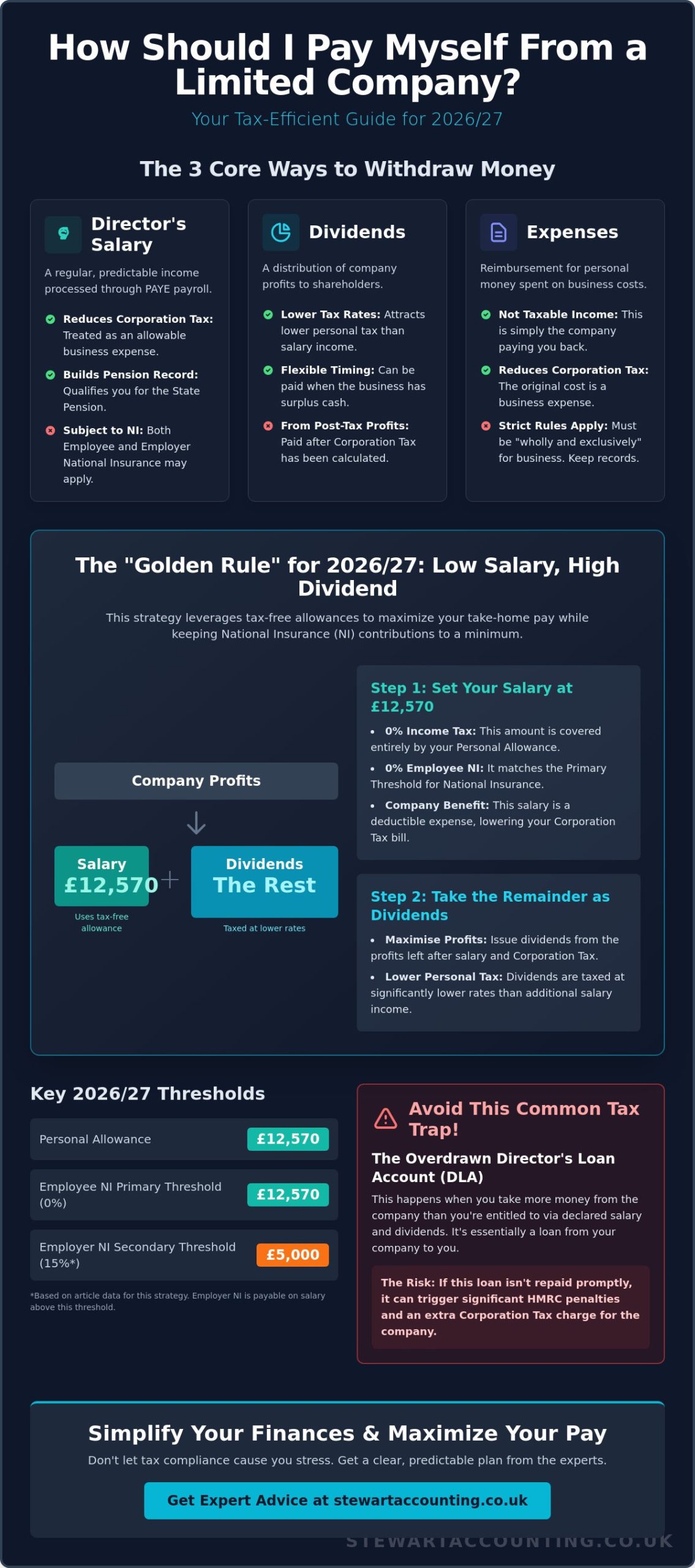
Determining the most efficient way to extract profit involves a careful balancing act. Your goal is to maximize your personal take-home pay while minimizing the total tax burden on your business. If you’re wondering how to pay myself from a limited company in the 2026/27 tax year, the strategy remains centered on a “low salary, high dividend” approach. This method is designed to utilize your tax-free allowances while keeping National Insurance (NI) contributions as low as possible.
The “Golden Rule” for most sole directors is to set a salary that matches the personal allowance of £12,570. Because this figure aligns with the 2026/27 Primary Threshold for National Insurance, you won’t pay any personal income tax or employee NI on this portion of your income. It’s a strategic sweet spot that provides you with a basic income while leaving the rest of your company’s profit available for dividends, which are taxed at lower rates than standard earned income.
Understanding the 2026 National Insurance thresholds
National Insurance can be confusing because there are different thresholds for you and your company. For the 2026/27 tax year, the Primary Threshold is £12,570; this is the point where you personally would begin paying 8% NI on your salary. However, the company must pay employer NI at a rate of 15% on any salary above the Secondary Threshold of £5,000. Even if your company pays some employer NI, keeping your salary at £12,570 is often still beneficial because it’s a deductible business expense that reduces your Corporation Tax. Crucially, as long as you stay above the Lower Earnings Limit of £6,708, you’ll still earn credits toward your State Pension without necessarily paying any NI yourself.
Scottish Income Tax vs. UK Dividend Tax
If you’re based in Scotland, your tax planning requires an extra layer of attention. While dividend tax rates are uniform across the UK, the Scottish Government sets its own income tax bands for salaries. This means that while your £12,570 salary remains tax-free, any amount above that could be subject to different rates than those in England or Wales. Fortunately, dividend tax rates remain at 10.75% for basic rate taxpayers and 35.75% for higher rate taxpayers regardless of where you live in the UK. Balancing these regional differences is a key part of professional tax planning.
To keep your total tax bill low, you should aim to keep your combined income from salary and dividends below the Higher Rate threshold of £50,270. After using your £12,570 salary and your £500 dividend allowance, you have roughly £37,200 of dividends that can be taxed at the lower basic rate. If you find you need to withdraw more than this, you might consider a Director’s Loan Account, though this carries specific risks that must be managed. For a deeper look at managing your business finances, see our guide on Year End Accounts: A Simple Guide for UK Small Businesses. This structured approach helps you maintain total peace of mind while ensuring your business remains a vehicle for your personal liberty.
Reimbursing expenses and managing benefits
Are you overlooking simple, tax-free ways to get money out of your business? While salary and dividends are the primary focus for most directors, reimbursing your business expenses is a vital method to consider when planning how to pay myself from a limited company. These payments aren’t technically income; they’re the company paying you back for costs you’ve already covered. To stay compliant with HMRC, you must follow the “wholly and exclusively” rule. This means every claim must be for a cost incurred solely for the purpose of your trade.
What counts as a legitimate business expense?
Many directors feel a sense of anxiety about what they can and can’t claim. We want to replace that confusion with clarity. When you’re mapping out how to pay myself from a limited company, remember that these reimbursements are a pound-for-pound saving. Common claimable items include:
- Travel and subsistence: You can claim mileage at 45p per mile for the first 10,000 business miles. You can also claim for meals, but only when you’re traveling away from your usual place of work for business purposes.
- Technology and equipment: If you buy a laptop, phone, or software subscription specifically for your work, the company can reimburse you. Just ensure the contract is in the company’s name where possible.
- Professional development: Training courses that refresh or update your existing skills are generally allowable. This helps you stay at the top of your field while reducing your company’s taxable profit.
Avoiding the pitfalls of Benefits in Kind
A “Benefit in Kind” (BIK) occurs when your company provides you with something for personal use, such as a company car or private medical insurance. These often trigger extra tax and National Insurance through a P11D form. We often find that for many directors, owning a car personally and claiming mileage is more efficient than the high tax costs of a company vehicle, unless you’ve opted for a low-emission electric model.
How to avoid the Director’s Loan Account tax trap
Sometimes, the standard routes of salary and dividends don’t cover every financial situation you face. If you find yourself in a position where you need to take extra money from the business that hasn’t been processed through payroll or declared as a dividend, you have effectively borrowed money from your company. This creates a Director’s Loan Account (DLA). It is a record of every penny that moves between you and your business. While this can be a useful tool for short term cash flow, it is also one of the most common ways directors accidentally trigger heavy tax penalties. Understanding the rules of the DLA is a vital part of learning how to pay myself from a limited company safely.
When a payment becomes a loan
Many directors fall into the DLA trap by accident. This often happens when you withdraw money during the year assuming there is enough profit to cover a dividend, only to realize at year end that the profits were lower than expected. In this scenario, the “dividend” you took is reclassified as a loan. If the total amount you owe the company stays below £10,000, there are no immediate personal tax implications. However, if the loan exceeds £10,000 at any point, it is treated as a Benefit in Kind. You will then need to pay personal income tax on the “interest” you would have paid on a commercial loan, and the company will face extra National Insurance costs.
For the 2026/27 tax year, HMRC applies a 33.75% S455 tax charge on any director’s loan balance that remains unpaid nine months and one day after the company’s accounting period ends. This is a temporary tax that the company can eventually claim back once the loan is repaid, but it can create a massive, unnecessary strain on your cash flow in the meantime.
Managing your DLA with professional oversight
To avoid these year end shocks, we recommend a proactive approach to your bookkeeping. Rather than waiting until your accounts are due, quarterly reviews allow you to see exactly where your DLA stands. This gives you the chance to “clear” the loan by declaring a dividend or adjusting your salary before the tax deadlines hit. You must also be aware of the “bed and breakfasting” rules. HMRC don’t allow you to repay a loan just before the deadline and then immediately withdraw the same amount a few days later. If you re-borrow the money within 30 days, they will treat the original loan as if it was never repaid.
The mental burden of tracking these specific dates and thresholds can be significant. By delegating the management of your DLA to us, you ensure that every transaction is documented correctly and that you are alerted well in advance of any potential tax traps. This total transfer of responsibility is a key step in achieving the financial liberty you started your business for. If you want to ensure your withdrawal strategy is fully compliant, our team can help you with expert tax planning that keeps your DLA in the green.
Setting up your monthly pay routine
Transitioning from financial theory to a practical monthly workflow is where many business owners feel the most stress. Establishing a clear, repeatable routine is the final piece of the puzzle when learning how to pay myself from a limited company. This process isn’t just about moving money between bank accounts; it’s about creating a bulletproof audit trail that satisfies HMRC and protects your hard-earned profits. A structured approach ensures you never miss a deadline or leave your business vulnerable to an inquiry.
The monthly payroll cycle
Your director’s salary must be processed through a formal Pay As You Earn (PAYE) system. This starts with registering as an employer to obtain your unique reference numbers. Every time you pay yourself, you’re required to submit a Real-Time Information (RTI) return to HMRC. This digital report tells the tax office exactly how much you’ve earned and details any deductions for tax or National Insurance. Even if your salary is set at the tax-efficient £12,570 mark and no tax is due, the RTI submission remains a legal necessity. We recommend using Xero for this task. It integrates directly with HMRC to make these submissions seamless and keeps your bookkeeping updated in real time. If you do have tax or NI to pay, ensure the funds reach HMRC by the 22nd of the month.
The dividend documentation checklist
While payroll is often automated, dividends require a more manual administrative touch. Many directors make the mistake of thinking a bank transfer is enough, but without the correct paperwork, HMRC could reclassify those payments as salary. This could result in an unexpected bill for back-dated National Insurance. To stay compliant, you must follow this checklist every time you take a dividend:
- Board Minutes: You must record a formal minute of a meeting where the dividend was declared. This applies even if you’re the sole director.
- Dividend Vouchers: You must issue a voucher that shows the date, the company name, and the total amount paid to you as a shareholder.
- Profit Check: You must confirm that the company has enough “retained profit” after Corporation Tax to cover the payment.
It’s a legal requirement to store these records for at least six years. Keeping these documents organized doesn’t just satisfy the law; it makes your year-end accounts preparation much smoother and faster.
Take control of your business finances today
Deciding how to pay myself from a limited company doesn’t have to be a source of constant anxiety. By setting a strategic £12,570 salary and supplementing it with documented dividends, you can maximize your take-home pay while staying fully compliant. Remember that keeping accurate records of business expenses and monitoring your Director’s Loan Account are the best defenses against unexpected tax charges. These simple steps ensure your business remains a vehicle for your personal and professional growth.
You started your business to find liberty, not to get buried in payroll administration and tax thresholds. As Chartered Accountants in Alloa, Stirling, and Falkirk, we have over 20 years of experience supporting Scottish SMEs with expert tax-efficient profit extraction. We are here to remove the technical burden from your shoulders, ensuring your monthly routine is smooth and stress-free. Let us handle your payroll and tax planning—book a free consultation today.
Your financial peace of mind is well within reach, and we look forward to helping you achieve it.
Frequently Asked Questions
Can I pay myself a salary without registering for PAYE?
No, you generally cannot pay a salary without registering for PAYE if the amount exceeds the Lower Earnings Limit of £6,708. HMRC requires you to register as an employer to report payments via Real-Time Information (RTI) submissions. This is a critical step when establishing how to pay myself from a limited company, as it ensures your business remains fully compliant with national tax regulations from day one.
How often should I pay dividends from my limited company?
You can pay dividends as often as you like, provided the company has sufficient retained profit after Corporation Tax. Most directors choose to take them quarterly or twice a year to keep the administrative paperwork manageable. It’s essential to document each payment with board minutes and a dividend voucher to ensure they aren’t mistaken for salary by HMRC during an inspection.
What happens if I take more money than my company has made in profit?
If you withdraw more money than your company has made in profit, the excess is usually treated as a Director’s Loan. This creates an “overdrawn” Director’s Loan Account, which can trigger a 33.75% S455 tax charge if not repaid within nine months and one day of your year end. This complex area often causes significant stress for business owners who lack professional oversight.
Is it better to take a higher salary or higher dividends in 2026?
Taking a lower salary and higher dividends remains the most tax-efficient method for how to pay myself from a limited company in 2026. While dividend tax rates increased by 2% on April 6, 2026, they are still lower than the combined cost of Income Tax and National Insurance on a higher salary. A salary of £12,570 is usually the ideal starting point to utilize your personal allowance.
Do I have to pay National Insurance if I only take dividends?
No, you don’t pay National Insurance on dividend payments because they are distributions of profit, not earned income. However, if you only take dividends and no salary, you won’t build up qualifying years for your State Pension. This is why most directors take a small salary above the £6,708 Lower Earnings Limit to protect their future benefits without paying unnecessary contributions.
Can my spouse be paid a salary or dividends from my company?
Yes, your spouse can receive a salary or dividends, but the payments must be justifiable to HMRC. A salary must reflect actual work they perform for the business at a commercial rate. To receive dividends, they must be a legal shareholder in the company. This is a practical way to utilize two sets of personal tax allowances and improve your household’s total take-home pay.
What is the 2026/27 Dividend Allowance in the UK?
The Dividend Allowance for the 2026/27 tax year is £500. This means the first £500 of dividend income you receive is tax-free, regardless of your other income levels. Any dividends above this amount are taxed at 10.75% for basic rate taxpayers, 35.75% for higher rate taxpayers, and 39.35% for those in the additional rate band. These rates reflect the 2% increase that took effect in April 2026.
How does the Scottish Higher Rate of tax affect my pay structure?
The Scottish Higher Rate of tax applies to the salary portion of your income, potentially increasing the tax due if your salary exceeds the specific Scottish threshold. However, dividend tax rates are set by the UK government and remain uniform across the country. We help our clients in Alloa and Stirling balance these different tax regimes to ensure their total take-home pay is maximized while staying compliant.