
When you're self-employed, an invoice isn't just a slip of paper asking for money. It's a critical business document that wraps up a project, reinforces your brand, and, most importantly, makes sure you get paid on time. Think of it as a legal requirement for your tax records that also doubles as a final, professional handshake with your client.
Why Your Invoice Is a Key Business Tool
It’s easy to see invoicing as a bit of a chore—something you quickly cobble together after the real work is done. But it’s so much more than that. Your invoice is often the last thing a client sees from you, so it's your final chance to make a great impression. A clear, well-organised invoice cuts down on confusion, prevents those annoying back-and-forth emails, and helps you get paid faster.
This isn't just about looking professional; it's about financial survival. The self-employed workforce is a huge part of the UK economy. In late 2025, there were around 4.39 million of us—freelancers, contractors, and sole traders—all relying on getting paid for our work. Solid invoicing is what keeps the cash flowing for this massive, vital part of the economy.
More Than a Bill: A Multi-Faceted Document
A good invoice does a lot of heavy lifting for your business, long after you’ve hit send.
Here’s a quick rundown of what it really does:
- Shows You're a Pro: A polished, well-branded invoice screams reliability and attention to detail. It reflects the quality of your work.
- Acts as a Legal Record: It’s your proof of the work you did and the payment terms you both agreed to. Invaluable if a dispute ever pops up.
- Makes Bookkeeping a Breeze: Every invoice is a breadcrumb for your financial records. It makes tracking your income and getting ready for your Self Assessment tax return so much simpler.
- Helps You Manage Cash Flow: By setting clear due dates and payment options, you’re taking control of when money comes in. This makes it far easier to plan ahead.
A great invoice doesn't just ask for money—it communicates professionalism, clarifies expectations, and protects your business. It’s a reflection of the quality of your work.
Of course, getting your invoicing right is just one piece of the puzzle. It's also vital to protect yourself and your business from the unexpected. It's worth looking into the essential insurance policies for self-employed professionals to make sure you're covered.
Ultimately, mastering your invoicing is a core skill. It helps you stay on the right side of HMRC, builds a sustainable business, and lets you focus on what you do best.
What Makes a Great UK Invoice?
Getting your invoice right is the final, crucial step in getting paid. Think of it less as a bill and more as a clear, professional summary of the brilliant work you've just delivered. A well-constructed invoice doesn't just ask for money; it builds trust, reinforces your professionalism, and makes it incredibly easy for your client to pay you promptly.
Getting this wrong, on the other hand, can cause frustrating delays. A missing detail or a vague description can leave your invoice sitting in someone's inbox while they try to figure out who it's from or what it's for. Let’s break down exactly what needs to be on there to make sure it’s professional, compliant, and gets you paid faster.
Start with Who's Who: Your Details and Your Client's
First things first, your invoice needs to clearly state who is sending it and who needs to pay it.
On your side, you must include:
- Your Business Name: This could be your own name if you're a sole trader (e.g., "John Smith") or a trading name you use ("JS Web Design").
- Your Business Address: Use the official address you have registered for your business.
- Contact Info: Always add an email address and phone number. It gives the client an easy way to get in touch if they have a quick question.
Just as important are the client's details. Make sure you have their full, official business name and address. If you can, address it to a specific person or the accounts department. This simple step can stop your invoice from getting lost in a general inbox, especially in a larger company.
The All-Important Numbers: Invoice ID and Dates
Every single invoice you send out needs a few key identifiers. These are non-negotiable for keeping your books in order and are a legal must-have for HMRC.
- A Unique Invoice Number: This is your invoice's fingerprint. A simple sequential system like 001, 002, 003 or INV-001, INV-002 works perfectly. Never, ever reuse a number.
- The Invoice Date: This is the date you issue the invoice, which officially starts the clock on the payment terms.
- The Payment Due Date: Be crystal clear. Don't just leave it to chance. State something like "Payment due within 30 days" or specify the exact date, such as "Due by 31 October 2025".
A unique invoice number is the golden rule of invoicing. It's the primary reference for you, your client, their accounts team, and your accountant. Skipping this creates a messy paper trail that’s so easy to avoid.
What Are They Paying For? A Detailed Breakdown
This is where you show your value. Vague one-liners like "Consultancy services" are a recipe for payment delays because the client is forced to come back and ask for more detail.
You need to be specific. Break down everything you did into itemised lines. For each service or product, list:
- A clear, concise description of the work.
- The quantity (e.g., 8 hours, 5 articles, 1 project).
- Your rate (£/hour, £/word, or a fixed price).
- The subtotal for that individual line item.
Let's compare. This is a bad example:
- Design Work – £2,000
And this is how it should be done:
- Logo Design & Brand Concepts (3 rounds) – £1,200.00
- Business Card & Letterhead Design – £800.00
This level of detail leaves no room for confusion. It shows the client exactly where their money is going, which builds confidence and justifies what you're charging. If you're looking for inspiration, checking out some well-formatted invoice examples for contractors can give you a great visual starting point.
To make it even clearer, here is a complete checklist of what you should include.
Essential Components of a UK Self Employed Invoice
| Component | Why It's Important | Example |
|---|---|---|
| Your Business Name & Address | Legally identifies you as the seller/service provider. | Jane Smith T/A JS Creative, 123 High Street, London, SW1A 0AA |
| Client's Name & Address | Ensures the invoice reaches the right person or department. | Acme Ltd, 456 Business Park, Manchester, M1 1AA |
| Unique Invoice Number | Essential for record-keeping, tracking, and tax purposes. | INV-0042 |
| Invoice Date | The official date the invoice is issued. | 15 October 2025 |
| Payment Due Date | Clearly communicates your payment terms and prevents delays. | Due by 14 November 2025 |
| Description of Services/Products | Provides a clear, itemised breakdown of what is being charged for. | "Website Copywriting (5 pages @ £150/page)" |
| Subtotal | The total cost before any taxes are added. | £750.00 |
| VAT (if applicable) | If you're VAT registered, you must show the VAT amount separately. | VAT (20%) – £150.00 |
| Total Amount Due | The final, total figure the client needs to pay. Make it bold! | £900.00 |
| Payment Details | Tells the client exactly how to pay you. | Bank: Starling Bank, Acc Name: JS Creative, Sort Code: 12-34-56, Acc No: 98765432 |
Getting these elements right on every invoice will make you look more professional and help you manage your cash flow more effectively.
The Final Figures and How to Pay
After you’ve listed out all your services, the final section needs to be impossible to misread.
Start with a Subtotal (the total before tax). If you're VAT registered, you then add a separate line for VAT, clearly stating the rate and amount. Finally, present the Total Amount Due. Make this figure big and bold. It should be the most prominent thing on the page.
And last but not least, tell them how to pay you! Don't make them hunt for your details. Clearly list your bank account name, sort code, and account number for a bank transfer. If you take card payments through tools like Stripe or PayPal, include a direct payment link. The easier you make it for them, the quicker that money will land in your account.
Navigating VAT and Tax On Your Invoices
Getting to grips with your tax obligations is a non-negotiable part of being self-employed in the UK. Your invoices aren’t just a way to ask for payment; they're official documents that form the very foundation of your compliance with HMRC. Nail the details on VAT and tax, and you're not just following good practice—you're meeting a legal requirement that keeps your business on the straight and narrow.
This is especially true when it comes to Value Added Tax (VAT). For most self-employed people I talk to, the big question is always, "When do I need to start worrying about this?"
The VAT Registration Threshold
The law is clear: you must register for VAT once your VAT-taxable turnover hits the government-set threshold within any rolling 12-month period. It's crucial to keep a running total of your turnover, not just what you've made in your financial year. You also need to register if you think you'll cross the threshold in the next 30 days alone.
Once you’re registered, the way you create an invoice for your self-employed work has to change. You'll need to start charging VAT at the correct rate on your taxable sales and issuing proper VAT invoices, which come with a much stricter set of rules than your standard ones.
A common trip-up is forgetting that the VAT threshold is based on a rolling 12-month period, not your accounting year. This means you have to constantly check your total sales from the last 12 months to avoid accidentally missing the deadline to register.
It can feel a bit confusing, especially when you're juggling different income streams. This handy infographic helps break down the key invoicing requirements based on your business structure and whether you're VAT registered.
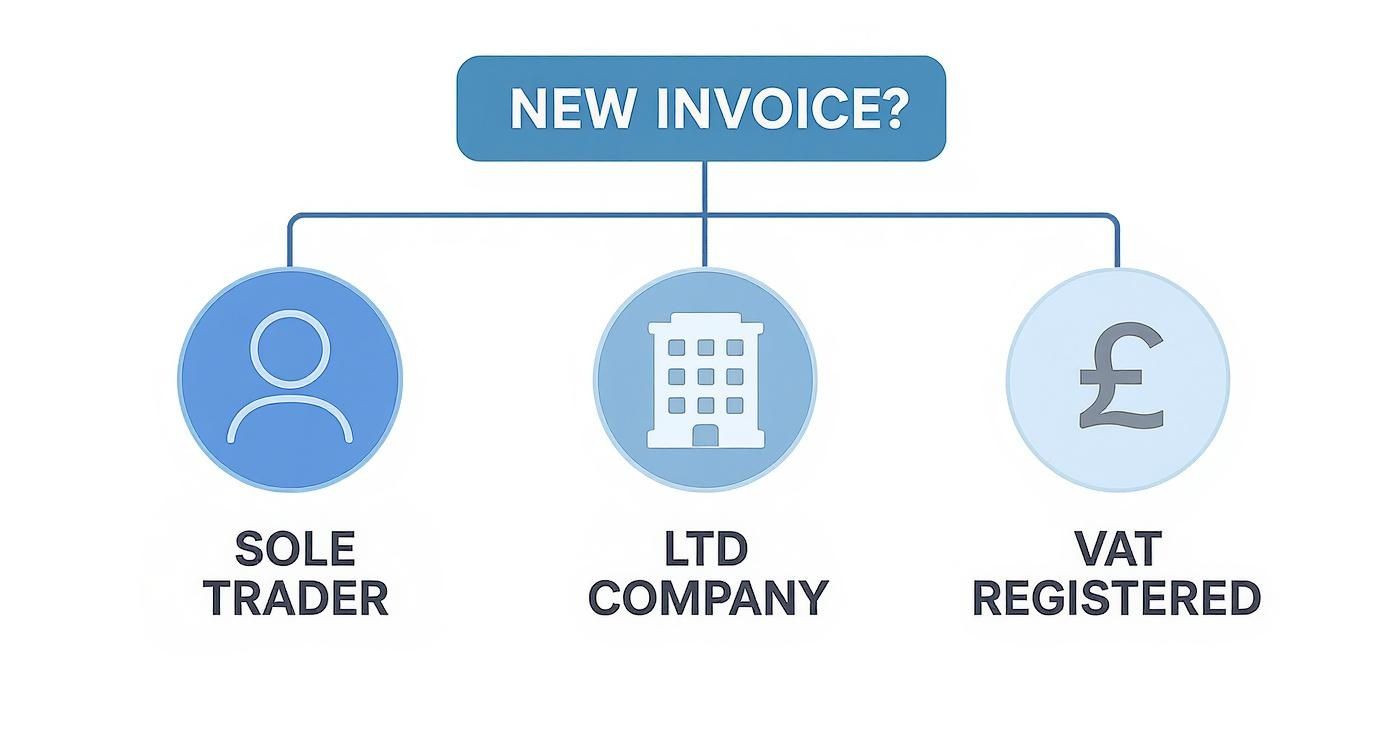
As you can see, your invoicing duties evolve as your business grows—from a straightforward sole trader invoice to the more detailed demands of a VAT-registered business.
What To Include On a VAT Invoice
When you become VAT-registered, a standard invoice just won't do anymore. HMRC has very specific rules about what a full VAT invoice must show. If you miss any of these details, it can create headaches for both you and your client, particularly if they need that invoice to reclaim their own VAT.
A compliant VAT invoice has to include several extra bits of information:
- Your VAT registration number: This is the unique code HMRC gives you.
- The tax point (or time of supply): This is usually the date you send the invoice, but it could be the date you got paid or finished the work if that happened earlier.
- A clear VAT breakdown: For every item on the invoice, you must show the net amount (before VAT), the VAT rate you've applied (e.g., 20%), and the actual amount of VAT you're charging.
- The total VAT charged: This figure needs to be shown clearly, separate from the subtotal.
Getting this right is absolutely vital for your VAT returns. For a really detailed look, Stewart Accounting Services explains more about what should be on a VAT invoice.
Invoicing and Your Self Assessment Tax Return
Think of your invoices as the primary source of truth for your income when it's time to file your Self Assessment tax return. Every single invoice you issue adds up to the turnover you declare to HMRC, which is then used to work out your Income Tax and National Insurance bills.
If you’re not VAT-registered, you must not charge VAT or even mention it on your invoices. To avoid any confusion, it’s a good idea to add a simple note like "Not VAT registered".
Ultimately, keeping a well-organised, accurate record of every invoice you send is the single best thing you can do to make tax time less of a nightmare. Each one is a building block that helps create a clear, compliant financial picture of your business.
Choosing The Right Invoicing Tools
Deciding how to create and send your invoices is a bigger deal than you might think. It’s not just admin; it’s about how fast you get paid and how much of your life you lose to bookkeeping. Your invoicing system can be a constant headache or a brilliant tool that buys you back hours every single month.
When you're first starting out, it’s tempting to go with what you know. Many of us begin by knocking up a template in Microsoft Word or Google Docs. It’s free, it’s familiar, and when you’re watching every penny, that’s a huge plus.
But this manual approach is riddled with traps. You have to remember to change the invoice number every single time. You have to double-check the date, manually add up the totals, and hope you don't make a typo. As soon as you get a few clients on the go, it becomes a real bottleneck—time spent fiddling with documents is time you’re not earning.
Dedicated Accounting and Invoicing Software
This is where proper accounting software changes the game. Platforms built for people like us—think Xero, QuickBooks, and FreeAgent—are designed to turn invoicing from a chore into a quick, automated task.
They come packed with features that a Word template just can’t compete with:
- Automation is key: The software handles all the boring bits. It generates sequential invoice numbers, calculates totals (including VAT, if you’re registered), and can even send out recurring invoices for clients on a retainer.
- Get paid faster: Most of these platforms let you connect a payment gateway like Stripe or PayPal. This adds a simple "Pay Now" button to your invoice, making it ridiculously easy for clients to pay you on the spot.
- Look the part: You can customise sleek, professional invoice templates that make your one-person operation look like a well-established business.
- Automated chasing: The system keeps track of when an invoice is sent, when your client opens it, and when it’s paid. Best of all, you can set up polite, automated reminders for overdue payments, so you don't have to be the bad guy.
A dashboard like this one from Xero gives you a live snapshot of your cash flow, showing exactly what's outstanding and what's overdue. It's a shift from just keeping records to actively managing your money.
Moving to proper accounting software is one of the best things you can do for your business. The time you save on admin and chasing payments almost always outweighs the monthly subscription fee.
When you’re looking at different options, consider how much support you might need. Some providers can connect you with specialists who offer services like Zoho Books implementation services to make sure you're set up for success from day one.
Simpler Invoicing Apps and Tools
If a full-blown accounting package feels like using a sledgehammer to crack a nut, there's a happy middle ground. Simpler, more focused invoicing apps can be a perfect fit.
Tools like Zoho Invoice or the invoicing part of FreshBooks give you the core features you need without the complexity of a full accounting suite. They’re often cheaper (some even have free plans) and are ideal if your needs are straightforward.
These apps are fantastic for firing off professional invoices in minutes, often right from your phone. You still get the crucial benefits like payment tracking and online payment options, but without the steeper learning curve. They make for a great stepping stone, professionalising your process until your business grows enough to need a more comprehensive system.
Strategies For Getting Paid On Time
Getting your invoice out the door is one thing; getting the money into your bank account is another entirely. That gap between sending an invoice and getting paid is where cash flow problems are born, so it’s something you have to actively manage. It’s all about being proactive, not just reacting when a payment is already late.
Late payments aren't just an inconvenience; they can seriously threaten the financial health of any self-employed person in the UK. Think it’s a minor issue? A recent report found that 62% of UK small businesses are currently chasing money from unpaid invoices, with the average amount owed being a staggering £21,400. You can see the full story in this in-depth report on late payments.
To make sure you don't become part of that statistic, you need a solid game plan.
Set Expectations From The Very Beginning
Honestly, the best time to ensure you get paid on time is before you’ve even done the work. Talking about money shouldn't be an awkward afterthought; it needs to be a standard, upfront part of your initial client conversations.
Before you start any project, make sure you’re crystal clear on:
- Your payment terms: Is it payment on receipt, 14 days, or 30 days? Whatever it is, get it in your contract or proposal.
- How you get paid: Let them know if you prefer a simple bank transfer, Stripe, or something else.
- What happens if they’re late: Mentioning your policy on late payment fees from the start sets a professional boundary. It’s not about being aggressive; it’s about being clear.
A quick, professional conversation at the beginning prevents so many headaches later on. It frames timely payment as a core part of your agreement, not just a casual expectation.
Make Your Invoice Easy To Pay
As soon as the job is done, get that invoice sent. Don’t wait. The value of your hard work is highest in the client's mind right after you've delivered, so capitalise on that momentum.
And please, always send your invoice as a PDF. A Word or Excel file can look a bit amateurish, is easily edited, and often doesn't display correctly on different devices. A PDF is universal, professional, and locks in your formatting.
Your goal is to remove every single bit of friction from the payment process. Make it so easy for them to pay you that it takes less time than thinking of a reason not to.
Consider adding a "Pay Now" button by linking to a payment gateway like Stripe or PayPal. Yes, they take a small fee, but the convenience often means you get paid days or even weeks faster. That's a trade-off that is almost always worth it for your cash flow. We cover more on this in our guide on how to improve cash flow with smarter invoicing habits.
The Gentle Art Of Chasing Overdue Payments
Even with the best system in the world, some invoices will slip through the cracks. How you handle this says a lot about your professionalism. The key is to have a calm, step-by-step process that doesn't immediately sour the relationship.
The First Reminder (1-3 days after the due date):
Your first follow-up should be a gentle, friendly nudge. Always assume it was an honest oversight. A polite email is perfect for this.
Example Email:
Subject: Just a friendly reminder about invoice [Invoice Number]
Hi [Client Name],
Hope you're having a good week.
This is just a quick, friendly reminder that invoice [Invoice Number] was due on [Due Date]. I've attached another copy for you just in case.
Could you let me know when I can expect to see the payment come through?
All the best,
[Your Name]
This approach keeps things positive and non-confrontational, and nine times out of ten, it’s all you’ll need to do.
When It's Time To Escalate
If a week or so goes by after that first email and you’ve heard nothing, it's time to be a little more direct. A follow-up email is a good start, but a phone call is often better. Your goal is to remain polite but firm.
Still no payment after 30 days? It’s time to bring up late payment charges. Under UK law, you have the right to charge statutory interest on late commercial payments, which is 8% plus the Bank of England base rate. You can also add a fixed sum to cover the cost of debt recovery.
Mentioning this isn't about being punitive. It’s a way of showing you take your business finances seriously. Often, the formal mention of interest is all it takes to get that invoice moved to the top of their payment pile.
Your Invoicing Questions Answered
Even with the best system in place, you're bound to run into some invoicing head-scratchers now and again. It just comes with the territory of being self-employed. So, let’s tackle some of the most common questions we hear from freelancers and sole traders across the UK.
How Long Must I Keep My Invoices?
This one’s non-negotiable. For tax purposes, HMRC requires you to keep all your business records for at least 5 years after the 31 January tax return deadline for that year. This isn't just about your sales invoices; it includes all your purchase receipts and expense claims too.
Whether you're a fan of old-school ring binders or prefer a slick digital archive, the key is having a system you can rely on. This is where cloud accounting software really comes into its own, neatly storing everything for you so it’s ready for your Self Assessment or if HMRC ever has a query.
What If I Make a Mistake on a Sent Invoice?
Don't panic—it happens to the best of us. The most important thing is how you fix it.
Whatever you do, never just delete the old invoice or edit and resend it. This creates a nightmare of a paper trail and can cause real headaches for your client’s bookkeeper (and yours!).
The proper way to handle it is by issuing a credit note.
- First, create a credit note that cancels out the original invoice. It can be for the full or partial amount of the error.
- Make sure this credit note has its own unique number (e.g., CN-001) and clearly states which invoice number it's correcting.
- Once that's sent, you can then raise a brand new, correct invoice with a fresh invoice number.
This simple two-step process keeps your records clean, clear, and auditable for both you and your client.
How Do I Handle Invoices for International Clients?
Invoicing clients based abroad can feel a bit daunting, especially when it comes to VAT. The rules really depend on where your client is and what you’re selling.
- Business clients in the EU: For most services, the 'reverse charge' rule applies. In simple terms, you don't charge UK VAT. Your client handles the VAT in their own country. You just need to put their VAT number on the invoice and add a note saying the reverse charge applies.
- Clients outside the EU: Work for clients in places like the US or Australia is generally 'outside the scope' of UK VAT, which means you don’t need to add it to your invoice.
Bear in mind, international VAT rules, particularly for digital services, can be a minefield and do change. It’s always a good idea to check the latest guidance on the official HMRC website or have a quick chat with your accountant to be safe.
Can I Use PayPal or Stripe for Payments?
Yes, and you absolutely should consider it! Using payment gateways like Stripe or PayPal can be a game-changer for getting paid on time.
Modern invoicing software, like Xero or QuickBooks, usually integrates directly with these platforms. This lets you add a simple "Pay Now" button to your invoices, making it incredibly easy for clients to pay you with a debit or credit card in just a few clicks. In my experience, that convenience almost always means faster payments, which is a massive win for your cash flow.
The only thing to remember is the transaction fees. They typically charge a small percentage plus a fixed fee per transaction. You'll want to factor this into your pricing, but for most freelancers, the benefit of getting paid promptly is well worth the small cost.
Juggling invoicing, VAT, and tax returns is a real challenge when you’re also trying to run your business and keep clients happy. At Stewart Accounting Services, we take that weight off your shoulders. We help self-employed professionals across the UK get a firm grip on their finances, giving them clarity and confidence.
Find out how we can give you more time, more money, and peace of mind by visiting us at https://stewartaccounting.co.uk.