

Staying on top of your VAT can feel like a full-time job, and the goalposts for getting it wrong have recently moved. The system for late VAT return penalties in the UK is now broken into two distinct parts: a points-based scheme for late filing and a separate set of financial penalties for late payment. Getting your head around this split is vital for keeping your business financially healthy.
Getting to Grips with HMRC's New VAT Penalty System
If you're running a VAT-registered business, you need to know how the new penalty system works. It kicked in for all VAT periods starting on or after 1st January 2023 and was brought in to be a fairer way of dealing with compliance.
The old system could feel brutal, hitting you with a financial surcharge for a single slip-up. This new approach is designed to penalise businesses that consistently get it wrong, not those who make an honest, one-off mistake.
The most important thing to grasp is that the new framework completely separates the act of filing from the act of paying. You could file your return on time but pay the bill late, and you'll face very different consequences than if you did the opposite. This two-pronged approach is HMRC's way of encouraging good habits on both the admin and the financial side.
The Two Pillars of VAT Penalties
The whole system is now built on two independent frameworks that run side-by-side. A slip-up in one area doesn't automatically mean a penalty in the other, but falling short on both can quickly lead to a painful mix of penalties and interest.
Here’s how the two components work:
- Late Submission Penalties: This is now a points-based system. It works a bit like getting points on your driving licence – each late submission adds a point to your record. Hit a certain threshold, and you’ll get a financial penalty.
- Late Payment Penalties: This is all about the money. It's a time-sensitive financial penalty that gets bigger the longer your VAT payment is overdue, calculated as a percentage of what you owe.
This separation is actually quite helpful. It means a business that files its return on the dot but is having a tough month with cash flow will only face late payment penalties, not points for late filing. On the flip side, a disorganised business that pays on time but always files late will rack up points that eventually lead to a fine, even if HMRC has all its money.
At its heart, the new regime is designed to distinguish between persistent non-compliance and the occasional mistake. HMRC wants to apply penalties that fit the behaviour, pushing businesses towards better long-term habits.
Ultimately, while this system might seem more complicated at first, it brings a bit more common sense to VAT compliance. By keeping on top of your records and talking to HMRC if you're struggling, you can steer clear of the costly stress of late VAT return penalties and concentrate on what you do best: running your business.
How the Penalty Points System for Late Submissions Works
Think of HMRC's new system for late VAT returns like penalty points on a driving licence. A single slip-up won't immediately land you in hot water, but each late submission adds a point to your record. Rack up too many, and you’re facing a fixed financial penalty. It’s a big shift from the old, all-or-nothing surcharge model to a system that penalises businesses for being consistently late.
Crucially, this points-based system is all about the filing of your VAT return. It’s completely separate from the penalties you might face for paying your VAT bill late. That means even if you pay every penny you owe on time, you'll still get a point if the return itself misses the deadline.
Accumulating Points and Reaching the Threshold
For every VAT return you file late, HMRC adds one penalty point to your business's record. It doesn't matter if you're a day late or a month late – it’s still one point. The system is designed to track a pattern of behaviour over time.
Of course, these points only start to bite once you hit a specific threshold. This limit isn't the same for everyone; it’s determined by how often you file your VAT returns. This is designed to be fairer, giving businesses that have to file more frequently a little more breathing room.
For most small and medium-sized businesses filing quarterly, the magic number is four points. You can dive deeper into the structure and what it means for you in our guide to the penalty points for late filing of VAT returns.
The diagram below clearly shows the two separate tracks for late submissions and late payments.
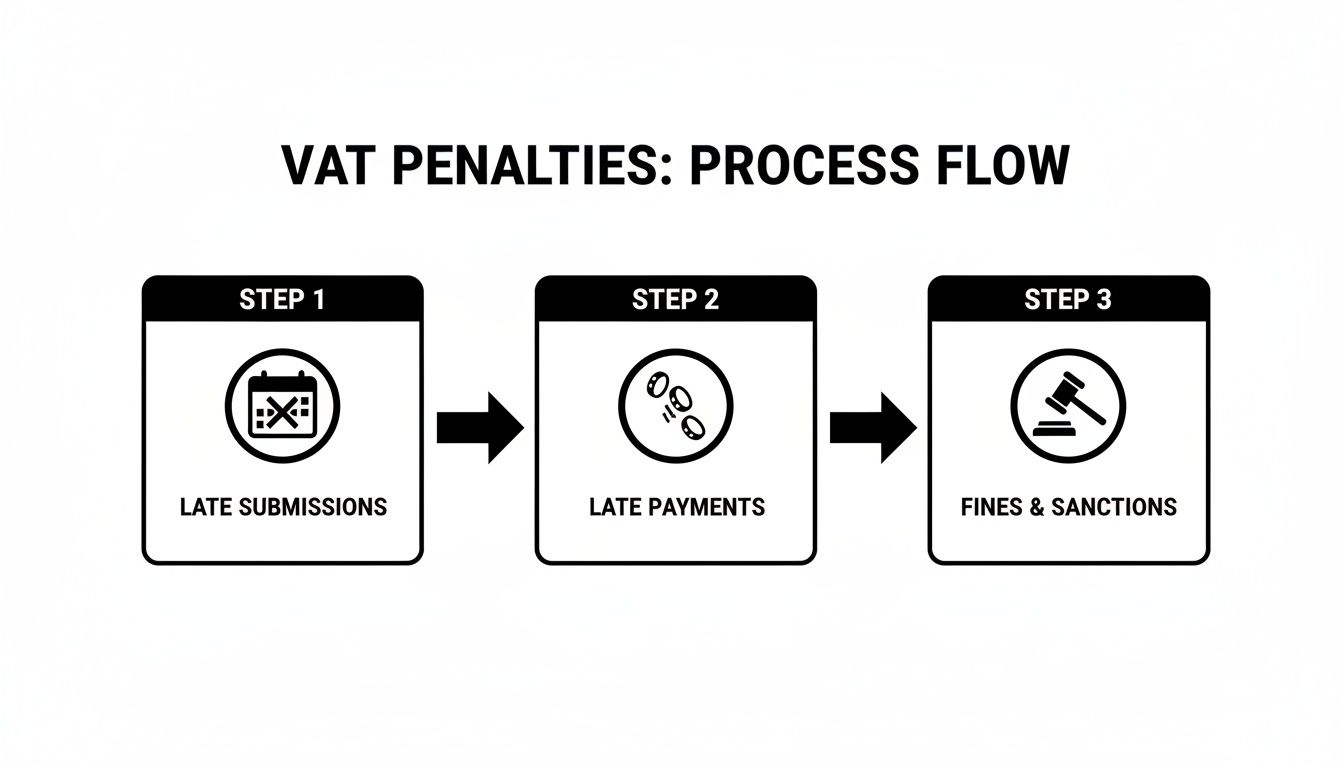
As you can see, while both problems lead to financial penalties, HMRC deals with them through completely different mechanisms: points for late filing, and interest charges for late payment.
What Happens When You Hit the Limit?
Once your business gets enough points to reach its threshold, a £200 fine is automatically triggered. And it doesn't stop there. For every subsequent late return you file while you're at the threshold, you’ll get another £200 fine. This isn't a one-off; it’s a repeating penalty designed to get your attention.
Let's say you're a quarterly filer and you've already accumulated four points from four late returns. If you then submit your next two returns late, you’ll be hit with two separate £200 fines, costing you £400 on top of any interest you might owe for late payment.
The system creates a powerful financial incentive for consistent, on-time filing. That £200 penalty is a clear signal from HMRC that their patience has run out and you need to get your house in order, fast.
Here’s a quick look at how the thresholds vary based on your filing schedule.
HMRC Penalty Point Thresholds by Filing Frequency
This table shows how many points you can accumulate before receiving that £200 fine, depending on how often you file.
| Filing Frequency | Penalty Point Threshold | Result of Reaching Threshold |
|---|---|---|
| Annually | 2 points | £200 financial penalty |
| Quarterly | 4 points | £200 financial penalty |
| Monthly | 5 points | £200 financial penalty |
As you can see, businesses filing more often are given a slightly higher threshold to account for the increased number of deadlines they have to meet.
Resetting Your Points to Zero
Getting points is easy; getting rid of them takes real effort. Unlike driving licence points that simply expire after a set time, these VAT points stick around until you prove you've changed your ways.
To wipe the slate clean and get your points back to zero, you have to meet two strict conditions:
- A period of perfect compliance: You must file all your VAT returns on time for a set period. For quarterly filers, this means 12 consecutive months (four successful on-time returns). For monthly filers, it's six months.
- All outstanding returns submitted: You must have filed every single return that was due in the past 24 months, even the ones you were late with.
You have to meet both of these conditions at the same time. Only then will HMRC reset your points. It’s a clear message: getting back on track isn't enough; you also have to tidy up any old administrative loose ends.
Calculating Penalties and Interest for Late VAT Payments
While the points system deals with the admin side of filing on time, HMRC’s approach to late payments is a whole lot simpler and hits you directly in the wallet. If you miss your VAT payment deadline, a separate system of penalties and interest charges kicks in, and they can add up surprisingly quickly.
It’s crucial to get your head around how these are calculated to understand the real cost of a delay. The system does offer a short grace period for genuine, brief slip-ups, but once that window closes, the financial consequences start to snowball. This two-stage penalty structure is designed with one thing in mind: to strongly encourage you to pay on time.
The First Penalty After 15 Days
For the first 15 days after your VAT payment is due, HMRC cuts you some slack. Think of it as a brief period of forbearance where no penalty is charged, acknowledging that minor delays can happen to anyone.
But if your payment is still missing on day 16, that’s when the first penalty is triggered. This initial charge is set at 2% of the VAT you owe at the end of day 15. It might not sound like a huge amount, but it’s an immediate financial sting for being just over two weeks late.
The Second Penalty After 30 Days
If the VAT bill is still sitting unpaid on day 31, things get more serious. A second, identical penalty comes into play, also calculated at 2% of whatever VAT was outstanding at the end of day 30.
The key thing to realise is that this is an additional penalty. It gets stacked right on top of the first one, meaning your total penalty rate has just jumped to 4%. This structure sends a clear message: letting a payment slide for a month is a costly mistake. For any business already managing a tight cash flow, this can dig the financial hole that much deeper. If you find yourself in this position, looking into an HMRC payment plan can be an absolute lifeline.
Think of the dual-penalty system as a financial staircase. The first penalty is a warning shot across the bows, but the second is a clear signal from HMRC that they now view the debt as a serious compliance problem.
A Worked Example: The Cost of a £10,000 Late VAT Bill
To see how this works in the real world, let's imagine your business has a VAT liability of £10,000 which was due on 7th August.
- Payment between 8th August and 22nd August (Days 1-15): You’re in the clear. If you pay in full during this period, you will face no late payment penalty.
- Payment on 23rd August (Day 16): You’ve just missed the grace period, so the first penalty kicks in. The charge is 2% of £10,000, which is £200.
- Still unpaid on 7th September (Day 31): Now the second penalty is triggered as well. This is another 2% of the outstanding £10,000, adding another £200. Your total penalty bill now stands at £400.
And remember, this example doesn't even factor in the late payment interest, which is quietly ticking away in the background, making the situation even more expensive.
Understanding Late Payment Interest
On top of these penalties, HMRC also charges late payment interest. This is completely separate from the penalties and is there to compensate the government for the time it was without the tax you owed.
Interest starts racking up from the very first day your payment is late and continues to build every single day until the bill is settled. It’s calculated at the Bank of England base rate plus 2.5%.
Because it accrues daily, even a short delay can add a surprising amount to your final bill. The longer the debt goes unpaid, the more interest piles up, compounding the financial pressure from the penalties. You can read more about how late payment penalties work on GOV.UK.
Ultimately, the combination of a tiered penalty system and daily accruing interest makes paying your VAT on time one of the most critical parts of your financial housekeeping.
The Hidden Sting: Penalties for Late VAT Registration
When people talk about VAT penalties, the conversation usually revolves around missing a filing or payment deadline. But there's another, often overlooked, trap that can catch a growing business completely off guard: failing to register for VAT in the first place. This isn't just a bit of admin you've forgotten; it can lead to some seriously painful financial consequences.
Registering for VAT isn't optional. Once your business hits a certain turnover, it becomes a legal requirement, and knowing exactly when that happens is crucial for staying on the right side of HMRC.
Hitting the VAT Registration Threshold
In the UK, the magic number is £90,000. The moment your total VAT taxable turnover for the last 12 months tips over this amount, you are legally required to register. The key here is that it's a rolling 12-month period, not your standard financial year. You could easily cross the threshold from, say, last February to this January, even if your annual accounts tell a different story. For a deeper dive into this calculation, check out our guide on the VAT registration limit in the UK.
Once you've crossed that line, the clock starts ticking. You have exactly one month from the end of the month you went over the threshold to get your registration sorted with HMRC. Miss that window, and you’re officially in 'failure to notify' territory, which comes with its own set of escalating penalties. While our guide focuses on the UK system, it's worth remembering that businesses with international clients need to get to grips with local rules, such as understanding VAT registration requirements in the UAE.
The penalty for registering late isn’t a one-off fine. It’s calculated as a percentage of the VAT you should have paid from the day you were legally required to be registered. The longer you leave it, the bigger the bill gets.
This is how a simple oversight can quickly snowball into a massive, unexpected tax liability for a business that had no idea it was even doing anything wrong.
Calculating the Cost of Late Registration
HMRC's penalty system for late registration is designed to hurt more the longer you delay. They work out what you owe based on two things: how late you are and how much VAT they've missed out on during that time.
The penalty bands are structured like this:
- Up to 9 months late: You’ll face a penalty of 5% of the VAT due.
- Between 9 and 18 months late: The penalty doubles to 10% of the VAT due.
- Over 18 months late: This jumps up to 15% of the VAT due.
Remember, this penalty is slapped on top of the full amount of backdated VAT you owe, plus any late payment interest that’s been adding up.
Let's put that into perspective. Imagine a freelance consultant whose turnover surges past the £90,000 threshold in March. They're busy, don't notice, and only register 10 months later in January. If HMRC calculates that they should have paid £8,000 in VAT during that period, the financial hit looks like this:
- Backdated VAT: £8,000
- Late Registration Penalty: As it's 10 months late, that’s a 10% penalty. 10% of £8,000 = £800
- Late Payment Interest: This will have been quietly accruing on the £8,000 debt every single day.
All of a sudden, what should have been a manageable tax situation has become a debt of nearly £9,000. It's a stark reminder that keeping a close eye on your rolling turnover isn't just good business practice—it's your best defence against a very costly mistake.
How to Successfully Appeal a VAT Penalty
Getting a penalty notice from HMRC can be a real gut-punch, but it isn't always the final word. If you’ve been penalised for a late VAT return, there’s a formal appeals process you can use. The key to unlocking it is having what HMRC calls a ‘reasonable excuse’ for why things went wrong.
A successful appeal boils down to one thing: proving that you couldn't file or pay on time because of circumstances genuinely outside your control. Forgetting the deadline or being short on cash, unfortunately, won't cut it. HMRC is looking for a legitimate, unavoidable event that made it impossible for you to meet your obligations.
Defining a Reasonable Excuse
So, what counts as a ‘reasonable excuse’? While HMRC doesn't publish an exhaustive A-Z list, they do accept certain situations, as long as you have the evidence to back up your story. It’s less about a simple mistake and more about a genuine crisis.
Here are a few examples of excuses that often hold up:
- Serious illness: This could be a life-threatening illness affecting you, a close family member, or a key business partner whose absence meant the VAT return simply couldn't be done.
- Bereavement: The death of a partner or close relative right around the filing deadline is a commonly accepted reason.
- Major IT failure: We’re not talking about a slow computer. This means a catastrophic and unexpected breakdown of your IT systems, accounting software, or internet service that was truly beyond your control.
- Things lost in the post: If you can prove you sent your return or payment with plenty of time to spare, but it was lost or significantly delayed by Royal Mail.
- Natural disasters: A fire or flood that destroyed your office or wiped out your business records would almost certainly be accepted.
Crucially, you must show that you put things right as soon as you possibly could. If you were unwell for two weeks, HMRC expects you to have filed the return as soon as you recovered, not weeks later.
A successful appeal is built on two pillars: a genuinely 'reasonable excuse' and the evidence to prove it. The burden of proof is on you to present a clear, honest, and compelling case to HMRC.
The Steps to Lodging an Appeal
If you’re confident you have a solid case, you need to follow the official procedure. Speed and good paperwork are your best friends here. You typically only have 30 days from the date on the penalty letter to get your appeal in, so don’t hang about.
Here’s the process in a nutshell:
- Gather Your Evidence: This is where you win or lose. Pull together every piece of documentation you have – doctor’s notes, death certificates, emails from your IT support company confirming a server outage, or proof of postage receipts.
- Submit Your Appeal: You can do this online or by post using form VAT595. Be crystal clear about why the penalty is wrong and lay out your reasonable excuse in detail.
- Present a Clear Timeline: Walk HMRC through the events as they happened. When did the problem start? When did it end? When did you finally manage to submit your return? A logical story makes it much easier for them to understand and accept your position.
While the subject matter is different, the underlying strategy is similar to other structured recovery processes. For example, guides on recovering from a Google Penalty also emphasise diagnosing the issue, collecting evidence, and following a clear plan. Your appeal to HMRC should be just as methodical and well-reasoned.
Proactive Strategies to Prevent VAT Penalties
The best way to handle late VAT return penalties is, without a doubt, to make sure they never happen in the first place. Instead of waiting for a penalty notice to land on your doormat and then reacting, a proactive approach turns VAT from a major headache into a predictable part of your business routine. It's about moving beyond just remembering the dates and building solid habits backed by the right tools.
By focusing on prevention, you’re not just saving money on fines. You're also freeing up your time and mental energy to concentrate on what really matters: running and growing your business. The aim is to make VAT compliance feel almost automatic.
Embrace Modern Accounting Technology
Honestly, relying on spreadsheets and manual ledgers these days is just asking for trouble. Modern cloud accounting software like Xero is specifically designed to take the pain out of VAT compliance and give you a live, up-to-the-minute view of your finances. These systems can automatically calculate your VAT liability and even prepare draft returns, which massively cuts down the risk of human error.
Crucially, they give you instant clarity on your turnover, so you can easily see if you're getting close to the registration threshold. Think of this digital oversight as your first and best line of defence against expensive mistakes.
Establish Disciplined Bookkeeping Habits
Of course, technology is only as good as the information you feed it. Consistent, disciplined bookkeeping is the bedrock of any penalty-proof VAT system. This doesn't need to be a huge chore; it just means getting into a good, steady routine.
Try setting aside a specific time each week to tackle your financial admin:
- Reconcile your bank transactions to make sure every penny of income and expenditure is correctly categorised.
- Snap and upload receipts and invoices immediately using a mobile app – this stops them from getting lost in a wallet or glovebox.
- Regularly check your financial reports to keep a firm grip on your cash flow and upcoming tax bills.
A solid bookkeeping routine gets rid of that last-minute panic. When your VAT return is due, all the figures are already organised, accurate, and ready to submit. It transforms a major task into a simple tick-box exercise.
This kind of consistency gives you a clear picture of what you owe at all times, completely eliminating nasty surprises.
Set Up Automated Reminders
Finally, never, ever rely on your memory alone to keep track of deadlines. It’s far too easy for things to slip when you're busy. Use your calendar and your accounting software to set up multiple automated reminders. I'd suggest creating an alert for at least a week before your VAT return is due, and another for the actual payment deadline.
This simple safety net ensures that even when you're flat out, your VAT obligations won't fall through the cracks. By combining smart technology with disciplined habits, you can build a system that makes avoiding late VAT return penalties feel like second nature.
Your VAT Penalty Questions Answered
When you're trying to get to grips with the VAT penalty system, a lot of specific questions can pop up. Let's walk through some of the most common ones we hear from business owners, breaking down exactly what HMRC expects.
What Happens If I Miss a VAT Deadline for the First Time?
Your first late VAT return won't hit you with a fine straight away. Instead, you’ll get one penalty point. Think of this as the start of a tally; for most businesses filing quarterly, hitting four points is what triggers a financial penalty.
But watch out – this only applies to the submission itself. If your payment is late, the rules are different. Late payment penalties can kick in from day 16, so even a one-off slip-up on paying your bill can cost you.
Can I Blame My Accountant for a Mistake?
It's a common question, but unfortunately, HMRC’s view is clear: the buck stops with the business owner. Relying on an agent or accountant isn't considered a ‘reasonable excuse’ for a late filing or payment. The legal responsibility to get things in on time is yours and yours alone.
An appeal on these grounds is highly unlikely to succeed unless you can show your accountant was affected by something completely unforeseeable and out of their control. It really drives home how crucial it is to work with an accounting partner you can trust to stay on top of your deadlines.
Key Takeaway: The ultimate responsibility for VAT compliance always rests with the business director or owner. Choosing a dependable accountant isn't just a good idea—it's a critical business decision.
How Long Do These Penalty Points Stick Around?
Penalty points don't just disappear after a year. To get your record wiped clean, you need to prove you can be compliant over a sustained period and have a clean history.
For a business filing quarterly, you have to meet two strict conditions to reset your points to zero:
- A full year of good behaviour: That means submitting four consecutive VAT returns on time, without fail.
- All past returns are in: You must also have filed every single return that was due in the previous 24 months.
HMRC will only clear your slate once both of those boxes are ticked.
What if I Can't Afford to Pay My VAT Bill?
If you know you’re going to struggle to pay your VAT, the worst thing you can do is ignore it. The best move is to contact HMRC immediately and ask for a ‘Time to Pay’ arrangement.
By getting a formal payment plan in place before the payment deadline, you can often avoid the late payment penalties. You will still be charged interest on the amount you owe, but being proactive shows goodwill and is always the smartest approach when you're facing a cash crunch.
Getting VAT right can feel like a minefield, but you don’t have to navigate it alone. Stewart Accounting Services works with SMEs across the UK to manage their VAT, head off expensive penalties, and keep their finances in order. Let us handle the stress of tax deadlines so you can focus on growing your business.