
The whole 'sole trader vs limited company' question really boils down to a single trade-off: simplicity versus protection. Going the sole trader route is straightforward and keeps your admin costs low. On the other hand, setting up a limited company separates you from the business, protecting your personal assets and opening up more tax-efficient ways to take money out.
Your choice here isn't just a box-ticking exercise; it hinges entirely on your profits, the level of risk your work involves, and what you see for the business down the line.
Choosing Your Business Structure: An Overview
Picking between operating as a sole trader or a limited company is one of the first, and most important, decisions you'll make when starting out in the UK. This isn't just about paperwork; it defines how you're taxed, your personal legal responsibilities, and even how easily you can get funding or win bigger contracts. While both paths let you be your own boss, they are worlds apart in the eyes of the law and HMRC.
These two models are the bedrock of the UK's business landscape. You might be surprised to learn that sole proprietorships make up 56% of all private sector businesses—that’s over three million people opting for this simpler setup. At the same time, limited companies aren't far behind, accounting for a hefty 38%, with more than two million trading today. This shows just how popular both options are, which makes it crucial to figure out which one truly fits your circumstances. If you're interested, you can explore more UK business statistics to get a feel for the bigger picture.
Sole Trader vs Limited Company At a Glance
To cut through the noise and make the 'ltd company or sole trader' decision easier, it really helps to see the core differences side-by-side.
Think of it this way: as a sole trader, you are the business. There’s no legal distinction, meaning your personal and business finances are one and the same. A limited company, however, is a completely separate legal 'person'. This creates a vital wall between your personal assets (like your house or car) and any business debts.
This table gives a quick summary of the fundamental differences.
| Feature | Sole Trader | Limited Company |
|---|---|---|
| Legal Status | You and the business are a single legal entity. | The business is a separate legal entity from you. |
| Personal Liability | Unlimited liability – your personal assets are at risk. | Limited liability – personal assets are protected. |
| Taxation | Pay Income Tax and Class 2/4 National Insurance. | Pays Corporation Tax on profits; directors pay tax on salary/dividends. |
| Administration | Simpler; requires an annual Self Assessment tax return. | More complex; requires annual accounts and a confirmation statement. |
| Public Record | Business details are largely private. | Company director and financial information is publicly available. |
| Credibility | Can be seen as less formal by some clients or lenders. | Often perceived as more credible and professional. |
That legal separation is the absolute cornerstone of what "limited liability" means, and it’s a huge draw for anyone whose business might take on debt or face legal challenges. But, this protection doesn’t come for free. It brings with it more formal responsibilities, like filing annual accounts with Companies House and submitting a separate Company Tax Return to HMRC each year.
Comparing Tax Liability and Financial Obligations
The choice between setting up as a sole trader or a limited company is one of the biggest financial decisions you'll make for your business. It directly shapes how you're taxed, how you can draw money from the business, and ultimately, your overall profitability. Getting this right from the start is key to managing your cash flow effectively and building a financially sound enterprise.
For a sole trader, the financial side of things is pretty straightforward. You and your business are one and the same in the eyes of the taxman. Every pound of profit is considered your personal income, which you'll report on your annual Self Assessment tax return before paying Income Tax and National Insurance Contributions (NICs) on it.
A limited company, on the other hand, introduces a crucial legal separation. The company is its own entity and first pays Corporation Tax on its profits. From there, you, as the director, can decide how to pay yourself out of what’s left, which is usually a mix of a small salary and dividends. Each of these is taxed differently.
This chart gives you a quick look at how popular each business structure is here in the UK.
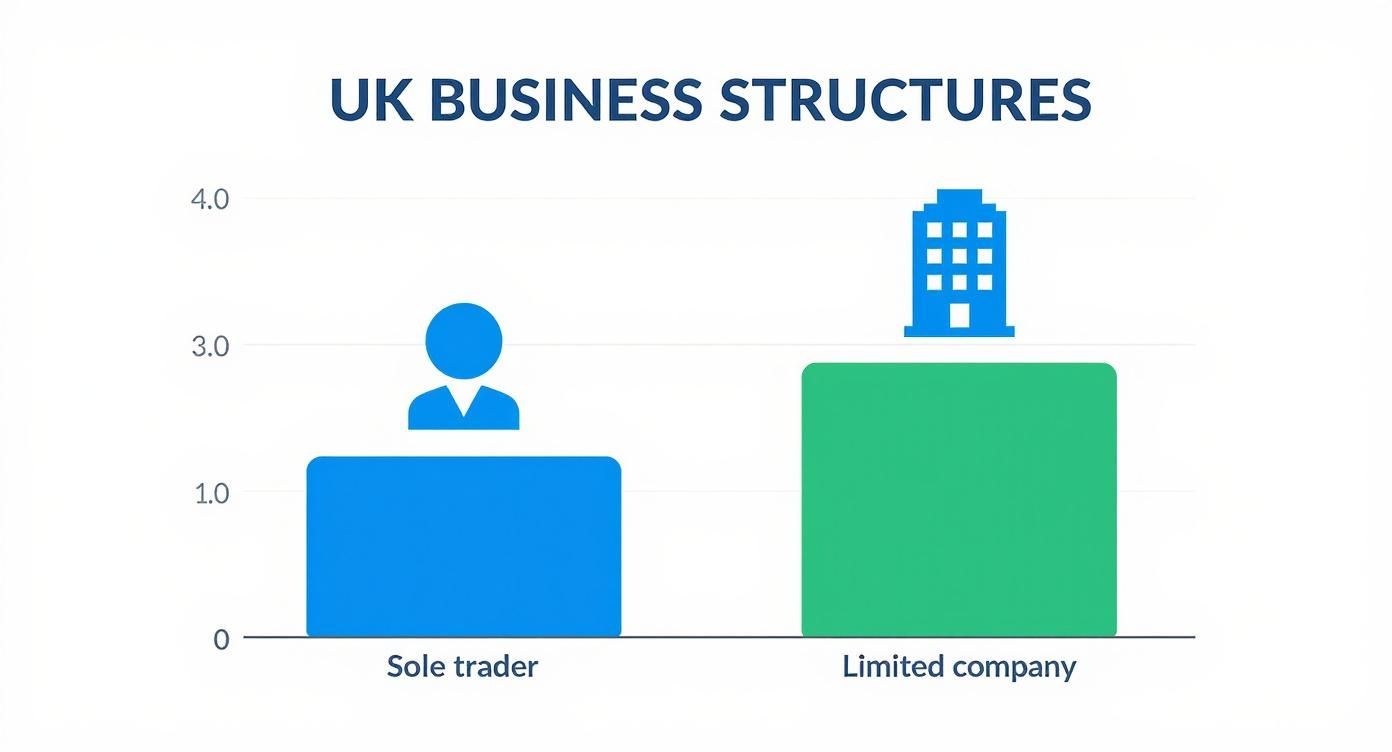
As you can see, while sole traders are far more common, limited companies represent a huge and vital slice of the UK's private sector.
Profitability and Take-Home Pay Scenarios
So, where do you see the biggest difference? It all comes down to your take-home pay. The structure you pick directly affects how much of your hard-earned revenue actually lands in your personal bank account after the taxman has taken his share.
Let’s walk through a few real-world profit scenarios to see this in practice. For these examples, we'll assume the limited company director is using a common tax-efficient strategy: taking a small salary up to the National Insurance threshold and the rest in dividends.
-
At £30,000 Profit: The difference here is often negligible. In fact, a sole trader might end up with slightly more in their pocket once you factor in the simpler admin and lower accountancy fees. At this level, the simplicity of the sole trader route often wins out.
-
At £60,000 Profit: This is typically the tipping point. It’s around this profit level that a limited company usually starts to make more financial sense. By paying Corporation Tax (currently 19% on profits up to £50,000) and then taking dividends—which are taxed at lower rates than income—a director can often achieve a higher net income than a sole trader who would be pushed into the higher-rate Income Tax bracket.
-
At £100,000 Profit: At this level, the tax advantages of a limited company become undeniable. The strategic combination of a low salary, dividend payments, and the ability to claim a broader range of business expenses can result in significant tax savings when compared to being a sole trader. We dive into the specifics in our guide covering limited company tax advantages.
The key takeaway here is pretty clear: as your profits grow, the tax efficiency of a limited company structure generally increases. Most accountants agree the financial tipping point often lies somewhere around the £30,000 to £40,000 profit mark.
VAT and CIS Compliance
Beyond your main tax bill, you also need to think about other obligations like VAT (Value Added Tax) and CIS (Construction Industry Scheme).
The rules for VAT registration are identical for both structures. You must register for VAT if your VAT-taxable turnover goes over the threshold (currently £90,000) in any 12-month period. Your business structure doesn't change this, but many find that managing VAT is a bit cleaner with a limited company's separate bank accounts and accounting records.
If you’re in the construction industry, you’ll also need to get to grips with the Construction Industry Scheme (CIS). Both sole traders and limited companies have to comply with these rules for handling payments between contractors and subcontractors. The admin does differ slightly, though, as payments made to a limited company are processed differently from those made to a sole trader under the scheme.
For any service-based business, from consultants to contractors, precise financial records are non-negotiable. Tools like time tracking apps for consultants are essential for accurately logging billable hours. This kind of precision is vital for getting your VAT, CIS, and overall profit calculations right, no matter which business structure you operate under.
Legal Protection vs. Admin: Weighing Your Options

When you're choosing how to structure your business, the conversation almost always lands on a fundamental trade-off. It’s a balancing act: you’re weighing the solid legal protection a limited company gives you against the extra paperwork and admin that comes with it. Getting this balance right is crucial for picking a structure that shields you without bogging you down.
The sole trader route is all about simplicity. Legally, you and your business are one and the same, which means you have unlimited liability. If the business runs into debt or faces a legal claim, your personal assets—your house, your savings, your car—are all fair game.
A limited company, on the other hand, creates a powerful legal barrier between you and the business. This is often called the 'corporate veil'. The company is its own legal person, with finances completely separate from yours. This protection, known as limited liability, keeps your personal assets safe from business creditors.
What Limited Liability Looks Like in the Real World
To see why this matters so much, let's play out a scenario. Imagine you're a freelance web developer, and you’ve just built a big e-commerce site for a new client. If you're a sole trader and a glitch in your code causes the client to lose thousands in sales, they could sue you personally. A court judgment could wipe out your personal bank account or even force you to sell your home to pay the damages.
Now, let’s rewind. If you'd set up as a limited company, the client's lawsuit would be against the company, not you. Any financial payout would be capped at the assets held within the business itself. This is a game-changer, especially in higher-risk sectors, as it protects your personal wealth from the ups and downs of your business.
The bottom line is this: with a limited company, you only risk what you've put into the business. As a sole trader, you risk everything you own.
This single legal difference is often the main reason why entrepreneurs planning to take out loans, sign hefty contracts, or work in industries prone to lawsuits will almost always choose the limited company structure.
The Catch: More Paperwork
While the legal protection is a huge plus, it doesn’t come for free. The price you pay is a heavier load of compliance and admin. The very simplicity that makes being a sole trader so appealing carries through to the paperwork.
For a sole trader, the main duty is pretty simple:
- Annual Self Assessment: You file a single personal tax return with HMRC each year, declaring your business income and expenses alongside any other personal income.
This keeps your accounting costs down and frees you up to actually run your business.
A limited company, however, has a much longer to-do list, with legal obligations to both HMRC and Companies House that you simply can't ignore.
- Annual Accounts: You have to prepare and file these with Companies House, where they become a public record of your company's financial standing.
- Company Tax Return (CT600): A separate tax return detailing your company's profits must be filed with HMRC.
- Confirmation Statement: This is an annual check-in with Companies House to confirm that all your company details (like directors and official address) are up to date on the public register.
- Statutory Registers: You're legally required to keep internal records of directors, shareholders, and any 'persons with significant control'.
All this extra work inevitably leads to higher accountancy fees and takes up more of your time. The decision really comes down to an honest look at your business risks and whether you have the appetite to handle these additional responsibilities.
How Your Business Structure Shapes Perception and Growth
Choosing between a ltd company or sole trader isn't just a box-ticking exercise; it sends a strong message to the outside world. How clients, suppliers, and especially lenders see you is directly influenced by your business structure, which can make all the difference when you want to grow, land bigger contracts, or secure funding.
While being a sole trader is a fantastic way to get up and running quickly, a limited company naturally projects a sense of permanence and professionalism. The formal registration at Companies House and the public record of your business details create a level of transparency that larger clients and banks really value.
This isn't just about appearances. This enhanced credibility brings real-world advantages. You'll find many larger organisations have procurement rules that prevent them from working with unincorporated businesses, meaning sole traders can't even get a foot in the door for those lucrative contracts.
Securing Funding and Investment
If your roadmap includes bringing in external cash to scale up, the limited company route is almost a foregone conclusion. Investors and lenders simply see it as a much safer bet.
The clean legal line between the business and its owners is what makes it so attractive. It provides a solid framework for investment—people can buy shares and become part-owners of a distinct legal entity. Trying to do something similar as a sole trader is a messy and legally complicated affair.
Banks also breathe a little easier when lending to a limited company. There are a few good reasons for this:
- Formal Records: Companies have a legal duty to keep detailed accounts, offering a clear, reliable picture of their financial health.
- Limited Liability: The structure shields lenders' interests from being caught up in the business's debts if things go wrong.
- Continuity: A limited company exists independently of its owners. It can carry on trading even if a director leaves, which offers far more stability than a sole trader business that effectively dies with its owner.
The limited company structure is built for growth. It gives you a straightforward way to raise capital by issuing shares to new investors—an option that simply doesn't exist for a sole trader.
Planning for Pensions and Long-Term Wealth
The way you set up your business has a massive impact on your long-term financial planning, especially your pension. While you can save for retirement either way, a limited company offers a much more tax-efficient path.
As a sole trader, you make personal contributions to your pension out of your post-tax profits. You earn your money, pay Income Tax and National Insurance on it, and then what’s left over can go into your pension pot. You get tax relief, but it’s a roundabout way of doing things.
A limited company, on the other hand, can make contributions directly into a director's pension scheme, and this is treated as an allowable business expense. That's a game-changer.
This means the money is paid out before the company's profit is calculated for Corporation Tax. The contribution reduces your profit, which in turn lowers your tax bill. The cash goes straight from the business account to your pension without being hit by Corporation Tax, Income Tax, or National Insurance. It’s an incredibly efficient way to build your retirement fund.
The Impact on Hiring and Expansion
When a business starts to grow, taking on staff is often the next logical step. The official figures show a clear pattern here: limited companies are far more likely to be employers. There are 1,143,065 limited companies with employees, compared to just 198,070 sole proprietorships.
This gap shows that the limited company model is simply better equipped for scaling a team. The legal framework provides a clearer basis for employment contracts, running payroll (PAYE), and offering benefits like company pension schemes. Plus, the ability to appoint new directors or offer share options can be a great way to attract top talent.
You can discover more UK small business statistics to see the wider economic picture. For any business owner with serious ambitions for expansion, the choice between a ltd company or sole trader usually points firmly in one direction.
A Framework for Making the Right Decision
https://www.youtube.com/embed/qdknG04MIDY
Deciding between a ltd company or sole trader isn't about finding a single "best" answer; it's about finding the right fit for you and your business right now. Your goals, your profit levels, and your appetite for risk all have a major part to play. This framework is designed to help you move past the theory and make a practical, confident choice.
It's also worth noting how industry and location can influence things. Across the UK, there are around 4.39 million self-employed workers, with London having the highest regional rate at 16.5%. Dig a little deeper, and you'll find that single-employee limited companies are most common in professional, scientific, technical, and construction fields, which shows how industry norms often shape this decision.
When to Stick With the Sole Trader Route
For most people starting out, the sole trader route is the most logical and straightforward path. It keeps things simple and costs down, which is perfect when you're just testing an idea or your business model carries very little risk.
You should probably stick with being a sole trader if:
- You're just getting started. If you’re a new freelancer or launching a side hustle, the beautiful simplicity of a single Self Assessment tax return is a massive plus.
- Your profits are modest. As a general rule of thumb, if your annual profits are consistently below the £30,000 mark, the tax benefits of a limited company probably won't outweigh the extra admin and cost.
- Your work carries low liability. If you provide services with little risk of causing financial loss to clients—think a freelance writer or a craft maker—the legal protection from a limited company might be an unnecessary complication.
Key Triggers for Switching to a Limited Company
As your business grows and changes, certain signals will start to appear that suggest it’s time to incorporate. Ignoring these triggers often means you’re paying more tax than you need to or, worse, leaving your personal assets exposed.
It’s time to seriously think about switching when:
- Your profits are growing. Once your annual profits start climbing past the £30,000-£40,000 threshold, the tax efficiency of a limited company becomes much more compelling.
- You need legal protection. If you're taking on bigger contracts, hiring staff, or borrowing money for the business, that limited liability separating your personal finances from your business finances becomes essential.
- You want to boost your credibility. Sometimes, having 'Ltd' at the end of your name just opens doors. It can make you look more established to larger corporate clients and can certainly make it easier to secure funding or investment.
The decision to switch is often a strategic one, prompted by growth and ambition. It’s a move from a simple setup to a structure designed for expansion, protection, and greater financial planning opportunities.
Your Decision-Making Checklist
Before you make the final call, run through these practical questions. Your answers should give you a clear steer on whether a ltd company or sole trader structure is the right choice for you at this moment.
- Profitability: Are my annual profits likely to push past £30,000 in the next year?
- Risk Profile: Does my work involve significant financial or legal risk for my clients?
- Growth Plans: Do I plan to hire employees or look for external investment down the line?
- Client Base: Am I trying to win work from larger corporate clients who might prefer dealing with incorporated businesses?
- Administrative Capacity: Honestly, am I ready for the extra bookkeeping and filing that a limited company demands?
- Industry Specifics: Are there particular requirements in my sector? For property professionals, for instance, understanding these nuances is critical, as detailed in this comprehensive landlord survival guide.
The good news is that the process of moving from one structure to the other is a well-trodden path. Our guide on changing from a sole trader to a limited company breaks down all the steps involved to ensure it's a smooth transition.
Partnering With an Accountant for Success

Deciding between being a ltd company or a sole trader is a huge first step, but what really drives long-term success is solid financial management. Whether you're just starting out or ready to scale, having an expert on your side takes the guesswork out of the numbers and helps you reach your goals.
At Stewart Accounting Services, we offer hands-on support that’s built around your specific business structure and where you want to go. We can take care of the entire company formation process and then manage the detailed compliance that comes with running a limited company.
Our team makes sure you never miss a deadline with HMRC or Companies House, looking after everything from your annual accounts to your confirmation statement. It frees you up to do what you do best: run your business, not get bogged down in paperwork.
Strategic Support and Modern Tools
Getting the compliance right is just the starting point. We see our role as your financial partner, providing strategic tax planning that ensures your business is set up as efficiently as possible. The goal is always to maximise your take-home pay and boost profitability.
If you’re thinking of moving from a sole trader to a limited company, we can manage the whole transition. We’ll make sure it's a smooth, compliant switch. Our experience of how accountants support growing businesses means we’re always thinking ahead, offering advice that lines up with your long-term vision.
We believe technology is key to financial clarity. By integrating modern cloud accounting software like Xero, we don't just manage your books; we provide you with real-time financial insights to make smarter, faster decisions.
This approach turns accounting from a chore you do once a year into a powerful tool for growth. It simplifies your bookkeeping, makes your figures more accurate, and gives you a clear view of your cash flow and performance whenever you need it.
Here’s a snapshot of how we can help:
- Company Formation and Setup: Getting your business registered correctly from day one.
- Ongoing Compliance Management: Handling all submissions to HMRC and Companies House.
- Cloud Accounting Integration: Setting you up on Xero for real-time financial tracking.
- Strategic Tax Planning: Structuring your finances for maximum tax efficiency.
Working with us means you get more than just an accountant; you get a proactive partner who’s genuinely invested in your business's financial health and growth.
Frequently Asked Questions
Choosing between setting up as a sole trader or a limited company throws up a lot of questions. We get asked the same things time and again, so we've put together the answers to help you get your head around the key issues.
Think of this as a quick-fire guide to the practical details that will help you make the right call for your business.
Can I Switch From a Sole Trader to a Limited Company Later?
Yes, and it's a very common move. Many businesses start life as a sole trader and then 'incorporate' once they start growing. The process involves setting up a new limited company at Companies House and then officially moving your existing business assets and trade over to it.
It sounds simple, but getting this transition right is key to avoiding any disruption. You’ll need to finalise your sole trader accounts for HMRC, transfer assets correctly, and get the new company’s payroll and tax systems up and running. It’s one of those times where getting a bit of professional advice really pays off to make sure the switch is seamless.
What Is IR35 and How Does It Affect My Choice?
If you’re a contractor, you need to know about IR35. It’s legislation (also called the 'off-payroll working rules') designed to stop 'disguised employment' – where someone works like an employee but bills through their own limited company to save tax.
If your contract is deemed 'inside IR35', most of the tax benefits of using a limited company disappear. This means figuring out your IR35 status is a non-negotiable first step for any contractor weighing up their options.
For contractors, the 'ltd company or sole trader' question often hinges on IR35. Getting it wrong can lead to a surprise tax bill from HMRC, so it's a critical piece of the puzzle.
Do I Still Need to File a Personal Tax Return as a Director?
Almost certainly, yes. As a director of a limited company, you have to file a Self Assessment tax return each year. This is where you tell HMRC about any income you’ve received that hasn't been taxed already through a payroll system.
The most common example is dividends. If you earn dividends above the tax-free allowance, or if you have any other untaxed income (like from property), it must be declared on your personal tax return. Your salary as a director is usually handled via PAYE, but everything else is on you to report.
Is a Limited Company More Expensive to Run?
On paper, yes. There are more hoops to jump through, which comes with higher costs. You've got the initial company formation fee, and then ongoing accountancy fees for things like statutory accounts and the company tax return, which are more complex than a sole trader's.
A sole trader’s tax affairs are far simpler, and therefore usually cheaper to manage. But here’s the thing: once your profits hit a certain level, the tax savings you can make with a limited company – not to mention the massive benefit of limited liability – often make those extra admin costs look like a very smart investment.
Ready to make the right choice for your business? The team at Stewart Accounting Services can provide expert guidance on whether a limited company or sole trader structure is best for you and manage the entire setup or transition process. Get in touch today to secure your financial future.