

Management Accounts Services: Clear Financial Insight to Scale Your UK Business

Think of management accounts as the live financial dashboard for your business. It’s about shifting your perspective from just looking back at what happened last year to understanding exactly what’s happening right now—and what's likely to happen next. This is the information you need to make smart, forward-looking decisions that actually drive growth.
So, What Exactly Are Management Accounts?
If you've ever tried to drive a car while only looking in the rearview mirror, you'll know it's a terrible idea. You can see where you've been, but you have no clue what's ahead. Running a business using only your year-end accounts is pretty much the same thing—you're flying blind.
This is where proper management accounts services come in. They give you that clear, real-time dashboard, so you can steer your business with confidence, knowing your speed, fuel level, and engine health at all times.
Looking Back vs. Looking Forward
Most business owners are familiar with statutory accounts (or year-end accounts). They’re a legal must-have, a snapshot of your past performance created for HMRC and Companies House. They’re important for compliance, but they're fundamentally historical documents. They tell you where you've been, not where you're going.
Management accounts are the complete opposite. They act as your business's live satnav. They're prepared regularly—usually monthly or quarterly—and are created for an audience of one: you. Their goal isn't to tick a compliance box; it's to give you genuine clarity and turn raw numbers into actionable insights.
It's no surprise that this forward-looking approach is catching on. The UK accounting services market, which covers these crucial services, was valued at £12.4 billion in 2023 and is expected to climb to £15.7 billion by 2028. More and more businesses realise they need this kind of ongoing financial insight to grow from six figures to seven and beyond. You can dig deeper into the UK accounting services market growth to see the full picture of this trend.
A Quick Comparison
To make the distinction crystal clear, here’s a simple breakdown of how the two types of accounts stack up against each other.
Statutory Accounts vs Management Accounts At a Glance
| Feature | Statutory Accounts (Year-End) | Management Accounts (Monthly/Quarterly) |
|---|---|---|
| Purpose | Compliance with HMRC & Companies House regulations. | Internal strategic decision-making and performance monitoring. |
| Audience | External stakeholders (tax authorities, banks, shareholders). | Internal stakeholders (you, your directors, management team). |
| Focus | Historical performance (looking back over the past year). | Real-time and forward-looking (what's happening now & what's next). |
| Format | Strictly regulated and follows a legally required format. | Flexible and customised to your specific business needs and KPIs. |
| Frequency | Annually, after the financial year has ended. | Frequently (monthly or quarterly) to provide timely insights. |
Ultimately, statutory accounts are a necessity for compliance, while management accounts are a powerful tool for growth. You need both, but they serve very different and equally important roles.
A Clearer View Under the Bonnet
Management accounts aren't just one report; they're a set of interconnected documents that, together, give you a complete and detailed picture of your business's financial health. To go back to our car analogy:
- The Profit & Loss (P&L) Statement: This is your speedometer. It shows how profitable you were over a specific period, telling you whether you're speeding up (making more money) or slowing down.
- The Balance Sheet: This is your engine diagnostic report. It gives you a snapshot of your company's financial health at a single point in time, showing what you own (assets) versus what you owe (liabilities).
- The Cashflow Forecast: This is your fuel gauge. It projects the cash moving in and out of your business, helping you spot potential shortfalls long before you risk running on empty.
By moving from a once-a-year historical review to a monthly strategic overview, you gain the foresight needed to make genuinely informed decisions. This isn’t just about number-crunching; it’s about building a predictable, scalable, and far more valuable business.
Decoding Your Key Financial Reports
Think of your business's financial data as a language. If you can't speak it fluently, it's just a jumble of numbers. This is where management accounts services come in. We act as your expert translator, taking that raw data and turning it into a clear story about where your business has been, where it stands today, and where it’s headed.
These reports aren't just paperwork for the sake of it; they are genuine strategic tools. Each one gives you a different angle on your business, and when you put them together, you get the complete picture of your financial health. Getting to grips with them is the first step towards making smarter, more confident decisions that actually grow your bottom line.
This diagram shows how management accounts work like a GPS for your business, using past data and real-time information to map out the road ahead.
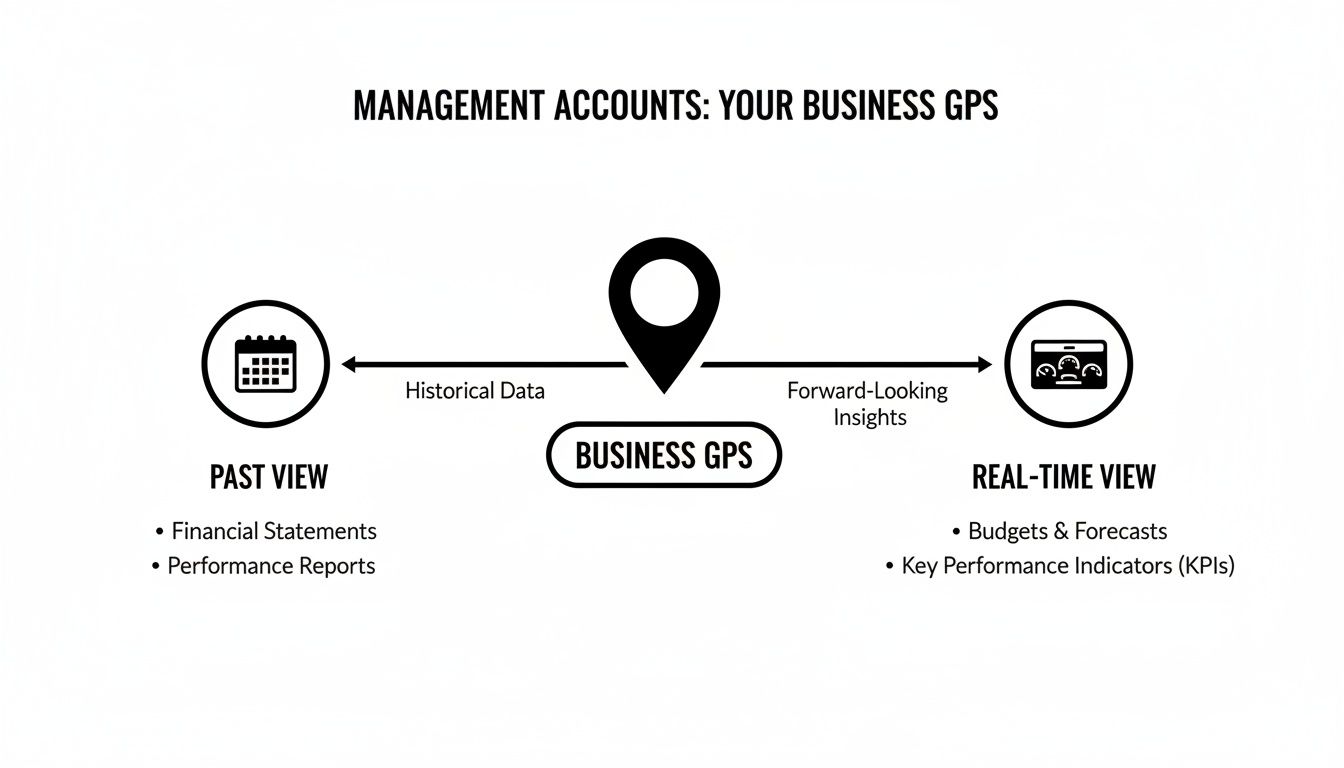
By looking back at what worked (and what didn't) while keeping an eye on your current numbers, you can build a reliable forecast to navigate the future.
The Profit and Loss Statement
The Profit and Loss (P&L) statement is essentially your business's report card for a set period, like a month or a quarter. It answers the most fundamental question of all: "Are we actually making any money?"
It gets to the answer by adding up all your sales and then subtracting all your costs. That final number – your net profit or loss – is the headline, but the real value is in the detail. A proper P&L lets you:
- See which services make you the most money: Pinpoint your high-margin winners and spot any offerings that are secretly costing you a fortune.
- Keep an eye on rising costs: Easily track where your money is going and identify opportunities to be more efficient.
- Analyse your profit margins: It’s not just about if you're profitable, but how profitable. Is that number getting better or worse over time?
For a closer look at this crucial report, our guide on how to read financial statements is a great place to start.
The Balance Sheet
If the P&L is a video of your performance over time, the Balance Sheet is a single snapshot. It shows your company’s exact financial position on a specific day, like a statement of net worth. It’s all built around one simple, rock-solid equation:
Assets = Liabilities + Equity
This formula has to balance, every single time. It gives you a crystal-clear view of what your business owns (assets), what it owes (liabilities), and what’s left for the owners (equity). Looking at this helps you understand how financially stable your business really is.
The Cashflow Forecast
You’ve probably heard the old saying: "Profit is an opinion, cash is a fact." It’s true. A business can look profitable on paper but go under because it runs out of cash. The Cashflow Forecast is your early warning system.
This report projects the cash moving in and out of your bank account over the next few weeks and months. It's arguably the most important tool for day-to-day survival. It helps you spot potential cash shortages long before they become a crisis, giving you time to arrange finance or cut back on spending. On the flip side, it also shows you when you’ll have a surplus, signalling the perfect time to invest in new kit or hire that key person.
KPI Dashboards: Your Strategic Compass
Beyond the three main reports, the real game-changer is the Key Performance Indicator (KPI) dashboard. This is where the numbers stop being abstract and become a practical roadmap for hitting your goals.
Instead of drowning in spreadsheets, a good KPI dashboard visualises the handful of metrics that truly matter to your business. It’s completely tailored. For instance, if you run a subscription-based business, you'd be tracking things like:
- Monthly Recurring Revenue (MRR): The predictable income you can count on.
- Customer Acquisition Cost (CAC): Exactly how much it costs to land a new client.
- Customer Lifetime Value (LTV): The total amount you expect to earn from an average customer.
- Churn Rate: The percentage of customers you lose each month.
When you track these KPIs, you can see the immediate impact of your decisions. Launch a marketing campaign? You can watch your CAC and LTV to see if it paid off. This turns financial reporting from a backwards-looking chore into a powerful, forward-looking tool to steer your business with confidence.
How Modern Technology Powers Financial Clarity
Getting timely, insightful management accounts isn't magic. It all hinges on smart technology, with cloud accounting software sitting right at the heart of it. This tech is what turns financial reporting from a sluggish, backward-glance into a dynamic tool for planning your next move.
The big idea here is creating a 'single source of truth'. Think about it: platforms like Xero mean you, your team, and your accountant are all looking at the exact same, up-to-the-minute numbers. No more emailing conflicting spreadsheets or waiting for someone to send over the latest file. Everyone is on the same page, in real-time.
This sync-up saves a staggering amount of time and cuts out the confusion. Instead of wasting hours trying to figure out which spreadsheet is the right one, you can focus your energy on what the numbers actually mean and make decisions that put you ahead.
The Power of Automation in Accounting
One of the biggest wins with modern management accounts services is automation. Those repetitive, soul-destroying tasks that used to eat up your evenings? Software now handles them instantly and accurately, freeing up your accountant to focus on high-level strategy.
Automation really shines in a few key areas:
- Bank Reconciliation: Live bank feeds pull your transactions straight into the books, matching payments to invoices and bills automatically. This massively reduces manual data entry and the risk of human error.
- Automated Invoicing: You can set up recurring invoices for regular customers, making sure you get paid on time without even thinking about it.
- Receipt Capture: Apps like Dext let you snap a photo of a receipt on your phone. The software then reads the important details and files it away for you.
By letting the software handle the number-crunching and data entry, your accountant can spend less time on basic bookkeeping and more time analysing your performance, spotting trends, and giving you the strategic advice that actually grows your business.
From Rearview Mirror to Forward-Facing Dashboard
This mix of cloud software and automation completely changes the game. It shifts your view from the rearview mirror—only seeing where you've been—to a forward-facing dashboard showing you what's happening right now and helping you see what’s around the corner. For a great primer on this, check out this article on What is Cloud Accounting: A Simple Guide.
The beauty of platforms like Xero is how they make complex financial data easy to digest at a glance.
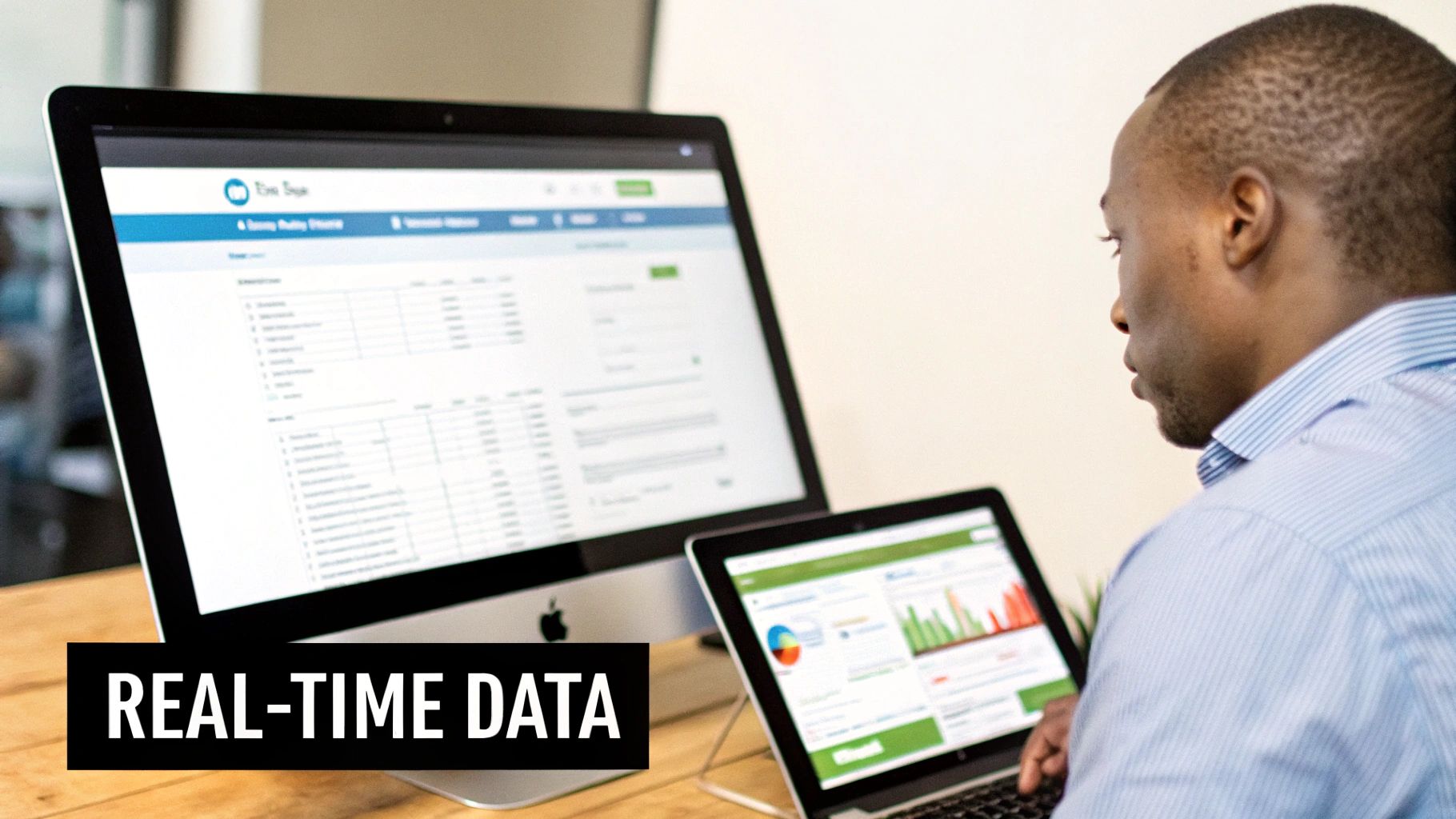
Your dashboard brings together all the crucial metrics—cash flow, profit and loss, outstanding invoices—into one simple view, empowering you to make faster, better-informed decisions. Getting the right tech in place is the first step towards getting a truly clear picture of your financial health. You can learn more about making this work for you in our guide on cloud accounting for small business.
Ultimately, this integrated approach ensures your management accounts are more than just reports; they're a live, interactive toolkit for navigating your way to seven-figure success.
Turning Financial Insights Into Business Growth
Raw data is just noise. It’s a jumble of numbers on a page until you give it meaning and turn it into action. This is where professional management accounts services really earn their keep, transforming your financial reports from a backwards-looking history lesson into a forward-looking roadmap for growth.
It’s all about connecting the dots—linking every figure on your P&L or balance sheet to a smart, strategic decision that strengthens your business. For ambitious owners, this isn't about guesswork or luck; it's the engine that powers the journey from a six-figure turnover to a seven-figure enterprise.
Pinpointing Your Growth Levers
Let’s imagine you run a busy digital marketing agency. Your top-line revenue looks healthy, but you have that nagging feeling you’re working harder than ever for less reward. A detailed management report can slice and dice your data in ways your annual accounts never could, like breaking down profitability by service.
You might discover that your big-ticket web design projects, while impressive on paper, only yield a 15% profit margin once you factor in subcontractor fees and all those extra revisions. But then you see your monthly SEO retainer service, with its smaller, recurring fees, is quietly delivering a rock-solid 65% profit margin.
Suddenly, the path forward is crystal clear. This one insight is a complete game-changer. The numbers are telling you exactly what to do:
- Lean into the winner: You now have the evidence to confidently invest more in marketing your highly profitable SEO services.
- Fix the weak link: You could re-evaluate your web design pricing, create a tighter process to cut down on costs, or even decide to phase out the service entirely.
Without this level of detail, you're flying blind. With it, you have a clear, data-driven strategy to boost your profitability.
Maximising Returns for Property Landlords
This exact same principle applies to landlords managing a property portfolio. It’s all too easy to just look at the total rent coming in each month and assume everything is ticking along nicely. Management accounts, however, force you to dig deeper and analyse the performance of each property individually.
A granular report might show that one of your flats, despite having a high rental yield on paper, is a real headache. It suffers from frequent and lengthy void periods between tenants. Once you add up the lost income and extra advertising costs, you realise its actual return is far lower than another, less glamorous property that is consistently occupied.
Armed with this knowledge, you can take corrective action. Perhaps a minor refurbishment is needed to make the difficult flat more appealing, or maybe a slight rent adjustment would attract more stable, long-term tenants. You’re no longer just a rent collector; you’re a strategic asset manager focused on maximising your returns.
The value of this strategic advice is reflected across the UK economy. The accounting and auditing sector hit £38.7 billion in 2024, with advisory services like this making up a huge 45% of all revenue. Why? Because businesses using these insights see real results, especially when it comes to cashflow—a critical advantage when late payments can saddle the average SME with £25,000 of debt.
Tracking Your Progress to Seven Figures
Setting a bold revenue target is the easy part. Actually hitting it requires a plan and a way to measure your progress. Management accounts provide the framework for this, using specific Key Performance Indicators (KPIs) to keep you on track.
By connecting your financial data to operational metrics, you create a feedback loop that keeps your strategy on track. You’re not just hoping for growth; you're actively measuring and managing it.
For a business aiming to break the seven-figure barrier, you'd be laser-focused on KPIs like these:
- Monthly Recurring Revenue (MRR): The bedrock of a scalable business. This tracks the predictable, stable income you can count on every month.
- Customer Acquisition Cost (CAC): How much does it really cost to win a new customer? If this number starts creeping up, it’s an early warning that your sales or marketing efforts need a tune-up.
- Gross Profit Margin: This measures the core profitability of your products or services. A healthy, steady margin means your pricing and delivery costs are in a good place.
- Sales Conversion Rate: How effective are you at turning potential leads into paying customers? Even a small improvement here can be one of the quickest ways to boost revenue without increasing your marketing spend.
Good management accounts give you the data to understand the return on every pound you invest. You can explore more strategies for measuring marketing ROI to see how this drives real growth. By keeping a close eye on these KPIs month after month, you can make small, continuous adjustments that build momentum over time, turning that ambitious goal into an achievable reality.
Finding the Right Accounting Partner
Picking a firm for your management accounts services isn't just about finding someone to crunch the numbers. It’s about finding a genuine partner, someone who’s as invested in seeing your business grow as you are. The right accountant goes far beyond ticking compliance boxes; they deliver the forward-looking advice you need to really scale up.
Think of it as an investment, not a cost. While the price tag is always a consideration, the real focus should be on the return. Done right, management accounts pay for themselves many times over by improving your cash flow, finding hidden savings, and empowering you to make smart, data-driven decisions that fuel growth.
How Do Firms Charge for This?
When you start your search, you'll likely run into a couple of common pricing models. Knowing the difference helps you find a setup that works for your budget and your business.
-
Fixed Monthly Fees: This is the most popular and predictable way to pay. You agree on a set scope of services and pay the same amount each month. It's fantastic for budgeting because you'll never get a surprise bill, and it encourages you to pick up the phone without worrying about being charged for every quick question.
-
Tiered Packages: Many accountants offer a few different packages—think of them as basic, standard, and premium options. This lets you pick a service level that fits where you are right now, with an easy path to upgrade as your business gets bigger and your needs get more complex.
The goal isn't to find the cheapest option, but to find a partner who offers transparent pricing that truly reflects the value they deliver. You're looking to build a long-term relationship based on trust and real results.
Questions to Ask a Potential Accountant
To find that perfect fit, you have to ask the right questions. Treat it like an interview for a key member of your leadership team. A great accountant will welcome your questions and give you clear, confident answers.
Here’s a practical checklist to guide your conversations. Use it to dig a little deeper and see if a firm is truly the right partner for your growth journey.
Checklist for Selecting a Management Accounts Provider
Use this table to make sure you cover all the important bases when talking to potential accounting partners.
| Area of Enquiry | Key Questions to Ask | What to Look For in the Answer |
|---|---|---|
| Industry Expertise | Do you have experience with other businesses in my sector? | They should be able to talk about common challenges and opportunities specific to your industry, not just generic accounting principles. |
| Technology Stack | What accounting software do you specialise in? Are you proficient with cloud tools? | You’re looking for expertise in modern platforms like Xero, which ensures your data is real-time, accessible, and secure. |
| Strategic Input | How do you turn reports into actionable advice? What does that process look like? | The answer should include regular meetings, goal-setting discussions, and a proactive approach to identifying trends and making recommendations. |
| Relationship & Contact | Who will be my day-to-day point of contact? | You want a consistent, named contact who knows your business inside-out, not a generic support desk. |
| Quality of Work | Can you show me a sample management report pack? | This is your chance to see their work first-hand. Look for clarity, depth, and easy-to-understand visualisations, not just a wall of numbers. |
Choosing the right partner from day one is one of the best things you can do to build a solid financial foundation for your business. For a deeper dive, check out our guide on how to choose the right bookkeeping and accounting services.
By asking these questions, you can move forward with confidence, knowing you’ve picked a partner who will help turn your financial data into a clear roadmap for success.
From Financial Fog to Focused Strategy: A Case Study
It’s one thing to talk about theory, but it’s another to see it work in the real world. Let’s walk through the story of ‘ScotBuild Ltd,’ a fictional construction company that, on the surface, was doing great but was actually sailing blind.

The 'Before': A Picture of Stress
The owner, David, was the classic successful but perpetually stressed entrepreneur. His order book was full and his team was flat out, yet cash flow was a constant nightmare. He'd close out what he thought was a profitable quarter, only to find the bank balance dangerously low. This forced him into uncomfortable choices, like delaying supplier payments or even dipping into his own pocket.
His decisions were driven by gut feeling, not data. He priced new jobs based on what felt right and grabbed any work that came along, believing all revenue was good revenue. This financial fog kept him in a reactive state—constantly fighting fires, missing real opportunities, and spending his weekends worrying instead of planning.
The Turning Point: Implementing Monthly Reports
At his wit's end, David hired an accounting firm to produce monthly management accounts. When the first reports landed, one thing jumped off the page: a detailed breakdown of profitability by service type. The numbers were a complete shock.
His large-scale extensions, the ones that brought in the big revenue figures, were operating on a razor-thin profit margin of just 8%. Once he factored in all the subcontractor costs and the inevitable project delays, there was barely anything left. On the flip side, the smaller kitchen and bathroom refurbishments were consistently churning out a very healthy 45% margin.
This single piece of information, hidden in plain sight until that moment, changed everything. It was the point where David stopped guessing and started making smart, data-backed decisions.
Armed with this newfound clarity, he completely changed his approach. He shifted his marketing spend to target more refurbishment jobs and reworked his pricing for large extensions to guarantee they were actually profitable. For the first time, he could confidently turn down low-margin work, knowing it was the right move for the business's long-term health.
The 'After': Clarity, Profit, and Freedom
The results were incredible. Within six months of this strategic shift, ScotBuild’s overall net profit shot up by 20%, even though his total revenue stayed roughly the same.
Cash flow finally stabilised, the nasty financial surprises vanished, and David got back an estimated 10 hours a month that he used to spend just worrying about money. This story shows you exactly what management accounts are for. They aren't just a stuffy report of what happened last month; they're a practical roadmap to growth, profitability, and genuine business freedom.
Answering Your Questions About Management Accounts
Even when you see the potential, it’s completely normal to have a few practical questions before committing to professional management accounts services. Let's clear up some of the common queries we hear from business owners, so you can feel confident about taking the next step towards real financial clarity.
This section gets into the nitty-gritty, covering how often you need reports, whether it's a worthwhile expense, and what a professional brings to the table that software alone can't.
How Often Should I Get Management Accounts?
For most ambitious businesses, monthly reports are the sweet spot. This rhythm lets you spot trends as they’re happening, get a real grip on your cash flow, and make smart decisions before a small hiccup turns into a major headache.
You might get away with quarterly reports if your business is very stable or has predictable seasonal swings. But for anyone looking to scale or react quickly to market changes, monthly reporting is what keeps your finger on the pulse.
Are Management Accounts Really Worth the Cost for a Small Business?
Without a doubt. It’s better to reframe this as an investment, not a cost. For a small business, where every decision counts and the margin for error is thin, truly understanding your numbers isn't a luxury—it's essential.
The insights you gain will help you dodge expensive mistakes, confirm your pricing is actually making you money, and build the solid financial foundation you need to grow. Honestly, the cost of not knowing where you stand is almost always far greater than the fee for the service itself.
Can’t I Just Use My Accounting Software to Create These Reports?
While brilliant software like Xero is fantastic for pulling together the raw data, the real magic of professional management accounts services is the expert analysis and strategic advice that comes with it.
A good accountant doesn't just email you a spreadsheet. They turn the numbers into a story about your business. They’ll explain what the data actually means for your goals, point out opportunities you might have missed, and suggest what you should do next. It’s that human expertise that transforms raw data into profitable action.
Ready to swap financial guesswork for a clear growth plan? The team at Stewart Accounting Services can deliver the expert analysis and strategic guidance you need to confidently scale your business.
Recent Posts
15 Oct, 2026
14 Oct, 2026