

Rental income allowable expenses: A UK landlord guide

When you're a landlord, the rent you collect each month isn't pure profit. Just like any other business, you have running costs. The good news is that you can deduct many of these costs from your rental income to lower your tax bill. These deductible costs are what HMRC calls allowable expenses.
What Exactly Can You Claim?
Think of your rental property like a small shop. You wouldn't calculate your profit based on just the money in the till at the end of the day; you'd first subtract the cost of your stock, the electricity bill, and your staff's wages. It's the same principle for your property business. The costs you incur to keep your rental running—from letting agent fees to essential repairs—are your allowable expenses.
The golden rule from HMRC is that an expense must be 'wholly and exclusively' for the purpose of renting out the property. This is a crucial distinction. It means the cost was for your rental business, not for your personal benefit.
For instance, paying a plumber to fix a leaky tap in your tenant's bathroom is clearly a business cost. But buying a new TV for your own living room, even if you sometimes answer tenant emails from your sofa, doesn't count. The purpose of the expense is what matters.
The Key to Paying the Right Amount of Tax
Getting a firm grip on what you can and can't claim is fundamental to running a tax-efficient property business. It’s how you make sure you’re only taxed on your actual profits, not your total turnover.
Getting it wrong can be costly. You might end up overpaying tax by missing legitimate claims, or worse, underpay and attract unwanted attention and penalties from HMRC. For a more detailed look at the specifics, it's worth reading up on rental property tax deductions.

Quick Guide to Common Allowable vs Non-Allowable Expenses
To help you get started, let's break down some everyday landlord costs into what's usually claimable and what isn't. This table gives a quick overview to help you categorise your spending.
| Expense Category | Generally Allowable? | Example |
|---|---|---|
| Repairs & Maintenance | Yes | Fixing a leaking pipe or replacing a broken window. |
| Letting Agent Fees | Yes | Fees for finding tenants or managing the property. |
| Capital Improvements | No | Building a new extension or converting a loft. |
| Personal Mortgage | No | The mortgage repayments on your own home. |
Remember, this is just a starting point. The "wholly and exclusively" rule is your main guide for any cost you're unsure about.
Your Checklist of Key Allowable Expense Categories

When it comes to working out your taxable profit, you need a system for tracking what you spend. The best way I've found is to break down all your rental income allowable expenses into logical categories. This simple bit of organisation makes sure nothing slips through the cracks when it's time to file your Self Assessment tax return.
Think of it like sorting your receipts into different folders. One for repairs, one for fees, one for bills. It's a straightforward approach that turns a potential headache into a manageable task, giving you a clear list of every possible deduction.
Let's dive into the main expense categories you’ll be dealing with as a landlord.
Day-to-Day Running Costs
These are the regular, ongoing costs of actually letting your property and keeping your tenants happy. They're often the most common and varied expenses you'll have.
- Letting Agent Fees: Whether you've paid an agent just to find a tenant or for their full property management service, those fees are fully deductible. This covers everything from their commission and admin charges to the cost of an inventory.
- Advertising Costs: Any money spent to market your property and find new tenants is an allowable expense. This could be listings on property websites, an ad in the local paper, or even a targeted social media campaign.
- Landlord Insurance: The premiums you pay for specialist landlord insurance policies—covering the building, contents, and public liability—are all claimable.
A critical, recurring cost for UK landlords is understanding essential safety compliance like the gas safety certificate. These annual checks are a legal must, and thankfully, the cost is deductible.
Property Bills and Utilities
Even an empty property costs money. The good news is that HMRC lets you claim for these bills during void periods, provided the property is still being actively marketed for let.
You can deduct costs like:
- Council Tax
- Gas and electricity
- Water rates
- Ground rent and service charges (for leasehold properties)
It's vital to keep every single utility bill and council tax statement from these empty periods. This paper trail is your proof if HMRC ever asks you to justify claiming expenses while the property was unoccupied.
Professional and Legal Fees
Sometimes, you need to call in the experts. The fees you pay for professional advice are generally allowable, as long as they relate directly to the running of your rental business.
This includes:
- Accountancy Fees: The cost of hiring an accountant to sort out your rental accounts and handle your tax return is a classic allowable expense.
- Legal Fees: You can claim for legal advice on tenancy issues, like drafting a tenancy agreement or dealing with a dispute. Be careful, though—any legal fees for buying the property are seen as a capital cost and can't be deducted from your rental income.
- Other Professional Services: This might include fees for surveyors, valuers, or other specialists you need to consult for your rental business.
Getting to grips with all the specific costs you can claim is a game-changer. In fact, many landlords miss out on valuable deductions. You can see some of the most common oversights in our guide: https://stewartaccounting.co.uk/10-tax-deductions-uk-landlords-often-miss/.
For landlords with a smaller rental income, there are simpler options. The government's property allowance lets you earn up to £1,000 in rental income completely tax-free, without needing to list out every single expense. If your income is higher, you have a choice: you can either deduct this £1,000 allowance or your actual costs, whichever saves you more money.
How to Handle Mortgage Interest and Finance Costs
For most landlords, the mortgage is easily the biggest single expense tied to their rental property. But how you get tax relief on it has completely changed in recent years, and getting your head around the shift is crucial for getting your tax bill right.
It used to be simple. You’d just deduct your full mortgage interest from your rental income, which directly lowered your taxable profit. This was a huge advantage, especially for higher and additional-rate taxpayers. But those days are gone.
Now, things work a bit differently. You have to declare all your rental income first and work out your tax based on your total profit. Only after that do you get to apply a tax credit, which is fixed at 20% of whatever you paid in mortgage interest that year. This credit then gets knocked off your final tax bill. For a really detailed walkthrough of how this all works in practice, our guide on the mortgage interest deduction for rental property is a great place to start.
The Real-World Impact for Landlords
So, what does this actually mean for your wallet? For basic-rate (20%) taxpayers, not much has changed. The real sting is felt by landlords in the higher-rate (40%) or additional-rate (45%) tax brackets, who no longer get relief at their marginal rate. Everyone now gets the same flat 20% credit.
Let's break it down with an example:
- Rental Income: £15,000
- Other Allowable Expenses: £3,000
- Mortgage Interest Paid: £6,000
Under the current rules, your taxable profit is £12,000 (£15,000 income minus £3,000 expenses). If you’re a higher-rate taxpayer, your initial tax bill would be £4,800 (£12,000 x 40%). You then apply your tax credit of £1,200 (£6,000 interest x 20%), leaving you with a final tax bill of £3,600.
Now, compare that to the old system. Your taxable profit would have been just £6,000 (£15,000 – £3,000 – £6,000), and your tax bill would have been only £2,400. That's a £1,200 difference, straight out of your pocket.
Don't Forget Other Finance Costs
It’s easy to focus on the interest payments, but don't forget the other costs you incurred just to get the mortgage in the first place. These are also considered allowable rental income allowable expenses.
Make sure you're including things like:
- Mortgage arrangement or product fees
- Lender-required valuation fees
- Fees paid to a mortgage broker
These costs are treated in exactly the same way as your mortgage interest – you get a 20% tax credit on them.
Quick reminder: It’s crucial to remember that you can only claim relief on the interest part of your mortgage payments. The capital repayment element, which is you paying back the actual loan, is not a tax-deductible expense against your rental income.
The sheer scale of these finance costs is massive. Recent tax data shows that UK landlords claimed for £9.05 billion in residential finance costs, which accounted for a huge 31% of all expenses claimed against rental income. You can discover more insights about these landlord income records to see just how significant this is across the market.
The Difference Between Repairs and Improvements
One of the trickiest areas for landlords trying to figure out their rental income allowable expenses is getting to grips with what counts as a ‘repair’ versus an ‘improvement’. It’s a classic headache, and getting it wrong can lead to a rejected expense claim and a bigger tax bill.
But don’t worry, the distinction is actually quite straightforward once you understand the core idea. Think of it as restoring versus upgrading.
A repair is all about bringing something back to its original condition. You're fixing wear and tear or damage. For example, if a winter storm blows a few tiles off your roof and you pay a roofer to replace them, that's a classic repair. You’re simply putting the roof back to how it was before the damage. This cost is a revenue expense, which means you can deduct it directly from your rental income for that tax year. Simple.
An improvement, however, is what HMRC calls capital expenditure. This is any spending that genuinely enhances or upgrades the property beyond its original state. We’re talking about adding something new or making a significant upgrade that increases the property's value. Building an extension, converting a loft, or adding a conservatory are clear-cut examples. These costs aren't deductible from your rental income.
Instead, you'll need to keep a record of these capital costs. They can be used to reduce your Capital Gains Tax bill when you eventually decide to sell the property.
The 'Like-for-Like' Replacement Rule
This is where the lines can get a little fuzzy for many landlords. Let's say you replace an old, draughty, single-glazed wooden window with a modern, energy-efficient uPVC double-glazed one. The new window is obviously much better, right? So, is it an improvement?
Surprisingly, HMRC generally sees this as a repair. Why? Because you are simply replacing an existing asset with its nearest modern equivalent. Technology and building materials evolve, and it's often impossible (or impractical) to find an identical replacement for a 20-year-old fixture. As long as the new item does the same fundamental job as the old one, it's usually classed as a repair.
The crucial question to ask yourself is this: are you restoring the property's function or are you adding a brand-new feature? Swapping a tired, old kitchen for a modern, similar-quality one is a repair. But tearing out a basic kitchen and installing a high-end designer one with granite worktops and a fancy island could easily be viewed as a capital improvement.
This decision tree visualises how your taxpayer status affects the tax relief you receive on finance costs, another key area with specific rules.
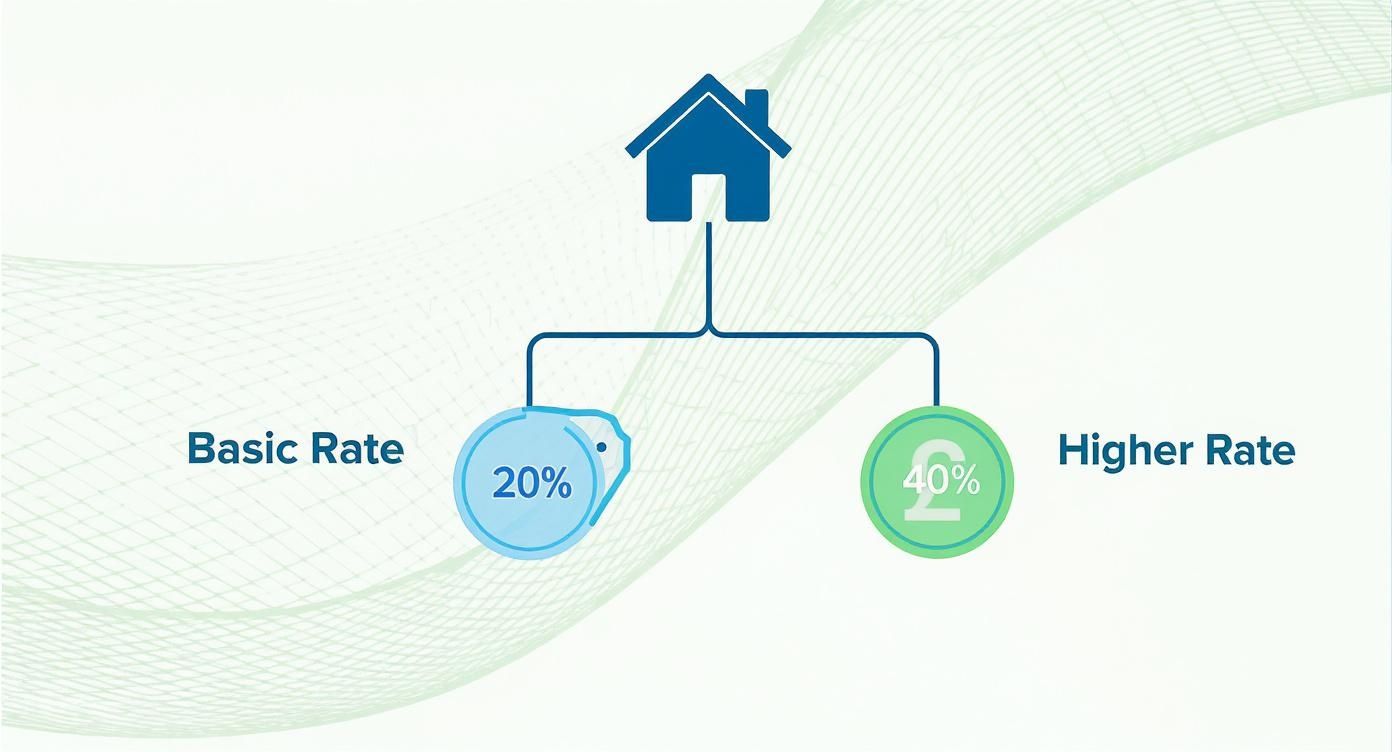
As the infographic shows, while the 20% tax credit on finance costs is the same for everyone, higher-rate taxpayers feel the pinch more compared to the old system where they could deduct the full interest amount.
Repair vs Capital Improvement: A Landlord's Checklist
To really nail this down, it helps to see some real-world examples side-by-side. I've put together a quick checklist to help you distinguish between the two in common scenarios you're likely to face as a landlord.
| Scenario | Repair (Allowable Expense) | Capital Improvement (Not an Allowable Expense) |
|---|---|---|
| Heating System | The old boiler gives up the ghost, so you replace it with a modern, energy-efficient combi boiler. | The property only had electric wall heaters, and you install a full central heating system for the first time. |
| Windows | Replacing rotten single-glazed wooden frames with modern uPVC double-glazing. | Knocking through a wall to add a new bay window where a small, flat one used to be. |
| Flooring | Ripping up a stained, damaged laminate floor and putting down new laminate of a similar quality. | Upgrading from basic carpet or laminate to expensive, solid oak hardwood flooring. |
| Roof | Paying a roofer to fix a leak or replace a few slates that were damaged in a storm. | Converting a standard flat roof into a usable roof terrace with decking and safety railings. |
Getting this distinction right is absolutely fundamental to filing an accurate tax return and making sure you’re claiming everything you’re entitled to.
When you're in any doubt, the best policy is to keep incredibly detailed records. Make sure your invoices from tradespeople clearly describe the work that was done – this paper trail can be invaluable if HMRC ever asks questions.
Keeping Records That Satisfy HMRC
Claiming every allowable expense you're entitled to is brilliant for reducing your tax bill, but it comes with one non-negotiable condition from HMRC: you've got to have the proof. Good record-keeping isn't just a nice-to-have habit for landlords; it's a legal requirement that validates every single deduction you make.
Think of your records as the evidence that backs up your tax return. Without them, your claims are just numbers on a form, easily challenged. With them, you have a solid, defensible position if HMRC ever decides to take a closer look at your tax affairs. Getting organised from the start will save you a world of stress later.
Your Essential Record-Keeping Checklist
So, what exactly do you need to keep? The good news is you don’t need a complicated system. Whether you prefer a simple spreadsheet, dedicated landlord software, or even just a well-organised physical folder, the key is to be consistent.
Make sure you hold on to the following:
- Proof of Income: This means copies of tenancy agreements, any invoices you issue, and bank statements clearly showing the rent payments coming in.
- Proof of Expenses: Keep every single receipt and invoice for things you've paid for. This includes fees from your letting agent, bills from tradespeople for repairs, your insurance policies, and annual mortgage interest statements.
- Mileage Log: If you're claiming for travel, you need a simple log. Just jot down the date, the reason for the trip (e.g., "property inspection at 123 Fake Street"), and the number of miles you drove.
It's worth noting how these records fit into the bigger picture. UK landlord taxation has seen some big shifts over the years, particularly in how housing costs are measured. These changes have wider implications for the economy, and if you're interested in the details, you can read more on how these approaches are measured.
How Long Must You Keep Records?
HMRC is very clear on this. You must keep all your records for at least five years after the 31st January submission deadline for that tax year.
Let’s break that down. For the 2023-24 tax year, the filing deadline is 31st January 2025. This means you need to keep all your paperwork for that year until at least the end of January 2030.
A classic mistake is to file the tax return and then immediately have a clear-out. But HMRC can open an enquiry years down the line. If that happens and you've ditched your records, you’ll have no way to defend your expense claims, which could lead to a bigger tax bill and penalties. This isn't just for landlords; building strong financial habits is crucial for any business, as we cover in our guide to self-employed record keeping.
A Few Common Questions We Get Asked
When you're dealing with the nitty-gritty of being a landlord, some real-world questions pop up that don't always have a straightforward answer. You'll often find yourself in situations where that "wholly and exclusively" rule from HMRC needs a bit more thought.
Let's walk through some of the most common queries we hear from property owners. Getting these details right is what separates a good landlord from a great one, keeping your finances in order and HMRC happy.
Can I Claim Expenses When My Property Is Empty?
Yes, you absolutely can. Just because the property is empty doesn't mean the bills stop. Any expenses you rack up during a 'void period' between tenants are almost always allowable.
The crucial point here is that the property has to be available for let. You need to be actively trying to find a new tenant. Think of it this way: your property is still a business asset, even when it's quiet. The costs of keeping it ready for business are legitimate expenses.
This typically includes things like:
- Council tax
- Utility bills (gas, electricity, water)
- Landlord insurance
- Ground rent or service charges
But there's a catch. If you decide to stay in the property yourself for a bit during this empty spell, you can't claim for everything. You'd need to work out the business portion. For example, if the property was empty for three months but you used it for one of those months, you could only claim for two-thirds of the bills from that period.
Are My Travel Costs an Allowable Expense?
Good news – yes, they are. The cost of travelling to and from your rental property is an allowable expense, provided the trip is for business purposes. That means driving over to do an inspection, meet a prospective tenant, or sort out a repair all counts.
You've got two ways to handle this:
- Claiming the Actual Costs: This means keeping every single receipt. Fuel, train tickets, parking – you name it. It's thorough but can be a bit of a hassle.
- Using HMRC's Mileage Allowance: This is usually the simpler route. You can claim a flat rate for business miles travelled in your own vehicle. For cars and vans, that’s 45p per mile for the first 10,000 miles each tax year.
A quick but vital tip: If you use the mileage method, you must keep a log. It doesn't have to be fancy. A simple notebook or spreadsheet showing the date, the reason for the trip, and the miles covered will do the job perfectly. And remember, if a trip has a dual purpose—like swinging by the property during a family holiday—HMRC won't let you claim it.
What About Costs I Paid Before I Even Let the Property?
HMRC calls these 'pre-letting expenses', and the rules are surprisingly generous. You can often deduct these initial costs from your first year's rental income.
Amazingly, you can claim for expenses incurred up to seven years before your property business officially started. The rule of thumb is this: if the expense would have been allowable once you were up and running, you can claim for it as a pre-letting cost.
This is designed to help with those initial setup tasks. Think about things like:
- Advertising for your very first tenant.
- Getting a mandatory gas safety certificate before anyone moves in.
- The cost of a professional clean or a quick coat of paint to make the place look its best.
It's really important to distinguish these from major upgrades. If you bought a dilapidated property and had to do a massive renovation to make it liveable, that’s considered a capital improvement, not a pre-letting running cost.
How Do I Claim for Using My Home as an Office or My Personal Phone?
When you’re using your own phone or a room at home for your rental business, you can definitely claim a portion of the costs. The trick is to figure out a fair and reasonable way to split the business use from the personal use.
For your phone, a good approach is to go through a couple of monthly bills and work out what percentage of your calls and data is actually for the property business. You can then apply that percentage to your total phone costs for the tax year.
When it comes to a home office, you can either calculate the business proportion of your actual household bills (based on how much space you use and for how long) or simply use HMRC's simplified flat rates for working from home. Whichever method you pick, the key is to be consistent and have a clear calculation you can explain if HMRC ever asks.
Juggling the finances for a rental property can feel like a full-time job in itself, but you don't have to figure it all out on your own. The team at Stewart Accounting Services works with landlords across the UK every day, helping them navigate their tax obligations, claim every penny they're entitled to, and stay compliant. Free up your time and get peace of mind by letting our experts handle the numbers. Visit us at https://stewartaccounting.co.uk to see how we can help you.
Recent Posts
21 Oct, 2026
19 Oct, 2026