

For any director of a UK limited company, figuring out how to pay yourself is one of the biggest financial decisions you'll make. The classic salary versus dividends question really comes down to a strategic trade-off. A salary reduces your company's Corporation Tax bill but gets hit with National Insurance, while dividends are paid from what's left after tax but are NIC-free. This often means more cash in your pocket.
Getting to Grips with the Basics
Your remuneration strategy directly impacts your personal tax bill and your company's bottom line. It’s rarely a simple case of picking one over the other. The smart money is usually on a carefully planned mix of both, designed to be as tax-efficient as possible.
The right blend depends on your company's performance, how much you need to live on, and of course, the ever-changing tax rules. Before you can find that sweet spot, you have to understand how HMRC treats these two very different ways of taking money out of your business.
What’s the Real Difference?
Think of it like this: a salary is what you earn for doing your job as the director (an employee), while a dividend is your share of the profits for owning the company (a shareholder). That small distinction makes a huge difference when it comes to tax. Salaries are paid before the company's Corporation Tax is worked out, but dividends are paid from profits that have already had Corporation Tax deducted.
Let's break down the main points of difference:
- Tax Treatment: Your salary is a business expense, so it lowers the company's profit and, therefore, its Corporation Tax bill. Dividends don't work like that; they're a distribution of profits after tax has been paid.
- National Insurance: This is the big one. Salaries are subject to both employee's and employer's National Insurance Contributions (NICs), which can add up quickly. Dividends are completely free of NICs for everyone involved.
- Legal & Admin: To pay a salary, you must be registered for PAYE (Pay As You Earn) with HMRC and run a payroll each time you're paid. For dividends, you just need to make sure the company actually has enough retained profit and keep a record of the decision with board meeting minutes.
The heart of the salary vs. dividend debate is about minimising tax leakage. You're trying to get money from the company's bank account into your own while handing over as little as possible to the taxman in Corporation Tax, Income Tax, and National Insurance.

At a Glance: Salary vs Dividends Key Differences
To put it all into perspective, this table summarises the core differences. Getting your head around these points is the foundation for building a remuneration strategy that works for you and your company.
| Factor | Director's Salary | Shareholder's Dividends |
|---|---|---|
| Business Expense | Yes, it is an allowable expense that reduces Corporation Tax. | No, it is a distribution of post-tax profits. |
| National Insurance | Subject to both Employee's and Employer's NICs. | Completely exempt from all National Insurance Contributions. |
| Payment Basis | Compensation for services rendered as an employee. | A share of company profits paid to shareholders. |
| Timing & Regularity | Typically paid on a regular schedule (e.g., monthly). | Can be paid anytime the company has sufficient profits. |
| State Pension | Qualifying salary contributes to State Pension entitlement. | No impact on State Pension qualifying years. |
| Administration | Requires running a PAYE payroll system. | Requires board minutes and dividend vouchers. |
Seeing it laid out like this makes the trade-offs much clearer. Salary helps with things like your State Pension but comes with the heavy cost of National Insurance. Dividends, on the other hand, are much lighter on tax but depend entirely on your company being profitable.
How Director Salaries Impact Your Business
When you’re weighing up salary versus dividends, think of your director's salary as the most direct lever you can pull to manage your company's tax bill. It isn't just money in your pocket; it's a legitimate, tax-deductible business expense.
Every pound you pay yourself as a salary comes straight off the company's revenue before its profits are calculated. This means you directly reduce your company's taxable profit, which in turn lowers the final Corporation Tax payment. For a business owner, this is a powerful way to take value out of the company while simultaneously easing its tax burden.
Of course, that tax efficiency for the business has a flip side: your personal tax obligations. Any salary you draw is subject to Income Tax and National Insurance Contributions (NICs), which we'll get into next.
Understanding Personal Tax on Your Salary
Once you start paying yourself a salary, HMRC sees you as an employee of your own limited company. Your income must be processed through a PAYE (Pay As You Earn) payroll scheme, with all the usual taxes taken off before it hits your bank account.
Your salary is subject to standard UK Income Tax bands and also Employee's NICs. But it doesn't stop there. Your company also has to pay Employer's NICs on your salary once it crosses a certain threshold. This is a crucial point many forget – it’s an extra cost to the business over and above the gross salary figure.
It’s these combined deductions, especially the double-hit of NICs, that make a high salary a less-than-ideal route for most company directors.
The key is to find the sweet spot. A salary reduces your company's Corporation Tax, but it triggers personal Income Tax and National Insurance for you. The goal is to find that perfect balance where the corporate tax saving outweighs the personal tax cost.
Finding the Optimal Salary Level
This brings us to the idea of an 'optimal salary'. For the vast majority of directors, this isn't about paying yourself the highest amount possible. Instead, it’s a strategic, and often surprisingly low, figure. The most common approach is to pay yourself a salary that sits at a very specific National Insurance threshold.
There are two main thresholds you need to know about:
- The Lower Earnings Limit (LEL): Earning above this level means you’re building up qualifying years for your State Pension, but without actually having to pay any NICs.
- The Primary Threshold (PT): Once your earnings go past this point, you start paying Employee's NICs. Your company also starts paying Employer’s NICs once you pass the Secondary Threshold.
So, the trick is often to set your salary just above the LEL but below the other thresholds. This way, you bank a qualifying year for your State Pension—a huge long-term win—without creating a big NICs bill for you or your company. This small, highly efficient salary then becomes the bedrock of your overall payment strategy.
Beyond the tax planning, taking a regular salary has real-world advantages. It provides consistent proof of income, which is incredibly important when you're applying for a mortgage or other personal loans. Lenders tend to look much more kindly on a steady PAYE salary than they do on lumpy dividend payments, which helps build your financial credibility.
How Dividends Work for Profit Extraction
Think of it this way: a salary is what you get for being a director, but a dividend is your reward for being a shareholder. It's the most common way company owners take money out of their business, but the rules are a world away from running payroll.
The single biggest difference is how dividends and Corporation Tax relate to each other. A salary is a business expense, so it reduces your profit and, therefore, your Corporation Tax bill. A dividend, on the other hand, is a distribution of post-tax profits. This means your company has to work out and pay its Corporation Tax first. Only the money left in the pot after HMRC has taken its slice—the retained profit—can be paid out.
The Tax Advantage of Dividends
So, why bother with dividends? For you personally as the shareholder, HMRC treats this income very differently, and that's where the real tax efficiency comes in. The headline benefit is that dividends are completely free from National Insurance Contributions (NICs). This isn't just a saving for you; the company doesn't pay any employer's NICs either, which makes it a far cheaper way to extract cash than a salary.
Instead of Income Tax, you'll pay Dividend Tax, which comes with its own set of rates and allowances. Everyone gets a tax-free Dividend Allowance—for the 2025-26 tax year, this is £500. Any dividends you receive above this amount are then taxed at rates significantly lower than their Income Tax equivalents.
After you've used up your allowance, the rates are 8.75% for basic-rate taxpayers, 33.75% for higher-rate taxpayers, and 39.35% for additional-rate taxpayers. This structure is a deliberate part of the UK tax system, designed to encourage investment by treating the returns more favourably than salaried income.
The Legal Formalities of Paying Dividends
You can't just move money from the business account to your personal account and call it a dividend. For the payment to be legal and recognised by HMRC, you have to follow a strict process. Getting this wrong can lead to HMRC reclassifying the payment as a salary, which would land you with an unexpected bill for both tax and National Insurance.
A dividend is only legal if the company has sufficient retained profits to cover the payment. Distributing funds the company doesn't have is known as an 'illegal' or 'ultra vires' dividend, which can have serious personal liability consequences for directors.
Before any money changes hands, the directors need to hold a board meeting to formally 'declare' the dividend. This decision absolutely must be documented in the company’s official board meeting minutes.
For every dividend payment, you also have to issue a dividend voucher to each shareholder. This is a formal receipt that proves the payment is legitimate and must include:
- The company name and number
- The date of the payment
- The names of the shareholders receiving the dividend
- The number of shares they own
- The total dividend payable
These aren't just bureaucratic hoops to jump through; they are legal requirements that prove to HMRC that the payment is a genuine dividend. It’s also crucial to know that there are times when you simply can't pay one. Our guide covers circumstances when dividends cannot be paid.
Comparing the Tax Efficiency of Each Method
It’s one thing to talk theory, but seeing the real-world numbers is what truly matters. This is where the rubber meets the road—we’re going to move beyond the concepts and show you exactly how much cash ends up in your pocket after HMRC has had its share.
Let's work through a practical example. Imagine your limited company has turned a pre-tax profit of £60,000. As the sole director and shareholder, you want to take this entire amount out for personal use. We’ll compare two very different strategies to see which leaves you better off.
Strategy 1: The Full Salary Approach
First up, the straightforward option: paying the whole £60,000 to yourself as a director's salary. It seems simple, but this method triggers a whole cascade of taxes that can seriously eat into your take-home pay.
The good news for your company is that the salary is an allowable business expense. This reduces the company’s taxable profit to zero, meaning the Corporation Tax bill is £0. The entire tax burden, however, now lands squarely on your shoulders.
Your gross salary of £60,000 gets hit with:
- Income Tax: This is calculated at the standard rates after your Personal Allowance.
- Employee's National Insurance Contributions (NICs): A percentage is deducted from your earnings above the Primary Threshold.
- Employer's National Insurance Contributions (NICs): This is an additional cost the company has to pay on the salary above the Secondary Threshold.
That "double whammy" of both employee's and employer's NICs is precisely why taking a large salary is almost never the most efficient way for a director to get paid. For a deeper dive into how these contributions work, our small business owner's guide to National Insurance has all the details.
Strategy 2: The Low Salary, High Dividend Mix
Now for the classic, widely recommended hybrid approach. The plan here is to pay yourself a small, tax-efficient salary just up to the National Insurance Secondary Threshold. For the 2024/25 tax year, this figure is £9,100. You then extract the rest of the profit as dividends.
Here’s how that breaks down:
- Salary: The company pays you a salary of £9,100. As a business expense, this reduces the company's taxable profit from £60,000 down to £50,900.
- Corporation Tax: The company then pays Corporation Tax on the remaining profit. At the 19% small profits rate, that comes to £9,671.
- Dividends: The profit left after tax, which is £41,229, is now available for you to take as a dividend.
This infographic gives you a quick visual breakdown of the different UK dividend tax rates you'd be looking at.
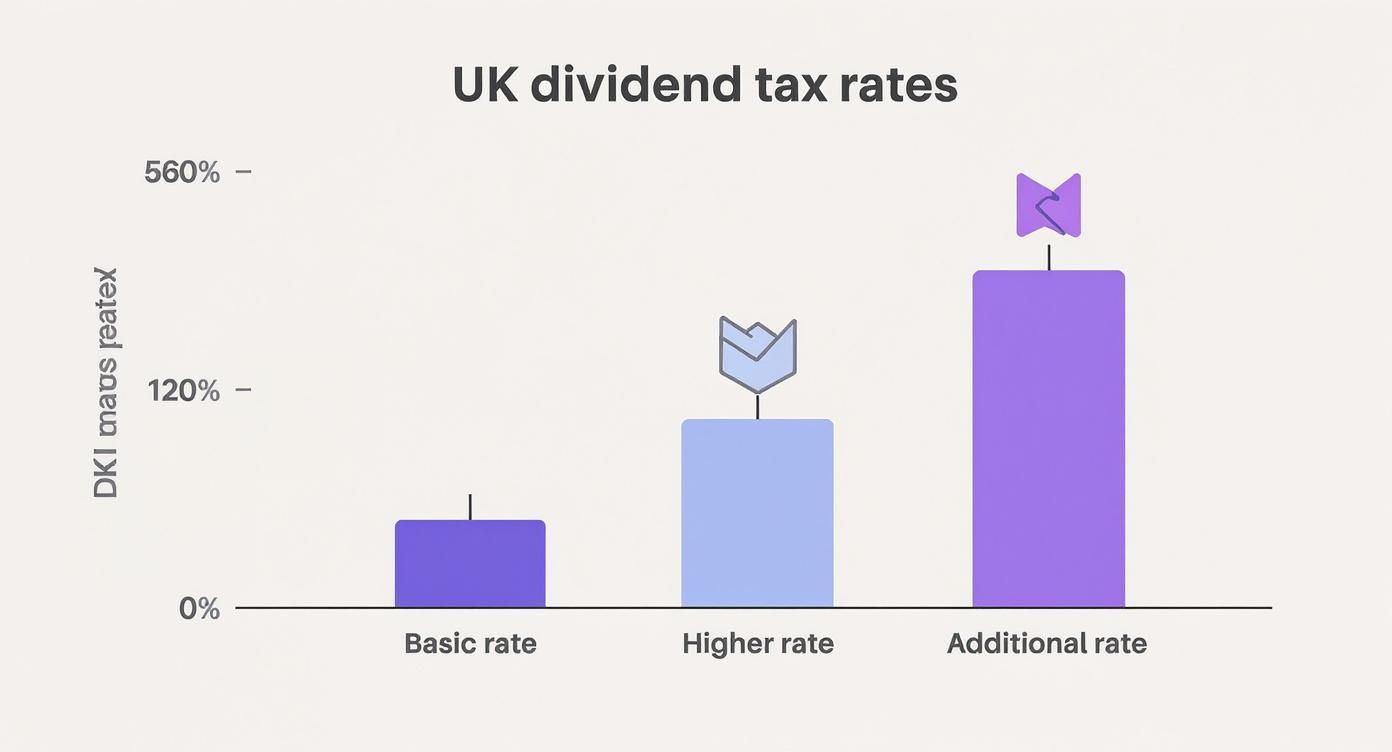
As you can see, dividend tax rates are significantly lower than income tax rates, which is the key to their efficiency.
Side-By-Side Financial Breakdown
The difference between these two strategies is night and day when you lay the numbers out. We’ve crunched the numbers to calculate the total "tax leakage"—that’s the combined amount lost to all taxes, from the initial £60,000 company profit to the money hitting your personal bank account.
Tax Leakage Analysis: Salary vs Dividend Strategy on £60,000 Profit
Here's a detailed look at where every pound goes under each scenario.
| Tax Component | Full Salary Strategy (£) | Low Salary/High Dividend Strategy (£) |
|---|---|---|
| Initial Company Profit | 60,000.00 | 60,000.00 |
| Director's Salary | 60,000.00 | 9,100.00 |
| Employer's NICs | 7,024.10 | 0.00 |
| Corporation Tax @ 19% | 0.00 | 9,671.00 |
| Remaining Profit for Dividends | 0.00 | 41,229.00 |
| Personal Taxable Income | 47,430.00 | 47,829.00 |
| Personal Income Tax | 8,746.00 | 0.00 |
| Employee's NICs | 4,249.20 | 0.00 |
| Dividend Tax | 0.00 | 2,831.29 |
| Total Tax Leakage | 20,019.30 | 12,502.29 |
| Net Cash in Hand | 39,980.70 | 47,497.71 |
The results speak for themselves. The low salary/high dividend mix completely out-performs the full salary approach by a significant margin.
By opting for the low salary, high dividend strategy, you would have an extra £7,517.01 in your pocket from the same £60,000 of company profit. This demonstrates the powerful tax efficiency of avoiding National Insurance Contributions.
This direct comparison makes the case for a hybrid remuneration strategy undeniable. The savings are substantial and directly boost your personal wealth. Of course, to properly optimise your approach, you need to unlock the secrets to tax efficiency and financial freedom, especially when dealing with complexities like international tax. While this example is based on a specific profit level, the principle holds true across a wide range of business incomes.
Making the Decision Beyond Purely Tax
While the tax numbers often lean towards a low-salary, high-dividend strategy, that's only one piece of the puzzle. How you pay yourself has ripples that extend far beyond your tax bill, touching everything from your company’s cash flow and your personal mortgage application to shareholder relationships.
Making a decision based solely on tax can sometimes store up trouble for later. It’s vital to look at the bigger picture. The best salary vs. dividend mix is one that works for your personal life and keeps the business on a healthy footing.
Cash Flow and Business Stability
One of the most immediate, practical differences between salaries and dividends is how they affect your company's bank balance. A director's salary, run through PAYE, is a fixed, predictable outgoing every month. That regularity makes forecasting a lot easier – you know exactly what needs to be in the account and when.
Dividends are a different beast altogether. They can only be paid out of post-tax profits, so they're completely tied to the company's performance. For a business with seasonal or unpredictable income, this flexibility is a huge plus. No profit? No dividend payment obligation. It's a great pressure release valve during leaner times.
But that unpredictability is a double-edged sword. If you rely on a steady income for your personal bills, the fluctuating nature of dividends could cause you some serious financial headaches.
The core difference lies in their rhythm: a salary provides a steady, predictable beat for financial planning, while dividends offer a flexible rhythm that moves with the company's performance. The right choice depends on how mature your business is and how much you personally need that reliable income.
Perceptions of Lenders and Financial Institutions
The way you take your money can dramatically change how lenders, especially mortgage providers, see you. A consistent salary showing up on regular payslips is the gold standard for them. It’s simple, easy for underwriters to understand, and fits perfectly into their risk assessment boxes.
Dividends, while completely legitimate, can muddy the waters. A lender will likely want to see a couple of years' worth of company accounts and your personal tax returns to get comfortable with your income's stability. They need convincing that the company's profits are consistent enough to support the drawings, which can be a hurdle for directors of newer or less predictable businesses.
- Salary: Lenders see this as stable, reliable income. It generally makes for a smoother mortgage application.
- Dividends: Be prepared to provide more paperwork. Lenders will want to see a solid track record of profitability over several years.
Shareholder Dynamics and Fairness
Things get even more complicated when there are multiple shareholders, especially if some are active directors and others are passive investors.
Salaries are paid for the job you do. This gives you the crucial flexibility to pay directors different amounts based on their roles, responsibilities, and the hours they put in. It’s a straightforward way to reward effort fairly.
Dividends, on the other hand, are legally required to be distributed to all shareholders according to the number of shares they hold. You can’t legally pay a bigger dividend to the director working 12-hour days than you do to a hands-off investor with the same shareholding. This rigidity can quickly cause friction if the active directors feel they're not being properly compensated for their hard graft compared to silent partners.
To make sure your remuneration strategy is sustainable, you really need to get under the bonnet of your company's finances. Learning how to analyze financial statements is a crucial step. It gives you the insight needed to strike the right balance between the needs of the business and the expectations of everyone who owns a piece of it.
Structuring Your Optimal Remuneration Strategy

After weighing up the pros and cons of salary versus dividends, a clear picture emerges for most UK directors. The challenge isn't about picking one over the other; it's about crafting a smart hybrid model that plays to the strengths of both. This nearly always leads back to the tried-and-tested "low salary, high dividend" strategy.
This approach gives you a powerful mix of tax efficiency and real-world benefits. By drawing a small, carefully set salary, you lock in long-term advantages like qualifying for the State Pension. The bulk of the company's profits can then be taken as dividends, which have the significant benefit of being free from National Insurance.
Setting Your Optimal Salary Level
The cornerstone of this strategy is pegging your salary to a key tax threshold. For most directors, the sweet spot is a salary set at or just below the National Insurance Secondary Threshold. This is the exact point where the company would have to start paying Employer's NICs on your earnings.
Keeping your salary at this level achieves a brilliant outcome: you earn just enough to get a qualifying year for your State Pension record, but you sidestep any meaningful NICs bill for both you and your business. As a bonus, this small salary is still an allowable business expense, trimming your Corporation Tax bill.
The optimal salary isn’t about giving yourself the biggest possible monthly paycheque. It's a strategic figure, designed to unlock state benefits at the lowest tax cost. This creates the most efficient foundation for drawing the rest of your profits as dividends.
Adapting the Strategy to Your Situation
While the low salary, high dividend model is an excellent starting point, it isn't a one-size-fits-all solution. Every business owner's circumstances are different, and your strategy needs to reflect that reality.
Think about these common scenarios:
- The Sole Director: If the company is your only source of income, your goal is simple: get profits out in the most tax-efficient way possible. The classic low salary/high dividend structure is perfect for this.
- A Director with External Income: Do you have income from a rental property or a private pension? That money uses up your personal tax allowances first. Your salary and dividend planning needs to account for this, as it can push your dividends into higher tax bands sooner than you expect.
- A Business with Fluctuating Profits: If your company's profits are up and down, the flexibility of dividends is invaluable. You can take larger dividends when cash flow is strong and hold back during leaner times to protect the business. You can even leave profits in the company and draw them down later through your director's loan account.
This strategic thinking fits into a wider economic pattern. Between 2000 and 2019, nominal dividends in the UK ballooned by around 298%, jumping from £48 billion to £191 billion. In stark contrast, real wages barely moved, showing a massive gap between returns on capital and labour.
Ultimately, deciding how to pay yourself is one of the most important financial decisions you'll make as a director. The principles here give you a solid framework, but there's no substitute for professional advice. Speaking with an accountant will ensure you build a strategy that’s perfectly aligned with your company's health and your personal financial goals.
Got Questions About Salary and Dividends? We’ve Got Answers
Figuring out the best way to pay yourself as a company director can feel like a minefield. It's natural to have questions, and getting them answered properly is key to staying compliant and making your money work harder. Let's tackle some of the most common queries we hear from business owners.
Can I Just Pay Myself in Dividends and Skip the Salary?
Technically, yes, you could pay yourself entirely in dividends. But it's almost always a bad idea. Forgoing a salary means you miss out on some significant long-term perks.
The smart move is to take a small, tax-efficient salary. As long as it's above the Lower Earnings Limit (£6,396 for 2024/25), you'll earn a qualifying year towards your State Pension. The best part? Neither you nor your company will pay a penny in National Insurance on that amount. A salary also provides a clear basis for making personal pension contributions directly from the business, which is a fantastic tax-deductible expense.
How Often Can I Take Dividends?
There's no legal limit on how often you can declare dividends. Whether it's weekly, monthly, or quarterly, you can pay them as often as you like, with one crucial condition: your company must have enough retained profit to cover the payment each and every time.
Don't get caught out by the paperwork, though. Every single dividend payment requires you to follow the correct legal procedure. That means holding a quick board meeting (even if it's just you), recording the decision in the minutes, and creating a dividend voucher for each shareholder. Skipping these steps can land you in hot water with HMRC.
A word of warning: paying a dividend when you don't have the retained profits to back it up is known as an "illegal" or "ultra vires" dividend. If this happens, directors can be held personally responsible for paying the money back to the company. It's a risk that highlights why meticulous, up-to-date accounts are non-negotiable.
What if I Pay a Dividend My Company Can't Afford?
If you realise you've paid a dividend from funds the company didn't have, that payment is classified as illegal. HMRC will likely re-categorise it as a director's loan, which means you personally owe that money back to the business.
This creates a serious tax headache. If that loan isn't repaid within nine months of your company's year-end, the business gets hit with a painful tax charge (called an S455 charge) of 33.75% on the outstanding balance. This is exactly why your dividend decisions should always be driven by accurate financial statements, not just the cash sitting in your bank account.
At Stewart Accounting Services, we're here to help you build a payment strategy that's both tax-savvy and watertight. Book a consultation today and let's get it right from the start.