

A Complete Guide to Sole Trader Tax Deductions in the UK

As a sole trader, getting your head around tax deductions is one of the most important things you can do. Put simply, they are the allowable business expenses you can subtract from your total income to lower your taxable profit. This single step is the key to paying the right amount of tax – ensuring you’re only taxed on what you actually earn, not just what you bring in.
How Sole Trader Tax Deductions Really Work
Let's imagine you run a small coffee stall. The cash you take from customers buying lattes and cappuccinos is your total income, or revenue. But you can't just pocket all of that. You had to buy coffee beans, milk, cups, and pay for the electricity to run your espresso machine. These are the costs of doing business.
The money left over after you've paid for all those essential supplies is your profit. That's the figure HMRC cares about. Tax deductions work on this exact same principle: you deduct the legitimate costs of running your business from your sales to figure out your taxable profit.
The whole system hinges on one golden rule from HMRC.
To be deductible, an expense must be incurred 'wholly and exclusively' for business purposes. This means the cost was for your business and your business alone, with no personal element mixed in.
Getting this rule right is the foundation of every claim you'll make. Every single pound you spend on a valid business expense directly reduces your profit, which in turn lowers your tax and National Insurance bill. The more legitimate expenses you correctly identify and claim, the more of your hard-earned money stays where it belongs – with you.
This simple but powerful calculation is what it all boils down to.
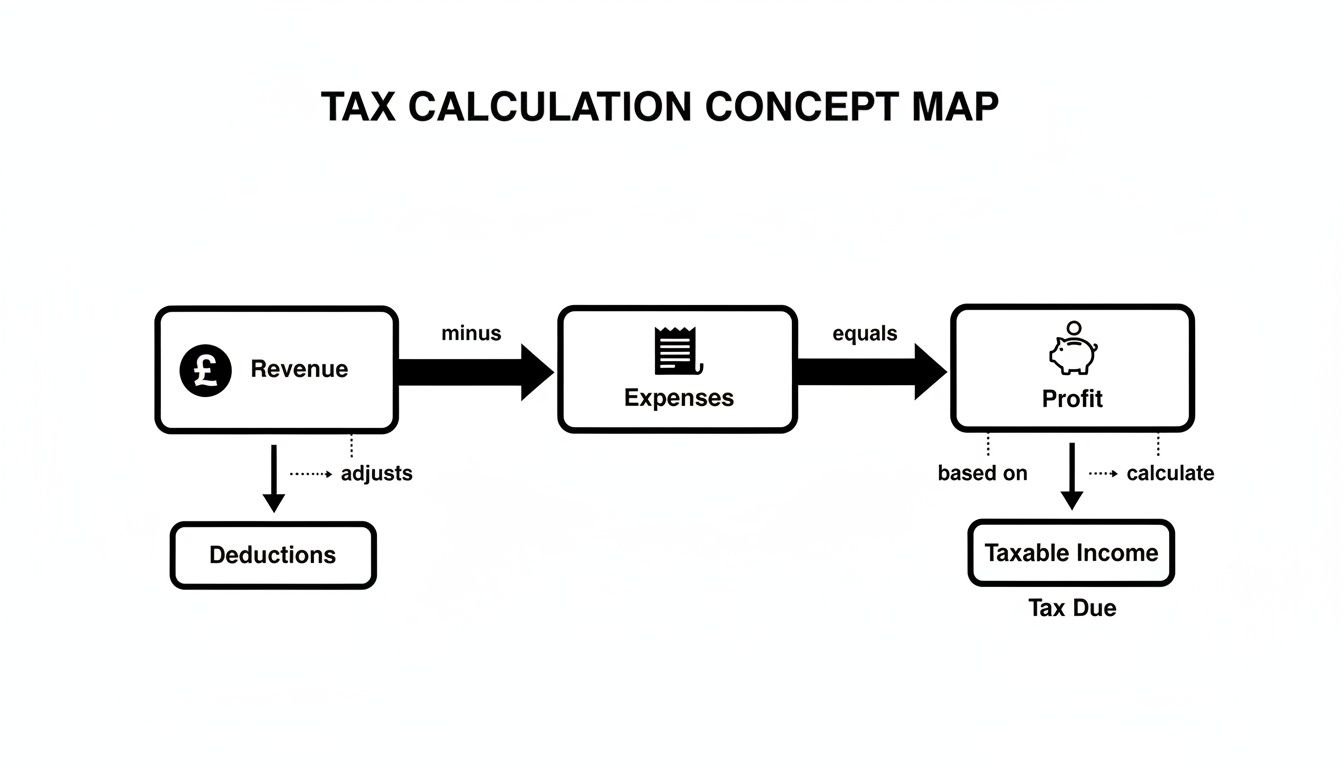
As the diagram shows, you start with your total revenue, subtract all your allowable expenses, and what's left is the profit you pay tax on. While the fundamental principles are similar across different countries, the specific rules can differ. For instance, our friends down under have their own set of guidelines, which you can read about in this guide: Sole Trader Tax Deductions Australia: Maximise Your Claims.
Common Allowable Expenses for Sole Traders at a Glance
To give you a clearer picture of what you can claim here in the UK, it helps to see some common examples broken down by category.
This table provides a quick overview of typical expenses that most sole traders will encounter.
| Expense Category | Common Examples | Key Consideration |
|---|---|---|
| Office Costs | Stationery, business software, phone bills, postage | Must be for business use. You'll need to apportion costs if there's mixed personal and business use. |
| Travel | Fuel (mileage), train tickets, parking, hotel stays | Journeys must be for business purposes. Commuting to a regular place of work is not included. |
| Marketing | Website hosting, online advertising, business cards | Any costs incurred to promote your business and attract new customers are generally allowable. |
| Professional Fees | Accountant fees, legal advice, business insurance | These are for services essential to running and protecting your business. |
Remember, this isn’t an exhaustive list, but it’s a fantastic starting point for understanding what you should be tracking throughout the tax year.
Claiming Your Home Office and Utility Expenses
For so many sole traders today, the home is the head office. While convenient, this setup often creates a classic tax headache: just what household costs can you legitimately claim as a business expense? Thankfully, HMRC recognises this blurred line and gives you two distinct methods for calculating your tax deductions for using your home for business.
Getting this choice right is crucial. One route is all about speed and simplicity, while the other involves more number-crunching but can often lead to a much bigger deduction. The best path for you really depends on your own circumstances, like how often you work from home and whether you have a space used purely for your business.
The Simplified Expenses Flat Rate Method
Think of the simplified expenses method as the “no receipts, no stress” option. Instead of wrestling with fractions of your utility bills, HMRC lets you claim a flat monthly amount based on the sheer number of hours you work from home.
It’s designed to be straightforward and is a brilliant choice if you’d rather minimise your admin time. You just need to keep a rough log of your hours and claim the corresponding fixed rate.
HMRC’s rates for the 2024/25 tax year are:
- £10 per month for 25-50 hours
- £18 per month for 51-100 hours
- £26 per month for 101+ hours
Annually, this works out to:
- 25 to 50 hours per month: £120 per year
- 51 to 100 hours per month: £216 per year
- 101+ hours per month: £312 per year
One vital point to remember: this flat rate is only for heat, light, and power. It does not cover your phone or internet bills. You still need to calculate and claim the business portion of those costs separately.
Calculating a Portion of Your Actual Costs
The second method is where you calculate the business percentage of your actual household running costs. Yes, it demands more effort and some diligent record-keeping, but it very often results in a significantly higher tax deduction, particularly if you have a dedicated office space.
This approach lets you claim a fair slice of several key household bills.
Key Idea: The ‘actual costs’ method is about claiming a fair and reasonable proportion of your total household expenses – the costs that are essential for both your home life and your business to function.
You’ll need to figure out what percentage of your home you use for business and for how long. The key here is that your calculation must be logical and justifiable; you can’t just pluck a figure out of thin air.
How to Apportion Your Actual Household Costs
So, how do you do it? To calculate your claim using the actual costs method, you need a sensible way to divide your bills between personal and business use. A common and HMRC-accepted approach is to work it out based on the number of rooms in your house.
Let’s walk through a quick example.
Imagine you live in a five-room house (we’ll exclude bathrooms, hallways, and landings) and you use one of those rooms exclusively as your office. Simple maths tells us that 20% of your home is used for business.
Now, you can apply that 20% figure to your relevant annual household bills:
- Total Gas & Electricity Bill: £1,800
- Total Council Tax: £1,500
- Mortgage Interest (important: only the interest, not the capital repayment): £3,000
- Total Annual Bills: £6,300
With this method, your potential claim would be 20% of £6,300, which is £1,260. As you can see, that’s a world away from the maximum £312 you could get using the simplified flat rate.
Of course, if that room has a dual purpose – say, it’s your office by day and a spare bedroom on weekends – you need to adjust your claim. You’d have to reduce the final figure to reflect only the hours it’s actually being used for work. Getting this apportionment right is vital, and our detailed guide on how to claim home office expenses dives into the finer details to help you make an accurate calculation.
Getting to Grips with Vehicle, Travel, and Meal Expenses
For most sole traders, travel is just part of the job. But it’s also an area where the line between business and personal spending gets blurry, and it’s crucial to get it right. Knowing exactly what you can claim is key to making sure you’re not overpaying on your tax bill.
The golden rule from HMRC is that you can only claim for journeys made ‘wholly and exclusively’ for your business. Think trips to see clients, heading to a temporary work site, or picking up supplies. The one major thing you can’t claim for is your regular commute.
Crucial Distinction: The journey from your home to a permanent workplace (like a workshop you rent or a single client’s office you go to every day) is classed as ordinary commuting. That’s not tax-deductible. However, a trip from your home office to meet a new client absolutely is.
When it’s time to claim for using your own car or van, you have two options – a bit like the choice you have for home office expenses. You can either use a simple, flat-rate mileage allowance or go down the route of claiming a proportion of your vehicle’s actual running costs.
Mileage Allowance vs. Actual Costs: Which Is for You?
The simplified mileage allowance is by far the most straightforward way to handle things. You just need to keep a log of your business miles and then claim a set rate for each mile you drive. This flat rate is designed to cover everything – fuel, insurance, tax, servicing, and the general depreciation of your vehicle.
HMRC’s current approved mileage rates for cars and vans are:
- 45p per mile for the first 10,000 business miles you do in a tax year.
- 25p per mile for any business miles after that 10,000-mile mark.
The alternative is the actual costs method. This involves a bit more maths. You’ll need to add up every single running cost for your vehicle – fuel, insurance, repairs, MOTs, servicing – and then work out what percentage of your total mileage was for business. You can then claim that percentage of your total costs.
If you go with the actual costs method, you can often claim Capital Allowances on the price of the vehicle itself. This can be a really valuable deduction, especially in the year you buy it. For a much deeper dive into how this all works, check out our guide on car and travel costs for the self-employed.
Which Vehicle Expense Method Will Save You More?
Working out which route is best for your wallet really depends on how much you drive and how much your car costs to run. If you rack up a lot of miles in a cheap-to-run car, the flat mileage rate will likely be your best friend. But if you don’t drive as much and your vehicle has high insurance or maintenance bills, calculating the actual costs might leave you better off.
To make it clearer, here’s a side-by-side look.
Simplified Mileage vs. Actual Vehicle Costs: A Comparison
Choosing your method is a key decision that affects both your tax bill and your admin workload. This table breaks down the main differences to help you figure out the best approach for your business.
| Feature | Simplified Mileage Allowance | Actual Running Costs |
|---|---|---|
| What You Claim | A flat rate per business mile (45p/25p). This covers all running costs. | A percentage of your total vehicle costs (fuel, insurance, repairs, etc.). |
| Record Keeping | A detailed log of business journeys is essential: dates, destinations, and miles driven. | You must keep receipts for all vehicle expenses plus a log of business and personal mileage. |
| Capital Allowances | Not available. The mileage rate is designed to include a contribution towards depreciation. | Yes, you can claim Capital Allowances on the business portion of the vehicle's purchase price. |
| Best For | Sole traders who drive a high number of business miles or want to keep their bookkeeping simple. | Those with lower mileage but high running costs, or who have recently bought an expensive vehicle. |
Remember, once you choose a method for a particular vehicle, you generally have to stick with it for as long as you use that vehicle for your business.
What About Subsistence and Other Travel Costs?
It's not all about your own car, of course. Any other travel costs you incur for business are also valid sole trader tax deductions. That means you can claim for train tickets, bus fares, flights, and taxi rides taken for business purposes. If a work trip means you need to stay overnight, the cost of your hotel is an allowable expense too.
This leads us to one of the most commonly misunderstood areas: meals, or what HMRC calls 'subsistence'. Let’s be clear: you cannot claim for the cost of your daily lunch. That’s just a normal cost of living.
However, you can claim for reasonable meal costs if you're on an overnight business trip or taking a journey that's well outside your normal routine. The key is that the expense has to be a direct result of your business travel. So, grabbing a sandwich on the motorway while driving two hours to a client meeting? That's usually fine. Buying lunch from the café next to your usual place of work? That's a no-go.
Here's the rewritten section, designed to sound completely human-written and natural:
Don't Forget These Everyday Business Expenses
Beyond the big-ticket items like your home office and travel, a sole trader's life is full of smaller, everyday costs. It’s easy to overlook them, but they can make a serious dent in your final tax bill. Think of it this way: every pound you spend to keep your business ticking over is a pound you can potentially claim back.
These day-to-day running costs are what HMRC calls revenue expenses. They’re the bread and butter of your business spending, from the software you rely on to the accountant who sorts out your tax return. Getting into the habit of tracking these is just as crucial as logging your mileage.
Office, Admin, and Professional Help
Every business has those essential background costs that keep everything running smoothly. Thankfully, these are some of the most common and clear-cut expenses you can claim.
- Office Supplies: This is more than just pens and paper. It covers everything from printer ink and postage to notebooks and staples.
- Software & Subscriptions: Do you pay for accounting software like Xero or project management tools? What about industry-specific apps or professional journal subscriptions? They're all claimable.
- Professional Fees: The money you pay an accountant to handle your Self Assessment or a solicitor for business advice is a fully deductible cost. It’s an investment in getting things right, and HMRC recognises that.
- Business Insurance: Public liability, professional indemnity, or any other policy you need to operate safely and legally is an allowable expense.
These aren't just costs; they're essential for keeping your business compliant and professional.
Getting the Word Out: Marketing and Growth
As the old saying goes, "you have to spend money to make money." The good news is that most of the cash you spend promoting your business can be claimed back as an expense.
This covers a huge range of activities you might undertake to find new customers:
- Running adverts on Google, Facebook, or in a local paper.
- Paying for your website domain name and hosting.
- Printing off business cards, flyers, or brochures.
Claiming these costs means your investments in growing your business are properly accounted for, helping you expand without taking an unnecessary tax hit.
A Quick Word of Warning: One classic mistake is trying to claim for "client entertainment." Taking a potential customer out for lunch or coffee is considered a disallowable expense, even if you seal a brilliant deal over dessert. HMRC is very strict on this one.
The Big Stuff: Equipment and Capital Allowances
So, we've covered the daily running costs. But what happens when you buy something more substantial for your business, like a powerful new laptop, a professional-grade camera, or a specific piece of machinery?
This isn't a simple running cost; it's what's known as capital expenditure. You're buying an asset that will last.
Instead of just deducting the full amount from your profits in one go, you'd typically claim for its value over time through a system called Capital Allowances. It’s basically the taxman’s version of depreciation.
However, there’s a fantastic shortcut for most sole traders. It's called the Annual Investment Allowance (AIA). Right now, this lets you deduct 100% of the cost of most business equipment in the year you buy it, up to a massive limit of £1 million.
So, if you buy a new work computer for £1,200, you can usually knock that entire £1,200 off your profits for the year. This is one of the most powerful tax reliefs available, giving you immediate help when you invest in the tools you need to get the job done.
Building a Bulletproof Record Keeping System
Claiming every tax deduction you're entitled to is brilliant, but in HMRC's eyes, a claim without proof is just a guess. This is where great record-keeping stops being a chore and becomes your best friend. Building a simple, effective system isn’t about creating mountains of paperwork; it’s about having a clear, organised trail that backs up every single figure on your tax return.
A solid system gets rid of the end-of-year stress. It means that if HMRC ever asks questions, you’ve got the answers ready to go. It turns your Self Assessment from a frantic scramble through a shoebox of receipts into a straightforward process of plugging in numbers you can actually trust.
Think of it this way: your records are the evidence you present to make your case for a lower tax bill. The stronger your evidence, the stronger your case.
What Records You Must Keep
HMRC is pretty specific about what sole traders need to hang on to. The trick is to have a system that captures all these puzzle pieces as they happen, not just in a mad rush once a year.
Here’s a quick checklist of the essentials:
- All Sales and Income: Make sure you have copies of every invoice you send out.
- All Business Expenses: This means every receipt, from a £3 train ticket to a £1,000 laptop.
- VAT Records: If you’re VAT registered, you’ll need to keep your VAT invoices and maintain digital records to comply with Making Tax Digital rules.
- Personal Income: Keep track of any other income you have, maybe from employment or a rental property.
- Bank Statements: Having both your business and personal statements gives you a complete picture of the money flowing in and out.
Getting these documents organised from the start makes it dead simple to prove that your expenses were genuine business costs.
Modernising Your Record Keeping
Forget dusty shoeboxes overflowing with faded receipts. These days, technology makes building a bulletproof system easier than ever. For many sole traders, cloud accounting software is a complete game-changer, doing a lot of the heavy lifting for you.
Key Takeaway: Good record-keeping isn't just about staying on the right side of HMRC; it's a powerful business tool. It gives you a real-time view of your financial health, helping you make smarter decisions about pricing, spending, and when to grow.
Modern platforms like Xero or QuickBooks let you link your business bank account, which then automatically pulls in all your transactions. You can then use their mobile apps to snap a photo of a receipt the second you get it, attaching it directly to the right transaction. Just like that, you’ve created a digital, organised, and HMRC-compliant record in seconds.
This approach doesn’t just save you a ton of time; it dramatically cuts the risk of losing those small receipts that really add up to significant tax savings over a full year.
How Long to Keep Your Records
Once you’ve finally hit 'submit' on your Self Assessment tax return, you can't just toss everything in the bin. HMRC has strict rules on how long you must keep your business records, just in case they decide to take a closer look at your tax affairs.
The rule is straightforward: you must keep your records for at least five years after the 31st January submission deadline for that tax year.
Let's take an example. For the 2023-24 tax year, the online filing deadline is 31st January 2025. That means you need to keep all your records for that year safe until at least the end of January 2030. Whether you store them digitally in the cloud or in neatly organised files at home, it's a legal requirement to make sure they're safe and accessible for this period.
Claiming Expenses on Your Self Assessment Return
You’ve spent the year carefully tracking your income and outgoings. Now it’s time to report those figures to HMRC and see all that hard work pay off. This is where meticulous record-keeping turns what can feel like a stressful chore into a straightforward process.
Everything happens on your annual Self Assessment tax return. Specifically, you’ll be working on the self-employment supplementary pages, officially known as the SA103 form.
Of course, before you can claim anything, you need to be in the system. If this is your first time, make sure you register for Self Assessment tax as soon as possible. It’s the essential first step for any sole trader in the UK.
Entering Your Figures on the Form
When you file your return online, the system is designed to walk you through it. First, you'll enter your total turnover – that's all the money your business brought in for the tax year. After that, you get to the really important bit: declaring your allowable expenses.
The good news? You don't have to list every single coffee or train ticket. HMRC just wants the total figure for each expense category.
The online form has dedicated boxes for the most common sole trader tax deductions, including:
- Costs of goods sold: The direct cost of any stock or materials you sold.
- Office costs: A catch-all for stationery, phone bills, software, and similar items.
- Travel costs: The sum of your business mileage, public transport fares, and parking.
- Legal and professional costs: This is where you’d pop your accountant's fee.
All you need to do is add up your totals for each category from your own records and type the final number into the right box. The online form handles the rest, automatically subtracting your total expenses from your turnover to calculate your taxable profit.
For a more detailed walkthrough, check out our guide on https://stewartaccounting.co.uk/how-to-complete-self-assessment/.
When to Call in an Accountant
Many sole traders are perfectly comfortable filing their own tax returns, and that's fantastic. But there are times when getting an expert involved is less of a cost and more of a smart investment. An accountant does more than just fill in the blanks; they offer strategic advice to make sure your business is as tax-efficient as it can be.
You might want to think about getting professional help if:
- Your business is growing quickly, and your finances are getting more complicated.
- You're not sure how to handle things like Capital Allowances or large asset purchases.
- You simply want the peace of mind that comes with knowing everything is filed correctly and on time.
A good accountant can often spot deductions you’ve missed, potentially saving you more in tax than the cost of their fee.
Frequently Asked Questions About Sole Trader Tax
When you're running your own business, a few tricky questions about expenses always seem to pop up. Getting your head around these grey areas is key to filing your Self Assessment return correctly and making sure you don't miss out on tax relief.
Let’s clear up some of the most common queries we hear from sole traders.
Can I Claim for Clothing as a Sole Trader?
This is a classic question, but the answer is usually no. HMRC is quite strict on this. The cost of everyday clothing, like a smart suit you buy for client meetings, isn't an allowable expense because it has a dual purpose – you could wear it outside of work.
However, there are a few specific exceptions:
- Branded Uniforms: If your workwear has your company logo permanently embroidered or printed on it, that’s fair game.
- Protective Gear: Think steel-toed boots for a builder, a high-vis jacket for a surveyor, or scrubs for a therapist. If it’s for safety, it’s claimable.
- Costumes: An actor or entertainer can claim for a specific costume needed for a performance.
A good rule of thumb is to ask yourself: "Could I reasonably wear this down the pub on a Friday night?" If the answer is yes, you almost certainly can't claim for it.
What Are Pre-Trading Expenses and Can I Claim Them?
Yes, absolutely! Pre-trading expenses are simply costs you incurred before you officially opened for business. It's easy to forget these, but HMRC allows you to claim for qualifying expenses from up to seven years before your start date.
This could include things like buying your initial stock, paying for your website to be designed, or purchasing essential software to get you started. So long as the expense would have been allowable if your business were already running, you can claim it back.
On your tax return, all these pre-trading costs are treated as if they were spent on your first day of trading. It’s a great way to get tax relief on those vital start-up investments.
What Makes an Expense Disallowable?
A disallowable expense is any cost that HMRC says you can't subtract from your income to calculate your taxable profit. Trying to claim these can land you with an incorrect tax bill and even penalties.
The most common culprits include:
- Costs for entertaining clients (lunches, drinks, events).
- Any kind of fine, like a parking ticket or speeding penalty.
- The cost of your regular commute between home and your main place of work.
- Any expense that has a mix of personal and business use where you can't clearly split the business part out.
Do I Really Need a Separate Business Bank Account?
While you're not legally required to have one as a sole trader, it's highly recommended. Opening a separate bank account is one of the best things you can do for your business admin.
It draws a clear line in the sand between your business and personal spending. This simple habit makes bookkeeping a thousand times easier, drastically reduces the chance of you forgetting to claim an expense, and makes filling out your tax return a far less painful experience.
Getting to grips with the ins and outs of sole trader tax deductions can feel like a full-time job in itself, but you don't have to tackle it alone. At Stewart Accounting Services, our team of Chartered Accountants can help you spot every allowable expense, keep your records in order, and give you the confidence that your tax is being handled by experts. Find out how we can help you save time and money by visiting us at https://stewartaccounting.co.uk.
Recent Posts
25 Oct, 2026