
The single most important difference between a sole trader and a limited company comes down to legal identity. As a sole trader, you are the business. Legally, there's no distinction between your personal and business finances. A limited company, on the other hand, is a completely separate legal entity, which shields your personal assets from business debts.
This isn't just a technicality; your choice has real-world consequences for your liability, tax bill, administrative workload, and even how potential clients see your business.
Choosing Your UK Business Structure
Deciding whether to operate as a sole trader or to set up a limited company is one of the very first, and most significant, decisions you'll make as a UK business owner. It’s far more than a simple administrative step—it lays the foundation for your personal risk, your tax planning, and the day-to-day paperwork you'll need to handle.
For many people just starting out, the sole trader path is the most straightforward. The setup is simple, the administrative burden is light, and you're good to go. It’s a popular choice for freelancers, contractors, and small businesses where the financial risks are relatively low. To get a better feel for this approach, you can understand the sole proprietorship model, which is very similar to the UK's sole trader setup.
Setting up a limited company creates a formal business structure that exists independently of you, the owner. This separation provides "limited liability," which means that if the business encounters financial difficulties, your personal finances—like your home or savings—are safe. It also tends to project a more professional and established image, which can be a real advantage when you're trying to win contracts with larger organisations.
Interestingly, the trend in the UK is shifting. Between March 2024 and March 2025, the number of private sector companies actually grew by 1.8%, while the number of sole proprietorships dropped by 4.1%.
Key Takeaway: Your decision should reflect your ambitions. If you want simplicity and minimal fuss, being a sole trader is a great fit. But if you’re aiming for serious growth, need to take on debt, or work in a risky industry, the protection offered by a limited company is almost essential.
Sole Trader vs Limited Company At a Glance
To help you see the differences side-by-side, here’s a quick comparison of the two structures. Think of it as a starting point for weighing up what matters most to you and your business.
| Feature | Sole Trader | Limited Company |
|---|---|---|
| Legal Status | You and the business are legally the same entity. | A separate legal entity from its owners (shareholders). |
| Personal Liability | Unlimited. Your personal assets are at risk if the business fails. | Limited. Your personal assets are generally protected from business debts. |
| Setup Process | Very simple. Just register for Self Assessment with HMRC. | More involved. You must incorporate the company with Companies House. |
| Taxation | You pay Income Tax and National Insurance on all business profits. | The company pays Corporation Tax on profits. You pay tax on salary and dividends. |
| Admin & Reporting | An annual Self Assessment tax return is the main requirement. | You must file annual accounts, a confirmation statement, and a company tax return. |
| Public Perception | Often seen as smaller or less formal. Perfect for many one-person businesses. | Projects a more professional, credible, and established image. |
Ultimately, getting to grips with these key differences is your first step. If the simplicity of the sole trader route sounds right for you, we've put together a guide on https://stewartaccounting.co.uk/how-to-register-as-sole-trader/. This will help you measure these points against your own specific goals and what level of risk you're comfortable with.
Understanding Your Legal Liability and Personal Risk
When you're weighing up whether to be a sole trader or form a limited company, this is arguably the most important factor to get your head around. It's not just legal jargon; the difference in liability has very real consequences for your personal finances and how you manage risk. Getting this right from the start is fundamental.
As a sole trader, you and your business are one and the same in the eyes of the law. Every contract signed, every loan taken out, every debt owed—it's all on you personally. This is called unlimited liability, and it’s a big deal.
What it means is that if your business runs into financial trouble and can’t pay its debts, creditors can legally come after your personal assets to get their money back. That includes your savings, your car, and even your family home. The legal line between your business life and your personal life simply doesn't exist, which puts all the financial risk squarely on your shoulders.
The Sole Trader Scenario Unpacked
Let’s put this into a real-world context. Imagine you're a freelance graphic designer operating as a sole trader. You land a huge project, but your client suddenly goes bust and can't pay your £15,000 invoice. To make matters worse, the business credit card you used for new equipment is maxed out at £5,000.
Suddenly, your business is £20,000 in the red with no money coming in. Because of unlimited liability, the credit card company can pursue you personally for that debt. If you can't pay up, a court could order the seizure of your personal belongings to cover the amount owed. It's a sobering thought, and it highlights how the simplicity of being a sole trader comes at the cost of zero financial protection if things go sideways.
The Limited Company's Corporate Veil
This is where the limited company really shines. By incorporating, you create a completely separate legal entity. Think of it as a person in its own right—it can own assets, sign contracts, and rack up debts, all under its own name. This creates what's known as the ‘corporate veil’.
This separation means your personal liability is limited to whatever you've invested in the company, which is usually just the nominal value of your shares. If the company fails and can't pay its debts, your personal assets are generally safe and sound. Creditors can only make a claim against the assets held by the company itself.
By forming a limited company, you build a legal firewall between your business finances and your personal life. This is the single most compelling reason why businesses that handle significant debts, valuable contracts, or operate in high-risk sectors choose this structure.
When the Corporate Veil Can Be Pierced
Now, it’s important to know that this protection isn't a get-out-of-jail-free card. There are a few specific situations where a director can be held personally responsible for company debts, effectively "piercing the corporate veil."
- Personal Guarantees: If you apply for a business loan, it’s very common for banks to ask for a director's personal guarantee. This is a binding agreement where you promise to pay back the loan personally if the company can't.
- Wrongful Trading: You can’t keep trading and taking on new debt if you know the company is insolvent (can’t pay its bills) and has no realistic chance of recovery. If you do, you could be made personally liable for those new debts.
- Fraudulent Activity: Any kind of fraud or deliberate misconduct will instantly dissolve the protection of limited liability. In this case, you will be held personally accountable for the fallout.
Ultimately, choosing between these two structures is a decision about how much risk you're willing to take on. The sole trader route gives you simplicity but exposes you to maximum personal risk. In contrast, a limited company requires more admin but provides vital protection for your personal assets.
Comparing Tax and National Insurance Obligations
Let's get straight to the point: for most people choosing between a sole trader and a limited company structure, tax is the single biggest decider. The way HMRC views your profits and how you actually get that money into your bank account is fundamentally different for each setup.
These differences have a direct and significant impact on your take-home pay, so getting your head around them is crucial before you commit to one path or the other.
As a sole trader, things are wonderfully straightforward. Your business profits are treated as your personal income. You pay tax on everything the business earns, after you've deducted your allowable expenses, all wrapped up in a single Self Assessment tax return each year. Simple.
A limited company, on the other hand, plays by a different set of rules. The business is its own legal and tax entity. This means it pays its own tax—Corporation Tax—on its profits first. Only then can you, as the director, draw money out, and you'll be taxed personally on whatever you take, usually through a mix of salary and dividends.
How Sole Traders Are Taxed
If you're a sole trader, your tax bill is a mix of two things: Income Tax and National Insurance Contributions (NICs). All your business profits for the tax year are simply added to any other personal income you might have, and that total figure is what you're taxed on.
Income Tax is charged in bands. Everyone gets a Personal Allowance (the amount you can earn tax-free), and any profits above that are taxed at the basic, higher, or additional rates depending on how much you earn.
On top of Income Tax, you'll also pay two types of National Insurance:
- Class 2 NICs: A small, flat weekly rate you pay if your profits are above a certain threshold.
- Class 4 NICs: A percentage-based contribution paid on profits that fall within a specific band.
This direct link between business profit and personal tax is easy to understand, but it means that as your business grows, your tax bill can climb pretty steeply. You can get more insights on https://stewartaccounting.co.uk/paying-class-4-nics/ and see how they're worked out in our detailed guide.
How Limited Companies Are Taxed
The tax structure for a limited company is a bit more layered, which is where the opportunities for efficiency come in. First off, the company pays Corporation Tax on its annual profits. This is a flat rate, which is often much lower than the higher personal Income Tax rates.
Once the company has settled its Corporation Tax bill, the remaining profit is available to be distributed. As a director, you can pay yourself a salary through a PAYE (Pay As You Earn) scheme. This salary is a brilliant tool because it's an allowable business expense, which reduces the company's profit and, in turn, its Corporation Tax bill. But remember, you'll pay personal Income Tax and National Insurance on this salary.
The go-to strategy for most owner-directors is to draw a small, tax-efficient salary—often just enough to qualify for National Insurance credits without actually paying much tax—and take the rest as dividends. Dividends are paid from the company's post-tax profits. Their big advantage? They're taxed at lower rates than salary income and are completely free from National Insurance.
A Practical Tax Comparison Example
Nothing beats seeing the numbers side-by-side. Let's imagine a business makes a profit of £50,000 before the owner takes any money out. The table below gives a simplified but clear breakdown of the tax bill for each structure.
Tax Calculation Example Profit of £50,000
| Tax Item | Sole Trader Calculation (£) | Limited Company Calculation (£) |
|---|---|---|
| Business Profit | 50,000 | 50,000 |
| Director's Salary | N/A | 12,570 |
| Corporation Tax (19%) | N/A | (50,000 – 12,570) x 19% = 7,112 |
| Income Tax | 7,486 | 0 (on salary) |
| National Insurance | 3,241 | 0 (on salary) |
| Dividends Paid | N/A | (37,430 – 7,112) = 30,318 |
| Dividend Tax | N/A | 1,598 |
| Total Tax Paid | 10,727 | 8,710 |
| Take-Home Pay | 39,273 | 41,290 |
As you can see, the difference is clear. In this scenario, running as a limited company and using that salary-dividend mix leaves you with over £2,000 more in your pocket. As profits climb higher, these savings often become even more significant, making the limited company route a very attractive option for ambitious, growing businesses.
Navigating Administrative and Reporting Duties
Beyond the big-ticket items like tax and liability, the day-to-day reality of running your business is shaped by the admin on your plate. This is where you'll feel one of the sharpest differences between being a sole trader and running a limited company.
One path is all about simplicity and keeping paperwork to a minimum. The other asks for more formal, structured reporting in return for its powerful legal protections.
For sole traders, the administrative load is refreshingly light. Your main legal task is to keep accurate records of your business's sales and expenses. This is so you can correctly calculate your profit for your annual Self Assessment tax return, which is pretty much the core of your reporting duties.
There’s no need to file public accounts or report business changes to a central body like Companies House. This simplicity is a huge plus for freelancers, consultants, and small tradespeople who'd rather spend their time on their craft, not on compliance.
The Sole Trader's Admin Checklist
The admin cycle for a sole trader is straightforward and revolves almost entirely around HMRC. Your key responsibilities are:
- Registering for Self Assessment: You just need to let HMRC know you're self-employed.
- Good Record-Keeping: You must keep a clear trail of all your income and business-related spending. Using tools like various receipt templates can make it much easier to prove your expense claims.
- Annual Self Assessment: Every year, you have to file a tax return detailing your profits and pay the Income Tax and National Insurance you owe.
Key Insight: The beauty of the sole trader setup is its privacy and simplicity. Your financial details are just between you and HMRC, and all your reporting is wrapped up in one single annual task.
The Limited Company's Reporting Obligations
A limited company, on the other hand, operates under a much stricter set of rules. As a separate legal entity, it has formal duties to both HMRC and Companies House, the UK’s registrar of companies. This means more admin and, more often than not, the need for professional help.
The company is legally required to maintain a series of official records, often called statutory books. These include registers of directors, shareholders, and important company decisions. They aren't just for your own reference; they're a legal must-have.
What's more, a limited company's financial information is public. You must prepare and file annual accounts with Companies House every year, where they can be viewed by anyone—clients, suppliers, and even your competitors. Our detailed guide explains how to submit company accounts to make sure you tick all the right boxes.
On top of the annual accounts, you also have to file:
- A Company Tax Return (CT600): This goes to HMRC to work out and pay your Corporation Tax.
- A Confirmation Statement: This is an annual update to Companies House to confirm that the information they have about your company (directors, address, etc.) is still accurate.
- PAYE Reporting: If you're paying yourself or anyone else a salary, you have to run a PAYE scheme and report payments and deductions to HMRC in real-time.
All this extra complexity almost always means higher professional fees. The cost of an accountant for a limited company is significantly more than for a sole trader's Self Assessment—a real, tangible cost to weigh up in your decision.
Looking Ahead: Credibility and Growth Potential
How your business comes across to clients, investors, and even the bank can make or break its future. The structure you choose – sole trader or limited company – is a huge part of that first impression and directly impacts your ability to scale up.
For many larger organisations, there's a definite preference for dealing with limited companies. That little ‘Ltd’ at the end of your name acts as a signal of credibility. It suggests a level of professionalism and stability that, rightly or wrongly, a sole trader can sometimes find harder to project.
It’s not just a matter of perception, though. A limited company's details are on the public record at Companies House. This transparency means potential partners or big-ticket clients can easily verify your business exists and check its financial track record. It’s a layer of reassurance that the more informal setup of a sole trader just can't match.
Securing Investment and Loans
When it's time to find funding, the gap between the two structures widens considerably. Investors and lenders see a limited company as a much tidier, more appealing prospect. Its finances are separate from yours, its legal framework is solid, and its performance is documented through filed accounts.
Banks, for instance, are often more comfortable lending to limited companies. The formal reporting gives them a clear window into the business's financial health, making their own risk assessment far simpler. While a sole trader can absolutely get a loan, the process usually involves a much deeper look into your personal finances, and you'll likely have to put up personal assets, like your home, as security.
And if you're thinking about equity investment? A limited company isn't just a better option—it's the only option. The entire model of equity funding relies on issuing shares. You can’t sell a percentage of your business to an investor if, in the eyes of the law, you are the business.
A limited company is built for growth. Its structure is designed to support the sale of equity to raise capital—a fundamental step for angel investment or venture capital that is simply impossible for a sole trader.
Planning for the Future: Growth and Exit Strategies
Think about your long-term plans. A limited company is designed to scale, making it much easier to adapt as your ambitions grow.
Let’s look at a few common growth scenarios:
- Bringing on Partners: With a limited company, you can easily bring new partners on board by issuing them shares. The process is legally straightforward, clearly defining ownership and responsibilities. For a sole trader, adding a partner means dissolving your current business and starting a whole new partnership from scratch. It’s a lot more disruptive.
- Employee Share Schemes: Want to attract and keep top talent? Offering shares to key employees is a fantastic incentive. This is a standard move for limited companies but isn't an option if you're a sole trader.
- Selling the Business: The separate legal identity of a limited company turns it into a saleable asset. You can sell the entire business by transferring the shares—a clean, well-established process. Selling a sole trader business is much messier; it involves selling off individual assets like client lists, equipment, and goodwill, rather than the business entity itself.
In the end, starting as a limited company, or switching to one down the line, is a strategic play. It positions your business for serious growth, gives you a leg up in credibility, and opens doors to more significant financial opportunities. It’s a clear signal to the world that you're building something to last.
Making the Right Choice for Your Business Stage
Deciding whether to be a sole trader or form a limited company really boils down to where your business is right now, and where you want it to go. Think of each structure as a different tool for a different job. The "right" choice is simply the one that fits the business you're trying to build.
For many, the sole trader route is the perfect launchpad. It’s a great fit for freelancers, contractors, and anyone running a side hustle where the risk of personal liability is low and keeping things simple is the main priority. If your goal is to start trading as quickly as possible with minimal red tape, this is probably the best way to go.
But as your business grows and your goals get bigger, the benefits of a limited company start to look very attractive.
When is a Limited Company the Right Move?
A limited company is built for two things: protection and growth. It becomes the logical next step when you start hitting certain milestones or have clear, ambitious goals. It's time to seriously consider forming a limited company if you find yourself in these situations:
- You're working in a riskier field: If your business could potentially face financial claims or build up significant debt, the protection of limited liability is invaluable. It puts a legal wall between your business finances and your personal assets.
- You need to bring in outside money: Banks, investors, and lenders almost always prefer the transparent, formal structure of a limited company. It gives them the confidence they need to back you.
- You want to project a more professional image: Having ‘Ltd’ after your company name can genuinely boost your credibility. This can make all the difference when you're trying to win contracts with larger, more established clients.
This decision tree gives you a visual on how the choice you make can influence your ability to land clients, secure investment, and plan for future expansion.
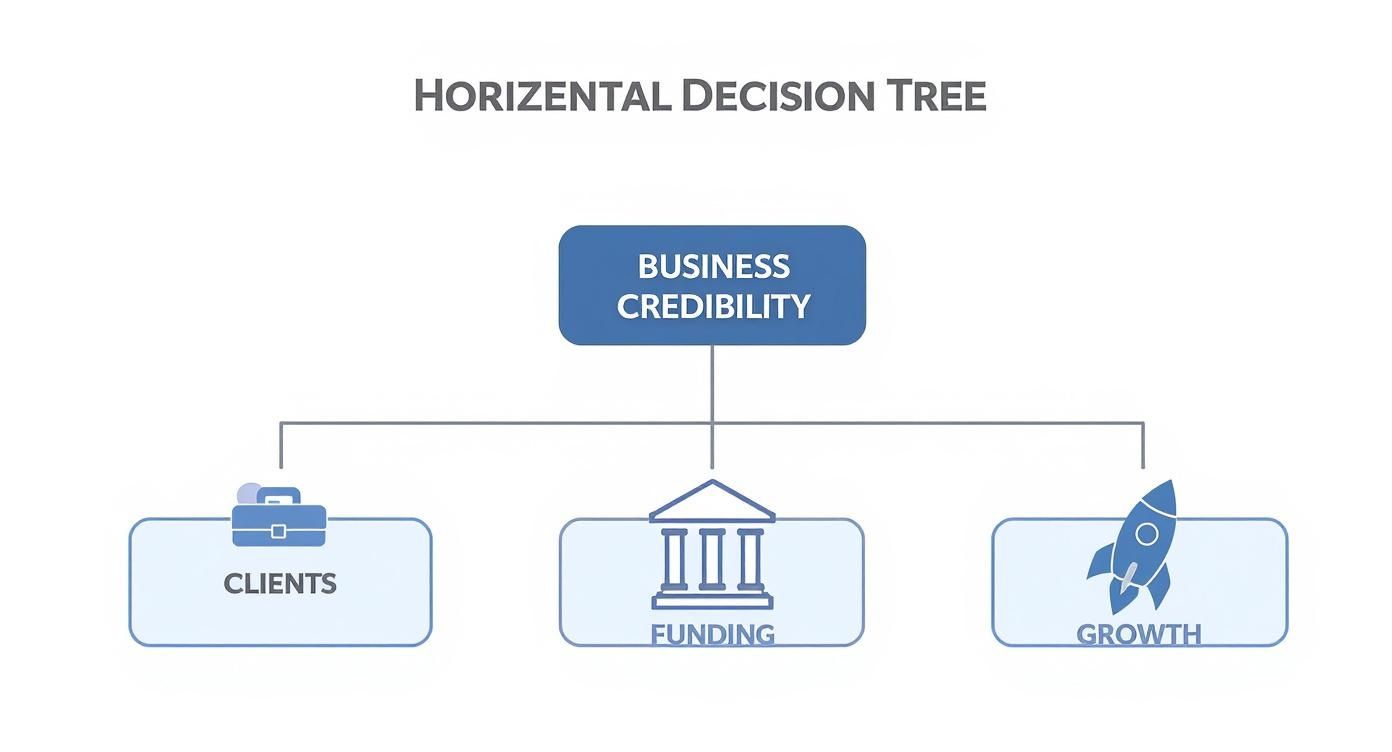
As the infographic shows, setting up as a limited company often creates a much clearer and more appealing route for anyone looking to secure external funding and scale their operations.
From Sole Trader to Limited Company
Making the leap from sole trader to a limited company is a classic sign of a business on the up. This isn't just a box-ticking exercise; it's a strategic move often triggered by rising profits, the need to hire employees, or a conscious decision to shield personal assets. It's a clear signal that your business is entering a new stage of maturity.
Switching from a sole trader to a limited company isn't just an administrative change; it's a strategic move that aligns your business structure with your growth ambitions and protects your personal wealth.
The actual process involves setting up a new company with Companies House and officially transferring your business assets over. A good tip is to time this transition with the end of your financial year – it just makes the accounting much cleaner and simpler.
Profitability is often the tipping point. For example, on profits of £50,000, a sole trader might take home roughly £40,268 after tax. A limited company director, through a mix of salary and dividends, could end up with around £39,925. But as your profits climb past that point, the tax advantages of a limited company really start to kick in, widening the gap in your favour. You can learn more about these tax calculations on wise.com to play with the numbers and see how different profit levels would impact your take-home pay.
Got Questions? We’ve Got Answers
Even with all the details laid out, you probably still have a few specific questions buzzing around. It's completely normal. Let's tackle some of the most common ones that crop up when you're weighing up the sole trader vs limited company decision.
Can I Start as a Sole Trader and Switch to a Limited Company Later?
Absolutely. In fact, it’s a well-trodden path for many growing businesses. You can incorporate a limited company whenever the time is right by registering with Companies House and moving your business assets over.
A quick tip: try to time the switch with the end of your financial year. It just makes the accounting side of things a whole lot cleaner. Getting professional advice here is a smart move to make sure you tie up the sole trader side correctly with HMRC and start your new company on the right foot.
Which Structure Is Better If I Need to Get a Business Loan?
Generally speaking, lenders tend to view a limited company more favourably. The formal structure and the fact that its financial accounts are on public record give banks a clearer picture of the business's health. This transparency often makes them more comfortable assessing risk and approving finance.
It's not impossible for sole traders to get loans, of course, but the lender will likely want to take a much closer look at your personal finances. You might also find that you have to secure the loan against personal assets, like your home.
In many circles, having 'Ltd' after your business name just carries more weight. It gives off an air of permanence and credibility, which can be a real advantage when you're trying to win over larger corporate clients or build trust in the market.
Is It Really More Expensive to Run a Limited Company?
In a word, yes. The costs associated with a limited company are definitely higher, both at the start and on an ongoing basis. You've got the initial registration fee with Companies House, plus more complex annual filings like formal accounts and a confirmation statement.
This extra complexity usually means you’ll need to hire an accountant. While a good accountant is worth their weight in gold, their fees will naturally be higher than what you'd pay for a straightforward Self Assessment tax return as a sole trader.
Figuring out whether to be a sole trader or a limited company can feel like a major hurdle, but you don't have to clear it alone. At Stewart Accounting Services, our team has walked countless business owners through this exact decision. We can help you look at your own circumstances and figure out which path makes the most sense for you. Get in touch with us today and let's find your clear path forward.