

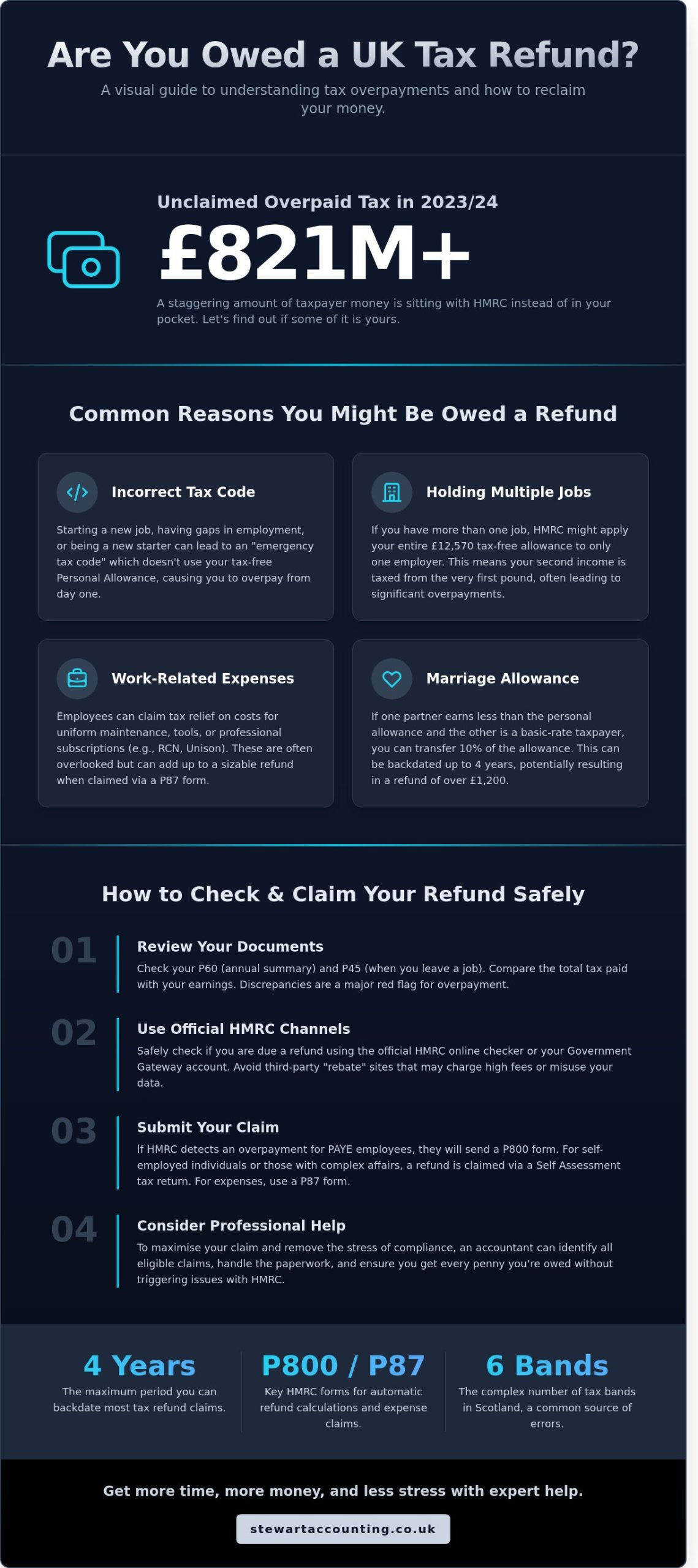
Did you know that HMRC figures from the 2023/24 tax year suggest that over £821 million in overpaid income tax remains unclaimed by UK taxpayers? It’s a staggering amount of money sitting in government accounts rather than in your own pocket. We know how frustrating it is to stare at a confusing tax code, worried that you’re paying too much but terrified of making a mistake on a formal claim. Dealing with HMRC can feel like a mountain of stress, especially when you’re trying to figure out the specific tax bands for Central Scotland.
You deserve more time, more money, and “more mind” with less stress. This guide shows you exactly how to check your eligibility and follow the simplest steps to secure your tax refund uk safely. We’ll walk you through the 2026 allowance updates and show you how to maximise your return through legitimate claims. Let’s take the paperwork off your hands so you can focus on what matters most while we ensure you get every penny you’re owed.
Key Takeaways
- Understand the common triggers for overpayment, such as incorrect tax codes or splitting your personal allowance between multiple employers.
- Discover how to safely verify if you are owed money using official HMRC channels rather than risking your data with third-party rebate websites.
- Learn the exact step-by-step process to claim your tax refund uk and how far back you can legally go to recover your hard-earned money.
- Find out how professional year-end accounts and expert tax planning can identify hidden refund opportunities while removing the stress of HMRC compliance.
What is a Tax Refund in the UK and Why Do Overpayments Occur?
A tax refund is a repayment from HM Revenue and Customs (HMRC) that occurs when you’ve paid more Income Tax than you actually owe. It’s essentially the government returning your own money to you. Understanding What is a Tax Refund and how it applies to the UK’s PAYE system is the first step in reclaiming what’s yours. Whether you’re an employee or a business owner, these overpayments are a common part of the fiscal cycle.
Overpayments happen frequently across the UK workforce for various reasons. You might have switched employers mid-year, or perhaps you’ve been placed on an incorrect tax code after a period of leave. Many people also miss out on a tax refund uk because they don’t realise they can claim for work-related expenses like professional fees, uniform maintenance, or travel. In the 2023/24 tax year, HMRC repaid billions to taxpayers who had simply paid too much through their monthly salaries.
Don’t feel nervous about asking for your money back. Claiming a refund is a standard, routine procedure. It isn’t a “red flag” and it won’t trigger an investigation into your finances. At Stewart Accounting, our goal is to give you back your “mind” by simplifying these complex rules. We want to remove the stress of HMRC paperwork, allowing you to enjoy more time and more money while we take the technical burden off your hands.
How do I know if I have overpaid my tax?
You can usually spot a discrepancy by reviewing your P60 or P45 documents. Your P60 summarises your total pay and tax for the year ending 5 April, while your P45 is provided when you finish a role. If these figures don’t align with your expected earnings, a discrepancy likely exists. New starters often face “emergency tax codes,” which don’t account for your tax-free Personal Allowance. A tax code is the primary tool HMRC uses to calculate your take-home pay.
The difference between PAYE and Self Assessment refunds
- PAYE Employees: HMRC often sends out an automatic notification called a P800 calculation between June and November. This explains how to claim your refund online or via a cheque.
- Business Owners and Landlords: If you’re self-employed, you must usually claim your refund by correctly filling out your annual tax return.
We manage Self Assessment tax returns for clients to ensure every possible deduction is claimed and no overpayments are missed. Whether you’re based in Alloa, Stirling, or Falkirk, our team ensures your records are accurate so you don’t pay a penny more than necessary. We focus on making the process smooth and efficient, ensuring you get your money back without the headache of dealing with HMRC directly.
Common Reasons You Might Be Owed a HMRC Tax Refund in 2026
HMRC’s automated systems often struggle when your life doesn’t follow a perfectly linear path. If your financial circumstances changed during the 2025/26 tax year, there is a high probability you’ve overpaid. One of the most frequent triggers for a tax refund uk involves the £12,570 personal allowance. When you hold two part-time jobs simultaneously, HMRC might apply your entire tax-free allowance to one employer while the second job is taxed at the basic rate from the very first pound. This often results in hundreds of pounds sitting in government coffers that should be in your bank account.
Marriage Allowance offers another significant opportunity for a rebate. If one partner earns less than the personal allowance and the other is a basic-rate taxpayer, you can transfer 10% of that allowance. This claim can be backdated by up to four years. For many couples, this results in a lump sum exceeding £1,200. Accuracy is vital during this process. Submitting incorrect figures can lead to HMRC investigations or financial penalties, which is why many clients prefer to let us take the paperwork off their hands. We focus on getting you more money and less stress.
Claiming for work-related expenses
You don’t need to be a business owner to claim expenses. Employees often overlook “flat rate” deductions for specialised clothing, tools, or mandatory professional subscriptions. If you pay for your own RCN or Unison fees, or if you travel between different temporary workplaces, you’re likely eligible. You can use a P87 form to claim these costs if you don’t file a full Self Assessment. These small, legitimate claims significantly reduce your overall tax bill over a full year.
Scottish Tax Bands: A unique consideration
Taxpayers in Scotland face a different set of rules than those in England or Wales. With six different tax bands ranging from the Starter Rate to the Top Rate, errors are common. If you live in Stirling or Falkirk but work for a company headquartered in London, your tax code might lack the essential ‘S’ prefix. This error leads to incorrect deductions every month. Because we are local experts, our team at Stewart Accounting ensures your residency status is correctly recorded so you only pay what you truly owe.
Redundancy and mid-year job changes
PAYE systems calculate your tax based on the assumption you’ll earn a steady income for all 12 months of the year. If you are made redundant or stop working mid-year, the tax deducted from your earlier payslips will be too high. While the first £30,000 of a redundancy payment is usually tax-free, errors frequently occur in the final pay packet regarding holiday pay or notice periods. Check your final P45 against the Official UK Government Claim Process to identify where your tax refund uk is hiding. Most people who leave a job and don’t start a new one within the same tax year are due a substantial refund by April 2026.
How to Check if You Are Due a Refund: A Step-by-Step Guide
Finding out if you have overpaid shouldn’t be a source of stress. While many third-party “tax rebate” websites claim they can speed up the process, they often take a 30% cut of your money in fees. You don’t need them. The safest and most efficient way to secure a tax refund uk is through official HMRC channels. By using the right tools, you can gain more “mind” (less stress) and ensure every penny of your hard-earned cash returns to your pocket.
Using the HMRC Personal Tax Account
Your first port of call is the HMRC Personal Tax Account. You can access this via the Government Gateway or the official HMRC app. Once you’re logged in, look for the “Check your Income Tax” service. This section provides a detailed breakdown of your earnings from the 2025/26 tax year and the amount of tax collected by your employer. It’s a transparent way to see if the numbers match your P60 or P45. If your estimated income looks wrong, you can update it directly in the portal. This simple step prevents future overpayments and keeps your finances on track.
What to do if you receive a P800 letter
HMRC sends out P800 tax calculation letters between June and the end of November each year. This letter is a formal notification that you’ve paid too much or too little tax. A genuine P800 will clearly state your total income, your tax-free allowance, and the exact amount you’re owed. For the most accurate and up-to-date information, you should always consult the official government guidance on tax refunds before clicking any links in digital communications.
- Bank Transfers: If the letter says you can claim online, the money usually reaches your account within 5 to 10 working days.
- Cheques: If you don’t claim online, HMRC will post a cheque within 14 days of the letter date.
Be extremely cautious of “HMRC refund” phishing scams. HMRC will never send a text or email with a direct link to enter your bank details. If you receive a suspicious message, delete it immediately.
Checking your tax code for errors
Your tax code is the primary tool HMRC uses to tell your employer how much to deduct. The most common code for 2026 is 1257L, which means you can earn £12,570 before paying any tax. If your code starts with a “K” or ends in “T” or “BR,” you might be paying more than you should. An incorrect tax code is the number one cause of long-term overpayments in the UK, often affecting 1 in 10 taxpayers after a job change.
If your code looks suspicious or your situation is complex, we can help. Our team at Stewart Accounting Services can take this “off your hands” entirely. Whether you’re in Alloa, Stirling, or Falkirk, consulting a Chartered Accountant in Scotland ensures your tax refund uk is handled professionally, giving you more time and more money to focus on what matters to you.
The Claim Process: How to Get Your Money Back Safely
Claiming your tax refund uk doesn’t need to be a source of stress. HMRC manages the process through the Pay As You Earn (PAYE) system or Self Assessment. If you’ve overpaid, you’re legally entitled to that money back. You can claim for the current year and the previous four tax years. By April 2026, this means you can still recover overpayments dating back to the 2021/22 tax year. Most people find the biggest hurdle is simply starting because the system feels daunting. We break this down into small, manageable tasks so you can reclaim your “three freedoms”: more time, more money, and less worry.
Claiming online vs. by post
Using your Personal Tax Account is the most efficient method. It allows you to track progress in real-time and reduces the risk of manual errors. While 92% of taxpayers now use digital services, you might still need a paper R40 form if you’re specifically claiming back tax on savings interest. Before you log in to the Government Gateway, ensure you have these items ready:
- Your National Insurance number
- Your P60 or P45 from your employer
- Records of work-related expenses, such as uniform maintenance or professional subscriptions
- A valid Government Gateway user ID and password
Timeline: How long does a tax refund take?
Speed depends on your chosen payment method. Online claims are typically processed within 5 to 10 working days. If you opt for a bank transfer, the funds often arrive in your account 3 to 5 days after the processing is complete. Cheque refunds are significantly slower. These can take up to 6 weeks to arrive by post and then require additional time to clear in your bank. You can check the status of your claim 24/7 through the HMRC app to see exactly where your money is in the queue.
Avoid the “tax refund company” trap
Be wary of “click-to-claim” adverts on social media. Many of these companies charge a 30% commission plus VAT, meaning on a £1,000 refund, they could keep over £350 of your money. You can submit these claims yourself for free directly through HMRC. If your tax affairs are complex, a professional firm like Stewart Accounting offers a transparent, expert service. We don’t just click a button; we ensure your entire tax position is optimised. We take the burden off your hands and ensure you keep the maximum amount of your hard-earned cash without the hidden fees.
If you’re unsure about your entitlement or find the HMRC portal confusing, let our chartered accountants in Central Scotland handle the paperwork for you.
How Stewart Accounting Maximises Your Refund and Minimises Stress
We believe every business owner deserves three specific freedoms: more time, more money, and less stress. Claiming a tax refund uk shouldn’t be a source of anxiety or a weekend spent buried in spreadsheets. Our team of experts takes the complex burden of HMRC paperwork and turns it into a streamlined, profitable process for you. We don’t just file forms; we look for every legal avenue to keep more money in your pocket.
By preparing professional year end accounts, we identify hidden refund opportunities that basic automated software often misses. This might include specific capital allowances, overlooked professional subscriptions, or nuanced home-office expenses. We take the entire task off your hands, allowing you to focus on your core operations while we handle the technical details with HMRC.
Proactive tax planning vs. reactive claiming
Waiting until the 31st January deadline to look at your finances is a recipe for overpayment. We work with our clients throughout the year to ensure overpayments don’t happen in the first place. For limited company directors, this involves optimising salary and dividend splits to remain tax-efficient. Sole traders benefit from our advice on timing equipment purchases to maximise relief. Our local presence in Alloa, Stirling, and Falkirk means we’re accessible to Central Scotland businesses for face-to-face strategy sessions. We’ve ensured 100% of our clients meet their filing obligations while maintaining the best possible tax position.
Our commitment to your “Mind Freedom”
The relief of knowing your tax affairs are handled by fully qualified Chartered Accountants is what we call “Mind Freedom.” It’s the end of that nagging worry about HMRC enquiries or missed deadlines. We follow a methodical, rigorous approach to compliance, ensuring every tax refund uk claim is robust and accurate. This precision reduces the risk of future audits and gives you total peace of mind. Our team is dedicated to providing a supportive, approachable service that removes the “complicated” from your accounting.
Ready to see how much you could reclaim? We invite you to book a free consultation to discuss your specific tax position. Whether you’re a contractor or a growing small business, we’ll help you secure the refund you’re entitled to. Get in touch today to start your journey toward the three freedoms.
Claim Your 2026 Overpaid Tax Today
Navigating HMRC regulations doesn’t have to feel like a burden. Most overpayments happen because of incorrect tax codes or shifting between jobs; this is especially common with the unique Scottish tax bands applicable in 2026. You can check your status through your Personal Tax Account, but missing a deadline means leaving your own money on the table. Securing a tax refund uk wide requires precision and an understanding of the latest legislative updates.
Our team of Fully Qualified Chartered Accountants takes the complexity off your hands. With local offices in Alloa, Stirling, and Falkirk, we focus on the “three freedoms”: giving you more time, more money, and less stress. We’ll ensure every calculation is accurate so you don’t pay a penny more than necessary. Let Stewart Accounting handle your tax refund and give you back your peace of mind. You’ve worked hard for your income, so make sure you get back what’s rightfully yours.
Frequently Asked Questions
How long do I have to claim a tax refund in the UK?
You have exactly four years from the end of the tax year to claim your tax refund uk. For the 2025/26 tax year, you must submit your application to HMRC by 5 April 2030. If you miss this statutory deadline, you’ll lose the right to recover any overpaid funds. We recommend checking your status every April to ensure you don’t leave your hard-earned money in the government’s hands.
Will HMRC automatically send me a tax refund if I have overpaid?
HMRC will automatically send a P800 tax calculation if you’re a PAYE employee, but this doesn’t cover every situation. These letters usually arrive between June and October after the tax year ends. However, if you have specific work expenses or complex income, the system won’t trigger a refund without a manual claim. You shouldn’t rely on their automated systems to identify every deduction you’re legally entitled to receive.
Can I claim a tax refund if I am self-employed?
Yes, you can claim a refund by submitting your Self Assessment tax return by the 31 January deadline. Many sole traders overpay through Payments on Account or by missing eligible expenses like mileage and home office costs. In the 2023/24 tax year, HMRC processed over £1 billion in refunds for self-employed individuals. We can take this off your hands to ensure your return is accurate, giving you more money and less stress.
What should I do if I think my tax code is wrong?
You must notify HMRC immediately or update your details through your Personal Tax Account if your code looks incorrect. An incorrect code, such as 1257L being replaced by an emergency BR code, can cost you £200 or more in extra tax every month. Most updates take 5 to 10 working days to process through the payroll system. We help our clients decode these numbers to ensure they’re paying the right amount from day one.
How much does it cost to have an accountant claim a tax refund for me?
Accountant fees for a tax refund uk claim typically range from a flat fee of £150 to a percentage of the successful refund, often between 20% and 30%. At Stewart Accounting Services, we provide transparent pricing based on the complexity of your records. Hiring a Chartered Accountant ensures your claim is compliant and maximised. This investment saves you time and provides the peace of mind that experts are handling the paperwork.
Is a tax refund taxable income?
No, a tax refund isn’t considered taxable income because it’s a repayment of your own money that you’ve already paid tax on. You don’t need to list the refund amount on your next tax return. However, if HMRC includes a “repayment supplement” interest payment because they delayed your refund, that specific interest portion might be taxable. For 95% of taxpayers, the total amount received is entirely tax-free and yours to keep.
What happens if HMRC denies my tax refund claim?
You have the right to appeal HMRC’s decision within 30 days if they reject your claim. You’ll need to provide further evidence, such as missing P60s, P45s, or valid expense receipts to support your case. If the internal review is unsuccessful, you can take your appeal to an independent tax tribunal. Statistics show that roughly 30% of tribunal cases result in a positive outcome for the taxpayer, so it’s often worth the effort.
Can I claim a tax refund for previous years?
You can claim a refund for the four previous tax years. In 2026, this means you’re still eligible to recover overpaid tax from the 2022/23, 2023/24, 2024/25, and 2025/26 periods. This look-back window is a legal right under the Taxes Management Act 1970. Many of our clients are surprised to find they’re owed thousands of pounds from jobs they left years ago. We’ll help you look back and claim what’s yours.