

The VAT reverse charge can feel like it turns the normal tax process completely upside down. In a nutshell, it shifts the responsibility for reporting and paying VAT from the seller to the buyer. It’s a major change, but one that’s designed to combat tax fraud, particularly in certain high-risk industries and for cross-border transactions.
Understanding The VAT Reverse Charge Mechanism
Normally, a VAT transaction is straightforward. The supplier charges a customer VAT, collects it, and then passes that money on to HMRC. Think of it like a simple chain.
With the reverse charge, that chain works differently. The supplier doesn't add VAT to the bill. Instead, the buyer is responsible for calculating the VAT themselves and reporting it directly to HMRC. This might sound a bit odd at first, but there's a very clear reason for it.
By making the customer account for the VAT, HMRC effectively cuts out the middleman. This stops fraudulent suppliers from charging and collecting VAT, only to vanish before ever paying it to the tax authorities—a common tactic known as "missing trader fraud." It’s why you'll often find the reverse charge applied in sectors with complex supply chains, like construction.
Why Does It Exist?
The main reason for the reverse charge is to clamp down on fraud. But it also has other effects on how a business operates. Getting your head around the ‘why’ makes dealing with the ‘how’ much simpler.
- Combating Fraud: Its primary job is to disrupt organised criminals who exploit the VAT system, especially in industries dealing with high-value goods or services.
- Simplifying Cross-Border Trade: When UK businesses buy services from overseas, the reverse charge means they don’t have to get tangled up in foreign tax systems. The entire transaction is accounted for under UK rules.
- Improving Tax Compliance: The reporting responsibility often falls to the final customer in a supply chain, who may be a larger, more established business with more robust accounting systems.
A perfect example is the domestic reverse charge for the construction industry, which came into force on 1 March 2021. This rule completely changed how subcontractors invoice contractors. Now, the customer (the contractor) accounts for the VAT on their own return, not the supplier (the subcontractor). For most, this has a net-zero impact on the VAT bill, as they declare the VAT as both a sale and a purchase.
The core idea is simple: instead of the supplier charging you VAT, you essentially charge yourself the VAT and declare it to HMRC. On the very same VAT return, you then reclaim that same amount back.
Standard VAT vs Reverse Charge At a Glance
To see the difference in action, this table breaks down the key steps in each process.
| Action | Standard VAT Process | Reverse Charge Process |
|---|---|---|
| Supplier's Invoice | Includes VAT amount (e.g., 20%) | Shows no VAT, but notes "reverse charge applies" |
| Buyer's Payment | Pays supplier the gross amount (including VAT) | Pays supplier the net amount (excluding VAT) |
| VAT Reporting (Supplier) | Declares the VAT collected as output tax to HMRC | Makes no VAT entry for the sale on their return |
| VAT Reporting (Buyer) | Reclaims the VAT paid as input tax | Declares the VAT as both output tax and input tax |
| Cash Paid to HMRC | Supplier pays the VAT to HMRC | No VAT cash is paid by either party (entries cancel out) |
As you can see, the reverse charge creates a self-contained accounting loop on the buyer's VAT return, keeping the cash out of the supplier's hands.
The Accounting Flip in Action
So, what does this look like on paper? When the reverse charge applies, the supplier issues an invoice that shows no VAT but must include a clear note stating that the reverse charge is in effect.
The customer who receives this invoice then performs a special kind of "double entry" on their VAT return. They record the VAT amount as if they've both collected it (output VAT) and paid it (input VAT). For any fully VAT-registered business that can reclaim all its VAT, these two figures cancel each other out perfectly. The end result? No actual cash related to that VAT amount moves between the business and HMRC.
To get a better grip on these terms, it can be really useful to understand the difference between output and input VAT in a bit more detail. We’ll cover the practical steps for handling these entries in your bookkeeping software later in this guide.
How to Know If The Reverse Charge Applies to You
Figuring out whether the reverse charge applies to your business can feel like navigating a maze, but it gets a lot clearer once you know what to look for. The rules aren't random; they're designed to target specific situations, usually where there's a high risk of VAT fraud or to simplify cross-border transactions.
This isn't a blanket rule that affects everyone. It only kicks in under certain conditions, and as a business owner, it’s up to you to spot when it does. Let’s break down the main areas where you're most likely to come across it.
The Domestic Reverse Charge for Construction Services
The biggest area you’ll see this in the UK is the building and construction industry. HMRC brought it in to clamp down on "missing trader" fraud, where suppliers would charge VAT, collect the cash, and then vanish before paying the taxman.
If you’re in construction, you need to ask a few key questions:
- Are both you and your customer VAT registered in the UK? If one of you isn't, the reverse charge is off the table.
- Is the work you’re doing reported under the Construction Industry Scheme (CIS)? The reverse charge rules are deliberately tied to the CIS framework.
- Is your customer an ‘end user’? This is a critical one. An end user is the business that uses the construction service for itself and doesn't sell it on as part of its own construction services. Think of a developer building houses to sell directly to homeowners, or a retailer getting a shop fitted out. The reverse charge does not apply to end users, but they have to tell you this in writing.
Basically, the domestic reverse charge catches the transactions happening up the supply chain between VAT-registered businesses working under CIS—like a subcontractor invoicing a main contractor. It doesn't apply to the final sale to the ultimate client.
Buying Services From Overseas Suppliers
This is another really common scenario. Your UK business buys services from a supplier based outside the UK – maybe you run digital ads with a US tech giant, use a software subscription from an Irish company, or hire a consultant from Germany.
In these situations, the overseas supplier won't add VAT to their invoice. It’s your job to apply the reverse charge. This means you account for the UK VAT on your own VAT return as if you were both the supplier and the customer.
For a business that can reclaim all its input tax, this is usually a cash-flow neutral exercise. You declare the VAT as output tax in Box 1 of your VAT return, and then you reclaim the exact same amount as input tax in Box 4. It’s a paper transaction that ensures the tax is correctly paid in the UK, where the service is used, without forcing thousands of foreign companies to register for UK VAT.
It’s a neat mechanism that really helps to grease the wheels of international trade, making it much easier for UK businesses to work with suppliers from all over the world.
Dealing in Specific Goods Prone to Fraud
The reverse charge isn't just for services. HMRC also uses it for certain types of goods that are magnets for fraudsters. These are usually high-value, small-volume items that are easy to shift quickly.
The main culprits on this list include:
- Mobile phones
- Computer chips and microprocessors
- Wholesale gas and electricity
- Emission allowances
If your business trades in these goods, you absolutely have to get to grips with the reverse charge rules. They're very specific, often with value thresholds that trigger the mechanism. Always double-check the latest HMRC guidance if you work in these sectors, because getting it wrong can lead to some painful penalties.
By understanding these three key areas—construction, overseas services, and high-risk goods—you’ll be in a much better position to know when the VAT reverse charge applies to you.
How to Invoice and Account for Reverse Charge Transactions
Getting the paperwork right is where the theory of the reverse charge meets the real world of your business. Whether you're the one sending the invoice or the one paying it, even small mistakes can snowball into major headaches with HMRC.
Let's walk through the practical steps for both sides of the deal. Getting your invoicing and accounting spot on is the key to staying compliant.
The whole process hinges on the supplier creating the correct invoice. If they get it wrong, it has a knock-on effect, causing confusion for the customer and potentially leading to an incorrect VAT return.
This chart breaks down the process for the main sectors affected – from construction and overseas services to goods imports.
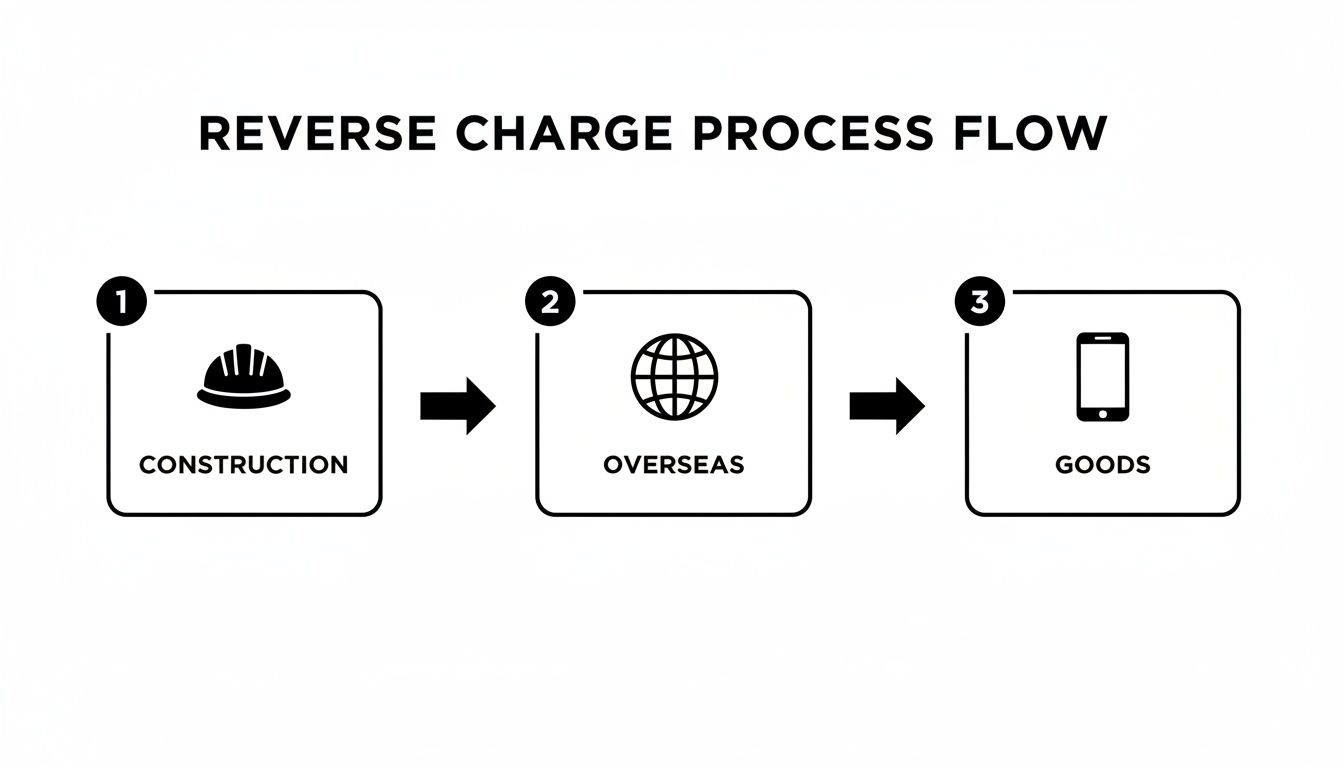
You can see that while the industries are different, the core idea of shifting the VAT responsibility stays the same.
For The Supplier Issuing The Invoice
As the supplier, your job is simple but crucial: create an invoice that clearly flags the reverse charge. This isn't your standard VAT invoice; it needs specific wording to tell your customer exactly how to handle the VAT on their end.
Of course, your invoice must still show all the usual details – your company name, address, VAT number, and so on. The big difference is in the numbers. You must not add any VAT to the final amount due.
Here’s what you need to do:
- Show the VAT rate that would normally apply (e.g., 20% or 5%), but don't actually calculate the VAT amount or add it to the total. The customer only pays you the net amount.
- Include a clear note on the invoice stating that the reverse charge applies. This is an official requirement from HMRC – you have to show that the customer is responsible for accounting for the VAT.
A simple, foolproof phrase is: "Reverse charge: Customer to pay the VAT to HMRC." This leaves absolutely no room for error and covers you legally. Don't skip this.
Getting this wrong can lead to awkward questions and delayed payments. To make sure all your paperwork is up to scratch, it's worth brushing up on what should be on a VAT invoice.
For The Customer Receiving The Invoice
When a reverse charge invoice lands on your desk, it's your turn to handle the accounting. You'll pay your supplier the net amount shown on the invoice, but the "missing" VAT still needs to be dealt with in your books and on your VAT return.
Think of it as an accounting "flip." You'll be making a double entry in your bookkeeping software to show the VAT being paid and reclaimed at the same time.
Here's how you do it, step-by-step:
- Calculate the VAT: First, work out the VAT that would have been charged on the net amount. For instance, on a £1,000 invoice at 20%, the VAT would be £200.
- Record it as Output VAT: You need to declare this £200 as output VAT (tax on your sales) in Box 1 of your VAT return, almost as if you'd made the sale yourself.
- Record it as Input VAT: At the same time, you reclaim that exact £200 as input VAT (tax on your purchases) in Box 4 of the same return.
For most businesses that can reclaim all their input VAT, these two entries perfectly cancel each other out. The net effect on what you owe HMRC is zero. It's really just a paper exercise, but it's a vital one to get right to show HMRC you're handling the transaction correctly. The whole point is to account for the tax without it affecting your cash flow.
Getting the Reverse Charge onto Your UK VAT Return
Once you've sorted the invoice or booked the transaction in your accounts, the final piece of the puzzle is getting it right on your VAT return. This is where a lot of people feel a bit of a wobble, but it's actually quite a logical process once you see how the numbers fit together.
The main thing to remember is that even though no VAT cash actually changes hands between you and your supplier, the whole transaction still needs to be declared to HMRC. It's a paper exercise that proves you're playing by the rules.
How to Map the Transaction to Your VAT Return
As the customer receiving a reverse charge invoice, the ball is in your court to account for the VAT. This means making entries in a few key boxes on your return.
Let’s walk through a quick example. Imagine you’ve just received a reverse charge invoice for construction services for £5,000. The standard VAT rate of 20% would be £1,000.
Here’s exactly where those numbers go:
- Box 1 (VAT Due on Sales): You’ll add the £1,000 of reverse charge VAT here. Think of it as declaring the output tax on behalf of your supplier.
- Box 4 (VAT Reclaimed on Purchases): Next, you reclaim that very same £1,000 as input tax in this box (assuming your business can recover all its VAT, which most can).
- Box 6 (Total Value of Sales): Do not put the net value of the purchase in this box. Box 6 is strictly for your sales, and this was a purchase.
- Box 7 (Total Value of Purchases): The net value of the purchase—our £5,000—goes straight into this box.
For most businesses, the entries in Box 1 and Box 4 simply cancel each other out. The net effect on what you owe HMRC for that specific transaction is zero. It feels strange, but it’s correct.
This two-step process gives HMRC a clear line of sight. It confirms the VAT that should have been paid by the supplier has been correctly handled by the customer, which is the whole point of the reverse charge system.
For a more detailed look at the entire submission process, our guide on how to prepare VAT returns breaks it down step-by-step.
What About Cross-Border Services After Brexit?
The reverse charge is particularly important when you buy services from overseas. Since Brexit, UK businesses purchasing services from abroad still need to self-account for the VAT.
Under what's known as the 'reverse charge for services received from abroad' rule, a UK VAT-registered business must declare output VAT and—if eligible—reclaim the input VAT on the same return. Again, for most businesses, this results in no actual VAT cost, but careful reporting is essential to avoid mistakes. VAT rules can shift, so it’s always wise to stay on top of any changes.
VAT Return Box Guide for Reverse Charge Transactions
To make this crystal clear, here’s a simple table you can use as a checklist when you're filling out your return. This shows how you, as the customer, report a reverse charge transaction.
| VAT Return Box | What to Include for Reverse Charge | Note for the Customer |
|---|---|---|
| Box 1 | The VAT amount due on the service/goods | This is the 'output tax' you are self-declaring. |
| Box 4 | The same VAT amount, reclaimed as input tax | This is the 'input tax' you are reclaiming. |
| Box 6 | Nothing. Leave this transaction out of Box 6 | This box is only for the value of your sales. |
| Box 7 | The net value of the purchase (excluding VAT) | This shows the value of the goods/services you bought. |
Following this simple structure removes all the guesswork. It ensures your VAT return is compliant and gives you the confidence that your filings are spot on, protecting you from potential headaches with HMRC down the line.
How Reverse Charge Hits Your Cash Flow and Compliance
The reverse charge isn't just an accounting exercise; it has a real, tangible impact on your company's bank balance and its exposure to risk. Getting your head around these effects is critical because it moves the reverse charge from a simple box-ticking task to a core part of managing your business finances.
The most immediate and obvious change is to your cash flow. The reality for suppliers is starkly different from that of their customers, and this new dynamic demands careful financial planning to stay afloat.
The Cash Flow Squeeze for Suppliers
If you're a supplier, especially a subcontractor in the building trade, the reverse charge can feel like a sudden financial shock. Under the old system, you’d invoice for your work plus 20% VAT. That extra cash, while technically owed to HMRC, would sit in your bank account until your next VAT return was due, acting as a handy short-term buffer.
Many small businesses rely on this VAT float, whether they realise it or not, to cover wages, buy materials, or just manage the day-to-day ebb and flow of money. When the reverse charge kicks in, that buffer disappears. Literally overnight.
Think about it: a subcontractor invoices for a £10,000 job. They used to receive £12,000 (£10,000 + £2,000 VAT). Under reverse charge, they get just £10,000. That £2,000 of temporary cash is gone, which can put a massive strain on a business running on tight margins.
This sudden drop in working capital means suppliers have to be much more disciplined with their money. Without the VAT float, some will struggle to pay their own bills on time, potentially causing a domino effect down the supply chain.
The Cash Flow Boost for Customers
On the flip side, the customer (often the main contractor) gets a welcome cash flow advantage. Instead of paying out that extra 20% VAT and then waiting to claim it back from HMRC on their next return, they simply get to hold onto the money.
This gives the customer two clear wins:
- Better working capital: The cash that would have been locked up as reclaimable VAT is now free to be used for other things.
- Less admin hassle: They don't have to chase VAT reclaims from HMRC, which simplifies their cash management.
This shift undoubtedly improves the customer’s financial stability, but it comes directly at the expense of their supplier. It's a zero-sum game, really, which is why it’s so important for suppliers to see it coming and prepare.
The Serious Risks of Getting It Wrong
While the cash flow pain is immediate, the compliance risks can create much bigger problems down the line. HMRC is serious about the correct application of the reverse charge, and mistakes can lead to hefty penalties and stressful investigations. Both the supplier and the customer have a duty to get it right.
One of the most important jobs is to check the status of the person you're trading with.
Essential Compliance Checks:
- VAT Registration: The supplier absolutely must confirm their customer is VAT registered. If they aren't, you just use the normal VAT rules.
- CIS Status (Construction): For construction businesses, you need to know if the work falls under the Construction Industry Scheme (CIS).
- End User Status: The reverse charge doesn't apply if your customer is an 'end user' or an 'intermediary supplier' linked to one. Your customer has a legal duty to tell you this in writing. If you fail to charge VAT because you wrongly assumed the reverse charge applied, you’ll be the one liable for the missing tax.
Skipping these checks is asking for trouble. If a supplier applies the reverse charge to a customer who isn't VAT registered, HMRC will come knocking on the supplier's door for the unpaid VAT. Likewise, a customer who gets the accounting wrong could face penalties. Clear communication and proper due diligence aren't just good practice—they're essential.
Managing The Reverse Charge in Your Accounting Software
Trying to manage the reverse charge with manual spreadsheets is asking for trouble. It's not just time-consuming; it's incredibly easy to make a mistake that could come back to bite you. The good news is that modern accounting software is built to handle these complex VAT rules for you.
Pretty much any solid accounting platform—think Xero, QuickBooks, or Sage—has features designed for the reverse charge. Instead of you having to figure out the double-entry accounting, the software uses special tax codes. You apply the code, and it does all the heavy lifting, making sure the right numbers land in the right boxes on your VAT return.
Getting Your Software Set Up Correctly
The most important thing you can do is get the settings right from the very beginning. You’ll need to find and activate the specific tax rates for the reverse charge in your software. Most platforms that cater to UK businesses will have these ready to go for both the domestic construction scheme and for services bought from overseas.
In Xero, for example, you’ll see specific tax rates like "20% VAT on Imports" for services from abroad or "Domestic Reverse Charge @ 20% (CIS)" for construction work. When you apply one of these codes to a purchase, the software knows exactly what to do.
This automation is where the magic happens. The system instantly adds the VAT amount to Box 1 and Box 4 of your return, and the net value to Box 7—all from one simple entry. It completely takes the guesswork and risk of human error out of the equation.
A few minutes spent on this initial setup will make a complicated VAT rule feel like just another part of your day-to-day bookkeeping.
A Step-by-Step Software Workflow
Once your tax codes are switched on, putting them to use is dead simple. It just becomes another step in your usual invoicing process, whether you're the one buying or selling.
For Customers (When you receive a reverse charge invoice):
- Enter the Bill: Just create a new bill from the supplier’s invoice like you always do.
- Pick the Right Tax Code: This is the key step. Instead of your usual VAT code, choose the correct reverse charge one. The software will show the VAT amount for your records but won't add it to what you owe the supplier.
- Approve and Pay: You only pay the net amount on the invoice. Your software handles the VAT in the background for your return.
For Suppliers (When you issue a reverse charge invoice):
- Create the Invoice: Draft your sales invoice as normal.
- Apply a 0% Reverse Charge Code: Select the tax rate that signifies a 0% reverse charge sale. This tells the system not to add any VAT to the customer's total.
- Add the Required Wording: Make sure your invoice template includes the legally required note from HMRC, something like: "Reverse charge: customer to pay the VAT to HMRC."
This organised workflow keeps you compliant on every single transaction. It’s also worth noting that different sectors can have their own quirks; for example, if you're involved with online education, understanding the specific VAT implications for online course platforms is vital, as they often have unique tax and invoicing rules. A properly configured system makes managing all these scenarios much easier.
Got Questions About The VAT Reverse Charge?
Even when you think you’ve got a handle on the rules, the VAT reverse charge can throw up some tricky situations. Let's tackle some of the most common questions that pop up, giving you quick, practical answers to keep you on the right side of HMRC.
Getting these details right isn't just about good bookkeeping; it’s about avoiding headaches during an inspection. Let's clear up a few things.
What Happens If I Forget To Apply It?
This is a common worry, and the answer really depends on where you sit in the transaction. If you're the supplier, the buck stops with you. You're still liable for the VAT that your customer should have declared, so you'll need to issue a corrected invoice and sort out the mess.
If you're the customer and a supplier has wrongly charged you VAT on a reverse charge service, don't pay it. Your best move is to ask for a corrected invoice that applies the reverse charge properly. Paying the incorrect VAT and trying to reclaim it later just creates a complicated paper trail that’s a nightmare to fix.
Does It Apply To All Construction Work?
No, and this is a really important distinction to make. The domestic reverse charge for construction only kicks in for specific building and construction services that fall under the Construction Industry Scheme (CIS).
It's designed for business-to-business transactions within a supply chain. That means it does not apply to:
- Services you provide directly to an 'end user', like a homeowner or the final business client.
- Work for intermediary suppliers who are connected to that end user.
- Any construction services that are already zero-rated for VAT.
You have to be certain about your customer's status and the specific type of work before you decide whether the reverse charge applies.
One of the easiest mistakes to make is applying the reverse charge to a non-VAT registered customer or an end user. Always get written confirmation of your customer's status to protect yourself. The responsibility to check is on you.
How Does This Work With The Flat Rate Scheme?
If you're using the Flat Rate Scheme, you need to be extra careful. Any goods or services you buy that are subject to the reverse charge have to be dealt with outside of your normal flat rate calculations.
You’ll have to declare the VAT on your return as a reverse charge, which means you pay the output tax to HMRC. The catch? Under the Flat Rate Scheme, you generally can’t reclaim this as input tax. This can make the scheme a lot less appealing if your business has a lot of reverse charge purchases.
Navigating the ins and outs of VAT can feel like a full-time job. Stewart Accounting Services offers expert VAT guidance to make sure you stay compliant and keep your cash flow healthy. Find out how we can help your business at https://stewartaccounting.co.uk.