

What are the auto enrolment pension duties for employers in 2026?

What if the biggest threat to your business’s cash flow in 2026 isn’t a market dip, but a £10,000 daily fine for a simple pension oversight? It’s a valid concern for many local business owners who feel the weight of complex regulations. Managing the auto enrolment pension duties for employers is a recurring commitment that requires precise payroll integration. We know the confusion surrounding worker categories and the administrative burden of compliance can make your workload feel quite heavy.
We believe that managing your team’s retirement savings should bring satisfaction, not stress. This guide offers a clear path to understanding your legal workplace pension obligations and staff assessment requirements. We’ll preview how to handle the 2026 earnings trigger of £10,000 and the specific qualifying earnings bands, ensuring you achieve total compliance and the peace of mind that comes from a perfectly managed, efficient payroll process.
Key Takeaways
- Identify your legal obligations under the Pensions Act 2008 and determine if you meet the specific criteria of an employer under current regulations.
- Navigate the initial setup process with ease by following a structured five-step plan, from securing your letter code to selecting a qualifying pension scheme.
- Correctly categorize your workforce as eligible or non-eligible jobholders using the 2026 thresholds to ensure you meet all auto enrolment pension duties for employers.
- Establish a smooth monthly payroll cycle for contributions and opt-outs while preparing for the mandatory three-year re-enrolment window.
- Learn how delegating your pension administration to experts can remove the compliance burden and restore your focus to growing your business.
Understanding the Legal Framework of Auto Enrolment in 2026
The Pensions Act 2008 serves as the foundation for modern workplace savings. It exists to ensure every worker has access to a retirement fund, shifting the responsibility of saving from the state to a partnership between employers and employees. As an employer, your primary obligation is to provide a qualifying workplace pension scheme for your team. The Pensions Regulator (TPR) monitors these activities closely, using real-time data from HMRC to ensure every business meets its legal requirements without exception. This watchdog role is vital for maintaining the integrity of the UK pension system. While the goal is to reduce poverty in old age, the administrative weight falls squarely on your shoulders.
A qualifying workplace pension must meet specific criteria to be considered compliant:
- It must be a regulated UK pension scheme.
- It must allow for both employer and employee contributions.
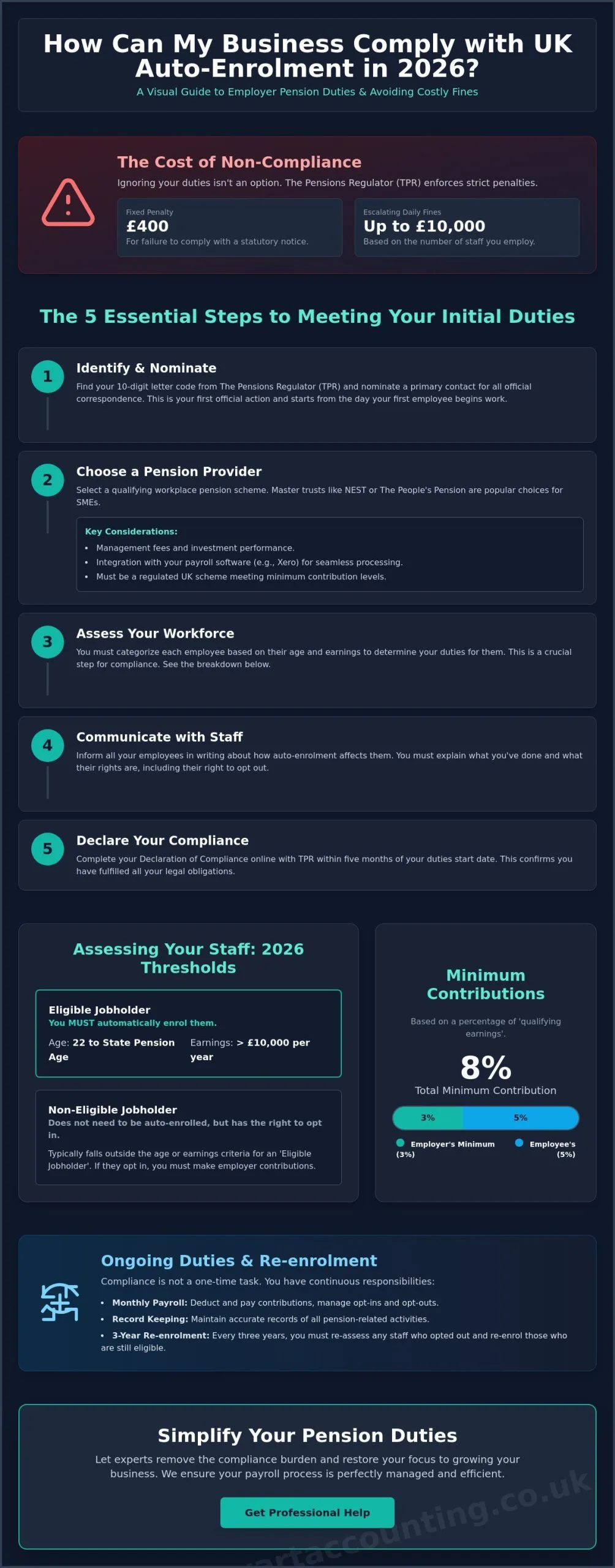
- It must meet the minimum total contribution rate of 8% of qualifying earnings, with at least 3% coming from you.
Who Does Auto Enrolment Apply To?
Many business owners in our local community ask if these rules apply to them. If you employ at least one person who works in the UK, you have auto enrolment pension duties for employers. This includes limited companies, sole traders with assistants, and even charities. While older businesses might remember “staging dates,” newer firms follow a “Duties Start Date,” which is the first day your first member of staff starts work. If you’re a director of a limited company with no other employees, you’re generally exempt. However, you must still notify TPR of your status to avoid being flagged for non-compliance. Understanding your specific category is the first step toward a stress-free payroll process.
The Consequences of Non-Compliance
Ignoring your obligations isn’t just a risk; it’s an expensive mistake. TPR follows a strict enforcement path that begins with warning notices and statutory letters. If these are ignored, the financial impact escalates quickly. As of 2026, the fixed penalty for failing to comply with a statutory notice is £400. Beyond this initial fine, persistent non-compliance can lead to daily fines reaching as high as £10,000, depending on the number of staff you employ. These fines are designed to be punitive, ensuring the cost of compliance is always lower than the cost of neglect. We help you navigate these auto enrolment pension duties for employers so you never have to face a TPR inspector or a mounting debt.
The 5 Essential Steps to Meeting Your Initial Duties
Moving from confusion to compliance requires a structured, logical approach. When you first hire staff, your auto enrolment pension duties for employers begin immediately. It isn’t a task you can postpone without risking penalties. The process follows five essential steps designed to get your workplace savings scheme running smoothly. First, you must identify your 10-digit letter code provided by The Pensions Regulator (TPR) and nominate a primary contact for all future correspondence. This ensures you never miss a critical update or deadline. Next, you need to select a qualifying pension provider that fits your business model and your employees’ needs.
Choosing the Right Pension Provider
For many small and medium-sized enterprises (SMEs), master trusts like NEST or The People’s Pension are the most pragmatic choices. These schemes are designed specifically for ease of use and low setup costs. When comparing providers, look beyond the brand name. Consider the monthly management fees and the historical investment performance for your staff. Crucially, check how well the provider integrates with your cloud accounting software. If you use tools like Xero, selecting a pension provider with a direct API connection can turn a complex manual upload into a simple, one-click task. If you’re unsure which platform suits your workflow, our payroll services team can help you evaluate the best options for your specific regional business.
The third step involves assessing your workforce. You must determine who is an “Eligible Jobholder” and who falls into other categories based on their age and earnings. Following The Pensions Regulator’s official guidance is the best way to ensure your assessment is accurate. Once assessed, the fourth step is communicating these findings to your staff in writing. Finally, you must complete your Declaration of Compliance. This is an online form submitted to TPR confirming you’ve met all your legal obligations. You must complete this within five months of your duties start date to avoid a fixed penalty fine.
The Importance of Statutory Communications
Transparency is a core requirement of the auto enrolment pension duties for employers. You must send a statutory letter to every member of staff within six weeks of your duties start date. This letter must explain how auto enrolment affects them, the contribution rates, and how the “Opt-out” process works. Even if a staff member doesn’t meet the criteria for automatic enrolment, they often have a “Right to Join” or a “Right to Opt-in.” You’re legally required to provide clear instructions on how they can exercise these rights and what your contribution obligations will be if they choose to do so.
Assessing Your Staff: Worker Categories and Contributions
Assessing your workforce is a recurring task that requires attention every single pay run. It’s one of the primary auto enrolment pension duties for employers to ensure every staff member is categorized correctly based on their age and earnings. For the 2026/27 tax year, the earnings trigger is set at £10,000. If an employee is between 22 and the State Pension age and earns above this amount, they’re an “Eligible Jobholder” and must be enrolled immediately. Other workers fall into different brackets that carry different responsibilities for you as a business owner.
- Non-eligible Jobholders: These workers earn between £6,240 and £10,000. They don’t need to be enrolled automatically, but they have the right to opt-in. If they choose to do so, you must pay the employer contribution.
- Entitled Workers: Those earning less than £6,240 are entitled to join a scheme. While you must facilitate this, you aren’t legally required to contribute to it.
Understanding the difference between “Qualifying Earnings” and “Pensionable Pay” is vital for accurate calculations. Most employers use qualifying earnings, which is the band of pay between the Lower Earnings Limit of £6,240 and the Upper Earnings Limit of £50,270. This calculation includes basic salary, bonuses, commissions, and statutory payments like maternity or sick pay. Using this band ensures you’re only paying contributions on the earnings that the law requires, which helps manage your business’s overheads.
Contribution Rates: Who Pays What?
Handling Fluctuating Earnings
Managing staff with irregular hours can be one of the most confusing auto enrolment pension duties for employers. If a worker’s pay spikes due to overtime or a seasonal bonus, they might hit the trigger only for that specific pay period. This is a common scenario for businesses in Stirling and Falkirk during peak holiday seasons. You can use a three-month postponement window to avoid the admin of enrolling and then de-enrolling temporary staff. This gives you breathing room to see if their earnings remain high before you commit to the full enrolment process. You must still issue a postponement notice to the employee within six weeks of the date they first became eligible.
Ongoing Monthly Duties and the Re-enrolment Cycle
Managing the auto enrolment pension duties for employers isn’t a “set and forget” task. It’s a rhythmic, monthly commitment that lives directly within your payroll process. Every time you run payroll, you must re-assess your staff. A simple birthday or a small pay rise can instantly change a worker’s category from non-eligible to eligible. Once you’ve identified who needs to be enrolled, you must deduct the employee contributions, add your employer portion, and pay these across to your pension provider. This cycle must be completed by the 22nd day of the following month for electronic payments, or the 19th for cheques.
Handling opt-outs is another critical part of the monthly routine. If an employee decides to leave the scheme within one month of being enrolled, you must process their refund in full. This usually happens through your next available payroll run. Accuracy is paramount here; the Pensions Regulator (TPR) expects you to keep meticulous records. You must retain data regarding active members and their contributions for six years. If a staff member opts out, you need to keep that specific notice for four years. Keeping these records organized ensures you’re always prepared for a potential compliance check.
The Monthly Payroll-Pension Link
Manual data entry remains the single biggest risk for SME compliance. Typing National Insurance numbers or contribution amounts into a pension portal every month is time-consuming and prone to error. A single typo can lead to a failed upload, resulting in late payment flags from TPR. We believe your time is better spent growing your business than wrestling with spreadsheets. The team at Stewart Accounting Services provides payroll services designed to integrate directly with your pension provider. By automating the data transfer, we ensure your monthly auto enrolment pension duties for employers are met with total precision and zero stress.
Re-enrolment: A Second Chance for Staff
Every three years, the law requires you to put eligible staff who previously opted out back into the pension scheme. This re-enrolment cycle is a mandatory “second chance” for your employees to save for retirement. You have a six-month window to choose your re-enrolment date, which spans three months before and three months after the third anniversary of your duties start date. Once you’ve assessed and re-enrolled the relevant staff, you must complete a second Declaration of Compliance. This confirms to TPR that you’re still fulfilling your legal obligations. It’s a vital step that many business owners overlook, but missing it can lead to the same escalating fines mentioned earlier in this guide.
How Stewart Accounting Services Simplifies Your Pension Duties
Do you find the prospect of managing monthly pension files more draining than running your actual business? It’s a common sentiment among the small and medium-sized enterprise owners we support across Central Scotland. The complexity of auto enrolment pension duties for employers can create a persistent sense of anxiety that distracts from your core goals. We believe your professional life should be defined by growth and liberty, not by a struggle with administrative paperwork. By choosing to delegate these tasks to Stewart Accounting Services, you can replace confusion with total confidence. We take the entire burden of pension admin off your desk, ensuring your business remains 100% compliant with The Pensions Regulator at all times.
Our Integrated Payroll and Pension Solution
We provide a seamless experience by combining our SME Payroll Services with proactive auto enrolment management. This integration is vital because it removes the risk of data silos or manual entry errors. Our team at Stewart Accounting Services handles the monthly assessment of your staff, calculates the precise contributions required, and manages the secure upload to your chosen pension provider. We also take responsibility for all statutory communications and TPR correspondence, significantly reducing your mental load. This methodical approach ensures that your Year End Accounts always reflect accurate pension liabilities, providing a clear and honest picture of your firm’s financial health.
Why Scottish SMEs Trust Stewart Accounting Services
Our firm is built on a specific three-part promise to our clients. We focus on the liberation of your time, your finances, and your mental well-being. This Thematic Triad is what sets Stewart Accounting Services apart from cold, corporate accounting firms. We act as a dependable partner for businesses across Central Scotland, offering the kind of local support that national providers simply cannot match. Whether you’re based in Alloa, Stirling, or Falkirk, we’re available for face-to-face reassurance whenever you need it. We understand the regional business landscape and the specific challenges you face when managing a local workforce.
You don’t have to navigate the complexities of the 2026 pension regulations alone. Our pragmatic approach focuses on tangible results: reduced stress, optimized resources, and total peace of mind. We’re here to ensure that your auto enrolment pension duties for employers are handled with the highest level of professional care. If you’re ready to reclaim your time and protect your business from the risk of TPR fines, we invite you to take the first step toward a simpler future. Book a free consultation with our Alloa accountants today and discover how total delegation can transform your business operations.
Take Control of Your Workplace Pension Compliance
Successfully managing the auto enrolment pension duties for employers is about more than just avoiding fines; it’s about building a sustainable future for your business and your team. We’ve discussed how meticulous assessment and timely communication form the backbone of a compliant workplace pension scheme. By staying ahead of the re-enrolment cycle and maintaining precise records, you protect your company from the stress of regulatory scrutiny. This proactive approach ensures that your payroll remains efficient and your legal obligations are met without compromise.
You don’t have to carry this administrative burden on your own. As Chartered Accountants with offices in Alloa, Stirling, and Falkirk, Stewart Accounting Services specializes in providing stress-free payroll and compliance solutions for local SMEs. Our focus remains on liberating your time and restoring your mental well-being through total delegation. Let us handle your pension and payroll duties—contact Stewart Accounting Services to begin your journey toward total peace of mind. We look forward to helping your business thrive while you focus on what you do best.
Frequently Asked Questions
Do I still have auto enrolment duties if I only have one employee?
Yes, you have legal obligations even if you only employ one person. If that staff member is aged between 22 and the State Pension age and earns over £10,000 per year, they must be enrolled. You must still assess them and provide statutory information even if they don’t meet the trigger. This ensures every worker in the UK has the opportunity to save for their retirement.
What is the minimum employer contribution for auto enrolment in 2026?
The minimum employer contribution remains at 3% of qualifying earnings for the 2026/27 tax year. This forms part of a total 8% minimum contribution, with the employee typically providing the remaining 5%. These rates are calculated on qualifying earnings between the lower limit of £6,240 and the upper limit of £50,270. You can always choose to pay more to support your team.
How do I complete a Declaration of Compliance for The Pensions Regulator?
You must submit your declaration through the TPR online portal within five months of your duties start date. This form confirms you’ve met all your auto enrolment pension duties for employers, including enrolling eligible staff and choosing a qualifying scheme. Missing this deadline often triggers an automatic £400 fine. We often handle this task for our clients to ensure total accuracy.
Can an employee opt out of the workplace pension scheme?
Yes, employees can choose to opt out within a one-month window after being enrolled. If they do this, you must stop deductions and refund any contributions already taken through your next payroll run. After this initial month, they can still choose to “cease membership” at any time. However, they might not be entitled to a refund of the contributions they’ve already paid.
What happens if I miss my re-enrolment deadline?
Missing the deadline puts your business at risk of statutory notices and financial penalties from TPR. The regulator typically issues a fixed penalty of £400 as a first warning. If you don’t rectify the situation, daily fines can escalate quickly, sometimes reaching up to £10,000 for larger firms. It’s vital to track your three-year cycle carefully to avoid these unnecessary costs.
Do I need to pay into a pension for a part-time worker?
You must contribute for part-time workers if their earnings exceed the £10,000 annual trigger or the equivalent pro-rata amount for their specific pay period. For example, if a part-time staff member earns over £833 in a single month, they usually become eligible for enrolment. Always assess every staff member individually during every pay run to stay compliant with the current thresholds.
How long do I need to keep records of my pension contributions?
You are legally required to keep most pension records for six years to satisfy TPR requirements. This includes details of the contribution amounts paid and the names of all active members in your scheme. However, you only need to retain specific opt-out notices for four years. Keeping these files organized is essential for proving your compliance during a routine inspection or audit.
What is postponement in auto enrolment and how does it work?
Postponement allows you to delay the assessment of a new employee for a period of up to three months. This is a pragmatic tool for managing seasonal staff or workers on short-term probationary contracts. To use this window, you must issue a formal postponement notice to the worker within six weeks of their start date. This notice explains their right to join the scheme early.
Recent Posts
25 Oct, 2026