

What is a Confirmation Statement?

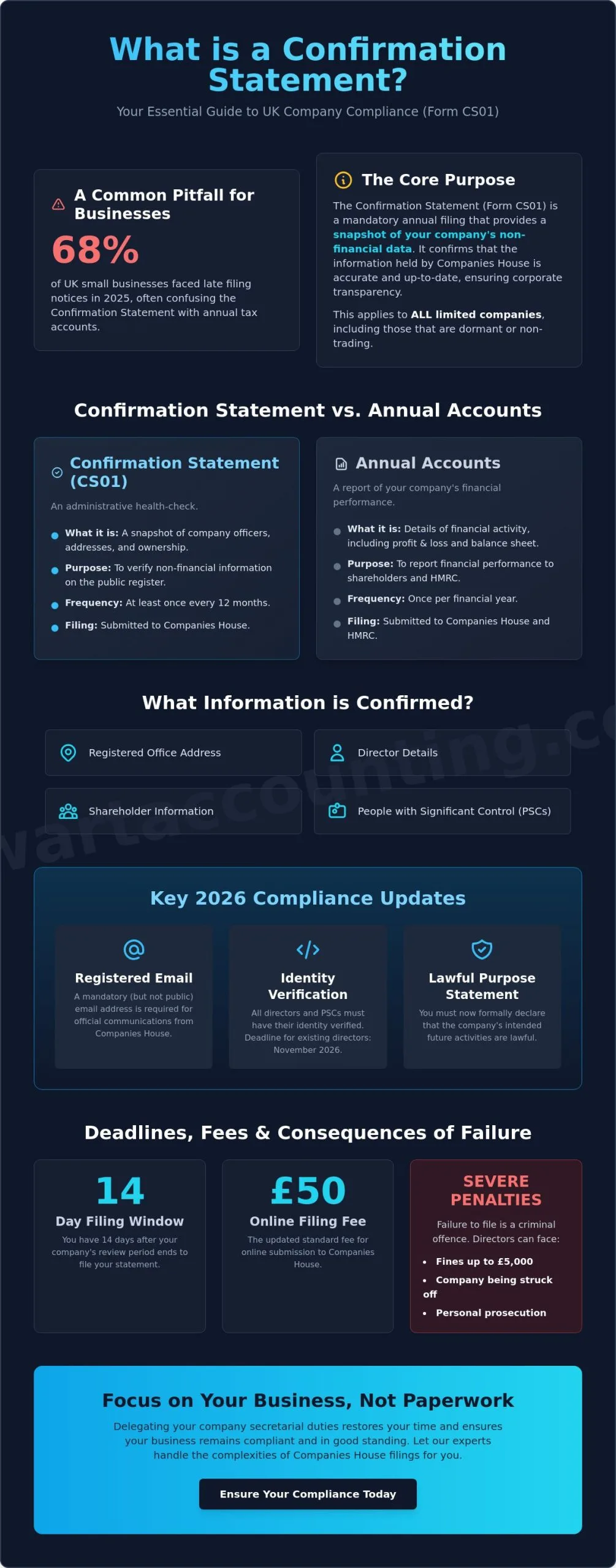
Over 68% of UK small businesses faced late filing notices in 2025, often because they mistook a simple administrative update for their annual tax accounts. It’s a common source of stress for directors, especially when you consider that failing to submit the correct paperwork can lead to a £5,000 fine or even your company being struck off the register. You likely want to focus on your daily operations rather than worrying about the nuances of the CS01 form or the latest identity verification rules. We understand that the shifting landscape of 2026 compliance feels daunting, but staying in good standing doesn’t have to be a burden.
This guide provides a clear and comprehensive answer to the question: what is a confirmation statement? We’ll walk you through your legal obligations to Companies House, including the updated £50 online filing fee and the mandatory identity checks for directors. By the end of this article, you’ll have a practical checklist to ensure your filing is accurate, timely, and stress-free. Let’s restore your peace of mind by simplifying the path to total compliance.
Key Takeaways
- Understand why Form CS01 is a mandatory administrative requirement for every UK company to keep the public register accurate.
- Clarify the crucial distinction between financial reports and what is a confirmation statement to avoid common filing errors.
- Identify the new 2026 requirements, including registered email addresses and mandatory identity verification for directors.
- Learn how to navigate the 14-day filing window and the updated fee structure to prevent costly penalties or company strike-off.
- Discover how delegating your company secretarial duties can restore your time and ensure your business remains in good standing.
Understanding the UK Confirmation Statement (Form CS01)
If you own a limited company, you’ve likely seen the term Form CS01 on your to-do list. But what is a confirmation statement exactly? At its heart, it’s a mandatory document that every UK limited company must file with Companies House at least once a year. It serves as a snapshot of your company’s non-financial information at a specific point in time. This confirmation statement (previously an annual return) was introduced in 2016 to make the process of updating company details more efficient. Instead of re-submitting every piece of data from scratch, you’re now simply confirming that the information Companies House currently holds is correct and up to date.
It’s a common misconception that if your business isn’t actively trading, you can skip this step. This isn’t the case. Even dormant or non-trading companies have a legal obligation to file. Failing to do so signals to the registrar that the company may no longer be required. This can trigger a process to strike the company off the register, which can be a nightmare to reverse. Whether you’re a high-growth startup or a small holding company, this filing is a non-negotiable part of your corporate life.
Why the Public Register Matters
Who is Legally Responsible for Filing?
The burden of ensuring this form is filed falls squarely on the company directors. It’s a statutory duty. If your company has a secretary, they often handle the administrative side, but the ultimate responsibility remains with the board. Many business owners find this task stressful, especially with the shifting regulations and identity checks introduced for 2026. That’s where professional support becomes a game-changer. By delegating your Company Secretarial Services to an experienced accountant, you ensure every detail is checked against the latest standards. It removes the administrative weight from your shoulders, letting you focus on your business while we handle the compliance.
What Information is Included in a Confirmation Statement?
When you ask what is a confirmation statement, you’re looking at a digital health check for your business. It isn’t a single document but a collection of data points that verify your company’s structure. According to official government guidance, you must check and confirm your registered office address, director details, and shareholder information. It’s about ensuring the world has the right facts about who owns and runs your firm. If you’ve issued new shares or seen a director resign during the year, this is where you officially log those changes.
You also need to identify your People with Significant Control (PSC). These are usually individuals who own more than 25% of the shares or voting rights. Transparency in this area is a high priority for the UK government; it helps prevent economic crime and builds trust with your financial partners. If these requirements feel like a lot to track, our Company Secretarial Services can take this entire administrative burden off your plate, ensuring every detail is accurate before submission.
2026 Updates: Identity Verification and Email Addresses
The rules for 2026 have become much stricter to combat fraud. Every company must now provide a registered email address. While this isn’t visible on the public register, it’s the primary way Companies House will contact you. Perhaps the biggest change involves identity verification. Since November 18, 2025, all new directors and PSCs must have their identities verified. Existing directors have a deadline of November 2026 to complete this process. You’ll also find a new “lawful purpose statement” on the form. This requires you to confirm that your company’s intended future activities are entirely legal. These steps are designed to protect your business from corporate identity theft.
SIC Codes and Business Activities
Every company is assigned a Standard Industrial Classification (SIC) code. This code tells the public and government agencies exactly what your business does. It’s a four or five-digit number that categorises your trade, such as “62020” for information technology consultancy. During the filing process, you should check if your SIC code still reflects your daily operations. If your business has pivoted, perhaps moving from selling physical goods to providing digital services, you must update this code. Keeping this accurate ensures you’re categorised correctly for credit checks and industry statistics. It’s a small detail, but it’s essential for maintaining a professional and transparent profile on the public register.
Confirmation Statement vs. Annual Accounts: Knowing the Difference
The most frequent error business owners make is assuming that because they’ve filed their annual accounts, their paperwork is finished for the year. This confusion is understandable, but it’s a mistake that can lead to serious legal trouble. If you’re still wondering what is a confirmation statement compared to your accounts, think of it this way: your accounts tell the story of your money, while the confirmation statement tells the story of your company’s structure. One is a financial report; the other is an administrative update.
To stay compliant, you must understand that these documents serve different masters. While both filings go to Companies House, only your annual accounts are shared with HMRC to determine your tax liabilities. The confirmation statement doesn’t contain a single pound sign regarding your turnover or profit. Instead, it focuses on the “who” and “where” of your business. By managing both correctly, you protect the three pillars of your professional life: your time, your finances, and your mental well-being.
Key Differences at a Glance
You can file your confirmation statement online quite easily, but the data required is vastly different from a set of year-end accounts. The following table highlights why you need to treat them as two distinct tasks.
| Feature | Confirmation Statement (CS01) | Annual Accounts |
|---|---|---|
| Primary Purpose | Verifies company structure and ownership. | Reports financial health and performance. |
| Core Content | Directors, shareholders, and PSC details. | Profit and loss, balance sheets, and notes. |
| Recipient | Companies House. | Companies House and HMRC. |
| Public Visibility | Full details are public. | Public (though small companies have exemptions). |
Why You Cannot Substitute One for the Other
Mistaking one for the other isn’t just an administrative slip; it’s a legal risk. Filing your accounts doesn’t satisfy your duty to submit a confirmation statement. If you miss the CS01 deadline, Companies House may assume your business is no longer operating. This can lead to your company being struck off the register, which freezes your business bank accounts instantly. Beyond the risk of dissolution, inconsistent data between these two filings can raise red flags. For instance, if your accounts show dividend payments to a shareholder who isn’t listed on your confirmation statement, it could trigger an HMRC enquiry. We often recommend aligning these filing dates where possible to simplify your schedule and ensure your records remain perfectly synchronised.
Deadlines, Fees, and the Consequences of Late Filing
Managing your company’s timeline is essential for staying on the right side of the law. To understand what is a confirmation statement in terms of timing, you must distinguish between the “review period” and the “filing period.” The review period is the 12-month window that the statement covers. Once this period ends, your 14-day filing period begins. This two-week window is your only opportunity to submit the form without falling into non-compliance. It’s a tight deadline, but it ensures the public register remains a live, accurate resource.
Cost is another factor that changed recently. As of February 1, 2026, the fee to file a confirmation statement online is £50. If you choose to file via paper, the cost jumps significantly to £110. This price gap is a deliberate move by Companies House to push businesses toward digital-only submissions. While there isn’t an automatic financial penalty for being late, unlike with your tax returns, the legal weight is much heavier. Failing to file is actually a criminal offence. It can lead to the prosecution of company directors and a fine of up to £5,000.
What Happens if You Miss the Deadline?
If you miss that 14-day window, the consequences escalate quickly. Companies House will eventually issue a “Notice to Strike Off.” This is a public declaration that the registrar intends to dissolve your company. Once this notice is active, your business credit rating will plummet, making it nearly impossible to secure funding. Even worse, many banks monitor these notices and may freeze your business accounts to protect themselves. You also face personal liability. As a director, you’re legally responsible for this filing. Persistent failure can lead to disqualification, preventing you from running any company for years.
Can You File a Confirmation Statement Early?
You don’t have to wait for your review period to end. Many directors choose to file early if there’s been a major change in share structure or a shift in People with Significant Control. Filing early resets your review date for the following year. This is a brilliant strategy for business owners who want to sync their administrative tasks with their year end accounts. By aligning these dates, you can handle all your major compliance duties in one go, freeing up the rest of your year for growth and innovation.
Don’t let a simple administrative deadline put your business at risk. If you’re feeling overwhelmed by the 2026 requirements, you can delegate this entire process to our experts through our Company Secretarial Services.
How Stewart Accounting Simplifies Your Company Secretarial Duties
Why struggle with complex forms when you can hand the entire responsibility to a trusted partner? Understanding what is a confirmation statement is the first step, but managing it year after year is another challenge entirely. At Stewart Accounting, we specialise in removing the administrative weight from your shoulders. We don’t just explain the rules; we execute them. Our team manages the new 2026 identity verification steps for every director and person with significant control, ensuring your business stays ahead of the latest Companies House reforms. By integrating this into our broader accounting services, we create a seamless compliance experience for businesses in Alloa, Stirling, Falkirk, and across Scotland.
We believe that your focus should be on your craft, not on government portals. Our approach involves a complete transfer of responsibility. From the moment you partner with us, we take ownership of your filing deadlines and data accuracy. This isn’t just about avoiding a fine; it’s about ensuring your company’s public record is a point of pride and a foundation for future growth.
Total Peace of Mind for Scottish SMEs
For many business owners, the fear of missing a letter from Companies House is a constant source of anxiety. We solve this by acting as your Registered Office. This means all official correspondence comes directly to us, allowing our experts to filter out the noise and act on the essentials immediately. We also operate a proactive reminder system that tracks your specific review periods. You’ll never have to worry about a 14-day filing window again. We recently helped a local Stirling-based business that had overlooked several notices while busy with day-to-day operations. Our team intervened just days before a “Notice to Strike Off” was finalised, saving the company from dissolution and protecting their established brand.
Restoring Your Liberty: Focusing on Growth, Not Forms
We’re proud to be a dependable, regional expert for the Scottish business community. Ready to secure your company’s standing? Book a consultation with our Alloa or Stirling team today to see how we can restore your professional liberty.
Secure Your Business Standing for 2026 and Beyond
Maintaining an accurate public record is more than a legal tick-box; it’s a vital part of your company’s reputation. Now that you understand what is a confirmation statement, you can see why the 2026 reforms, including mandatory identity verification and the updated £50 online filing fee, require careful attention. Missing the 14-day filing window or confusing this administrative update with your annual accounts can lead to unnecessary stress and the risk of company strike-off.
As Chartered Accountants with offices in Alloa, Stirling, and Falkirk, we specialize in navigating these complex SME compliance requirements. We’re here to remove the burden of paperwork, ensuring you meet every Companies House deadline with precision. By delegating these duties to our expert team, you protect your business credit rating and restore your personal liberty to focus on what matters most: your growth. Let us handle your Companies House filings so you can focus on your business. We look forward to helping your Scottish enterprise thrive in a compliant, stress-free environment.
Frequently Asked Questions
Do I need to file a confirmation statement if my company is dormant?
Yes, you must file a statement even if your company is dormant or non-trading. This filing is a legal requirement for all UK limited companies to ensure the public record stays current. It helps Companies House verify that the company still exists and hasn’t been abandoned. If you’re asking what is a confirmation statement for a dormant firm, it’s simply a way to confirm that your registered details haven’t changed during the year.
How much does it cost to file a confirmation statement in 2026?
The fee for filing your statement online is £50 as of February 1, 2026. If you prefer to use the paper-based Form CS01, the cost increases significantly to £110. Companies House has set these prices to encourage directors to use digital services. We recommend online filing not just for the lower cost, but because it’s processed much faster and reduces the risk of errors that could lead to rejection.
Can I change my company directors on a confirmation statement?
You can’t use the confirmation statement to notify Companies House of a new director or a resignation. These changes must be reported separately using forms AP01 or TM01 at the time they occur. The confirmation statement then acts as a final check to ensure the list of directors currently on the public register is accurate. It’s a verification tool rather than a method for making real-time board changes.
What is the difference between a confirmation statement and an annual return?
The confirmation statement replaced the old annual return in 2016 to make the filing process more straightforward. While the annual return required you to re-submit all your company information every year, the newer statement only asks you to confirm that the existing data is correct. It’s a “check and confirm” system that saves significant time for directors. Understanding what is a confirmation statement helps you see it’s a more efficient way to maintain transparency.
What happens if the information on my confirmation statement is wrong?
If you discover an error after submission, you should take steps to correct the public record as soon as possible. You can usually file a second statement with the corrected information or use a specific form to rectify the registry. Having incorrect data on the register can affect your business credit score and trust with lenders. Our team can help you review your filings and submit necessary corrections to ensure your company remains in good standing.
How long do I have to file my confirmation statement after the review period?
You have a strict window of 14 days to file your statement once your 12-month review period ends. This is a relatively short timeframe, so it’s important to have your information ready in advance. Missing this deadline is a criminal offence and can lead to the company being struck off the register. We provide proactive reminders to our clients in Alloa, Stirling, and Falkirk to ensure they never miss this critical two-week window.
Do I need an authentication code to file my confirmation statement?
Yes, you’ll need a six-character alphanumeric authentication code to file your statement through the Companies House online service. This code acts as a digital signature and verifies that you have the authority to update the company’s records. If you don’t have your code, you can request one online, but it’s sent to your registered office address by post. It’s best to check you have this code well before your filing period begins.
Can Stewart Accounting file my confirmation statement for me?
Yes, we can handle the entire filing process on your behalf. By choosing our Company Secretarial Services, you can delegate the administrative burden to our experienced team. We’ll check your data, manage the 2026 identity verification requirements, and ensure your statement is submitted accurately and on time. This restores your professional liberty, allowing you to focus on your business while we handle the complexities of Companies House compliance.