

If you treat your company bank account like a personal piggy bank, you might be setting yourself up for a 35.75% tax surprise from HMRC. It is a common mistake that causes significant anxiety for business owners who just want to manage their cash flow efficiently. You likely already know that the line between your personal finances and your company’s assets can feel thin. Having your director’s loan account explained clearly is the first step toward regaining your peace of mind and protecting your hard-earned profits.
We understand that the confusion between salary, dividends, and loans often leads to “overdrawn” account fears. It’s frustrating to feel like you’re walking a tightrope every time you move money. This guide provides a professional, straightforward roadmap to managing these transactions without falling foul of strict HMRC penalties. You’ll learn how to navigate the nine-month repayment rule, the 3.75% official interest rate for the 2026/27 tax year, and the specific steps required to avoid Section 455 tax charges. We are here to help you remove the burden of financial complexity so you can focus on your business with total confidence.
Key Takeaways
- Recognize that your company is a separate legal entity, meaning any money you take beyond salary or dividends must be recorded in a Director’s Loan Account (DLA).
- Have your director’s loan account explained to ensure you avoid the significant 35.75% Section 455 tax charge on overdrawn balances.
- Master the “nine months and one day” repayment rule to square your account before HMRC deadlines trigger heavy penalties.
- Understand the tax implications of beneficial loans and how to manage interest rates to protect your personal tax position.
- Discover how delegating DLA management to experts can restore your professional liberty and provide year-round compliance peace of mind.
What is a Director’s Loan Account (DLA)?
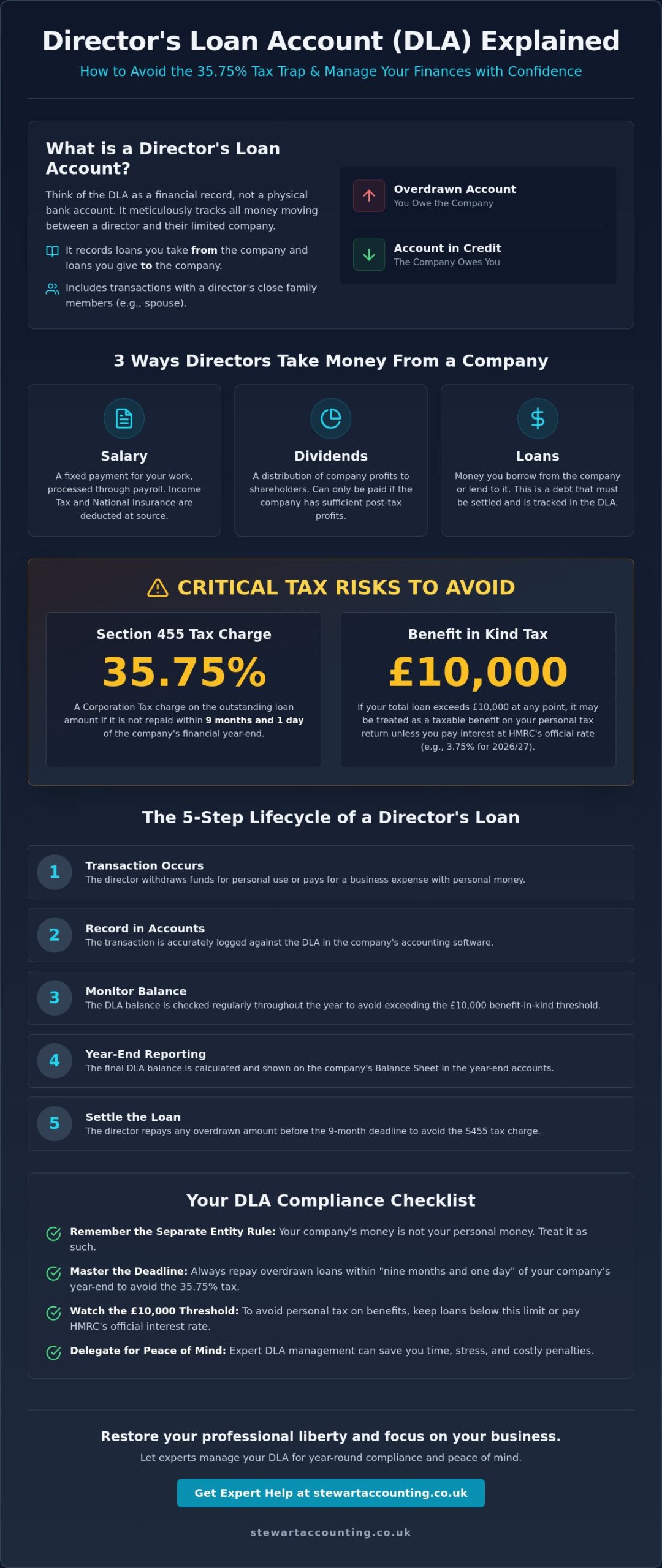
Think of your limited company as a separate person. Even if you own 100% of the shares, the company’s bank account is not your personal wallet. This distinction is the foundation of getting your director’s loan account explained correctly. A Director’s Loan Account (DLA) is a virtual ledger within your bookkeeping records that tracks every penny moving between the company and its directors. It isn’t a physical bank account, but a record of who owes what.
It isn’t just about your own spending, either. HMRC rules state that transactions involving your close family members, such as a spouse or civil partner, also count toward this account. If the company pays for your partner’s personal car insurance, that amount is recorded here. Keeping this record accurate is vital for compliance and for understanding the true financial health of your business. It ensures that every withdrawal is accounted for, protecting you from unexpected tax inquiries later.
To better understand this concept, watch this helpful video:
The Difference Between Salary, Dividends, and Loans
It helps to view the DLA as the “catch-all” for any money that isn’t clearly defined elsewhere. Most directors take money in three ways:
- Salary: This is a fixed payment for your work, processed through payroll, where Income Tax and National Insurance are deducted at source.
- Dividends: These are distributions of profit paid to shareholders. They are only available if the company has sufficient post-tax profit.
- Loans: This is money you borrow from the company or lend to it. Unlike salary or dividends, a loan is a debt that must eventually be settled.
When the DLA is in Credit vs. Overdrawn
Your account balance will always sit in one of two states. If you use your personal credit card to buy equipment for the business or inject your own savings into the firm, your DLA goes “in credit.” This means the company owes you money. You can withdraw that exact amount tax-free at any time. There is a great sense of emotional relief in seeing a credit balance; it represents a personal safety net within your business.
Conversely, if you take more money out than you have put in, the account becomes “overdrawn.” In this scenario, you owe the company money. While this is perfectly legal, it triggers specific reporting requirements during your year end accounts preparation. Managing this balance effectively is the key to avoiding unnecessary tax burdens and maintaining professional liberty.
How Does a Director’s Loan Work in Practice?
The practical lifecycle of a director’s loan begins the moment you transfer funds from the business account to your personal one. It isn’t just a simple withdrawal; it’s a transaction that needs to be tracked through your online accounting software like Xero. Having your director’s loan account explained in a real-world setting helps you see it as a moving balance that fluctuates throughout the year. At your financial year-end, this balance appears on your company’s Balance Sheet. If you owe the company money, it’s listed as an asset. If the company owes you, it’s a liability.
The lifecycle of a director’s loan typically follows a logical path:
- Initial Transaction: Moving money for personal use or paying a business cost personally.
- Recording: Matching the bank transaction to the DLA in your accounting software.
- Monitoring: Checking the balance monthly to ensure it doesn’t exceed the £10,000 “benefit in kind” threshold.
- Year-End Reporting: Finalizing the balance for the company tax return.
- Settlement: Repaying the loan via cash, salary, or dividends.
Accurate, real-time bookkeeping is the only way to stay on top of this. Many directors accidentally create loans by using a company card for personal groceries or a family meal. Without daily tracking, these small “accidental loans” can snowball into a significant overdrawn balance by the time your year-end accounts are prepared. Following the UK government rules on director’s loans ensures you remain compliant even when these small errors happen.
Borrowing Money from Your Limited Company
Directors often borrow from their firm to cover short-term personal cash flow gaps or unexpected emergencies. While the company can lend you money, you should document the decision with formal board minutes. This creates a clear paper trail for HMRC. Problems usually arise when borrowing becomes “routine” or “circular.” If you’re constantly dipping into company funds without a plan for repayment, HMRC may view this as a way to avoid paying Income Tax on a regular salary. We can help you review your bookkeeping records to ensure everything is correctly classified.
Lending Personal Funds to Your Business
It’s equally common for directors to lend money to their business, especially during the start-up phase or a period of rapid growth. When you pay for business expenses out of your own pocket, you’re effectively a creditor to your firm. The beauty of this arrangement is that you can withdraw this money back into your personal account tax-free at any time, as it’s simply a repayment of debt. You can even choose to charge the company interest on the loan. This can be a tax-efficient way to extract income, provided the interest rate is reasonable and you report it correctly on your personal tax return.
Understanding the Tax Risks: Section 455 and Beneficial Loans
HMRC monitors director’s loan accounts closely because they don’t want business owners using company funds as a permanent, tax-free source of personal income. If you leave your account overdrawn for too long, the tax office implements heavy charges to discourage the practice. Section 455 tax is a temporary charge on unpaid loans that acts as a placeholder for the tax the government would have received if you had taken the money as a salary or dividend.
For loans taken out on or after 6 April 2026, the Section 455 tax rate is 35.75%. This rate is specifically designed to match the higher dividend tax rate, ensuring there is no financial advantage to leaving a loan unpaid. Having your director’s loan account explained in the context of these risks helps you prepare for the potential impact on your company’s cash flow. While the percentage is high, it’s vital to remember that this isn’t a permanent “fine” but a deposit that can eventually be recovered.
The S455 Corporation Tax Charge Explained
The Section 455 charge triggers if you don’t repay your loan within nine months and one day of your company’s financial year-end. If the balance remains outstanding, the 35.75% tax is added to your company’s Corporation Tax bill for that period. This can create a significant financial burden during your year end accounts preparation if you haven’t set funds aside.
The good news is that Section 455 tax is refundable. Once you repay the loan to the company, you can claim the tax back from HMRC. However, you can’t claim the refund until nine months and one day after the end of the accounting period in which the repayment was made. This delay means your business could be without that capital for a considerable time, which is why we emphasize proactive monitoring of your DLA throughout the year.
Benefit in Kind (BIK) and the £10,000 Threshold
If your director’s loan exceeds £10,000 at any point during the tax year, HMRC classifies it as a “Beneficial Loan” if you aren’t paying a commercial rate of interest. For the 2026/27 tax year, the official HMRC interest rate is 3.75% per annum. If you don’t pay at least this amount to the company, the loan is treated as a Benefit in Kind. This creates two specific tax liabilities:
- Personal Tax: You must report the “notional interest” (the interest you saved by not paying the 3.75% rate) on your Self Assessment tax return and pay income tax on it.
- Company NICs: Your company must pay Class 1A National Insurance contributions on the value of that interest benefit.
Staying below the £10,000 threshold or ensuring you pay the official interest rate can eliminate these extra costs. It’s a simple way to reduce complexity and keep your personal tax position clean.
Repayment Rules: When and How to Square the Account
Settling your balance isn’t just about moving money; it’s about timing and strategy. To have your director’s loan account explained fully, you must understand that HMRC requires a clean break between borrowing and repayment. You can clear the debt by paying cash back into the company bank account, but most directors prefer to use salary or dividends to “offset” the balance. This accounting entry effectively cancels out what you owe using money the company was already going to pay you. It’s a smooth, paper-based transaction that settles the debt without you needing to find extra cash personally.
However, writing off a loan entirely is a different matter. If the company formally decides you don’t have to pay the money back, the amount is treated as taxable income. You’ll likely pay personal tax on that figure as if it were a dividend, and the company can’t claim a Corporation Tax deduction for the write-off. It’s a complex route that often leads to higher tax bills than a standard repayment. We always recommend a pragmatic approach that prioritizes long-term compliance over short-term convenience.
The Nine-Month Deadline for Repayment
The most critical date in your financial calendar is nine months and one day after your accounting period ends. This is the hard deadline to repay your loan and avoid the Section 455 tax charge. Many of our clients use their annual dividend declaration to square the account just before this date. This ensures the company’s Year End Accounts Preparation remains clean and free from unnecessary tax liabilities. For more help with these timelines, read our Year End Accounts Guide to ensure you never miss a filing milestone.
The Rules Against “Bed and Breakfasting”
HMRC is wise to the tactic of repaying a loan just before the deadline only to withdraw it again a few days later. This practice is known as “bed and breakfasting.” If you repay a loan of £5,000 or more and then borrow a similar amount within 30 days, HMRC may disregard the repayment for tax purposes. This anti-avoidance measure is designed to stop directors from bypassing Section 455 tax through circular transactions. If the repayment is disregarded, the tax charge still applies as if the loan was never settled.
We help business owners across Stirling and Falkirk navigate these complex anti-avoidance rules by reviewing their withdrawal patterns throughout the year. Our proactive approach aims to restore your professional liberty by removing the anxiety of potential HMRC scrutiny. If you’re worried about an overdrawn balance or need a clear strategy for repayment, get in touch with our team today for a professional review of your accounts.
Expert DLA Management with Stewart Accounting Services
Managing a director’s loan shouldn’t be a source of constant stress. We believe in restoring your personal and professional liberty by taking the weight of compliance off your shoulders. When you have your director’s loan account explained by a Chartered Accountant, you gain more than just a definition; you gain a strategy that protects your company’s future. Our core promise is built around the liberation of your time, your finances, and your mental well-being. We move the burden of tracking every withdrawal and repayment from your desk to ours, ensuring you never have to lose sleep over an “overdrawn” balance again.
Why Professional Oversight Prevents HMRC Penalties
We don’t wait until the end of the year to look at your numbers. By using online accounting services like Xero, we monitor your loan balance in real-time. This proactive approach ensures we can spot potential issues, like exceeding the £10,000 threshold, before they turn into costly mistakes. We also ensure that all necessary board minutes and loan agreements are legally compliant and ready for inspection. Our team focuses on pragmatic results, helping you time your dividends perfectly to clear your loans in the most tax-efficient way possible. This level of oversight turns a potentially risky financial tool into a smooth, managed part of your business operations.
Our Approach for Businesses in Central Scotland
Our firm is proud to be a regional expert, providing face-to-face support from our offices in Alloa, Stirling, and Falkirk. We understand the unique challenges faced by small and medium-sized enterprises across Central Scotland. By delegating your DLA management to us, you’re choosing a partner that values tangibility and resource optimization. We don’t just provide a service; we act as a solid, reliable partner for your growth. If you’re ever faced with an HMRC inquiry, our status as Chartered Accountants provides a foundation of competence and reliability to defend your position. We take full responsibility for the accuracy of your records, providing you with the peace of mind that comes from knowing experts are at the helm.
You are invited to visit us for a free consultation at our Alloa Business Centre office to discuss your specific needs. Whether you’re a new startup or an established firm, we tailor our support to your long-term objectives. Let us remove the burden of financial administration so you can enjoy the rewards of your hard work. Our logical and methodical approach ensures that your Year End Accounts Preparation is always handled with the utmost care. Let us manage your year-end accounts and DLA to ensure your business remains compliant and your mind remains at ease.
Secure Your Professional Liberty with Expert Compliance
Managing your company’s finances shouldn’t feel like navigating a minefield. You now have your director’s loan account explained, from the basics of overdrawn balances to the strict nine-month repayment deadline. Keeping your account in check isn’t just about avoiding the 35.75% Section 455 tax; it’s about maintaining a clear boundary between your personal life and your business entity.
By staying under the £10,000 threshold and using real-time bookkeeping, you can use director’s loans as a flexible tool rather than a source of anxiety. Our team of Chartered Accountants is ready to help you optimize your tax planning and remove the burden of HMRC compliance from your shoulders. We specialize in small business tax planning and provide local, face-to-face support from our offices in Alloa, Stirling, and Falkirk.
Book a free consultation with our Alloa, Stirling, or Falkirk accountants to discuss your specific needs today. We’re here to provide the expertise and peace of mind you deserve to grow your business with confidence.
Frequently Asked Questions
Can I take a director’s loan if my company is making a loss?
Yes, you can take a loan even if your company isn’t currently profitable. Unlike dividends, which require the business to have sufficient post-tax profits, a loan is simply a debt that you owe back to the company. You must ensure the company remains solvent and can still meet its obligations to creditors. Taking a loan during a loss-making period requires careful cash flow management to avoid future financial instability.
What happens if I cannot repay my director’s loan within 9 months?
If you miss the nine-month and one-day deadline, your company must pay Section 455 tax. For loans made on or after 6 April 2026, this charge is 35.75% of the overdrawn amount. This tax is added to your Corporation Tax bill. While you can reclaim this tax from HMRC once the loan is fully repaid, the refund process only starts nine months after the end of the accounting period in which you settle the debt.
Is a director’s loan the same as a dividend?
No, a director’s loan and a dividend are fundamentally different transactions. A dividend is a permanent distribution of company profits that belongs to you once paid. In contrast, a director’s loan is borrowed money that creates a legal obligation to repay the company. Having this director’s loan account explained clearly helps you distinguish between permanent income and temporary debt, which is vital for accurate bookkeeping and tax planning.
Does a director’s loan affect my personal credit score?
A director’s loan typically doesn’t affect your personal credit score. These transactions are private agreements between you and your limited company and aren’t reported to external credit agencies. However, if the company enters insolvency and you cannot repay an overdrawn loan, liquidators may pursue legal action. A court judgment against you would then have a severe, lasting impact on your ability to secure personal credit or mortgages in the future.
Can my spouse or partner take a director’s loan from my company?
Yes, your spouse or partner can receive a loan, but HMRC treats this as part of your own director’s loan account. Any funds borrowed by close family members are added to your balance for tax purposes. This means you remain personally responsible for ensuring the loan stays under the £10,000 threshold to avoid benefit in kind charges. You must also manage the repayment within the nine-month deadline to avoid the 35.75% Section 455 tax charge.
How much interest should I charge my company if I lend it money?
You should charge a commercial rate of interest that reflects what a bank might offer for a similar unsecured loan. If you lend money to your company, the interest you receive is a business expense for the firm, which reduces its Corporation Tax liability. You must report this interest as personal income on your Self Assessment tax return. We recommend documenting the interest rate in a formal loan agreement to satisfy HMRC’s requirements.
What records do I need to keep for my director’s loan account?
You must keep a detailed, real-time ledger of every transaction between you and the business. This includes bank transfer records, receipts for personal expenses paid by the company, and formal board minutes approving any significant loans. Using cloud software like Xero makes this process much easier. Accurate record-keeping is the best way to have your director’s loan account explained and defended if HMRC ever opens a compliance review or tax investigation.
Can a director’s loan be written off?
You can write off a loan, but it is rarely the most tax-efficient route. HMRC treats a written-off loan as a dividend payment to the director. This means you’ll pay personal income tax on the amount at your applicable dividend rate. While the company can eventually reclaim any Section 455 tax paid, it cannot claim the written-off amount as a tax-deductible expense. This often results in a higher overall tax burden for your business.