

Accrual accounting is all about timing. It’s a way of recording your income the moment you’ve earned it and your expenses the moment you’ve incurred them—and crucially, this is all done regardless of when the money actually changes hands.
Think of it less like your bank statement and more like a true performance report for your business. It gives you a clear, real-time picture of your financial health, not just a snapshot of what’s in the bank today.
Seeing Your True Financial Picture
Let’s bring this to life. Imagine you run a small gardening business. In June, you finish a big landscaping project and send your client an invoice for £5,000. They don't actually pay you until August, but with accrual accounting, you book that £5,000 as revenue in June—the month you did the work.
This principle works the other way, too. Say you buy £500 worth of new tools on credit in March but don't pay the supplier's bill until April. That £500 expense is recorded in March, when you actually took on the cost.
The whole point is to match revenues with the expenses that helped create them in the same period. This is a fundamental concept in accounting known as the matching principle, and it’s the bedrock of the accrual method.
A Shift to a Clearer View
There's a good reason this became the standard. Before accrual accounting was widely adopted, UK financial reporting was mostly based on simple cash in, cash out. This often meant big liabilities or upcoming revenues were completely missed, which could paint a misleading picture of a company's—and even the country's—economic health.
The switch was a massive step towards providing a 'true and fair' view of business finances. If you're interested in the history, the Office for National Statistics has some fascinating background on this evolution in UK national accounts.
Ultimately, accrual accounting forces you to look beyond the immediate cash in your bank. It helps you answer the questions that really matter for strategy:
- How profitable were we really last quarter?
- Do we have confirmed future income to cover upcoming bills?
- Are we consistently earning more than we're spending over time?
By focusing on when the economic activity actually happens, you get insights that are simply invisible if you only watch cash moving in and out.
The core difference is timing. Cash accounting is reactive; it shows you what’s already happened with your money. Accrual accounting is proactive; it gives you a complete picture of your financial obligations and earned income, which is exactly what you need for smart planning.
To really nail down the difference, it helps to see them side-by-side.
Accrual vs Cash Accounting At a Glance
Here’s a quick breakdown of the key differences between the two methods. It really highlights how accrual accounting provides a much deeper, more insightful view of your business's financial standing.
| Feature | Accrual Accounting | Cash Accounting |
|---|---|---|
| Revenue Recognition | Recorded when earned, regardless of payment. | Recorded only when cash is received. |
| Expense Recognition | Recorded when incurred, regardless of payment. | Recorded only when cash is paid out. |
| Financial Picture | Provides a comprehensive view of profitability. | Shows a simple view of cash flow. |
| Complexity | More complex, requires tracking receivables/payables. | Simpler, easier to maintain for very small businesses. |
| HMRC Compliance | Required for most UK limited companies. | Permitted for some sole traders and small businesses. |
As you can see, while cash accounting might feel simpler on the surface, the accrual method is what gives you the control and foresight needed to grow a sustainable business.
Accrual vs Cash Accounting: What UK SMEs Need to Know
The best way to get your head around accrual accounting is to see it side-by-side with its simpler cousin, cash basis accounting. Let's walk through a common scenario for a UK digital marketing agency to see just how different the financial picture can look.
Imagine our agency, "Digital Growth Ltd," lands a fantastic new client in March. They sign off on a £15,000 project, and the team gets it all done and invoiced by the 30th of March. The catch? The client has 60-day payment terms, so that cash won't actually hit the company bank account until the end of May.
A Tale of Two Financial Reports
With the accrual method, that £15,000 revenue is recorded in March—the month the work was finished and the income was earned. This gives a true and fair view of how the agency performed in the first quarter. It reflects strong business activity, even though the money is still on its way.
Now, let's flip the coin and look at this through the cash basis accounting lens. Because no money came in, March's revenue for this huge project is a big fat £0. The books will then show a massive, sudden spike in income two months later in May when the £15,000 finally arrives.
You can see how this creates a financial rollercoaster. March looks like a disaster, which could cause a lot of needless worry, while May looks unusually successful. This jerky, inconsistent view makes it incredibly difficult to plan, budget, or get a real feel for the health of your business.
Accrual accounting is all about smoothing out these peaks and troughs. It gives you a consistent, reliable picture of your profitability, letting you make smart decisions based on performance, not just the timing of your clients' payments.
This animated timeline helps visualise how UK accounting standards have evolved over the years, marking the official shift towards more accurate methods like accrual accounting.
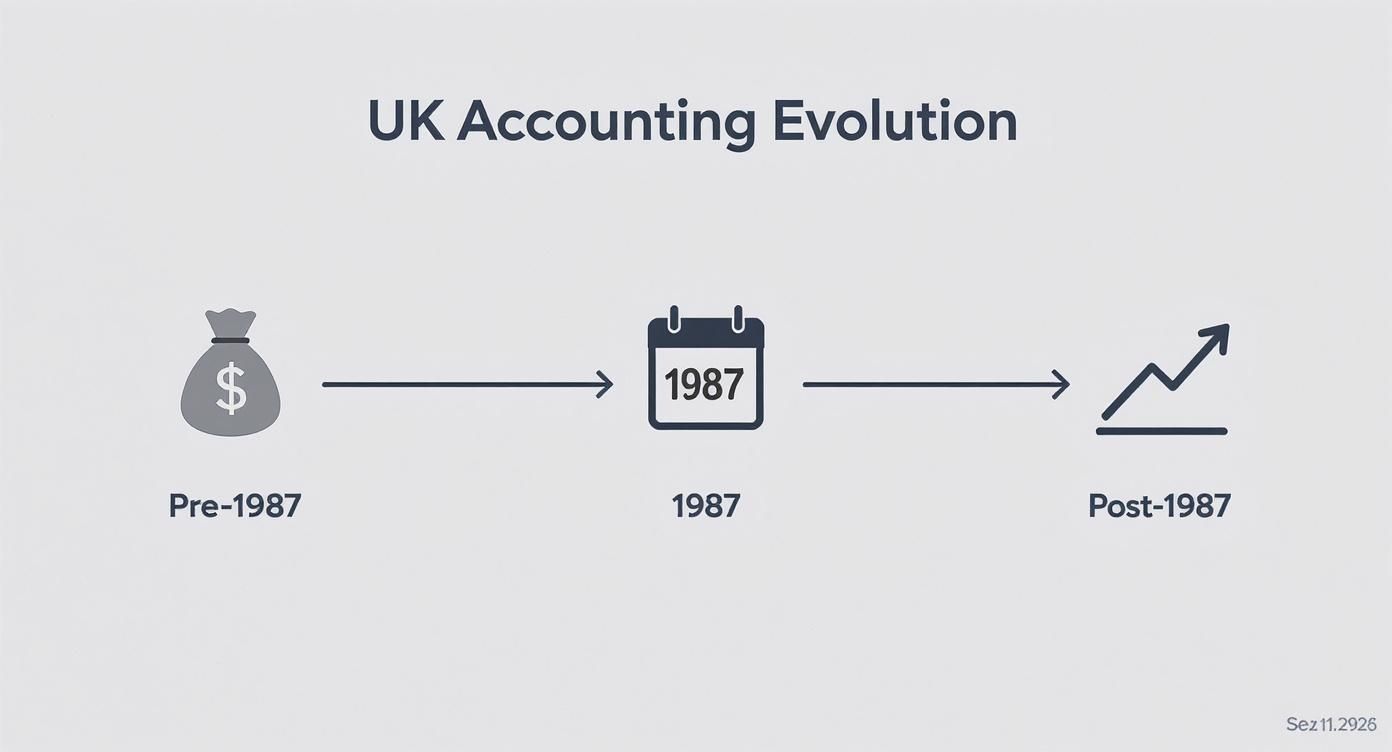
As the graphic shows, we’ve moved from a simple cash-in-hand system to a more sophisticated framework designed to present a much truer financial picture.
Choosing the Right Method for Your SME
So, which is the right choice for your business? It really boils down to your business model, your size, and your legal structure. For a much deeper dive, you can learn more about the differences between cash basis and accruals accounting in our detailed guide.
But as a quick rule of thumb, here's who each method suits best:
- Cash Accounting is best for: Very small sole traders or partnerships with straightforward operations. Think freelance writers, gardeners, or tutors who get paid on the spot and don’t hold stock. It works well if your turnover is below the VAT threshold.
- Accrual Accounting is essential for: The vast majority of UK businesses, and it's a must for all limited companies. If you hold stock, work on long projects, offer credit to customers, or ever plan on seeking a loan or investment, this is the standard you need to meet.
Why Growth Ambitions Demand Accrual Accounting
If you have any plans to grow your business, the accrual method isn't just a good idea—it's a necessity. Put yourself in the shoes of an investor or a bank manager. They need to see a reliable and accurate story of your company's financial health. A cash-based report with its unpredictable spikes and dips just won't cut it.
Furthermore, any business that deals with physical inventory must use accrual accounting. It's the only way to correctly match the cost of the goods you sell with the revenue from those sales in the same period, which is fundamental to calculating your gross profit accurately.
Think about a small retail shop. If you buy £10,000 of stock in February but don't sell it until April, cash accounting would show a huge expense in February and a massive income spike in April. This completely distorts the performance of both months. Accrual accounting, on the other hand, correctly matches the cost of that stock to the sales revenue in April.
This is exactly why modern cloud accounting platforms like Xero are built with the accrual principle at their core. They’re designed to give you that clear financial overview, which is the main benefit of the accrual method.
Choosing accrual accounting is about choosing clarity. It’s about giving yourself the control and the accurate insight you need to build a sustainable future for your business.
How Accrual Accounting Shapes Your UK Business Taxes
When it comes to your business taxes, understanding accrual accounting isn't just a good idea—it's essential. For the vast majority of UK limited companies, HMRC doesn't see it as an option; it's a requirement. Both your Corporation Tax and VAT liabilities are calculated based on when you earn the income and incur the expense, not when the money actually hits or leaves your bank account.
This is a really important distinction to get your head around. It means your tax bill is directly linked to your business activity during a financial year, not the cash moving through it. Nailing this concept is the bedrock of good tax planning and helps you avoid any nasty surprises down the line.
Corporation Tax: Your Liability Starts with the Invoice
The moment you send an invoice to a client, you’ve officially earned that income in the eyes of HMRC. It doesn't matter if they pay you tomorrow or in 90 days; that's when the clock starts ticking on your tax liability.
Let’s walk through a common scenario. Imagine your company’s financial year ends on the 31st of March. On the 15th of March, you finish a big project and send off an invoice for £20,000. Your payment terms are 60 days, so you won’t see that cash until mid-May, well into your next financial year.
With accrual accounting, that £20,000 of revenue is firmly planted in the financial year ending 31st March. The profit you made from that sale has to be included in your Corporation Tax calculation for that year, even though your bank balance hasn't changed.
This is the crux of accrual-based tax. Your profit and loss statement, which is what HMRC uses to get a 'true and fair' view of your performance, is built on the principle of recognising revenue the moment it's earned.
This is exactly how national tax revenues are reported, too. Corporation Tax liabilities are recognised as soon as they are earned by businesses across the country. While government reports often talk about cash receipts—like the £55.1 billion in Corporation Tax collected in the year to March 2019—the actual liability is figured out on an accruals basis. You can dig into the specifics in the official UK tax statistics commentary on gov.uk, which just goes to show why your own accounting needs to follow the same rules.
Managing VAT: It's All About the 'Tax Point'
The same logic applies to your VAT obligations. For most businesses using standard VAT accounting, the trigger is the 'tax point'—which is usually the date you issue a VAT invoice. This date determines which VAT return the transaction belongs to.
Think about it this way: you’re preparing your quarterly VAT return for January to March. You issue an invoice on the 30th of March. The VAT from that sale must be declared and paid on that return, even if your customer doesn't settle the bill until April or May.
This is a classic cash flow headache for many small businesses. You're legally on the hook to pay HMRC the VAT you’ve charged, whether or not you've actually collected it from your customer yet.
Here’s how you can stay on top of this potential cash flow trap:
- Set the VAT Aside: The moment you raise an invoice, treat the VAT portion as HMRC's money. It was never really yours. The simplest way is to move it into a separate savings account so you aren't tempted to spend it.
- Watch Your Debtors List: Keep a sharp eye on who owes you money. Chasing payments isn't just about getting paid; it's vital for making sure you have the cash on hand to cover your VAT bill when it's due.
- Look into the Cash Accounting Scheme: If your VAT taxable turnover is £1.35 million or less, you might be eligible for the VAT Cash Accounting Scheme. This lets you pay VAT to HMRC only when your customers have paid you, which can be a game-changer for your cash flow.
Getting to grips with what accrual accounting is and how it works is the key to managing your UK tax affairs properly. By accounting for everything when the activity happens, you can plan for your tax payments with confidence and keep your business financially healthy.
Putting Accrual Accounting into Practice with Xero

Knowing the theory behind accrual accounting is one thing, but actually making it work for your business is what really counts. Thankfully, you don’t need to be a bookkeeping whiz to get it right. Modern cloud accounting software like Xero is specifically built to handle the heavy lifting for you.
In fact, these platforms are designed around the accrual method right out of the box, so you’re set up for success from day one. Instead of getting tangled up in spreadsheets, the software guides you through the process, letting you focus on running your business while it records everything correctly behind the scenes. The trick is simply to build a few consistent habits.
Core Workflows for Accurate Accrual Records
Getting accrual accounting right in Xero boils down to a couple of repeatable tasks. Nail these, and your financial reports will always give you a true and fair view of how your business is actually performing. While we often focus on Xero, there are other great options out there; you can check out our comparison of Xero vs QuickBooks for UK businesses to see what might fit you best.
No matter the tool, these are the key actions to master:
-
Raise Invoices Promptly: The second you finish a job or deliver a product, create and send the invoice from your accounting software. This one action immediately records the revenue in your accounts. It doesn't matter when the client actually pays you; the income is now officially recognised for that period. That’s the heart of accrual accounting.
-
Enter Supplier Bills as They Arrive: As soon as a bill from a supplier lands in your inbox, enter it into Xero with its issue date. This logs the expense in the correct period, even if you don't plan to pay it for another 30 days. This simple step ensures your costs are properly matched to the revenue they helped generate.
These two habits are the bedrock of maintaining accurate, accrual-based books.
The Crucial Role of Bank Reconciliation
So, you’re recording income and expenses as they happen, but your bank account is still, by its nature, operating on a cash basis. The bridge connecting these two worlds is bank reconciliation. This is simply the process of matching the transactions in your software to the actual money moving through your bank.
Xero makes this incredibly easy by pulling in a live feed from your bank account. Your job is to go through and match each bank transaction to the corresponding invoice or bill you’ve already entered.
Think of reconciliation as the final check that confirms everything. It’s the step that verifies the revenue you recorded from an invoice has been paid, and the expense you logged from a bill has been settled. It's the essential check and balance for your entire system.
By reconciling your accounts regularly—ideally weekly—you keep a crystal-clear view of both your profitability (from your accrual-based reports) and your actual cash position (from your bank balance).
Automating and Optimising Your Process
Once you're comfortable with the basics, you can start making things even more efficient. Xero allows you to set up repeating invoices for regular clients and recurring bills for monthly costs like rent or software subscriptions. It's a huge time-saver.
Exploring tips on automating invoice follow-ups in Xero can take your efficiency to the next level, improving your cash flow by helping you get paid faster. By putting these simple practices into place with a tool like Xero, accrual accounting stops being an abstract theory and becomes a powerful, manageable system for true financial control.
Mastering Key Accrual Concepts
To really get to grips with accrual accounting, we need to talk about its two most important moving parts: Accounts Receivable and Accounts Payable. These two accounts are the real engine of the accrual method, tracking the value of every deal even before a single penny has changed hands.
Think of Accounts Receivable as a formal list of all the IOUs your customers owe you. It's the total value of all the work you've done and invoiced for, but you’re still waiting for the payment to come through.
On the other side of the fence, you have Accounts Payable. This is your pile of IOUs – the stack of bills for goods or services you've received from suppliers but haven't yet paid.
Why Receivables and Payables Matter
Understanding these two concepts is the key to measuring the short-term financial pulse of your business. They give you a live snapshot of what money you’re expecting to come in and what you’re committed to paying out.
This entire system relies on a tried-and-tested framework. To see how these entries are actually recorded in your books, it helps to understand the basics of what double-entry bookkeeping is, as it’s the mechanical system that makes accrual accounting work.
By tracking what you're owed and what you owe, you move beyond simply watching your bank balance. You start managing your business proactively, making smarter decisions about spending, chasing payments, and planning for the future with a clear, real-time view of your finances.
For instance, a big Accounts Receivable figure might look impressive on paper, but it could also be a red flag. It might be telling you that you need to get tougher on chasing late payments to make sure you have enough cash to cover your own bills.
To give you a clearer picture, let's look at how a typical credit sale would be recorded.
Example Accrual Journal Entries
| Date | Account | Debit (£) | Credit (£) |
|---|---|---|---|
| 15-Jun | Accounts Receivable | 1,200 | |
| 15-Jun | Sales Revenue | 1,200 | |
| (To record sale of services on credit) |
This entry shows the £1,200 sale being recognised immediately, even though the cash hasn't arrived. The debit to Accounts Receivable shows the customer owes you money, and the credit to Sales Revenue logs the income you've earned.
Bringing Your Data to Life with Reports
This is where accrual accounting really proves its worth. Because you’re recording every sale and purchase the moment they happen, you can generate powerful reports that are simply out of reach if you're using the cash method. Modern accounting software like Xero makes pulling these reports incredibly easy.
Two of the most indispensable reports are:
-
Aged Debtors Report: This report is your secret weapon for credit control. It lists every unpaid customer invoice and organises them by how long they've been outstanding (e.g., 0-30 days, 31-60 days, 61+ days). It tells you exactly who you need to chase and which debts are becoming a potential risk.
-
Aged Creditors Report: This gives you the flip side – a complete list of all your supplier bills, also neatly categorised by their due date. It’s essential for managing your cash outflow, helping you prioritise payments and keep your suppliers happy.
A critical part of this is making sure all your transactions are logged accurately. To see this process in practice, take a look at a clear accounting reconciliation example which walks you through this vital step.
Ultimately, these reports give you the forward-looking insight you need to run your business with confidence. They turn abstract numbers into real, actionable intelligence, helping you spot potential cash flow gaps, identify slow-paying clients, and maintain a healthy financial footing. That level of foresight is only possible through the lens of accrual accounting.
Steering Clear of Common Accrual Accounting Traps
Accrual accounting offers a brilliant, true-to-life picture of your business's performance, but it comes with one massive health warning: profit is not the same as cash. Getting your head around this single concept is the most important step to using accruals properly and dodging some seriously common pitfalls.
The biggest mistake we see business owners make is looking at a glowing Profit & Loss (P&L) statement and assuming the bank balance looks just as good. It’s entirely possible to be fantastically profitable on paper while being just a few weeks away from a cash flow disaster. This is a trap that catches out even seasoned entrepreneurs.
Think about it this way: a design agency has its best quarter ever and invoices £50,000 for a huge project. The P&L looks incredible. But what if the client is on 90-day payment terms? That means the agency has to find the cash for three months of salaries, rent, and software licences before a single penny of that income actually lands in the bank. Without a firm grip on cash flow, this "profitable" company could easily go under.
Facing Up to Bad Debts
Another classic error is being overly optimistic about unpaid invoices. Hope is not a sound accounting strategy. If you’ve been chasing a client for months and it’s becoming clear they can’t or won’t pay, you have to accept that the revenue you recorded isn't real anymore. Simply leaving it on your books makes your sales look better than they are and creates a dangerous false sense of security.
The only professional move is to write it off as a bad debt. This action pulls that phantom revenue out of your accounts, bringing your P&L back in line with reality. It’s a tough but essential part of keeping honest, accurate records.
Getting this right is what accrual accounting is all about—matching your books to what's actually happening, not just what you’ve invoiced.
Getting the Timing Right on Expenses
Finally, a crucial slip-up is failing to match expenses to the period they actually relate to. This is a big one for large annual costs that are paid upfront.
Let's say you pay your annual business insurance premium—£2,400—in one go in January. It would be a huge mistake to log a single £2,400 expense against January's figures. Doing so would make that month look artificially unprofitable and skew your entire year's reporting. The proper accrual method is to treat this as a prepayment.
Here’s how it should be handled:
- When You Pay: The initial £2,400 payment is recorded as a "prepaid asset" on your balance sheet, not an expense.
- Each Month: You then "use up" one-twelfth of that asset. So, every month, you move just £200 from the balance sheet to the P&L as an expense.
This small adjustment correctly spreads the cost over the 12 months the insurance policy actually covers. It ensures each month’s financial report is accurate and comparable, giving you the clarity you need to make genuinely smart decisions.
Frequently Asked Questions
Even when you've got your head around the theory, it's the practical, day-to-day questions that often pop up. We get it. Let’s tackle some of the most common queries we hear from business owners just like you.
Do I Have to Use Accrual Accounting?
For most limited companies in the UK, the short answer is yes. It's not really a choice.
UK law, specifically the Generally Accepted Accounting Practice (GAAP), mandates it for all but the very smallest businesses. The whole point is to ensure your statutory accounts present a 'true and fair' picture of your company's financial health, which the accrual method is designed to do.
Sole traders or partnerships operating below the VAT threshold might get by on a cash basis, but once you're a limited company, accrual accounting becomes the standard you need to follow.
Can I Still Keep an Eye on My Cash Flow?
Absolutely. In fact, you must. This is a common stumbling block, but it's crucial to understand that profitability and cash flow are two different things, and both need your attention.
Your accrual-based Profit & Loss report is perfect for judging your actual profitability over a period. But cash is what pays the bills tomorrow.
Good accounting software, like Xero, handles this brilliantly. It produces your P&L on an accrual basis while also giving you a real-time bank feed and a Statement of Cash Flows. The real skill in running a successful business is learning to use both reports side-by-side—one tells you if you're making a profit, the other tells you if you can survive.
What’s the Main Benefit When I’m Trying to Get a Loan?
Credibility. It's as simple as that. When you walk into a bank or talk to an investor, they need to see the real, underlying performance of your business, not just a snapshot of your bank balance on a good day.
Accrual accounting shows them your revenue and expenses as they're earned and incurred, smoothing out the lumps and bumps of cash collection. It demonstrates a consistent, predictable business model.
More importantly, it generates a proper Balance Sheet that lists what you're owed (Accounts Receivable) and what you owe (Accounts Payable). This complete financial picture gives a lender the confidence to assess your company's true value and risk, making you a far stronger candidate for that much-needed funding.
At Stewart Accounting Services, our passion is helping business owners across the UK truly understand their numbers to build more resilient and profitable companies. If you’re ready to get that kind of financial clarity, get in touch with our team of Chartered Accountants today.