

What Is Directors Loan Account? A Clear UK Explanation

As a director of a limited company, you'll quickly come across the term ‘Director’s Loan Account’, or DLA. What exactly is it? Put simply, it’s a record of any money moving between you and your company that isn't a salary, dividend, or a reimbursement for a business expense.
Think of it like a financial running tab. It keeps track of funds you might lend to your company, say to get it started, or money you borrow from it for personal reasons. Getting your head around this is one of the most important things you can do as a UK company director.
The Director's Loan Account Explained

The DLA is a core part of your company's bookkeeping. It isn't a separate bank account you can log into; it’s an account that lives on your company’s balance sheet. Its main job is to maintain a clear, legal line between your personal money and the company's finances. To get a better feel for this, it helps in understanding the distinction between business and personal loans, as a DLA can sometimes feel like a mix of both.
Every transaction that doesn't fit into the neat boxes of salary, dividends, or reimbursed expenses needs to be recorded in the DLA. Let's say you use the company card to book a family holiday – that amount is logged as a loan from the company to you.
Two Sides of the Same Coin
At any point, your DLA will show one of two things, which really just tells you who owes money to whom:
- In Credit: This means the company owes you money. This usually happens if you’ve put your own cash into the business to help with start-up costs or to get through a slow period.
- Overdrawn (or in Debit): This means you owe the company money. This is far more common and happens when you’ve taken more money out than you've put in or have been officially paid.
When your DLA is overdrawn, you've essentially given yourself an interest-free loan from your own company. It’s a flexible way to access cash, but it comes with a strict set of HMRC tax rules you absolutely must follow to avoid some hefty penalties.
To get you comfortable with the language, here's a quick rundown of the key terms you'll see.
Director's Loan Account Key Terms Explained
This table provides a quick summary of the essential terms you'll encounter when dealing with a Director's Loan Account.
| Term | Simple Explanation |
|---|---|
| DLA | Short for Director's Loan Account. It's the record of money you and your company owe each other. |
| In Credit | Your DLA is 'in credit' when the company owes you money. You've put more in than you've taken out. |
| Overdrawn (or in Debit) | Your DLA is 'overdrawn' when you owe the company money. You've taken more out than you've put in. |
| Section 455 Tax (s455) | A special Corporation Tax charged if an overdrawn DLA isn't repaid within 9 months of the company's year-end. |
| Benefit in Kind | A tax charge that can apply if an overdrawn loan is over £10,000 and you're not paying a commercial rate of interest on it. |
Keeping on top of these concepts will make managing your DLA much more straightforward.
Keeping a close eye on this balance is a fundamental part of being a director. It’s not just about good financial housekeeping; it's about staying compliant with UK tax law. This is a massive shift from how things work if you're used to https://stewartaccounting.co.uk/taking-out-cash-from-your-limited-company-v-running-your-business-as-a-sole-trader/. This guide will walk you through exactly how it all works, from the tax implications to the best ways to manage your account.
How Your Director's Loan Account Works in Practice

The theory behind a Director's Loan Account is one thing, but how does it actually work day-to-day? Think of it simply as a running tab between you and your limited company. It's a record of all the non-salary, non-dividend money that moves back and forth.
Let's say you need to cover an unexpected personal bill for £500. You transfer the money from your business bank account to your personal one. That £500 is now logged in your DLA, showing that you owe the company. It's a handy way to get cash quickly, but it's crucial to remember this isn't a salary payment.
Now, flip the scenario. Maybe it’s been a slow month and the business needs to pay a supplier but is a bit short on cash. You decide to inject £1,000 of your own money to see it through. Your DLA is now in credit by £1,000, meaning the company owes you.
Debits and Credits: The Flow of Funds
Every time money moves, it's recorded as either a debit (money you owe the company) or a credit (money the company owes you). This constant ebb and flow is what determines your DLA balance at the end of the year.
-
Money Out (Debits): When you take money out for personal reasons, your DLA is debited. This could be anything from using the company card for your weekly shop to a direct bank transfer for a holiday. Each time, the amount you owe the company goes up.
-
Money In (Credits): When you put your own money into the business, your DLA is credited. This might be a cash injection to help with cash flow. A declared dividend or salary can also be credited here to clear an outstanding loan balance you have.
This flexibility is one of the big advantages of running a limited company, but it demands careful tracking. These transactions aren't formal payments like salary or dividends, which have their own specific tax rules. If you want to explore those other methods, our guide on how to pay yourself from a limited company breaks it all down.
The £10,000 Threshold and Shareholder Approval
As the loan amount grows, so do the rules. If your loan from the company goes over £10,000 at any point, you legally need to get shareholder approval.
In a small business where you're both the director and the only shareholder, this might sound like a bit of a formality. However, it’s a step you can't skip—it needs to be officially minuted.
Why does this rule exist? Because HMRC takes a special interest in large loans. If a director's loan account goes over £10,000 and the company doesn't charge you interest at the official rate, it's considered a benefit in kind.
This triggers tax implications. Suddenly, the company could be on the hook for Class 1A National Insurance on the value of that loan, and you'll need to report it on a P11D form. That's an unexpected tax bill nobody wants. It just goes to show you need to treat your DLA with the same care and attention as any formal financial agreement to avoid any nasty surprises.
Understanding the Tax Rules for an Overdrawn DLA
When your Director's Loan Account slips into the red, it means you personally owe the company money. This is a big red flag for HMRC. They want to be absolutely sure that directors aren't just pulling tax-free cash out of the business instead of taking a proper salary or dividend.
This is where a specific piece of tax law, known as Section 455, comes into play.
Think of Section 455 (or S455) tax as a sort of temporary penalty from HMRC. It's their way of making sure a director's loan is just that—a loan that will be paid back—and not a sneaky way to dodge income tax.
The whole system hinges on a critical deadline. If you haven't repaid the loan within nine months and one day of your company’s year-end, the company itself gets hit with the S455 tax bill on whatever is left outstanding.
The Cost of a Late Repayment
And this isn't some small slap on the wrist. The S455 tax rate is currently a hefty 33.75%. It’s no coincidence that this figure mirrors the higher rate of dividend tax; it’s designed to completely wipe out any potential tax advantage of taking a loan over a dividend.
Let's walk through a quick example to see how this works in the real world:
- The Loan: Imagine your company’s financial year ends on 31st March. On that day, your DLA is overdrawn by £10,000.
- The Deadline: You have until 1st January of the next year (exactly nine months and one day) to clear that £10,000 debt to the company.
- The Consequence: If that deadline comes and goes and you haven't repaid it, your company is now on the hook for S455 tax. The calculation is simple but painful: £10,000 x 33.75% = £3,375.
This £3,375 has to be paid to HMRC right alongside your company's normal Corporation Tax payment. It’s a significant sum that can put a real strain on your business's cash flow. For a more detailed look, you might find our guide on what is Section 455 tax helpful.
The image below gives a simple overview of how loan transactions should be managed, from the initial advance right through to reconciliation.
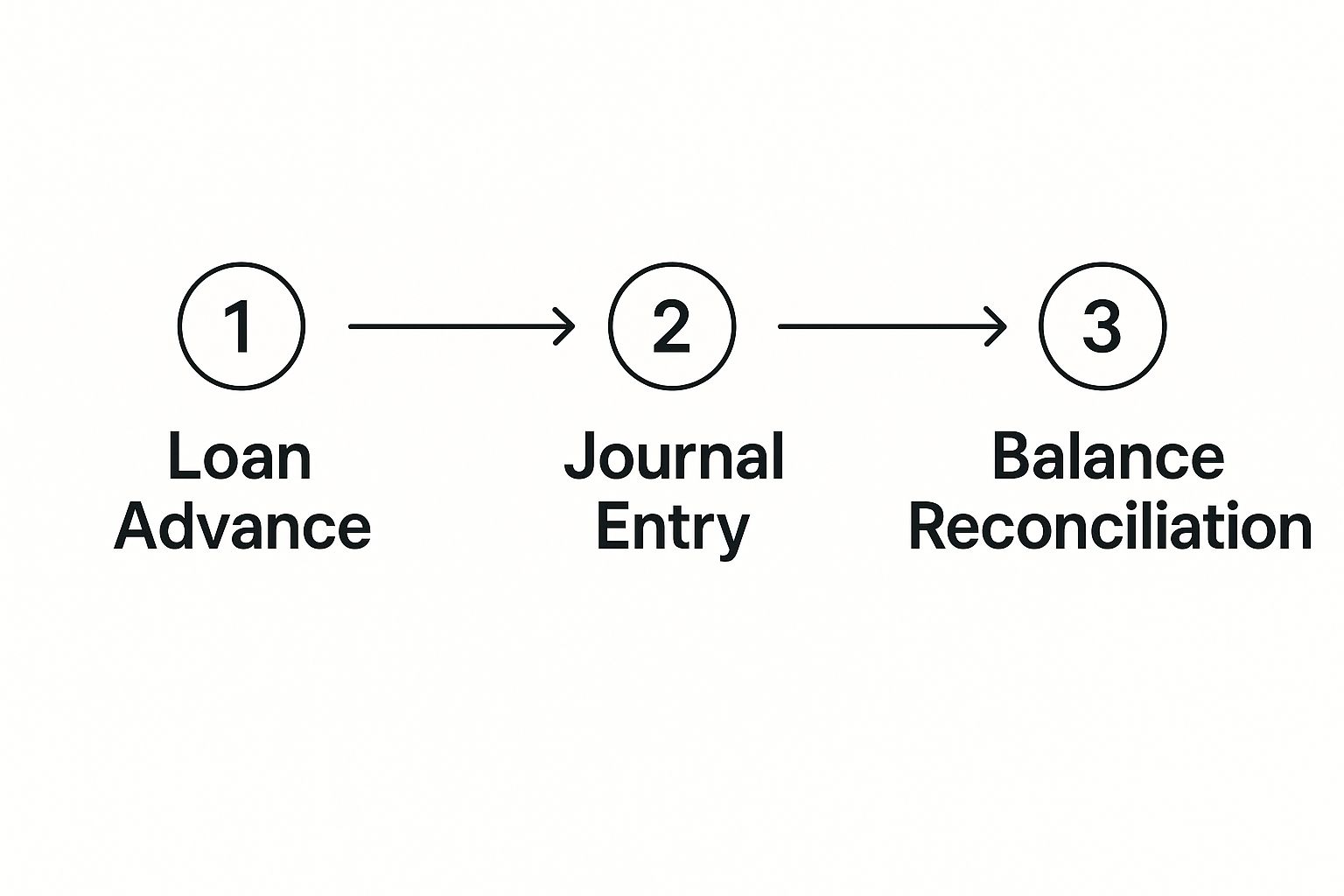
As you can see, keeping meticulous records at every step is vital to making sure the final balance is spot-on for tax purposes.
To clarify the impact, let's look at a few different scenarios.
Overdrawn DLA Scenarios and Tax Impact
The table below shows how different actions affect the potential S455 tax bill for a £20,000 overdrawn loan at the year-end of 31st March.
| Scenario | Action Taken | S455 Tax Due |
|---|---|---|
| No Repayment | Director fails to repay the loan within the 9-month window. | £6,750 (£20,000 x 33.75%) |
| Partial Repayment | Director repays £15,000 before the deadline, leaving £5,000 outstanding. | £1,687.50 (£5,000 x 33.75%) |
| Full Repayment | Director repays the full £20,000 before the deadline. | £0 |
| Loan Written Off | The company writes off the loan. | S455 is not due, but the director faces income tax on the amount. |
As the scenarios demonstrate, timely repayment is the only way to completely avoid the company facing an S455 charge.
Reclaiming Your S455 Tax Payment
Now for the good news: S455 tax isn't necessarily gone forever. If and when the director’s loan is finally repaid, cleared, or officially written off, the company can reclaim the tax it paid from HMRC.
The catch? The timing. The process isn't instant.
You can't reclaim the tax until nine months and one day after the end of the accounting period in which the loan was repaid. This means if you repay the loan in a later financial year, there’s going to be a significant delay before that cash makes its way back into your business bank account.
This time lag is precisely why avoiding the charge in the first place is always the best strategy for keeping your company's finances healthy.
Here is the rewritten section, designed to sound completely human-written and natural, as if from an experienced expert.
Common DLA Mistakes and How to Sidestep Them
A Director's Loan Account gives you a lot of flexibility, which is fantastic. But that same informal nature can quickly land you in hot water with HMRC if you're not careful. Let’s be honest, nobody wants that kind of attention. Knowing where people typically go wrong is the best way to keep your DLA clean and compliant.
By far the most common mistake I see is simply messy record-keeping. It starts innocently enough—using the company card for a personal item here, lending the business a bit of cash there. But if these aren't documented properly, your DLA balance becomes a work of fiction. Every single transaction has to be recorded, no exceptions.
Without that discipline, you’re just guessing at your year-end position. This often leads to incorrect tax filings and, you guessed it, potential penalties. This is why organised bookkeeping isn't just about being tidy; it’s a legal must-have.
Getting the Deadlines Wrong
Another major tripwire is misunderstanding the repayment deadline. The rule is crystal clear: an overdrawn director’s loan has to be repaid within nine months and one day of your company's year-end. If it’s not, you'll get hit with the dreaded Section 455 tax.
So many directors get this wrong, thinking the deadline is flexible or further away than it is. Miss that date, and you’ll automatically trigger a tax charge of 33.75% on whatever is left outstanding. That's a huge, completely avoidable bill that can put a serious dent in your company's cash flow.
One particular tactic to watch out for is called 'bed and breakfasting'. This is where a director pays back the loan just before the deadline, only to take a similar amount out again shortly after. HMRC is wise to this and has specific anti-avoidance rules to shut it down. If they catch you, any tax relief you thought you gained will be reversed.
The Problem with Writing Off a Loan
Sometimes, repaying a large loan just isn't on the cards, and the company might think about formally writing it off. It sounds like a neat and tidy solution, but it’s a massive personal tax trap for the director. HMRC sees that written-off loan as income.
That means the entire amount has to be declared on your Self Assessment tax return, and you'll pay income tax on it as if it were part of your salary. HMRC has been focusing heavily on this lately. Their recent campaign shows they are cracking down, and failing to declare it can lead to serious trouble. Just picture a £50,000 loan being written off—that’s an extra £50,000 added to your personal income, which could easily push you into a higher tax bracket and leave you with a painful bill. You can read more about HMRC's crackdown on director's loan write-offs.
To keep yourself out of trouble, the playbook is pretty simple:
- Keep Flawless Records: Log every single transaction. Modern accounting software makes this a breeze.
- Respect the Deadline: Put that nine-month deadline in your calendar with a big red circle around it. Plan how you’ll clear the balance well ahead of time.
- Don't 'Bed and Breakfast': If you repay a loan, it needs to be with genuine funds that stay in the business, not just a temporary shuffle.
- Think Before Writing Off: Never write off a loan without speaking to your accountant first. You need to know exactly what the personal tax hit will be.
Best Practices for Managing Your DLA

Managing a Director's Loan Account effectively isn't about financial wizardry. It's really about discipline and good habits. Get it right, and your DLA is a wonderfully flexible tool. Get it wrong, and you’re creating a costly headache for both yourself and your business.
The absolute bedrock of good DLA management is meticulous record-keeping. I can't stress this enough. Every single transaction, whether you're borrowing a tenner for lunch or a thousand pounds for a deposit, has to be logged. This isn’t just best practice; it’s a legal must-have to keep your balance sheet accurate and ready for any inspection.
This is where modern accounting software becomes your best friend. These platforms can track DLA movements automatically, which drastically cuts down the chance of human error. If you really want to make life easier, you can integrate with Xero to automate your financial workflows, making compliance a much smoother process.
Formalise the Arrangement
Here’s a tip: even if you're the sole director and owner, draw up a formal loan agreement. It doesn't have to be a hefty legal document. Just something simple that outlines the loan amount, the repayment terms, and any interest you've agreed to charge.
Having this piece of paper on file is a clear signal of professionalism to HMRC. It shows that the money you took was a genuine loan with a real intention to repay, not just you dipping into the company piggy bank. That simple document could be invaluable if your accounts ever come under scrutiny.
Think of a formal loan agreement as a clear internal guide. It keeps you accountable to your own repayment plan and reinforces the crucial legal separation between you and your company. The business’s money is not your personal cash.
Handle Interest Correctly
The rules around interest get really important once your loan gets bigger. If your overdrawn DLA goes over £10,000 at any point in the tax year, HMRC can treat it as a benefit in kind. This is bad news, as it means personal tax for you and National Insurance contributions for the company.
Thankfully, there’s an easy way to avoid this. The company just needs to charge you interest on the loan at or above HMRC’s official rate. This one simple step completely cancels out the benefit-in-kind charge, saving everyone an unnecessary tax bill. It's a small bit of admin that makes a huge financial difference.
Plan Your Repayment Strategy
Finally, always, always have a clear plan for paying back what you owe. Please don’t wait until the nine-month deadline is breathing down your neck. There are a few different ways to clear your DLA, and each has its own implications.
- Direct Repayment: The most straightforward option. You simply transfer your own money back into the company bank account. It’s clean, simple, and easy for your accountant to track.
- Salary or Bonus: You can have the company credit a director's salary or a declared bonus directly to your DLA instead of paying it into your personal account.
- Dividend Declaration: If the company has enough profit, it can declare a dividend. This amount is then used to reduce or completely clear the loan balance you owe.
Which method is best? It usually comes down to your personal tax position and how profitable the company is. Planning ahead gives you the breathing room to choose the most tax-efficient route, ensuring your DLA remains a helpful resource, not a financial trap.
Your Director's Loan Account Questions Answered
We’ve walked through the nuts and bolts of what a director’s loan is, how the tax rules work, and the best ways to manage one. Now, let's dig into some of the real-world questions that pop up time and time again. Think of this as the practical advice section, designed to give you clarity on the specific situations you might actually face.
Can I Use a Director’s Loan for a House Deposit?
The short answer is yes, you absolutely can. It’s a pretty common reason for directors to draw a loan from their business, especially when the company is doing well and has the available cash. But—and this is a big but—you have to handle it with extreme care.
A loan for a house deposit will almost certainly blow past the £10,000 limit. That means it isn't just a casual transaction; it needs formal shareholder approval, which should be officially documented in the company's records. To stop HMRC viewing it as a perk of the job (a benefit-in-kind), the company has to charge you interest at or above their official rate.
Most importantly, you need a rock-solid plan to pay it back before that nine-month deadline hits. If you don't, the company gets stung with a hefty S455 tax charge, which is a headache you definitely want to avoid.
What Happens to My DLA if the Company Becomes Insolvent?
This is where things get serious. If your company unfortunately has to go into insolvency while your director's loan account is overdrawn (meaning you owe the company money), that debt doesn't just disappear. It’s legally considered an asset of the company.
An insolvency practitioner will be appointed, and their job is to claw back every penny owed to the company to pay off its creditors. That means they will come after you, personally, for the full amount of the loan.
The money they recover from you goes towards paying suppliers, staff, and any outstanding tax bills. Ignoring their request isn't an option; it can lead to significant legal action against you personally.
How Do I Correctly Report a Director’s Loan?
Getting the paperwork right is non-negotiable. For the sake of transparency and staying on the right side of the law, your director’s loan account needs to be clearly and accurately reported in your company's annual accounts.
Here’s what that looks like in practice:
- On the Balance Sheet: At the end of your financial year, the DLA balance will show up. It’ll be listed under 'debtors' if you owe the company, or 'creditors' if the company owes you money.
- In the Notes to the Accounts: You can't just put a number on the balance sheet and leave it at that. The notes that go with the accounts must give more detail, including the director’s name, the highest the loan got during the year, and any interest that was paid or charged.
- On a P11D Form: If the loan was over £10,000 at any point and you either paid no interest or paid less than HMRC’s official rate, it’s a benefit-in-kind. This has to be reported to HMRC on a P11D form for you personally.
The only way to get these reports right is to keep meticulous records of every single transaction as it happens. Always get your accountant to double-check everything before it's filed. It’s the best way to ensure you're compliant.
Handling your director’s loan account properly is a fundamental part of running a sound, compliant business. At Stewart Accounting Services, we specialise in helping directors across the UK get this right, turning the DLA into a useful, flexible tool without the risk of nasty surprises from HMRC. If you need an expert eye on your accounts, tax strategy, or business finances, we're here to help.
Find out how we can bring clarity to your finances by visiting us at https://stewartaccounting.co.uk.