

At its heart, R&D tax relief is the government’s way of rewarding UK businesses for being innovative. It’s a seriously powerful incentive, designed to cut your Corporation Tax bill or, for loss-making companies, provide a direct cash payment.
Don't think of it as just another complicated bit of tax law. See it as the government co-investing in your company’s future.
Unlocking Growth with R&D Tax Relief
So many business owners I speak to think R&D tax relief is only for scientists in lab coats or massive tech firms with huge research budgets. That’s a common misconception. The reality is this incentive is for any UK company developing new products, processes, or services—or even just making significant improvements to existing ones.
It’s a reward for taking a risk and trying to solve a genuine technical problem. This could be anything from a software team writing complex new code, an engineering firm designing a more efficient widget, or a food producer creating a completely new manufacturing technique. The scheme is brilliant because it rewards the effort of trying to innovate, even if the project itself doesn't succeed in the end.
More Than Just a Tax Break
To really get to grips with what is R&D tax relief, you need to see it as a strategic financial tool. The benefits are real and can genuinely change a company's direction. A successful claim can help you:
- Boost Cash Flow: It injects capital straight back into your business, either by lowering your tax bill or as a cash credit from HMRC.
- Fund Future Innovation: The money you get back can be ploughed straight into the next project, creating a fantastic cycle of growth.
- Hire Top Talent: With more financial breathing room, you can afford to bring in the skilled people you need to push your projects forward.
- Gain a Competitive Edge: Funding those ambitious projects helps you pull ahead of the competition and secure your place in the market.
The scheme's core purpose is straightforward: to encourage and reward companies for investing time and money into solving technological uncertainties. If you're pushing boundaries and trying to do something that an expert in your field would find genuinely challenging, you're likely doing qualifying R&D.
To give you a clearer picture, this table breaks down the essentials at a glance.
R&D Tax Relief at a Glance
| Concept | What It Means for Your Business |
|---|---|
| Purpose | A government incentive to reward innovation and problem-solving. |
| Benefit | Reduces your Corporation Tax or provides a cash payment. |
| Eligibility | Open to UK limited companies trying to advance science or technology. |
| Schemes | Primarily the SME scheme for smaller companies and RDEC for larger ones. |
| Key Principle | Rewards the attempt to overcome technical uncertainty, not just success. |
Think of this as your starting point.
Throughout this guide, we’ll demystify the whole process, explaining the two main schemes and what kind of work HMRC actually considers to be R&D. We’ll also touch on other important financial tools; for more information, you can explore other reliefs and allowances for corporation tax purposes. Our goal here is to give you a clear, practical roadmap to making a successful claim.
Understanding the Two Paths to R&D Relief
When it comes to R&D tax relief, it's crucial to understand that there's no single, one-size-fits-all solution. The government has set up two distinct schemes, and the one you use depends entirely on the size and circumstances of your business.
The two pathways are the SME (Small and Medium-sized Enterprises) scheme and the RDEC (Research and Development Expenditure Credit). Figuring out which one applies to you is the first and most important step in building a successful claim.
Defining Your Business Size
So, what does HMRC consider an SME? It’s not just a gut feeling; there are specific thresholds you need to meet. Generally speaking, a company is an SME if it has:
- Fewer than 500 employees.
- Either a turnover of less than €100 million or a balance sheet under €86 million.
If your business falls within these limits, you'll most likely claim through the SME scheme, which is typically more generous. Larger companies that exceed these figures, or even SMEs that have received certain grants or are doing R&D as a subcontractor for a big corporation, will usually need to use the RDEC scheme instead.
The SME Scheme: The Engine for Small Business Innovation
For the vast majority of small, innovative businesses, the SME scheme is the go-to option. It was specifically designed to be highly rewarding, offering a much higher rate of relief that can make a real difference to your cash flow.
How does it work? It allows you to deduct an extra slice of your qualifying R&D spending from your annual profit, on top of the usual 100% deduction. This means your total deduction is actually more than you spent, which can seriously reduce your Corporation Tax bill.
For companies that aren't yet making a profit, the benefit can be even more powerful. Instead of just reducing a tax bill you don't have, you can opt to surrender some of your R&D-related losses in return for a direct cash payment from HMRC. This is a game-changer for startups, providing vital funding without you having to give away any equity.
Think of the SME scheme as a turbocharger for your innovation budget. It gives back a substantial portion of your R&D spend, allowing you to reinvest, hire new talent, and accelerate your next big project.
This simple decision tree helps visualise whether R&D tax relief, and which type of benefit, might apply to your business.
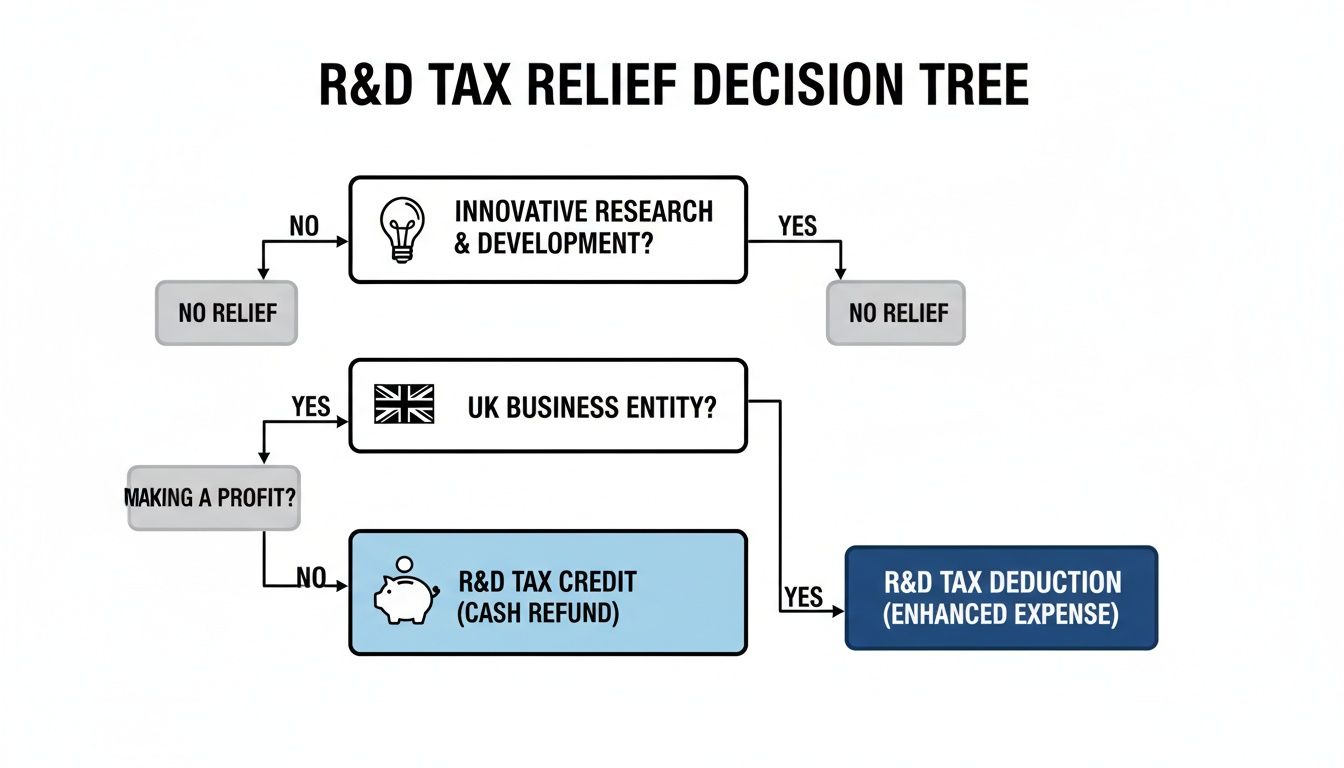
As the flowchart shows, being an innovative UK business is the starting point. From there, your profitability status determines whether you get a tax reduction or a cash credit.
The RDEC Scheme: Fuelling Large-Scale R&D
The RDEC scheme works quite differently and is primarily aimed at larger companies. It acts as a taxable credit that appears 'above the line' in your accounts, meaning it actually increases your pre-tax profit.
Rather than an enhanced deduction, RDEC gives you a credit that’s calculated as a percentage of your qualifying R&D spend. Because the credit itself is taxable, the net benefit is a little less than the headline rate, but it provides a very visible and valuable boost to a company's financial statements.
This makes it a popular incentive for big corporations, but it can also apply to SMEs in certain situations, like when they’ve been subcontracted to carry out R&D by a larger firm.
The landscape for these claims is shifting. In the 2023-24 tax year, UK businesses claimed a total of £7.6 billion in R&D tax relief. But the story within that number is telling: relief claimed under the SME scheme dropped by 29% to £3.15 billion, while the RDEC for larger firms shot up 36% to £4.41 billion. For the first time, RDEC has overtaken the SME scheme, showing a clear trend towards bigger, more thoroughly documented projects dominating the field. You can explore more about these R&D tax credit statistics and what they mean.
Knowing which scheme your business belongs to is fundamental. The SME route often provides a more significant direct cash benefit for smaller innovators, whereas RDEC offers a robust, profit-boosting credit for larger organisations.
Identifying Your Qualifying R&D Activities and Costs
So, what actually counts as R&D? It’s a common misconception that you need to be a scientist in a lab coat to qualify for tax relief. The truth is, it’s not about your industry; it’s about the problems you’re trying to solve.
HMRC has a specific, two-part test to define R&D. If your project ticks both these boxes, there’s a very good chance you’re sitting on a qualifying activity. Let's break down what they're looking for.
H3: Seeking an Advance in Science or Technology
First, your project must aim for an advance in the overall field of science or technology. This is a crucial point. It’s not enough to be making an improvement just for your own business; you need to be pushing the entire field forward.
This could mean creating a brand-new product, process, or service from scratch. But it also includes making a really significant, appreciable improvement to something that already exists. Think of it this way: are you trying to do something that a seasoned expert in your field would say isn’t readily available or easy to figure out? If so, you're on the right track.
H3: Overcoming Technological Uncertainty
Second, your project has to involve technological uncertainty. In plain English, this means you weren't sure if your goal was even possible from a technical standpoint when you started. You didn't know exactly how you were going to achieve it.
If the solution is common knowledge or a straightforward fix, then there’s no real uncertainty. The challenge is what makes it R&D. It's that journey of trial and error, of hitting roadblocks and having to experiment to find a way forward, that HMRC wants to reward.
The critical point is that R&D tax relief rewards the journey of overcoming these uncertainties, not just the final success. Even if a project ultimately fails to achieve its goals, the costs incurred while trying to solve the technological challenges can still qualify for relief.
Looking at a diverse Research and Development portfolio can be a great way to see how these principles apply in the real world.
H3: Real-World Examples of Qualifying Activities
Let’s bring this down to earth with a few examples from different sectors:
- Software Development: A tech firm is building a new machine-learning algorithm to analyse data 50% faster than any existing method. The uncertainty is two-fold: can they actually build a model this complex, and will it hit that ambitious performance target?
- Construction: An engineering company is developing a new composite building panel that's both ultra-lightweight and fire-resistant. They're facing real uncertainty about the material's structural integrity and how they can manufacture it cost-effectively at scale.
- Food & Beverage: A craft brewery is pioneering a new fermentation process for non-alcoholic beer that retains a rich flavour. The scientific challenge is figuring out how to stop alcohol production without stripping out the taste compounds.
In every case, the company is aiming high and tackling genuine technical hurdles.
H3: Pinpointing Your Qualifying Costs
Once you’ve identified a qualifying project, the next step is to nail down the exact costs. HMRC is very specific about what can and can't be included. These are essentially the ingredients that make up your R&D claim. It’s also worth noting that some expenses can be claimed even before a company starts trading, which we cover in our guide to https://stewartaccounting.co.uk/pre-trading-expenditure-for-companies/.
To help you get started, here’s a breakdown of the most common costs you can claim.
Qualifying R&D Expenditure Checklist
This table outlines the main categories of spending that are eligible for R&D tax relief. Getting this right is fundamental to building a solid claim.
| Cost Category | Examples and Key Considerations |
|---|---|
| Staff Costs | The gross salary, employer’s National Insurance, and employer’s pension contributions for employees directly working on the R&D project. This is usually the biggest part of any claim. |
| Externally Provided Workers (EPWs) | Payments made to agency staff or freelancers who are directed by your company and working on the R&D project. Typically, you can claim 65% of the cost. |
| Software Licences | The cost of software directly used for R&D. This can range from specialised CAD software for engineers to development platforms used by coders. |
| Consumable Items | This includes the materials and utilities you use up in the R&D process itself. Think raw materials for prototypes, chemicals for lab tests, and the proportionate cost of your energy bills for the R&D space. |
Remember, carefully tracking and documenting these costs is just as important as identifying the project itself. Good record-keeping is the backbone of any successful, compliant R&D claim.
The Real-World Financial Impact of R&D Claims
All the theory and rules are one thing, but R&D tax relief really clicks when you see the numbers in action. This is the point where the jargon stops and hard cash appears on your balance sheet, ready to fuel your next big idea.
Let's walk through two very different scenarios to see how it works. First, we’ll look at a profitable manufacturing SME, and then a pre-profit tech startup. These examples show just how a well-prepared claim can genuinely transform a company's financial footing.
Case Study One: A Profitable Manufacturing SME
Picture a successful manufacturing business based right here in Central Scotland. They’re turning a profit but are always hunting for ways to sharpen their production line. Last year, they took on a major project: designing and building a bespoke piece of machinery from scratch to slash waste by 15%.
The project was full of technical hurdles, particularly around material handling and automating a tricky part of the process. They were careful to track their qualifying costs—things like the salaries of the engineers involved, the materials they used for prototyping, and specialist software licences.
Here’s a simplified breakdown of how their R&D claim looked:
- Qualifying R&D Spend: £100,000
- R&D Enhancement (SME rate of 86%): £86,000
- Total Deductible Expense: £186,000 (£100,000 original spend + £86,000 enhancement)
- Corporation Tax Rate: 25%
Without a claim, they would have simply deducted the £100,000 they spent. But by claiming R&D relief, they got to deduct an extra £86,000 from their taxable profits.
The result? A direct tax saving of £21,500 (£86,000 x 25%). That's real money going straight back to their bottom line. It’s cash they can now use to reinvest in the business, perhaps by starting development on the next-gen machine or hiring a new engineer.
This shows how R&D relief directly rewards profitable companies for pushing boundaries. It turns innovation from a simple cost centre into a smart financial strategy, using the tax system to fund future growth.
Case Study Two: A Loss-Making Tech Startup
Now for a completely different picture: a tech startup with a groundbreaking software platform. They're still pre-revenue and have funnelled all their investment into development, which means they’re currently making a loss. For any startup, cash flow isn’t just king—it's the air they breathe.
This is where the cash credit part of the SME scheme becomes an absolute lifeline. The startup can choose to "surrender" its R&D-enhanced loss to HMRC in return for a cash payment.
Let’s look at their numbers:
- Qualifying R&D Spend: £150,000
- R&D Enhancement (86%): £129,000
- Total Enhanced R&D Loss: £279,000 (£150,000 + £129,000)
- Payable Credit Rate: 10%
By surrendering this enhanced loss, the startup can claim a cash injection straight from HMRC. The calculation is simple:
Cash Credit Calculation: £279,000 x 10% = £27,900
This £27,900 payment is pure, non-dilutive funding. It's not a loan they have to repay, nor does it mean giving away a slice of the company. For a startup burning through its cash reserves, this kind of injection can mean surviving another six months to find that all-important product-market fit, instead of being forced to shut down.
These two examples couldn't be more different, yet they perfectly illustrate the scheme's flexibility. Whether you’re an established, profitable business looking to cut your tax bill or a loss-making startup that needs cash to keep going, understanding what is R&D tax relief can have a huge and immediate financial impact on your company.
How To Prepare and Submit Your R&D Tax Claim

Alright, you understand what R&D relief is and how it can help your business. Now for the practical part: how do you actually put a claim together? It’s not just about filling out a few boxes on a form. A successful submission is a well-built case, backed by solid evidence that proves your innovation to HMRC.
Think of it as a roadmap. By following these steps, you can confidently navigate the process and present your groundbreaking work in the clearest, most compelling way possible.
Step 1: Identify Projects and Track Costs
This is the groundwork, and it starts long before you even think about submitting anything. The very first job is to look at your work and pinpoint which projects genuinely fit HMRC's definition of R&D. Remember, you're looking for projects where you sought a technological advance and had to overcome real uncertainty to get there.
Once you’ve identified a project, you need to get forensic about tracking the costs. Every penny spent on staff salaries, software licences, or materials used up in the development process needs to be recorded. This isn't optional—impeccable record-keeping is the bedrock of your claim, providing the proof that links your financial figures to your R&D activities.
Step 2: Craft a Compelling Technical Narrative
This is where you tell the story behind the numbers. The technical narrative is a detailed report that walks HMRC through your project. It needs to explain what you were trying to do, the specific technical hurdles you faced, and how you systematically worked to overcome them.
Essentially, it's the business case for your R&D. A strong narrative will:
- Set the Scene: Describe the state of play in your field before you started. What was the existing technology?
- Explain the Goal: Clearly state the specific advance you were trying to achieve.
- Highlight the Hurdles: Detail the technical challenges that made the outcome uncertain. Why wasn't the solution readily available?
- Show Your Work: Summarise the methodical steps your team took to tackle those challenges.
The language needs to hit a sweet spot. It should be detailed enough for a professional in your industry to respect, but clear enough for an HMRC inspector—who isn't a specialist in your field—to understand.
Your technical narrative is the bridge connecting your spreadsheets to your story of innovation. It's what proves your claim is legitimate and justified, turning a list of costs into a credible account of genuine research and development.
Step 3: Prepare and Submit the Required Forms
With your costs tallied and your story written, you're ready for the official paperwork. The claim is submitted as part of your regular company accounts and tax return process, involving two key documents.
- The Additional Information Form (AIF): This is a mandatory digital form that must be submitted before your tax return. It’s a detailed summary of your projects and costs, and without it, your claim won't even be considered.
- The CT600 Form: This is your standard Corporation Tax return. You'll need to fill in the specific sections for R&D tax relief, plugging in the figures you’ve so carefully calculated. For a closer look at this form, our guide on how to file company tax returns can be a big help.
Be aware that the landscape has shifted recently. New rules and stricter compliance have made the process more challenging, which is reflected in HMRC's 2025 statistics. These show a startling 26% drop in the total number of R&D claims for 2023-24, as many smaller businesses have been put off by the added administrative burden.
Finally, watch the clock. You have a strict deadline of two years from the end of the relevant accounting period to submit your claim. If you miss that window, the opportunity is gone for good. Procrastination can be very expensive.
Common Questions About R&D Tax Relief
Even after getting to grips with the basics, most business owners have a few specific questions before they dive into making a claim. Let’s tackle some of the most common ones I hear, so you can move forward with confidence.
Can I Claim If My Business Isn't Profitable?
Yes, absolutely! This is one of the most brilliant parts of the scheme, especially for start-ups or any company that's investing heavily for the future. If you're currently loss-making, you can surrender that R&D-enhanced loss to HMRC and get a payable tax credit back.
In simple terms, you receive a direct cash payment from the government. It’s a game-changing source of funding that doesn’t dilute your ownership, giving you the cash runway to keep innovating without giving away precious equity.
It's a huge myth that R&D relief is only for cutting a tax bill you already have. For a loss-making SME, it’s a vital cash injection that rewards you for taking a risk on innovation, regardless of whether you’re in profit yet.
What Happens If HMRC Opens an Enquiry?
First off, don't panic. An enquiry from HMRC isn't an accusation; it's simply their way of doing due diligence and asking for more detail. They’ve definitely tightened up their compliance checks recently to weed out invalid claims, so this is becoming more common.
An officer will want to dig deeper into your technical report and the costs you've claimed. They might ask to see project plans, technical drawings, staff timesheets, or testing logs. This is exactly why keeping detailed records and preparing a thorough, well-written technical narrative from the start is non-negotiable. Your best defence is always a solid, well-documented claim.
Does My Software Development Project Qualify?
It’s a definite "maybe." Lots of software projects qualify, but it’s never a given. The crucial question is: were you trying to overcome a genuine technological uncertainty?
Building a standard website or app using off-the-shelf tools and established methods probably won't make the cut. But if you were developing a brand-new algorithm, creating a novel data architecture, or integrating systems in a way that wasn't straightforward, then you're almost certainly in the right ballpark. The R&D has to be about advancing technology itself, not just creating a new product for the market.
How Long Does It Take to Get the Money?
After your claim goes in with your Corporation Tax return, HMRC's official aim is to process it within 40 working days. In reality, this can fluctuate. If you’re getting a tax reduction, the benefit is immediate—your bill is just smaller.
For a cash credit, the payment can take a few weeks or sometimes longer, particularly if HMRC has follow-up questions. A meticulously prepared claim, submitted by an experienced advisor, almost always helps things run more smoothly and quickly.
How an Expert Partner Maximises Your Claim
Navigating the world of R&D tax relief on your own can feel like you're trying to solve a puzzle with half the pieces missing. It’s certainly possible to go it alone, but you’ll likely end up leaving a significant amount of cash on the table or making a costly mistake. This is where bringing in a specialist really pays off.
Working with an expert isn't just about handing over the paperwork. It's a smart move to make sure your claim is solid, safe from HMRC enquiries, and worth as much as it can possibly be. They’ll look at your business with a trained eye, spotting every single project and cost that qualifies – often finding value in places you'd never have thought to look.
Building a Claim That Stands Up to Scrutiny
A specialist R&D accountant does more than just crunch the numbers; they get the story behind them. They know exactly how to link your financial records to your technical report, creating a compelling case that satisfies HMRC’s increasingly strict checks. This often involves using tools like Xero to build a crystal-clear audit trail.
This level of detail is absolutely essential. It provides concrete proof that your costs are tied directly to real R&D work. An expert ensures every single figure is justified, which drastically cuts the risk of a stressful and time-consuming HMRC enquiry.
Think of an experienced partner as your translator. They take your technical breakthroughs and put them into the precise language and format that HMRC needs to see. This turns a decent claim into an exceptional one, boosting your financial benefit while keeping you safely compliant.
Finding Every Last Pound of Qualifying Spend
It’s incredibly common for businesses to underestimate just how much of their spending actually qualifies for R&D tax relief. A specialist is trained to spot the hidden costs that are so easily missed, such as:
- Proportionate Staff Costs: Calculating the exact slice of a director's time spent overseeing R&D, not just the salaries of your hands-on team.
- Hidden Consumables: Pinpointing the cost of heat, light, and specific materials used up during prototyping and testing, which are usually lost in your general overheads.
- Supporting Activities: Identifying the costs of essential background tasks, like writing up technical documentation or maintaining the lab equipment.
By digging this deep, a specialist makes sure no stone is left unturned. This thorough approach almost always results in a much higher claim value than businesses find on their own, often adding thousands to the final figure.
Saving You Time and Taking Away the Headache
Let’s be honest, preparing an R&D claim properly takes a lot of time. Between writing the technical story, digging out all the financial proof, and filling in that complicated Additional Information Form, it can drag your key people away from what they do best – running the business.
An expert partner takes all of that off your plate. They’ll handle the interviews, write the reports, prepare the calculations, and deal with any back-and-forth from HMRC for you. This frees you up to focus on your next innovation and removes all the anxiety of getting tangled up in complex tax rules. It's not about just filling in a form; it's about making sure your hard work gets the maximum funding it deserves, without the risk.
Ready to make sure you get every penny of the R&D tax relief you're entitled to, without the stress? Stewart Accounting Services can manage the entire process, from finding the R&D to submitting the claim, ensuring it's fully maximised and compliant. Contact us today to discuss your innovation.