

What Is Statutory Sick Pay A UK Business Guide
When one of your team members calls in sick, their first worry shouldn't be about their bills. That's where Statutory Sick Pay, or SSP, comes in. Think of it as the legal minimum you, as a UK employer, must pay an employee who is too ill to work. It’s not a company benefit or a perk—it’s the law.
The Foundations of Statutory Sick Pay
SSP is a government-mandated scheme that provides a baseline income for employees during a period of illness. It’s paid directly by you, the employer, through your standard payroll process, just like their regular wages.
It's really important not to mix up SSP with your own company sick pay policy. Many businesses offer a more generous sick pay scheme, often called contractual or occupational sick pay. That's great, but SSP is the non-negotiable floor. You can always pay more, but you can never pay less than the statutory amount if your employee qualifies.
What Is The Current SSP Rate?
The government sets the SSP rate and typically reviews it each year. For the 2025/26 tax year, the weekly rate is £118.75. This is a flat rate, which means it’s the same for everyone who qualifies, regardless of whether they are a high or low earner.
How Long Can An Employee Receive SSP?
An employee who is eligible for SSP can receive it for up to 28 weeks in a single spell of sickness. This also applies to linked periods of sickness (separate absences that are close together). It provides a decent safety net for longer-term health issues. Once an employee hits that 28-week limit, your duty to pay SSP ends, but you have a responsibility to guide them towards other forms of government support.
To get a broader perspective, you might find this guide on understanding Statutory Sick Pay (SSP) in the UK helpful.
Understanding Waiting Days
Here's a crucial detail that often catches people out: the concept of "waiting days." SSP isn't paid from the very first day of sickness. The first three qualifying days of an employee's absence are unpaid under the SSP rules.
Key Takeaway: Payment only kicks in from the fourth qualifying day of sickness. This rule is designed to filter out very brief, one- or two-day absences and focus the support on illnesses that keep someone out of work for a more significant period.
These three pillars—the weekly rate, the 28-week cap, and the three waiting days—are the absolute fundamentals of SSP. Getting these right is the first step to staying compliant and supporting your employees correctly when they need it most.
For a quick and easy reference, here are the essential SSP details in one place.
Statutory Sick Pay Key Facts at a Glance
| SSP Component | Details for Tax Year 2025/26 |
|---|---|
| Weekly Rate | £118.75 |
| Maximum Duration | 28 weeks |
| Waiting Days | 3 days (unpaid) |
| Payment Starts | On the 4th qualifying day of sickness |
| Lower Earnings Limit (LEL) | Employee must earn at least £123 per week (2024/25 rate, 2025/26 TBC) |
This table provides a snapshot of the core figures you'll need to manage SSP correctly within your payroll.
Who Qualifies for Statutory Sick Pay?
Just because an employee calls in sick doesn't automatically mean they're entitled to Statutory Sick Pay. It’s not a given. Think of it more like a checklist – an employee has to tick several specific boxes set out by the government to get this financial support.
For any business owner, getting these rules right is fundamental. It's the first step to staying compliant, keeping your payroll accurate, and treating your team fairly.
The rules are there to make sure SSP supports people who are genuinely part of the workforce. At its heart, the system requires someone to be legally classed as an employee and to have actually done some work for you. Getting this right from day one is crucial, which is why understanding the basics in this ultimate guide to hiring your first employee is so important.
Let’s walk through exactly what it takes for an employee to qualify.
The Core Eligibility Checklist
To be eligible for SSP, an employee must meet every single one of these conditions. Miss just one, and they won't qualify.
- Be an employee: They need to have an employment contract and have started working for you.
- Be sick for 4 days in a row: This is a key rule. The four consecutive days include weekends and bank holidays and are known as a 'Period of Incapacity for Work' (PIW).
- Tell you they're sick: They have to follow your company's reporting procedure or, if you don't have one, let you know within 7 days.
- Provide proof of illness: For any sickness lasting longer than a week, they'll need to give you a doctor's fit note.
- Earn enough to qualify: This is a big one. Their earnings must meet a minimum threshold, which we’ll look at now.
The Importance of the Lower Earnings Limit
One of the biggest hurdles for SSP is the Lower Earnings Limit (LEL). This is a minimum earnings threshold that the government reviews and sets each tax year. For an employee to get SSP, their average weekly earnings (calculated over an 8-week period) must be at or above this limit.
For the 2024/25 tax year, the LEL is £123 per week.
Think of it as a gateway. If an employee earns less than this, they fall outside the SSP scheme, no matter how genuinely ill they are. This rule often affects people in part-time roles or on flexible contracts. In fact, it's estimated that around 1.3 million UK employees earn below the LEL, meaning they get no SSP entitlement at all when they're unwell.
Common Situations That Disqualify an Employee
Even if an employee seems to meet the main criteria, there are a few specific situations that will disqualify them from receiving SSP. It’s vital you know these to avoid making incorrect payments.
Important Note: If you determine an employee isn't eligible for SSP, you have a legal duty to give them form SSP1. You must issue it within 7 days of their sickness ending. This form explains why they don't qualify and helps them apply for other support, like Employment and Support Allowance (ESA).
An employee is not eligible for SSP if they:
- Have already had the maximum SSP: Entitlement stops after they've received 28 weeks of SSP in a single or linked period of sickness.
- Are getting maternity pay: An employee can't receive Statutory Maternity Pay (SMP) or Maternity Allowance at the same time as SSP.
- Are in legal custody: SSP is not payable for any day an employee is in prison.
- Were on strike: If their sickness began on a day they were taking part in a trade dispute, they are not eligible.
- Work outside the EU: And you, as the employer, are not liable for their National Insurance contributions.
Knowing these exclusions is just as critical as knowing the qualifying rules. It protects your business and ensures you follow the correct procedures for every single absence.
How to Calculate and Process SSP Payments
Knowing who qualifies for Statutory Sick Pay is the first hurdle. The next, and arguably more fiddly, step is getting the calculation right. This isn’t just about paying the correct amount; it’s about understanding the specific mechanics of how SSP works, a process with a few key concepts every employer needs to get their head around.
So, let's break it down. The whole process kicks off once an employee establishes a "Period of Incapacity for Work," or PIW.
A PIW is simply a stretch of sickness that lasts for at least four days in a row. Crucially, this includes non-working days like weekends and bank holidays. If an employee is only off for three days or less, a PIW isn't formed, and no SSP is due. It's as simple as that.
Identifying Qualifying and Waiting Days
Within that PIW, we need to think about two different types of days: qualifying days and waiting days.
Qualifying days are just the days your employee would normally work. If they’re on a standard Monday-to-Friday contract, those are their qualifying days. If they work a Tuesday-to-Saturday rota, then those days become their qualifying days instead.
The first three qualifying days in a PIW are known as waiting days. Here’s the key takeaway: SSP is not paid for these first three days. Payment only kicks in from the fourth qualifying day onwards. This is a fundamental rule of the SSP system.
Important Note: What happens if an employee comes back to work, only to go off sick again within eight weeks? These two absences are considered 'linked'. If they’ve already sat through their three waiting days during the first absence, they don't have to do it again for the second. SSP becomes payable from the very first qualifying day of that new absence.
This flowchart gives a quick visual of the journey from an employee calling in sick to confirming if they're eligible for SSP in the first place.
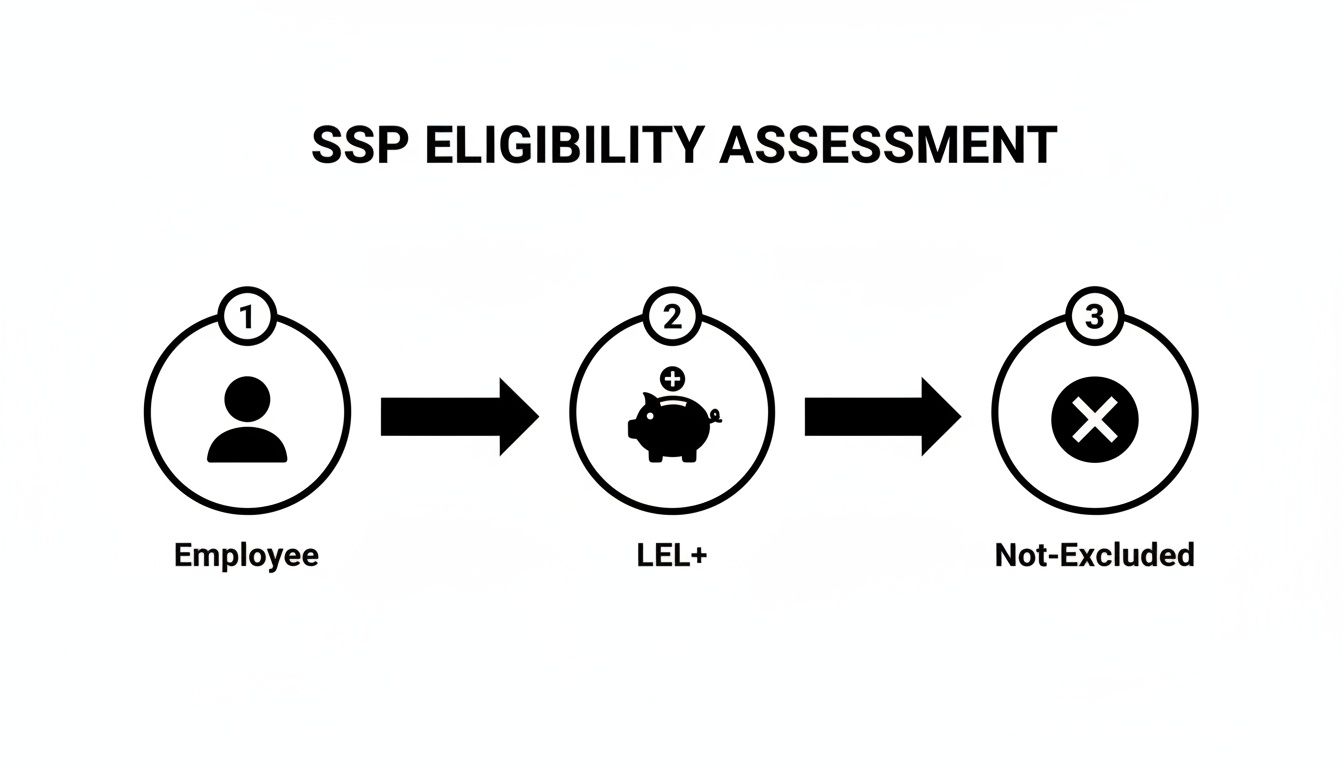
As you can see, it confirms the main checkpoints: the person must be an employee, earn above the Lower Earnings Limit, and not fall into any of the specific exclusion categories.
A Step by Step SSP Calculation Example
Let's see how this all comes together in a real-world scenario.
Imagine you run a small shop, and one of your team members, David, works Monday to Friday. He falls ill on a Monday morning and is off for a full week, returning to work the following Thursday. That’s ten consecutive days off.
Here’s exactly how you would calculate his SSP:
- Establish the PIW: David has been off for ten days in a row, which is well over the four-day minimum. A PIW has definitely been established.
- Pinpoint the Qualifying Days: David's qualifying days are his normal working pattern: Monday, Tuesday, Wednesday, Thursday, and Friday.
- Count the Waiting Days: The first three qualifying days of his absence are the unpaid waiting days. In this case, that’s Monday, Tuesday, and Wednesday of the first week.
- Calculate the Payable Days: SSP is due from the fourth qualifying day. So, we count Thursday and Friday of the first week, plus Monday, Tuesday, and Wednesday of the second week. That gives us a total of five payable days.
- Calculate the Final Payment: Now for the money. To get the final amount, you need the daily rate of SSP. You find this by dividing the weekly rate (let's use £118.75 for 2025/26) by the number of qualifying days in that week (five).
- Daily Rate: £118.75 / 5 = £23.75
- Total SSP Due: 5 payable days x £23.75 = £118.75
So, for his ten-day absence, David is entitled to exactly one full week's worth of SSP.
To make this even clearer, let's look at a table showing how a shorter, one-week absence would work for an employee with the same Monday-to-Friday schedule.
Sample SSP Calculation for a One-Week Absence
| Day of the Week | Work Status | SSP Status | Payment Due |
|---|---|---|---|
| Monday | Sick | Waiting Day 1 | £0.00 |
| Tuesday | Sick | Waiting Day 2 | £0.00 |
| Wednesday | Sick | Waiting Day 3 | £0.00 |
| Thursday | Sick | Qualifying Day 4 (Payable) | £23.75 |
| Friday | Sick | Qualifying Day 5 (Payable) | £23.75 |
| Saturday | Non-Working Day | – | £0.00 |
| Sunday | Non-Working Day | – | £0.00 |
This table shows that for a full week of sickness, the employee would receive SSP for just two days (£47.50) after the three waiting days have been served.
Processing SSP Through Your Payroll
One of the most common questions we hear from business owners is, "So how do I actually pay this?" Thankfully, the answer is straightforward: you process SSP through your normal payroll, just like you would with their regular wages.
This means SSP is not a tax-free perk. It’s treated as income and is subject to the usual deductions.
- PAYE Tax: SSP is considered earnings, so it’s liable for income tax.
- National Insurance: Both employee and employer National Insurance contributions are calculated on SSP payments.
You simply add the calculated SSP amount to the employee’s payslip for that pay period. Managing these deductions correctly is a core part of your employer duties. If you need a refresher on those responsibilities, our guide on what is PAYE for employers offers a detailed breakdown.
For a small business owner already juggling a dozen other tasks, getting these calculations and payroll runs perfect every time can be a real headache. A single slip-up could mean underpaying a staff member or reporting the wrong figures to HMRC. This is often where getting professional support becomes invaluable. It removes the guesswork, ensures every payslip is accurate and compliant, and frees you up to focus on what you do best—running your business.
Your Legal Duties for SSP Record-Keeping

Getting Statutory Sick Pay right isn't just about crunching the numbers correctly. You also have a legal responsibility to keep detailed records, and for HMRC, this is non-negotiable. If you don't have the right documentation, you could find yourself in hot water, facing anything from employee disputes to penalties during an inspection.
Think of your SSP records as the official story of an employee's sick leave. They need to be accurate, detailed, and ready to prove you’ve done everything by the book. It's a fundamental part of running a compliant UK payroll.
What You Must Record for Every SSP Case
Whenever an employee is off sick and qualifies for SSP, you're legally required to log some specific details. This isn't just good practice; it’s a rule. Your records create a clear audit trail for every penny of SSP you pay out.
For each period of sickness, your files must show:
- The exact dates the employee was off sick—this is their Period of Incapacity for Work (PIW).
- A clear record of the SSP payments you've made, including the total amount and which payslip it appeared on.
- A note of any days within that PIW that SSP wasn't paid, along with the reason why (like the first three 'waiting days').
It's also really important to show if different sickness periods are linked. This is crucial for making sure you don't apply the 'waiting days' rule incorrectly when an employee is off again for a related reason.
Key Compliance Requirement: You must keep all SSP records for at least three years after the end of the tax year they relate to. This is a firm HMRC rule and lines up with general payroll record-keeping duties.
Without these records, you're in a weak position if an employee questions their pay or if HMRC decides to take a closer look at your payroll.
Managing Sickness Notification and Evidence
Your duties don't stop at tracking payments. You also need to manage how your team reports their sickness and provides evidence. Having clear, consistent procedures in place is your best defence against any confusion or disputes down the line.
Your company handbook should clearly state how and when an employee needs to tell you they're unwell. If you don't have a specific company rule, the default statutory requirement is that they must let you know within seven days.
When it comes to proof of sickness, the rules are pretty straightforward:
- First 7 Days (Self-Certification): For the first week, an employee can simply "self-certify" their illness. You can ask them to fill out a form when they return, but you can’t demand a doctor’s note during this time.
- After 7 Days (Fit Note): If the absence lasts more than seven consecutive days, you are well within your rights to ask for medical evidence. This usually comes as a 'fit note' from a doctor or another qualified healthcare professional.
The fit note will advise if the employee is "not fit for work" or "may be fit for work" with certain adjustments. It's your job to understand and act on this advice. Keeping good records is a vital part of running any business, and you can learn more in our guide on what records to keep for your limited company accounts.
Let’s be honest, all this admin—tracking dates, filing fit notes, and double-checking payroll—can quickly become a headache for a busy business owner. This is exactly where getting professional support makes a huge difference. An accounting service can handle this entire process, making sure every detail is logged correctly so you stay fully compliant without the stress.
Contractual Sick Pay vs. Statutory Sick Pay: What’s the Difference?
Statutory Sick Pay is the legal safety net, but it's important to see it for what it is: the absolute minimum required by law. Many employers decide to go further by offering their own, more generous sick pay policy, which is usually called contractual or occupational sick pay.
Knowing how these two systems work together is crucial. Think of SSP as the floor – the non-negotiable baseline set by the government. Your contractual sick pay policy is everything you choose to build on top of that. You can always be more generous, but you can never legally pay an eligible employee less than the statutory rate.
What is a Company Sick Pay Scheme?
A contractual sick pay scheme is part of an employee's terms of employment. It lays out exactly how much they'll be paid when they're off sick, and for how long. These policies are often much more generous than SSP, with many offering full pay for a certain number of weeks.
The details are entirely up to you as the employer. For instance, a common and effective approach is a tiered system:
- Full pay for the first 4 weeks of sickness.
- Half pay for the next 4 weeks.
- After that, payment reverts to SSP only, up to the 28-week limit.
This kind of structure gives your team genuine financial security when they're unwell, which can be a huge advantage when it comes to attracting and keeping good people. It's vital to have these terms clearly defined, and our guide on what UK employment contracts need to know can help you get this right.
How Contractual Pay and SSP Work Together
One of the most common questions from employers is how to handle both types of pay on a payslip. It's simpler than it sounds: your contractual sick pay payment can include the SSP amount. You are not expected to pay your own sick pay on top of SSP.
Let's look at an example: Say an employee normally earns £500 a week. Your company policy offers full pay for the first two weeks of sickness. The weekly SSP rate is £118.75. For those first two weeks, you would simply pay the employee their full £500. This payment is made up of the £118.75 of SSP they're entitled to, plus a company 'top-up' of £381.25.
This "topping up" is the standard way to run payroll when both systems are in play. The employee gets their normal wage, and in doing so, you meet both your contractual promise and your legal duty to pay SSP.
Why a Better Sick Pay Policy Makes Good Business Sense
Offering more than the legal minimum does come at a cost, but a well-designed contractual sick pay policy often delivers business benefits that far outweigh the expense.
Since it was introduced back in 1982, UK Statutory Sick Pay has been notoriously slow to change. As a result, the flat-rate payment has fallen far behind average earnings. This has pushed over 50% of employers to create their own schemes to better support their staff. If you want to dig deeper, this analysis of paid sick leave in the UK is a great read.
A strong policy isn't just about being a good employer; it's a smart business move that can:
- Boost Morale and Loyalty: Staff who feel supported and valued are naturally more engaged and committed.
- Cut Down on 'Presenteeism': When people don't have to choose between their health and their rent, they're less likely to drag themselves into work while ill. This stops illnesses from spreading and prevents the productivity drain that comes with a sick workforce.
- Attract Top Talent: In a competitive job market, a solid benefits package that includes decent sick pay can be the very thing that makes a high-calibre candidate choose you over a competitor.
The challenge, however, is that managing a dual system of contractual and statutory pay makes payroll more complex. Calculating the top-up, tracking how much entitlement is left, and getting the tax and NI deductions right can be a real headache. This is where getting expert payroll support is invaluable, helping you avoid costly mistakes and stay compliant while taking proper care of your team.
Let the Experts Handle Your SSP Obligations
Let's be honest, getting Statutory Sick Pay right can feel like a full-time job in itself. You're trying to figure out qualifying days, calculate the right weekly payments, and then keep flawless records just in case HMRC comes knocking. It's a heavy administrative weight for any business owner to carry.
Just one small mistake—a miscalculation or a missed detail—can result in an employee being underpaid, leading to compliance issues and a whole lot of unnecessary stress. It's this exact kind of payroll headache that leads so many UK businesses to hand the whole process over to a specialist.
At Stewart Accounting Services, we lift this entire burden from you. Our payroll service is built to manage every single piece of SSP, guaranteeing accuracy and compliance every step of the way. We get lost in the details so you can get back to what you're passionate about: running your business.
How We Give You Payroll Peace of Mind
Working with us isn't just about outsourcing a task; it's about gaining a dedicated team of experts who genuinely care about your business's financial health. We manage your payroll using modern, cloud-based software, which means you get total clarity and control without any of the daily grind.
Forget spending your time worrying about:
- Tricky Calculations: We'll track those linked periods of sickness and make sure waiting days are applied correctly.
- Meticulous Record-Keeping: Every SSP payment and sickness absence is logged with precision, ready for any potential HMRC review.
- Keeping Up with Changes: We're always on top of the annual rate changes and new legislation, so you don't have to be.
We’re firm believers that your time is far too valuable to be spent wrestling with payroll spreadsheets. Our aim is to give you the freedom that comes from knowing these crucial financial duties are in safe, expert hands.
A Partner You Can Rely On
For years, Stewart Accounting Services has been the trusted partner for businesses across Central Scotland and the rest of the UK, from sole traders just starting out to established limited companies. We know the challenges you face because helping businesses like yours succeed is what we do every day.
Let us give you the confidence that your SSP and other payroll responsibilities are being handled perfectly. You'll free up your time, avoid costly errors, and clear the path to focus on what truly matters.
Common Questions About Statutory Sick Pay
Even when you think you’ve got a handle on SSP, real-life situations can throw a spanner in the works. Let’s tackle some of the most common questions we hear from business owners about how SSP works in practice.
What Happens When An Employee's SSP Runs Out?
Statutory Sick Pay is a crucial safety net, but it isn't indefinite. An employee can receive SSP for a maximum of 28 weeks within a single period of sickness (or linked periods).
Once that 28-week limit is reached, your obligation to pay SSP ends, even if the employee is still too ill to come back to work. At this stage, you must give them form SSP1. This official form explains why their SSP has stopped and is the key they need to apply for other benefits, such as Employment and Support Allowance (ESA). It’s vital to get this to them on or before their final SSP payment day to avoid leaving them in a lurch.
Can My Business Reclaim SSP Costs From HMRC?
This is a classic question, and the answer is a straightforward "no". The rules have changed.
There was a time when businesses could reclaim some SSP costs, and more recently, the temporary COVID-19 SSP Rebate Scheme offered some relief. However, that scheme is now closed. Today, the employer is responsible for funding 100% of SSP payments. This makes budgeting for staff sickness and managing your cash flow more critical than ever.
Do I Pay SSP to Zero-Hours Contract Workers?
Absolutely. Workers on zero-hours contracts are entitled to SSP, as long as they meet the same eligibility criteria as any other employee. That means being off sick for at least four days in a row and letting you know in the right way.
The key hurdle for them is meeting the average earnings requirement, known as the Lower Earnings Limit (which is £123 per week for 2024/25). You'll need to calculate their average weekly earnings over the eight weeks right before their sickness started.
Key Consideration: This calculation can get tricky for workers with fluctuating hours. You have to include every penny they earned that was subject to National Insurance contributions. It’s a minefield for potential errors, which is precisely why many businesses with a flexible workforce get professional payroll help to stay compliant.
Navigating these details is what we do best at Stewart Accounting Services. Let our expert payroll team take care of every calculation and compliance headache, so you can focus on what you do best: running your business. Discover how we can help at stewartaccounting.co.uk.
Recent Posts
12 Oct, 2026
12 Oct, 2026