

Are you still tracking your tax obligations based on last year’s rules, or have you prepared for the biggest shift in HMRC reporting in a generation? It’s completely normal to feel a sense of dread when the goalposts move, especially with the introduction of the new Making Tax Digital (MTD) requirements. Understanding the threshold for self assessment UK 2026 is no longer about a single number; it’s now a dual-track system that depends on how you earn your living and your total gross income.
We understand that the transition to MTD and the £50,000 income trigger can feel overwhelming, particularly when you’re trying to distinguish between trading income and actual profit. This article provides the clarity you need to move forward with confidence. You’ll discover exactly when you’re legally required to file a return, how the new digital rules apply to your specific situation, and what deadlines you must meet to avoid unnecessary penalties. We’ll break down the traditional triggers alongside the new digital mandates to give you a definitive yes or no answer regarding your filing status. Our goal is to restore your peace of mind and simplify your compliance journey.
Key Takeaways
- Understand the fundamental £1,000 gross income trigger for both trading and property income to determine your initial filing obligation.
- Identify if you meet the specific £50,000 threshold for self assessment UK 2026 that mandates a shift to the Making Tax Digital (MTD) quarterly reporting system.
- Learn the critical differences between the traditional annual tax return and the new requirement for digital record-keeping and quarterly updates.
- Discover a clear method to aggregate your various untaxed income sources and correctly assess your status against HMRC allowances.
- Explore how delegating your tax compliance to local experts can save you time and protect your mental well-being.
What is the Threshold for Self Assessment in the UK for 2026?
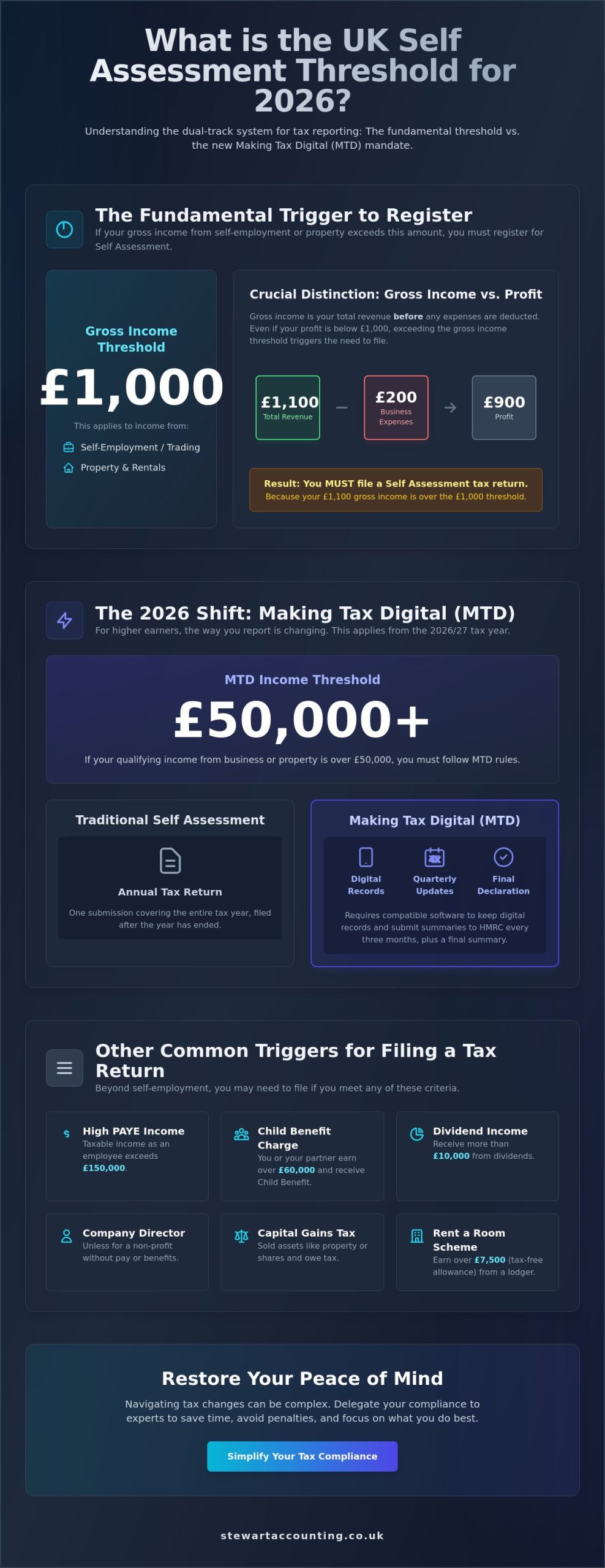
HMRC’s rules for who needs to register can feel like a moving target. However, the core threshold for self assessment UK 2026 starts at a surprisingly low level. If you’ve earned more than £1,000 in gross income from self-employment or property rentals between April 2025 and April 2026, you generally must register and file a return. This entry point remains the same even as other digital reporting mandates begin to shift for higher earners.
The £1,000 figure is known as the Trading Allowance or Property Allowance. These allowances act as a safety net for micro-businesses and casual landlords, meaning you don’t have to pay tax or even tell HMRC about your income if it stays below this amount. Once you cross that line, even by a single pound, the legal requirement to report kicks in. You might still choose to file voluntarily if your income is lower, perhaps to pay Class 2 National Insurance contributions and protect your future entitlement to the State Pension.
It’s vital to separate the tax years in your mind to avoid confusion. In late 2026, you’ll be focusing on filing for the 2025/26 tax year. Meanwhile, you’ll already be several months into the 2026/27 tax year. This distinction is crucial because the 2026/27 period is when the new Making Tax Digital (MTD) rules begin to impact those with income over £50,000. While MTD changes how you report, the £1,000 threshold still dictates if you need to enter the Self Assessment system at all. Planning ahead ensures you aren’t caught off guard by these overlapping requirements.
The £1,000 Gross Income Rule
Confusion often arises regarding the word “gross”. This refers to your total sales or rental receipts before you deduct any expenses like stock, travel, or repairs. For example, if your side hustle brought in £1,100 but you spent £200 on supplies, your profit is only £900. Despite being under the £1,000 profit mark, you’ve exceeded the gross income threshold and must submit a return. This rule applies identically to landlords receiving rental income from UK or overseas property. We find that many clients feel a weight lifted once this distinction is clear, as it removes the guesswork from their compliance.
Thresholds for High Earners and PAYE
Not everyone in the Self Assessment system is self-employed. If you’re an employee paid through PAYE, you must file a return if your taxable income exceeds £150,000. Additionally, the High Income Child Benefit Charge remains a significant trigger for many families. If you or your partner earn over £60,000 and receive Child Benefit, you’re required to report this to repay a portion of the benefit through your tax return. You’ll also need to file if you receive more than £10,000 in dividend income from shares or investments within the tax year. Keeping track of these various triggers is the first step toward total financial peace of mind.
Common Triggers: Who Must File a Tax Return in 2026?
Identifying your specific trigger is the first step toward tax compliance and mental clarity. While many focus solely on the income level, HMRC looks at various categories of income and responsibility. If you’re unsure about your status, consulting official government guidance is a helpful way to see which category you fall into. It isn’t just about how much you earn; it’s about the nature of that income and your role within a business or estate.
The most common groups required to file include:
- Self-employed sole traders with a gross income exceeding £1,000.
- Landlords receiving rental income from UK or overseas property.
- Company directors, unless the position is for a non-profit and you receive no pay or benefits.
- Trustees or representatives handling the affairs of a deceased person.
- Individuals who have sold assets and owe Capital Gains Tax.
We often find that clients feel a sense of relief once they understand these categories. Knowing exactly where you stand allows you to delegate the paperwork and focus on your professional growth. If you fall into any of these groups, our experts can manage your Self Assessment Tax Returns to ensure every detail is handled correctly.
Landlords and Property Income
Rental income is a major trigger for many taxpayers. If you let out a spare room in your own home, the Rent a Room scheme allows you to earn up to £7,500 tax-free. However, standard buy-to-let income or overseas property earnings usually require a return once they exceed the £1,000 allowance. For those managing holiday lets in Scotland or the wider UK, the rules regarding business rates and occupancy can further complicate your tax position. If your property portfolio is held within a limited company, you might find our Year End Accounts: A Simple Guide for UK Small Businesses helpful for understanding your corporate responsibilities.
Capital Gains and One-Off Income
Selling assets can trigger a filing requirement even if your regular monthly income is low. This includes selling shares outside of an ISA or disposing of crypto-assets. In 2026, you must report gains if they exceed the annual exempt amount. For residential property sales, remember that you usually only have 60 days from the completion date to report and pay any tax due. This is a separate requirement from your annual return, though it’s often reconciled within it later. Keeping these deadlines in mind is essential for maintaining a smooth relationship with HMRC. Understanding the threshold for self assessment UK 2026 ensures you aren’t caught out by these one-off events.
The 2026 Shift: Making Tax Digital (MTD) vs. Traditional Self Assessment
April 2026 marks a significant turning point in how many taxpayers interact with HMRC. While the basic £1,000 threshold for self assessment UK 2026 still determines if you need to enter the tax system, a new secondary threshold of £50,000 now dictates how you report that income. This shift moves away from the traditional once-a-year filing toward a more frequent, digital-first approach. For many, this change feels like a burden, but it’s designed to provide a real-time view of tax liabilities, potentially ending the “January surprise” of an unexpected tax bill.
The core difference lies in the frequency of updates. Under the traditional system, you submit one annual return by 31 January. Making Tax Digital (MTD) for Income Tax Self Assessment (ITSA) requires four quarterly updates throughout the year. These aren’t full tax returns; they are digital summaries of your income and expenses. At the end of the tax year, you’ll submit an “End of Period Statement” (EOPS) to finalize your figures. This replaces the finality of the old annual return for those above the digital threshold.
Digital record-keeping is now a legal requirement for those mandated into MTD. You can no longer rely on paper ledgers or simple spreadsheets that aren’t linked to HMRC’s systems. Every transaction must be recorded digitally using compatible software to ensure a seamless flow of information. If you’re unsure where you sit within these new categories, reviewing the UK government Self Assessment criteria can help you identify your primary filing obligations before you tackle the digital transition.
The £50,000 MTD Threshold Explained
The £50,000 threshold is based on your “qualifying income,” which is the combined gross income from all your self-employments and property rentals. From April 2026, sole traders and landlords with a combined gross income over £50,000 must comply with MTD rules. It’s important to monitor your earnings closely if you’re “creeping” toward this limit. If your combined income is £48,000 this year but rises to £51,000 next year, you’ll be moved into the digital reporting track. For those earning between £30,000 and £50,000, you will remain on the traditional annual Self Assessment system until April 2027.
Software Requirements for 2026
To meet the 2026 mandate, you must use HMRC-compatible software. This could be a full accounting platform like Xero or “bridging software” that connects your digital records to HMRC’s portal. For those earning under £50,000, traditional filing remains an option for now, but adopting digital tools early can simplify your bookkeeping. We provide expert Xero training and support to help you navigate this transition smoothly. By delegating the technical setup to us, you can focus on running your business while we ensure your digital records are compliant and your mental well-being is protected.
Calculating Your Income: Do You Meet the Filing Criteria?
Determining your status requires a methodical look at your finances. You shouldn’t look at each income stream in isolation. Instead, follow this four-step framework to see how you align with the threshold for self assessment UK 2026. This process helps you move from confusion to a definitive answer about your legal requirements.
- Step 1: Aggregate your income. Combine every source of untaxed revenue. This includes profits from side hustles, gross rental income, and dividends from shares.
- Step 2: Compare against the £1,000 allowance. If your total gross income from trade or property exceeds £1,000, you’ve met the primary filing trigger.
- Step 3: Evaluate the MTD limit. If your combined gross income from self-employment and property is over £50,000, you must prepare for the digital transition starting in April 2026.
- Step 4: Mark your calendar. Identify which deadline applies to you. If you still prefer paper, you must file by 31 October 2026. For online submissions, the date is 31 January 2027.
If this process feels daunting, you aren’t alone. Many business owners in Alloa and Stirling find that delegating this calculation to a professional restores their mental well-being and ensures total accuracy. We can help you calculate your tax obligations and remove the burden of HMRC compliance from your shoulders.
Record Keeping for 2026 and Beyond
HMRC requires you to keep records for at least five years after the 31 January submission deadline. While you might have a drawer full of paper receipts, the shift toward a paperless system is now a practical necessity. Digital records are harder to lose and much easier to organize. A common mistake is forgetting to include small one-off payments, such as casual freelance work or minor asset sales. These omissions can lead to HMRC enquiries if the information doesn’t match the data HMRC receives from third parties.
Deadlines and Penalties to Avoid
Missing the 31 January online deadline results in an immediate £100 penalty. This applies even if you have no tax to pay. If you’re a first-time filer, you must register for your Unique Taxpayer Reference (UTR) by 5 October 2026. Interest rates on late payments have risen recently, making it more expensive than ever to delay your settlement. By staying ahead of these dates, you protect your finances and your professional liberty.
How Stewart Accounting Services Simplifies Your Tax Compliance
Does the thought of navigating the complex threshold for self assessment UK 2026 or the new digital reporting mandates leave you feeling anxious? You aren’t alone. Tax legislation is shifting rapidly, and for many small business owners in Alloa, Stirling, and Falkirk, the pressure to remain compliant while running a business is a heavy burden. We specialize in taking that weight off your shoulders, providing professional chartered expertise that transforms a stressful annual chore into a smooth, managed process.
We understand the specific nuances of the Scottish tax system, which often differ from the rest of the UK. While the threshold for self assessment UK 2026 is a nationwide rule, the tax bands applied to your income in Scotland require a localized understanding to ensure your calculations are correct. Our team provides this regional expertise, ensuring your returns reflect the most current Scottish rates and allowances. This attention to detail prevents overpayment and keeps your relationship with HMRC transparent and professional.
The Stewart Accounting Approach: Reclaiming Your Freedom
We don’t just file forms; we remove the burden of HMRC correspondence from your desk entirely. From the moment you partner with us, we act as your authorized agent, handling the technical queries and administrative hurdles that often cause business owners the most stress. Our service includes customized tax planning designed to ensure you never pay more than is legally required. We offer pragmatic, results-driven business advisory that looks beyond the current tax year, helping you prepare for the future of your business with clarity and ease.
Ready to Delegate Your Tax Return?
If you’re ready to experience the peace of mind that comes from professional chartered oversight, we invite you to book a consultation at our Alloa, Stirling, or Falkirk offices. Moving your tax compliance to a dedicated partner is the first step toward restoring your personal and professional liberty. Don’t wait until the January deadline looms to address your filing status. You can contact us today to discuss your 2026 tax obligations and discover how we can simplify your journey through the Self Assessment system.
Take Control of Your 2026 Tax Future
The landscape of UK taxation is evolving, but your path to compliance doesn’t have to be a source of stress. We’ve established that while the basic £1,000 trading allowance remains the entry point, the new £50,000 mandate for Making Tax Digital represents a significant shift for many business owners. Understanding the threshold for self assessment UK 2026 is the first step toward reclaiming your professional liberty and ensuring you stay on the right side of HMRC.
By identifying your specific triggers early and adopting the right digital tools, you can avoid the anxiety of last-minute filings and unexpected penalties. Our team of Chartered Accountants in Alloa, Stirling, and Falkirk brings decades of experience to your side. We specialize in SME tax planning and seamless MTD transitions, ensuring that your mental well-being is protected while your finances are optimized. Let us take the stress out of your 2026 Self Assessment, contact Stewart Accounting Services today. You’ve built a successful business; don’t let complex tax rules slow your momentum. We’re here to help you move forward with total confidence.
Frequently Asked Questions
Do I need to file a tax return if I earn less than £1,000?
No, you generally don’t need to register or file a return if your gross income from self-employment or property is £1,000 or less. This is due to the Trading and Property Allowances designed for micro-businesses. You might still choose to file voluntarily to pay National Insurance contributions and protect your state pension entitlement.
What is the threshold for Self Assessment if I am a landlord in 2026?
The threshold for self assessment UK 2026 for landlords is £1,000 in gross rental income before expenses. This applies to both UK and overseas property earnings. If you’re letting a room in your main home, the Rent a Room scheme provides a much higher tax-free threshold of £7,500.
I am a high earner on PAYE; do I still need to file a return in 2026?
Yes, you’re required to submit a return if your taxable income through PAYE reaches £150,000 or more. Additionally, if you or your partner earn over £60,000 and receive Child Benefit, you must file to pay the High Income Child Benefit Charge. These triggers ensure all your various income streams are reconciled correctly.
How does the £50,000 Making Tax Digital threshold work for 2026?
The £50,000 limit is based on your combined gross income from all self-employment and property sources. If your total qualifying income exceeds this amount, you must move to quarterly digital reporting from April 2026. This is a mandatory shift away from the traditional annual filing system for higher earners.
What happens if I miss the Self Assessment registration deadline in October 2026?
Missing the 5 October registration deadline can result in HMRC penalties, especially if there’s tax to pay that isn’t settled on time. You need to register by this date to ensure you receive your Unique Taxpayer Reference (UTR) before the filing deadlines. Registering early is the best way to maintain your peace of mind.
Can I file my own Self Assessment or should I hire an accountant?
You can certainly file your own return, but many clients choose to hire an accountant to ensure total accuracy and minimize their tax liability. Delegating this responsibility to a professional removes the burden of HMRC correspondence and complex calculations. Our local experts in Alloa, Stirling, and Falkirk provide the chartered oversight needed to keep you compliant.
Does the threshold for Self Assessment change if I live in Scotland?
The registration threshold remains consistent across the UK, but the tax rates and bands applied to your income are different in Scotland. Scottish taxpayers are subject to local tax bands which can affect the final amount you owe. We specialize in navigating these regional differences to ensure your return is perfectly accurate.
What is the Dividend Allowance for the 2025/26 tax year?
The dividend allowance for the 2025/26 tax year is £500. You’re required to file a return if you receive more than £10,000 in dividend income within the year. It’s important to track this alongside your other untaxed income to ensure you don’t inadvertently miss a filing trigger.