
It’s a feeling that sinks in your stomach: you’ve filed your tax return, only to realise you’ve made a mistake. Don’t panic. It happens to the best of us, and thankfully, it’s usually quite simple to put right.
Amending a tax return simply means correcting an error or omission after you’ve already sent it to HMRC. It’s your way of updating the record to make sure you’re paying the right amount of tax—no more, no less. Getting it right keeps you compliant and can sometimes even lead to a welcome tax refund.
Why You Might Need to Amend a Tax Return
Finding an error on a filed tax return is far more common than you might think. Whether you're a sole trader who’s just found a stack of un-claimed receipts, a landlord who forgot about a repair bill, or a limited company director who mis-keyed a figure, things get missed. The first step is figuring out exactly what needs to be changed.
Forgetting to claim a legitimate business expense is probably the most frequent reason. I often see freelancers who, months later, stumble upon a year's worth of software subscription emails they never expensed. For a landlord, it could be realising they never claimed for that emergency boiler repair, a significant allowable cost.
On the flip side, you might find you’ve underreported your income. Perhaps a client paid an invoice later than you expected, or you completely forgot about a small side-hustle. It’s always far better to tell HMRC about this yourself rather than waiting for them to spot it.
Making a voluntary correction shows HMRC you’re taking your tax responsibilities seriously. It’s all about being accurate and transparent, which almost always prevents bigger headaches later on.
Common Scenarios for an Amendment
While every situation is different, most errors fall into a few common categories. Knowing what to look for can help you spot any potential issues with your own filings.
Here are a few of the most typical reasons people end up filing an amendment:
- Claiming Missed Expenses: You unearth receipts for business travel, office supplies, or professional development courses that you didn't include first time around.
- Incorrect Income Figures: It’s easy to mistype a number. Maybe you entered the wrong figure for your total sales or rental income.
- Forgetting to Claim Allowances: You bought new equipment for your business but forgot to claim capital allowances, or you missed out on another tax relief you were entitled to.
- Changes in Personal Circumstances: Life events like getting married or altering your pension contributions can impact your tax bill, and sometimes these details are overlooked.
Each of these situations needs an amendment to get your tax records straight. The good news is that HMRC has a clear process for submitting these changes, which we'll walk through in this guide. The key is to act as soon as you spot the error—it gives you peace of mind and keeps you in HMRC’s good books.
Understanding Your Deadlines for Tax Amendments
When it comes to correcting a tax return, timing is absolutely everything. HMRC sets firm deadlines for making changes, and getting your head around these is the first, most important step before you even think about amending. If you miss the window, what could have been a simple fix can quickly become a much bigger headache.
For most people filing a Self Assessment return, you have a 12-month window to make a change online. This period starts from the statutory filing deadline for that particular tax year. So, for the 2022-23 tax year, the filing deadline was 31 January 2024. That gives you until 31 January 2025 to submit an amendment. This same 12-month rule of thumb generally applies to limited companies needing to amend their Corporation Tax return (the CT600).
It's easy to feel a bit lost when you first realise a mistake has been made. This flowchart can help you pinpoint what's gone wrong and what your next steps should be.
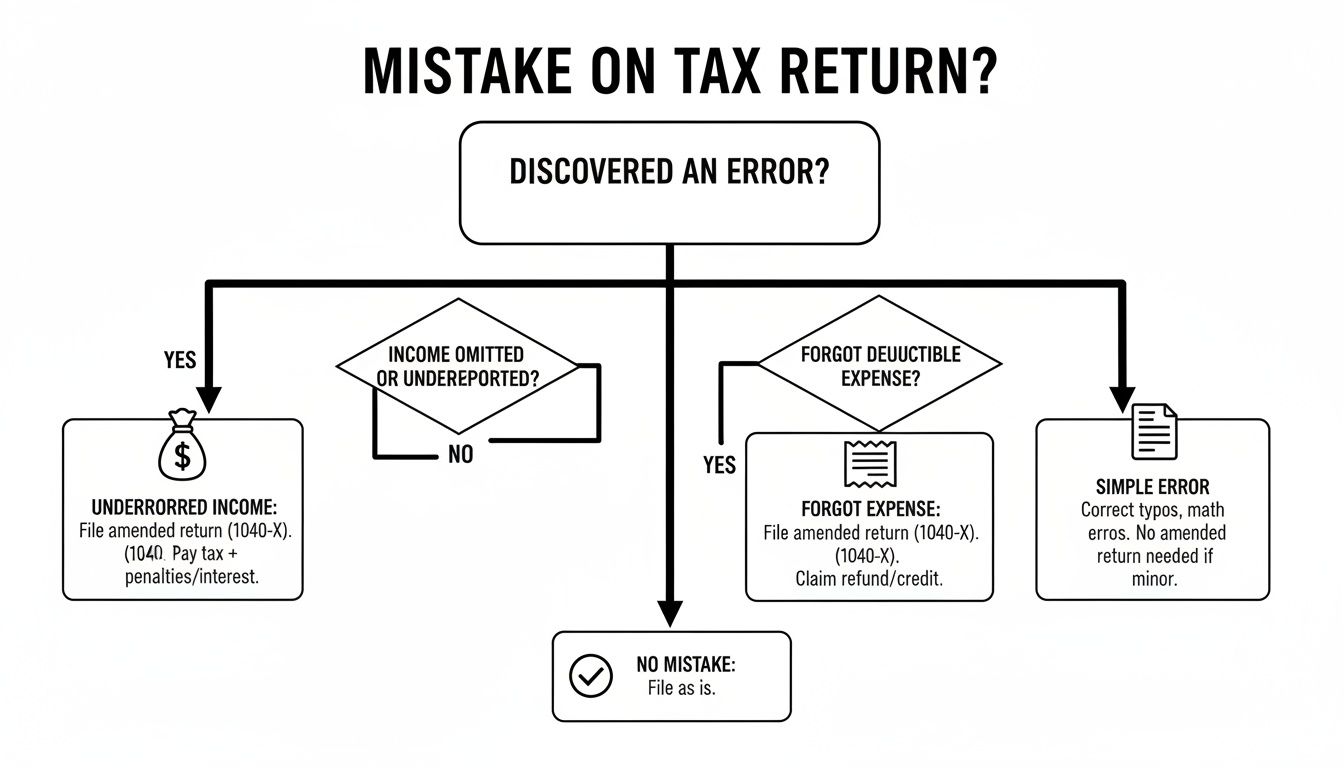
Whether you’ve just found a payslip you forgot about, realised you missed some allowable expenses, or simply made a typo, the path to putting it right always begins with identifying the mistake clearly.
Deadlines for Different Tax Types
It’s worth noting that the rules aren't one-size-fits-all across every type of tax. VAT, for example, plays by a different set of rules. If you spot a small error on a past return—usually below the reporting threshold of £10,000, or 1% of your turnover up to £50,000—you can often just adjust for it on your next VAT return. Bigger mistakes, however, require you to formally disclose the error to HMRC, typically by filling out form VAT652.
The self-assessment system, which came into play back in 1996, put the responsibility for accuracy squarely on our shoulders as taxpayers. With around 12 million people now filing a self-assessment return each year, it’s hardly surprising that things go wrong. In fact, over 1.5 million amendments are submitted annually as people spot errors or receive late information after filing.
To help you keep these timelines straight, here's a quick summary of the main HMRC deadlines for amendments.
HMRC Tax Return Amendment Deadlines
| Tax Return Type | Amendment Deadline | Notes |
|---|---|---|
| Self Assessment | 12 months from the statutory filing deadline. | Amendments are almost always done online through your Government Gateway account. |
| Corporation Tax | 12 months from the company's filing deadline. | You’ll usually need to resubmit the corrected CT600 form via your accounting software. |
| VAT | Depends on the size of the error. | Small mistakes can often be corrected on the next return; larger ones need a separate disclosure. |
As you can see, that 12-month window is the golden rule for Self Assessment and Corporation Tax. For VAT, it's the size of the error that really dictates your next move.
Keeping these dates in your diary is essential for staying on the right side of HMRC. For a fuller picture, it’s a good idea to familiarise yourself with all the important UK tax deadlines you can't afford to miss. Understanding the entire tax calendar not only helps prevent mistakes from happening in the first place but also ensures you can act swiftly and correctly if an amendment is needed. If you’re ever in doubt, the best advice is always to act quickly and get some professional guidance.
How to Correct Your Self Assessment Tax Return
If you’re a sole trader, in a partnership, or a landlord, finding a mistake on a tax return you’ve already filed is more common than you might think. Maybe you’ve unearthed a folder of receipts you forgot about, or perhaps you realised you didn’t claim a particular expense. Whatever the reason, correcting your Self Assessment is usually quite straightforward.
How you go about it simply depends on how you filed your return in the first place.
Most people file online these days, and if that’s you, the whole process is a breeze. All you’ll need is your Government Gateway user ID and password to log in.
Amending Your Return Online
Hands down, the quickest and easiest way to make a change is through the HMRC online portal. Once you’re logged in, you can pull up all your previous submissions.
From your account homepage, here’s what you’ll generally do:
- Head over to the Self Assessment section.
- Pick the tax year you need to correct.
- You’ll often see an option like "More Self Assessment details."
- From there, a link to "Amend your return" should be clearly visible.
Clicking this link essentially re-opens the tax return you originally sent. You can then click through to the sections that need updating, pop in the new figures, and resubmit the whole thing. The best part is that HMRC’s system automatically crunches the numbers and recalculates what you owe (or what you’re owed back).
Key Takeaway: The online portal saves all your original information, so there’s no need to fill everything out again. You just find the box with the wrong number, change it, and let the system handle the rest.
Let's say a freelance graphic designer files her return in May. A couple of months later, she finds receipts for her annual software subscriptions, which came to £600. She can simply log back in, navigate to the expenses section for her self-employment, and add the £600 to her "Office, property and equipment" costs. After resubmitting, the system will instantly produce a new SA302 calculation, showing a lower tax bill or even a refund.
What If You Filed a Paper Return?
For those who filed their original return by post, any amendments must also be done on paper. You can’t just hop online to fix a paper submission; you have to stick with the original method.
The process here is a bit more manual. You'll need to send HMRC the corrected pages from the main tax return form (the SA100) along with any supplementary pages you originally used, like the SA103 for the self-employed or the SA105 for UK property income.
To get this right, you need to:
- Go to the GOV.UK website and download fresh copies of the specific pages you’re changing.
- Fill them out with the correct figures.
- This is crucial: write ‘AMENDMENT’ in big, clear letters across the top of every single page you’re sending back.
- Make sure to include your name and Unique Taxpayer Reference (UTR) on each page, too.
Imagine a landlord who initially forgot to claim for a £1,200 emergency boiler repair. They would need to download a new SA105 property page, enter the boiler cost into the "Property repairs and maintenance" box, and then post this single, clearly marked page to HMRC.
Before you start, it’s always a good idea to gather all the right information. Our guide on how to complete a Self Assessment is a great refresher on what goes where. This helps ensure that your amended figures are not just submitted correctly but are also accurate and properly documented.
Amending a Corporation Tax Return for Your Limited Company
If you’re a director of a limited company, fixing an error on your tax return is a different beast compared to sorting out a Self Assessment. The whole process revolves around your Company Tax Return (CT600), and any changes can have a knock-on effect on the accounts you’ve also filed with Companies House.
Getting this right is about more than just staying compliant. It’s a strategic move that can seriously impact your company’s bottom line.
The crucial detail to remember is the 12-month amendment window, which kicks in from your company's filing deadline. As long as you're within this period, you can simply resubmit a corrected CT600. The easiest way to do this is through the same accounting software you used to file it in the first place. It’s by far the most straightforward route.
Here’s a common scenario: imagine your software development company files its return in June. A few months down the line, your accountant spots some qualifying Research & Development (R&D) expenditure that was completely missed. That’s a huge discovery. By amending the CT600, you can claim those valuable R&D tax credits, which could lead to a hefty tax refund or slash your tax bill, giving your cash flow a welcome boost.
How to Actually Amend the CT600
Unlike Self Assessment, you can't just log into your Government Gateway and tweak a few numbers. You have to submit an entirely new, corrected Company Tax Return. Your accounting software should have a clear option for this, letting you reopen the filed return, make your adjustments, and then fire it back over to HMRC electronically.
It’s also incredibly important to think about your statutory accounts. If the change you're making to the tax return also alters the figures in the accounts filed at Companies House, you’ll probably need to submit amended accounts there as well. This keeps everything consistent and above board.
Another classic example is getting capital assets wrong. Maybe you bought some specialist machinery but didn't claim the full capital allowances you were entitled to, like the Annual Investment Allowance (AIA). Correcting this through an amendment on a tax return can unlock a surprising amount of tax relief.
An accurate CT600 is the bedrock of your company's financial health. A timely amendment can transform a simple oversight into a real opportunity, helping you reclaim overpaid tax and improve your profitability.
For limited company owners, that 12-month window for CT600s is golden. In fact, data shows that 28% of all corporate amendments are to claim enhanced capital allowances, and these often lead to refunds averaging around £15,000. It just goes to show how a careful review and correction can pay off.
Getting It Done: Practical Steps and Things to Watch Out For
When you're gearing up to make an amendment, being organised is half the battle. Get all your paperwork together that proves the change—updated invoices, fresh calculations, or proof of expenses you've just uncovered. This makes sure your new submission is spot-on and gives you a clear audit trail if HMRC comes knocking.
Once you’ve made the changes in your software:
- Make sure the submission is clearly marked as an "amendment". Most software handles this automatically.
- It's good practice to include a brief note explaining the changes in the computations you send with the CT600.
- Always, always double-check that the updated figures have pulled through correctly to the final tax calculation.
Before you jump in, it might be worth refreshing your memory on the basics of corporate tax filings. Our detailed guide on how to file company tax returns offers a solid foundation, ensuring you're comfortable with the whole process before you start making changes. A little prep work now can save you a lot of headaches later.
Making Corrections to VAT, PAYE, and CIS Returns
It’s not just the big annual filings where mistakes happen. They can easily creep into the regular VAT, PAYE, and Construction Industry Scheme (CIS) returns you manage all year round. Catching and fixing these quickly is crucial for staying on the right side of HMRC and preventing small problems from turning into bigger headaches down the line.
The exact process for making an amendment on a tax return of this type really depends on which tax we're talking about, and often, the size of the mistake.
Unlike a Self Assessment, where you might reopen a previous submission, these kinds of corrections are usually about adjusting your next return. Getting this right means your regular payments to HMRC are accurate and you’re fully compliant.
Correcting a VAT Return
With VAT, how you handle a mistake comes down to its value. HMRC has a clear threshold that separates minor tweaks from significant errors that need a formal disclosure.
You can typically correct mistakes on your next VAT return if the net value of the errors is relatively small. The limits are:
- £10,000 or less.
- Up to 1% of your box 6 figure (the total value of your sales) for that return period, as long as the total error is under £50,000.
If your error is bigger than these limits, you can't just quietly adjust your next return. You have to formally report it to HMRC by filling out form VAT652. A classic example is a business that mistakenly charged the standard VAT rate on zero-rated goods, leading to a major overpayment of VAT.
Fixing Payroll (PAYE) and CIS Errors
Mistakes in your payroll submissions for PAYE and CIS are handled a bit differently. Here, the focus is on sending updated information to HMRC to ensure every employee's record is spot on.
For PAYE, if you spot an error in the current tax year, the fix is usually straightforward: you just send a Full Payment Submission (FPS) correction. This new, updated FPS overrides the incorrect details you sent for that specific pay period. This is perfect for simple data entry slips, like typing in the wrong salary amount for someone.
Found a mistake from a previous tax year? In the past, you'd send an Earlier Year Update (EYU). Now, for any tax year from 2020-21 onwards, HMRC prefers you to send a Corrective FPS. This streamlines the process and keeps things consistent.
Correcting PAYE is about more than just numbers; it’s about your employees' personal tax records. Fixing things promptly ensures they pay the right tax and National Insurance, which affects their future state pension entitlement and any benefits they might claim.
For businesses in the construction industry, amending a CIS return works in a similar way. You'll need to use your payroll software to send an amended CIS return for the specific month that was wrong. This often happens if you've verified a subcontractor on the wrong tax rate and need to adjust the deductions you reported. Acting fast keeps your records clean and makes sure your subcontractors are treated fairly by HMRC.
Knowing When You Need Professional Tax Advice
While many corrections are straightforward enough to handle yourself, some situations are clear signals that it’s time to call in an expert. Knowing when to make that call can save you a huge amount of stress, time, and potentially, a lot of money. An amendment isn't always about fixing a typo; sometimes it uncovers deeper issues.
Think of it as the difference between changing a lightbulb and rewiring the house. If you've just found a missed expense receipt, that's a lightbulb moment you can probably manage. But if you uncover a significant, systemic error, it’s best not to start pulling at wires without an electrician—or in this case, a chartered accountant.
Engaging an accountant isn't an admission of failure; it's a smart business decision. Their expertise transforms a potentially risky task into a controlled, strategic action that protects your financial standing.
Red Flags That Signal You Need an Accountant
Certain scenarios should immediately have you reaching for the phone. These situations often involve complexities that go far beyond a simple online form submission and can have serious financial consequences if you get them wrong.
Here are the key indicators that you're out of your depth:
- The Error is Outside the Standard Amendment Window: If you're past the 12-month deadline, you can't just hop online and amend. You may need to make an 'overpayment relief claim', which is a more formal process with its own strict four-year deadline and specific rules.
- You've Found Multiple Errors Across Several Tax Years: Uncovering one mistake is common. Finding a recurring error that spans two, three, or more years points to a fundamental misunderstanding of tax rules. This requires a comprehensive review to fix properly, not just a quick patch-up job.
- The Correction is Very Large or Complex: Amending your return to claim an extra £500 in expenses is one thing. Realising you’ve misclassified a major asset or need to claim six figures in R&D tax credits is another matter entirely. Big changes are far more likely to attract HMRC's attention.
An experienced accountant does more than just fill in the forms. They can communicate with HMRC on your behalf, correctly frame the reason for the amendment to minimise scrutiny, and ensure all your supporting documentation is flawless.
Turning a Problem into an Opportunity
It's also crucial to know when to seek professional tax advice if you're preparing for potential scrutiny. Consulting an ultimate audit preparation checklist can be invaluable here, but an accountant’s involvement provides an objective, expert eye. They can review your entire tax position, not just the single error you've spotted.
This often leads to them identifying other missed opportunities for tax relief or allowances you weren't even aware of. What starts as a stressful correction can end with a more robust and tax-efficient financial strategy for the future.
Ultimately, investing in professional advice gives you peace of mind. It ensures your amendment is handled correctly and turns a potential crisis into a chance for a full financial health check.
Got Questions About Amending Your Tax Return?
Even with the best intentions, you're bound to have a few questions when it comes to changing a tax return you’ve already filed. Let's run through some of the most common queries we hear from business owners.
What Happens If I've Missed the Deadline to Amend?
If the usual 12-month window has closed, you can't technically amend the return anymore. But don't panic if you've overpaid tax – all is not lost.
You might be able to make what's known as an ‘overpayment relief claim’. This has its own, much tighter deadline of four years from the end of the relevant tax year. The process is a bit more involved than a standard amendment, so this is definitely a time when getting some professional advice is a smart move to make sure you get it right.
Will Amending My Return Trigger an HMRC Investigation?
It's a common fear, but correcting a genuine, one-off mistake is perfectly normal and is very unlikely to put you on HMRC's radar. They expect people to make occasional errors.
However, certain patterns could raise a red flag. Be mindful if you find yourself:
- Making amendments year after year for the same reason.
- Reporting a very large or unusual change to your income or expenses.
- Submitting corrections that suggest you weren't careful the first time around.
The trick is to be prompt and precise with your changes, and always have the paperwork ready to back them up. It shows you're being transparent and acting in good faith.
Remember, HMRC's job is to collect the correct tax. Voluntarily correcting a mistake always looks much better than if they have to find it themselves.
How Long Does HMRC Take to Process an Amendment?
This really depends on how you file. If you amend your return online and you’re due a refund, you'll often see it processed within a few weeks.
Paper amendments, as you'd expect, take a lot longer – sometimes several months. Once they’ve processed it, HMRC will send you an updated tax calculation (like an SA302 for Self Assessment) to confirm your new tax position.
Dealing with tax amendments can feel a bit daunting, but you don't have to go it alone. The team at Stewart Accounting Services can make sure your corrections are handled properly and efficiently, giving you total peace of mind. Get in touch today to see how we can help.