

When it comes to paying yourself from your own limited company, the go-to strategy for most directors in the UK is a smart mix of a low salary and high dividends. This isn't some dodgy loophole; it's a standard, HMRC-compliant approach that lets you make the most of your tax-free allowances while keeping National Insurance contributions to a minimum.
Frankly, it's the most tax-efficient way to take home more of what you earn.
The Director's Pay Strategy That Actually Works
One of the first things new directors have to get their heads around is that the company's money isn't their money. It belongs to the business. You can't just dip into the company account whenever you need cash. Figuring out how to legally and efficiently move that money from the business to your personal bank account is a crucial early step.
The secret lies in understanding the two hats you wear: director and shareholder.
As a director, you're technically an employee, which means the company can pay you a salary. As a shareholder, you're an owner, entitled to a share of the company's profits in the form of dividends. It's by playing to the strengths of both roles that you build a seriously effective pay structure.
Why a Salary and Dividend Mix Is the Gold Standard
So, why is this combination so popular? It all comes down to tax efficiency. A director's salary is a business expense, which means it reduces your company's profit and, as a result, its Corporation Tax bill.
Dividends, on the other hand, are paid out from post-tax profits. The crucial difference is that they aren't subject to National Insurance, which immediately makes them a much cheaper way to draw out any further income once you've set your salary.
Here’s a quick rundown of why this dual strategy works so well:
- Uses Your Tax-Free Allowances: You can use your Personal Allowance against your salary and the separate Dividend Allowance for your dividend income. Double win.
- Slashes National Insurance: By keeping your salary at a specific, low level, you can often completely avoid paying both employee's and employer's National Insurance.
- Protects Your State Pension: A carefully calculated salary still counts as a qualifying year for your State Pension record, even if you don't pay any NI on it.
- Cuts Your Corporation Tax Bill: Every pound you pay yourself in salary is a pound less profit the company pays Corporation Tax on.
This isn't just about taking money out of the business; it's about being strategic. By blending salary and dividends, you're actively managing your tax bill and turning your personal pay into a key part of your company's financial planning. This is the foundation of smart director remuneration.
Setting Your Director's Salary for Maximum Benefit
Deciding on your director's salary is more than just picking a number that looks good on paper. It's one of the most important strategic decisions you'll make, directly affecting how much cash you actually take home at the end of the day. The goal is to find that "sweet spot" salary.
This magic number lets you draw a consistent income while keeping your personal tax and the company's National Insurance (NI) bill as low as possible. Getting this right is the foundation of the classic salary-and-dividend model that so many successful directors use.
Finding the Sweet Spot for Your Salary
So, what is this optimal salary? For most directors, the most tax-efficient figure is one that sits right at the Personal Allowance threshold. This is the amount of income you're allowed to earn each year before HMRC starts taking a slice in Income Tax.
By paying yourself a salary up to this limit, you get that regular monthly income without handing any of it back as tax. Better yet, this salary is usually high enough to count as a "qualifying year" for your State Pension. You're effectively building up your future pension rights without paying a penny in National Insurance contributions on your salary.
For the 2025/26 tax year, the number to aim for is often £12,570. Setting your salary at this level uses up your entire tax-free Personal Allowance, banks your National Insurance credit for the State Pension, and means your personal tax bill on that salary is zero.
While you won't pay any Income Tax or Employee's National Insurance on a £12,570 salary, your company will have a small amount of Employer's NI to pay. Even so, for most single-director companies, the overall tax saving from treating the salary as a business expense more than makes up for it.
To help you get your head around the different thresholds and what they mean in practical terms, here’s a quick breakdown.
Director Salary Thresholds and Their Real-World Impact
Understanding the key HMRC salary thresholds is crucial for setting your pay correctly. This table breaks down what each one means for your tax and National Insurance contributions as a director.
| Salary Threshold | Annual Amount | What It Means for You |
|---|---|---|
| Lower Earnings Limit (LEL) | £6,396 | Earn above this and you get NI credits for your State Pension without paying contributions. |
| NI Primary Threshold (PT) | £12,570 | This is when you (the employee) start paying National Insurance contributions. |
| NI Secondary Threshold (ST) | £9,100 | This is when your company (the employer) starts paying National Insurance contributions. |
| Personal Allowance | £12,570 | The amount you can earn before you start paying any Income Tax. |
As you can see, the £12,570 figure is powerful because it aligns perfectly with the NI Primary Threshold and the Personal Allowance, giving you the best of both worlds.
A Quick Word on the Employment Allowance
You might have come across the Employment Allowance, which can knock up to £5,000 off an employer's annual National Insurance bill. Sounds great, right? Unfortunately, for most small limited companies, there's a catch.
This allowance is generally not available for companies where the only employee is a single director. Because of this rule, you can't use it to wipe out the small amount of Employer's NI due on your salary. This is exactly why being precise with your salary level is so vital for managing your company's finances effectively.
This infographic gives you a great visual summary of how a salary combines with dividends to create a tax-efficient pay structure.
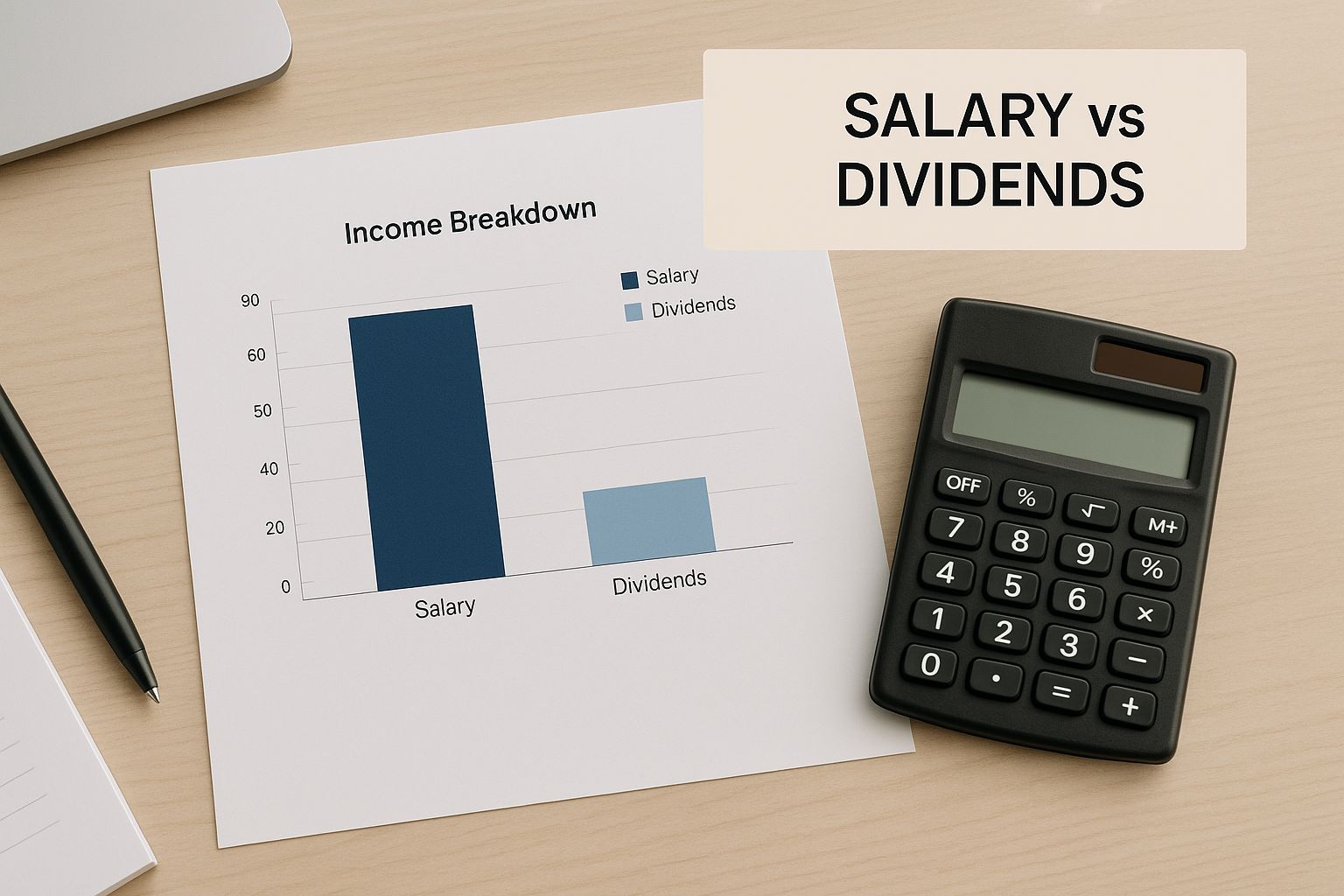
The image really drives home the point: a salary reduces your Corporation Tax bill, while dividends are free from National Insurance. It’s the combination of the two that unlocks the real savings.
Once you’ve got your salary sorted, you can start looking at more advanced tax efficiency strategies. By getting these fundamentals right, you ensure your salary works as hard for you as you do for your business, creating a solid base for taking out further profits via dividends.
Using Dividends to Unlock Company Profits
Once you’ve sorted your director's salary, dividends are the go-to method for drawing more cash from your limited company. The best way to think about a dividend is as a reward for being a shareholder—it’s your slice of the company’s profits. A salary is what you get for the work you do, but a dividend is your return on the investment you've made in your own business.
This distinction is key for tax purposes. Salaries are a business expense, paid out before your company pays Corporation Tax. Dividends, on the other hand, are distributed from the profits left over after the company has settled its Corporation Tax bill. This is precisely why the tax rates on dividends are lower than on salary income; HMRC has already taken its cut from the company's profit pot.

The Golden Rule of Issuing Dividends
There's one rule here that is absolutely non-negotiable: dividends can only be paid out of retained profits. If your company doesn't have any profit left after accounting for all its costs and taxes, you legally cannot pay a dividend. Simple as that.
If you take money out when there are no available profits, it's classed as an 'illegal dividend'. This can get you into hot water with HMRC. They’ll likely reclassify the payment as a director's loan, which triggers a whole different set of complex and often expensive tax rules.
Paperwork: The Bedrock of Compliance
Every single time you decide to pay a dividend, you have to get the paperwork right. This isn’t just about being organised; it's a legal necessity. For each dividend payment, you need to follow a clear process:
- Hold a directors' meeting to formally declare the dividend. Yes, even if you’re the only director in the "meeting"!
- Keep board meeting minutes that record this decision. This is your official paper trail.
- Issue a dividend voucher for each shareholder who is receiving a payment.
The voucher itself needs to detail the company name, date, the name of the shareholder, and the dividend amount. This documentation proves to HMRC that these payments are genuine distributions of profit, not just you taking cash out of the company account.
Key Takeaway: Correctly documenting dividends isn't optional. Board minutes and vouchers are your legal proof to HMRC that you're distributing profits properly. Without them, payments can be challenged, leading to tax headaches.
How Dividend Tax Actually Works
Everyone gets a tax-free Dividend Allowance. For the 2025/26 tax year, this allowance is £500. This means the first £500 of dividend income you receive in a tax year is completely tax-free, no matter what else you earn.
Once you've used up that allowance, any further dividends are taxed based on your Income Tax band. It’s a crucial part of your overall tax planning. For a complete breakdown, have a look at our detailed guide which explains how dividends work and how much you can take.
When planning profit distribution, it's always useful to be aware of the broader tax landscape. For instance, business owners operating internationally might find helpful context by understanding processes like registering for corporate tax in the UAE. Seeing how other regions handle company profits can put your own obligations into a wider perspective.
Getting to Grips with National Insurance Contributions

Let's talk about National Insurance, or NICs. For most directors, this is where things can get a bit confusing when working out the best way to pay themselves. It’s tempting to pay yourself a tiny salary, duck under the threshold, and avoid NICs entirely. But honestly, that’s a shortsighted move that can come back to bite you down the line.
A much better approach is to understand the key thresholds. This way, you can minimise what you and your company pay out while still banking the long-term benefits.
There are two main figures you need to keep in mind:
- The Primary Threshold: This is the earnings level where you, as the employee, start paying NICs.
- The Secondary Threshold: This is the point where your company, as the employer, starts paying NICs on your salary.
For years, the go-to strategy was to set a salary somewhere between these two figures. It was a neat trick – the salary was high enough to count towards your State Pension, but low enough that neither you nor the company paid a penny in National Insurance. But things have changed.
Finding the Sweet Spot for Your Salary
The smartest pay strategy is all about finding the right balance. Just avoiding Employer's NICs by paying a salary below the Secondary Threshold might feel like a win, but it could mean that year doesn't count towards your State Pension entitlement. That's a huge price to pay in retirement for a relatively small saving today.
This is exactly why a salary of £12,570 is so often the recommended figure for the 2024/25 tax year. It’s a bit of a magic number, really. It lines up perfectly with both your tax-free Personal Allowance and the Primary Threshold.
Yes, your company will pay a small amount of Employer’s NICs on the earnings above the Secondary Threshold. But you personally won’t pay any income tax or employee NICs. And most importantly, this salary locks in your qualifying year for the State Pension.
The optimal director's salary isn't just about minimising the immediate tax bill. It's a strategic decision that protects your long-term financial security by ensuring you build up your State Pension entitlement.
HMRC is always tinkering with the rules, and recent NIC adjustments make this calculation more important than ever. The constant shifts reinforce why a deliberate, well-thought-out approach is so vital. If you want to get into the nitty-gritty, our small business owner's guide to National Insurance breaks it all down.
By choosing this salary figure, the company's NIC bill is kept very low. Plus, the full salary is a tax-deductible expense for the business, and this corporation tax saving almost always outweighs the small NIC cost. It’s a win-win, making it a highly effective part of your overall pay structure.
Beyond Salary and Dividends: Other Smart Options
https://www.youtube.com/embed/gwdJlrNu2OQ
While the salary and dividend combo is the bread and butter for most company directors, it’s not the only tool in your financial toolkit. Digging a little deeper can give you more flexibility for immediate cash needs and, more importantly, help you build long-term wealth in a seriously tax-efficient way.
Let's look at a couple of powerful alternatives.
The Director's Loan: A Short-Term Fix
A director's loan is a common go-to when you need to borrow money from your company for something that isn't a salary, dividend, or expense reimbursement. Think of it as a useful stopgap for a one-off large expense, but be warned: it comes with strict rules you absolutely cannot afford to ignore.
Every transaction needs to be meticulously recorded in what's called a director's loan account. It's crucial to get this right. We've put together a detailed guide on what a director’s loan account is that walks you through how to manage these records properly.
The Rules You Must Follow
Here's the critical part: if you don't repay the loan within nine months and one day of your company’s year-end, your business will be slapped with a hefty tax charge. This is the infamous s455 charge, currently sitting at a painful 33.75% of whatever you still owe.
Now, the company can reclaim this tax once the loan is finally repaid, but in the meantime, it can cause a real cash flow headache.
On top of that, if your loan balance ever goes over £10,000, HMRC treats it as a 'benefit in kind'. This means you'll face personal tax on the interest. The key takeaway? A director's loan is a short-term solution, not a long-term pay strategy.
Building Your Future with Company Pension Contributions
This is perhaps the most powerful and surprisingly underused method for taking money out of your company. Funnelling profits directly into your pension is a fantastically tax-efficient move.
Here’s a quick rundown of why it works so well:
- It’s a business expense. The contribution is written off against your company's profits, which directly lowers your Corporation Tax bill.
- No personal tax or NI. Unlike taking a salary, you don't pay a penny of Income Tax or National Insurance on the contribution.
- It builds your retirement pot. You’re directly investing in your own future financial security.
Honestly, making substantial pension contributions is one of the smartest financial moves a director can make. You’re cutting your current tax liabilities while building a tax-sheltered fund for your retirement. It's a true win-win.
If you look at how most directors structure their pay, a familiar pattern emerges. The majority take a tax-efficient salary of £12,570 (to stay clear of income tax and NI) and top it up with dividends. But with the 2025/26 dividend allowance slashed to just £500 and the basic rate taxed at 8.75%, those dividends aren't as attractive as they once were.
When you factor that in, diverting profits into a pension becomes an even more compelling way to lower your overall tax burden and build real wealth for the future.
Got Questions About Paying Yourself?
Even with a solid plan, it’s the day-to-day practicalities that often trip people up. How often do you run payroll? Can you just take a dividend whenever you feel like it? Getting these details right is just as important as the big-picture strategy.
Let's dive into some of the most common questions we get from directors we work with.
Can I Just Pay Myself in Dividends and Forget the Salary?
You can, but it's rarely a good move. For most directors, taking a small, tax-efficient salary (like the optimal £12,570 for the 2024/25 tax year) is a cornerstone of a smart strategy. Why? It does two crucial things at once.
First off, it uses up your tax-free Personal Allowance. But more importantly, it builds up your qualifying years for the State Pension. Relying solely on dividends means you miss out on these valuable National Insurance credits, which could leave you short in retirement. A director's salary is also a legitimate business expense, which directly lowers your Corporation Tax bill. It’s a win-win that dividends alone can't offer.
What Happens if I Take More in Dividends Than My Company Has in Profit?
This is a big one, and it's a mistake you really want to avoid. It’s known as an 'illegal dividend', and HMRC takes it very seriously. Dividends can only be paid out of post-tax profits. If you take more than what's available, that payment isn't legally a dividend anymore.
HMRC will almost certainly reclassify the overpayment as a director's loan. If you don't repay that loan within nine months of your company's year-end, the company gets hit with a hefty tax charge (called an s455 charge) of 33.75% of the loan amount.
This can cause a real cash flow headache and a mess of tax complications. The golden rule is simple: always check your company's retained profits before you declare a dividend.
How Often Should I Actually Pay Myself?
This really comes down to having a clear and consistent process. The approach for your salary is quite different from how you handle dividends.
-
Your Director's Salary: Treat this like any other employee's wages. It needs to be paid regularly through a proper PAYE payroll system to keep HMRC happy. Most directors find it easiest to just run this monthly.
-
Dividends: You've got a lot more flexibility here. You can declare a dividend whenever the company has enough profit to support it. Many directors do this quarterly or after their year-end accounts are done, but the timing isn't the most important part—the paperwork is. For every single dividend payment, you absolutely must have board minutes and a proper dividend voucher on file. This isn't optional; it's what makes it official.
Do I Really Need an Accountant for All This?
Legally, no. Practically, it’s one of the best investments you can make, especially as your business gets more complex. A good accountant isn't just a number-cruncher who files your returns. They're the ones who stay on top of ever-changing tax rules, make sure your payroll is run correctly, and ensure all your dividend paperwork is watertight.
Think of it this way: the fee you pay for expert advice is almost always dwarfed by the tax they save you and the expensive penalties they help you steer clear of. It’s about having the peace of mind that this critical part of your business is being handled properly.
Getting your director's pay right is fundamental to your company's financial health and your own personal wealth. At Stewart Accounting Services, we specialise in helping limited company directors build tax-efficient payment strategies that fit their goals. If you want to be sure you're compliant and making the most of your hard-earned profits, get in touch with our team of Chartered Accountants today.