
Preparing a cash flow statement is all about tracking the cash moving in and out of your business over a specific period. The goal is to sort every transaction into one of three core activities: operating, investing, and financing. This process bridges the gap between your net profit and the actual change in your bank balance, giving you a clear, honest picture of your company's liquidity.

Why Your Cash Flow Statement Is Mission-Critical
Let's be blunt: profit on paper doesn't pay the bills. Cash does.
For any growing UK SME, the cash flow statement isn't just another accounting report; it's the financial pulse of your business. It cuts through the jargon to show the stark reality of how much cash you actually have to run the company. This is a crucial distinction where many businesses stumble.
It often comes as a shock to business owners that a profitable company can still run out of cash. Understanding why your profit doesn't match your bank balance is the first step to appreciating just how valuable this statement is.
This single report gives you the intel you need to survive and thrive. It helps you see cash shortages coming, fund growth with confidence, and make a solid case to lenders. Mastering it turns financial management from a reactive headache into a genuine strategic advantage.
A Real-World Scenario
Picture a UK-based creative agency juggling several client projects. Their income statement looks fantastic, showing a healthy profit based on all the invoices they've sent out.
But their cash reality is another story entirely. The agency has to pay its designers and for software subscriptions every week, yet clients are on 60-day payment terms. Without a cash flow statement, it's easy to walk into a crisis where payroll is due but a big client payment is still weeks away.
By preparing a cash flow statement regularly, the agency’s director can spot the dangerous mismatch between cash going out (salaries, rent) and cash coming in (client payments). This foresight allows them to:
- Negotiate better payment terms with new clients from the get-go.
- Arrange a short-term credit line to cover predictable gaps.
- Time big purchases, like new equipment, for right after a large project payment lands.
This simple discipline transforms potential cash crises into planned, manageable operational cycles.
The Three Pillars of Cash Flow
To really get to grips with preparing a cash flow statement, you need to understand its three core sections. Think of them as three distinct stories that, when woven together, tell the complete financial narrative of your business. In the current economic climate, this has become absolutely vital for UK SMEs. Recent data reveals that a staggering 57% of UK small businesses are bracing for rising costs, with most worried about the impact on their operations. Tracking cash is more important than ever.
A cash flow statement is an X-ray of your business's financial health. It reveals the underlying strength an income statement alone can't show and answers one simple, vital question: where did the cash come from, and where did it go?
To give you a quick overview, here’s a simple breakdown of what each section covers.
Cash Flow Statement at a Glance
| Activity Type | What It Shows | Example for a UK SME |
|---|---|---|
| Operating | Cash generated from your main day-to-day business activities. | A Bristol-based coffee shop receiving cash from customers and paying suppliers for beans and milk. |
| Investing | Cash used to buy or sell long-term assets like property, vehicles, or equipment. | A Manchester construction firm buying a new van or selling an old piece of machinery. |
| Financing | Cash from owners, investors, or lenders, and cash paid out for loans or dividends. | A London tech start-up receiving a government grant or making repayments on a bank loan. |
Each of these pillars gives you a different lens through which to view your business's performance. When you see them all together, you get the full picture. Grasping this structure provides a clear mental map for the practical steps ahead.
Laying the Groundwork: Getting Your Core Financials in Order
You can't build an accurate cash flow statement on a foundation of guesswork. Before diving into any calculations, the very first thing you need to do is gather the right financial documents. Think of it like a chef prepping their ingredients—getting this part right from the start makes the whole process run smoothly.
A bit of discipline here in your financial record-keeping can transform what seems like a daunting task into a simple, repeatable process.
Your Document Checklist
To get started, you'll need three core reports. These are the source of truth for all your numbers, giving you a clear snapshot of your business's performance and financial position for the period you're looking at.
Make sure you have these ready:
- Two Balance Sheets: You need one from the very start of your reporting period and one from the end. For instance, if you're preparing a statement for the month of March, you’ll need the balance sheets for 28th February and 31st March. Comparing the two is how you'll spot the crucial changes in your assets and liabilities.
- One Income Statement: This is your Profit and Loss (P&L) statement, and it needs to cover the entire period you're analysing (e.g., from 1st to 31st March). Your net income figure from this report is usually the starting point for your calculations.
These reports are the building blocks of a complete financial picture. To see exactly how they all fit together, take a look at our detailed guide on how to prepare financial statements.
For Xero and QuickBooks Users
If you're already using cloud accounting software like Xero or QuickBooks, this step is a breeze. Forget creating reports from scratch. Just head to the reporting section in your software and generate what you need.
In Xero, for example, you can run the "Balance Sheet" report and simply set the dates you need. For the income statement, you'll want the "Profit and Loss" report for the same period. The trick, of course, is making sure your books are fully up-to-date before you export anything.
An accounting report is only as good as the data it contains. If your bank feeds aren't reconciled and transactions are all over the place, your software will generate a cash flow statement that is technically correct but practically useless.
The Non-Negotiable: Clean Bookkeeping
This brings me to the most important point of all: your bookkeeping must be clean, reconciled, and accurate. I can't stress this enough. It’s not just "best practice"—it’s a non-negotiable prerequisite for creating a cash flow statement you can actually rely on.
Immaculate records are the bedrock of all financial clarity. Before you run a single report, double-check that:
- Bank Feeds are Fully Reconciled: Every transaction in your business bank account must be matched and categorised in your accounting software. An unreconciled bank feed is just another term for missing data.
- Transactions are Correctly Categorised: A loan repayment coded as a general "office expense" will completely distort your financing activities. A new laptop miscategorised as a simple "repair" will misrepresent your investing activities.
- Accounts Receivable and Payable are Spot On: Your list of unpaid customer invoices (debtors) and outstanding supplier bills (creditors) must be current. These figures are absolutely essential for adjusting your net income to find your true operating cash flow.
Taking a little time each week to maintain disciplined financial records pays off massively. It turns the often complex job of financial reporting into a straightforward routine, giving you real confidence in the numbers you use to make critical business decisions.
Calculating Cash Flow from Operating Activities
This section is really the engine room of your cash flow statement. It gets to the heart of how much actual cash your day-to-day business is generating, which, as many business owners discover, can be a world away from the profit figure on your income statement.
We’re going to focus on the indirect method here. It's the go-to approach for most UK SMEs simply because it’s practical – it starts with the numbers you already have in your profit and loss report and works backwards to find the cash.
The whole point of the indirect method is to bridge the gap between profit and cash. To do that well, you need a solid grasp of the differences between cash basis and accrual accounting. Think of it this way: your profit is based on accrual accounting, but your bank account only cares about cash. We’re about to translate one to the other.
Starting Point: Your Net Income
First things first, grab your income statement (or P&L) for the period you're looking at. Find the net income or net profit figure right at the bottom. This is our starting line.
This number shows your profitability on paper, but it includes all sorts of non-cash items and is based on when you earned revenue or incurred an expense, not when the money actually hit or left your bank. Our job is to strip all that out and get back to the real cash movement.
Adding Back Non-Cash Expenses
Your P&L has expenses that reduce your profit but don't actually involve cash leaving the business in that period. We need to add these back.
The classic example for any small business is depreciation. Let’s say you bought a new van for £20,000. You don’t expense that full amount in one go. Instead, you might depreciate it by, say, £4,000 a year. That £4,000 hits your profit and loss, making your profit look lower, but you didn't physically spend an extra £4,000 in cash that year on it.
To reverse this, we simply add these items back to our net income:
- Depreciation: Add back the total depreciation charge from your P&L.
- Amortisation: Same principle, but for intangible assets like software or patents. Add it back.
- Gains/Losses on Asset Sales: This one can be tricky. A loss on selling an old laptop reduces your net income, but it's not an operating cash outflow, so you add it back. A gain boosts net income, but the cash you received belongs in the investing section, so you subtract the gain here to avoid double-counting.
The key takeaway is simple: your net income was reduced by these paper expenses. To find the cash, we just need to reverse that effect by adding them back.
Adjusting for Changes in Working Capital
Now for the part that often trips people up, but it's where the real story is told. We need to look at the changes in your working capital—essentially, your short-term operational assets and liabilities. This means looking at things like your customer invoices (accounts receivable), your stock levels (inventory), and what you owe suppliers (accounts payable).
You’ll need your balance sheets from the start and end of the period for this. The logic is all about figuring out where your cash has been tied up or freed up.
- Increase in an Asset (e.g., Accounts Receivable): If your customers owe you more money at the end of the month than at the start, it means you've made sales but are still waiting for the cash. That cash is trapped, so you subtract this increase from your net income.
- Decrease in an Asset (e.g., Inventory): If your stock levels have dropped, it’s usually because you’ve sold more than you’ve bought. This generally means cash has come in. So, you add this decrease back to your net income.
- Increase in a Liability (e.g., Accounts Payable): If you owe your suppliers more money, it means you’ve held onto your cash instead of paying them immediately. This has preserved your cash position, so you add this increase to net income.
- Decrease in a Liability (e.g., Accounts Payable): If you've paid your suppliers and reduced what you owe, cash has left your business. Therefore, you subtract this decrease from net income.
Getting your head around https://stewartaccounting.co.uk/what-is-accounts-payable-and-receivable/ is fundamental to getting these adjustments right.
The process of pulling this information together from your core reports is a clear, logical flow.
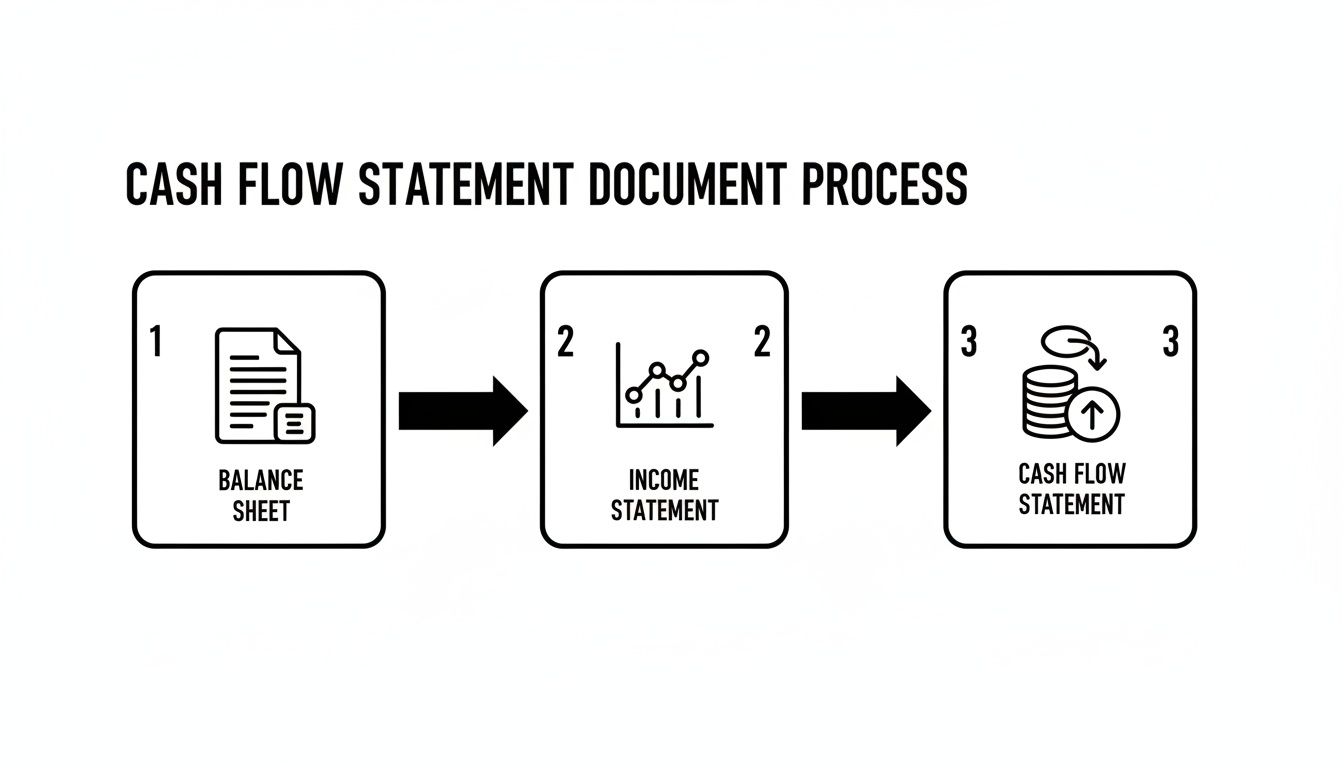
As you can see, the balance sheet and income statement are the two documents that feed directly into creating your cash flow statement.
A Worked Example: E-commerce Business
Let's make this real. Imagine "Crafty Creations Ltd," a UK-based e-commerce store. Here are their numbers for the last quarter:
- Net Income: £30,000
- Depreciation Expense: £5,000
- Increase in Accounts Receivable: £8,000 (More customers owe them money)
- Increase in Inventory: £4,000 (They bought more stock than they sold)
- Increase in Accounts Payable: £6,000 (They owe more to their suppliers)
Here’s how Crafty Creations would work out its operating cash flow.
They'd start with their £30,000 Net Income.
Then, they'd add back the non-cash depreciation of £5,000.
Next, the adjustments for working capital. The £8,000 increase in what customers owe them is a cash drain, so that gets subtracted. The £4,000 they spent on extra stock also used up cash, so that’s subtracted too. Finally, holding off on paying suppliers by an extra £6,000 kept cash in the bank, so that figure is added.
The calculation looks like this:
£30,000 (Net Income) + £5,000 (Depreciation) – £8,000 (Receivables) – £4,000 (Inventory) + £6,000 (Payables) = £29,000
So, their Net Cash from Operating Activities is £29,000.
Even though the business posted a healthy £30,000 profit, the actual cash it generated from its core operations was £1,000 less. This is a perfect, everyday example of why you can't run a business off the P&L alone. You need to know where your cash is.
Tracking Your Investing and Financing Activities
Beyond the day-to-day running of the business, your investing and financing decisions tell the real story of your long-term strategy. Getting these two sections right is crucial for showing lenders and investors how you're building for the future.
The good news? These sections are often much simpler to piece together than the operating activities. You're usually dealing with fewer, larger transactions that are much easier to find in your records. Think of them as the big, deliberate financial moves your company makes.
Decoding Your Investing Activities
This part of your cash flow statement is all about how you're reinvesting in the business's future. It focuses purely on the cash you spend or receive from buying or selling long-term assets—the kind of things you use to generate revenue for years, not items you plan to resell quickly.
Cash going out in this section isn't necessarily a bad thing. In fact, it's often a positive sign of growth, showing you're putting money back into the company's infrastructure.
Here’s what you’re looking for:
- Purchasing property, plant, and equipment (PP&E): This is the classic example. It could be anything from a new delivery van and workshop machinery to upgrading the office computers.
- Selling PP&E: If you sell an old asset, the cash you get from the sale is a cash inflow right here.
- Buying or selling investments: If your company invests in shares or even acquires another small business, those transactions belong in this section.
A common trip-up is misplacing interest received. Under UK accounting standards, any interest or dividends you receive from investments are typically classified as operating cash flows, not investing ones. It feels counter-intuitive, but that's where they belong.
So, where do you find the numbers? A great starting point is to compare the fixed asset details on your opening and closing balance sheets. If your equipment's value has jumped by £10,000 and you know you had £2,000 in depreciation for the period, it points towards a £12,000 cash spend on new gear. Always double-check this against your actual bank transactions to confirm the exact cash amount that left the account.
Unpacking Your Financing Activities
Financing activities show how you fund the business. It’s all about cash movements between the company and its owners, investors, and lenders. This section gives a crystal-clear view of your financial structure and stability.
For any potential lender or investor, this part of the statement is a must-read. It reveals how reliant you are on external funding and how you're managing your financial obligations.
These transactions involve the company's capital and include:
- Securing a business loan: The moment cash from a new bank loan hits your account, it’s a financing inflow.
- Repaying debt: When you make principal repayments on a loan, that’s a financing outflow. Just remember, the interest part of the payment goes under operating activities.
- Issuing shares: Bringing in new investors by selling shares in your limited company creates a financing cash inflow.
- Paying dividends: Any distribution of profit to shareholders is a financing cash outflow.
For UK SMEs, deciding how to pay for new equipment can be tricky. Should you buy it outright or take out a loan? To help you figure out the best approach, you can learn more about the various funding options for asset acquisition and see how they'd affect your cash flow.
A Tech Startup Scenario
Let's see how this works in the real world. Meet "Innovate UK Ltd," a tech startup that has just closed a seed funding round and is starting to scale up. Here’s a snapshot of their investing and financing activities for the last quarter:
Investing Activities:
- They dropped £50,000 on new high-performance servers and laptops for their growing team. This is a cash outflow for purchasing assets.
Financing Activities:
- They received £250,000 from angel investors in return for equity in the business. A huge cash inflow from issuing shares.
- They also paid back £5,000 of the principal on an early startup loan. This is a cash outflow.
To get the net cash flow figure for each activity, the calculation is simple:
| Activity | Calculation | Net Cash Flow |
|---|---|---|
| Investing | £0 (Inflows) – £50,000 (Outflows) | (£50,000) |
| Financing | £250,000 (Inflows) – £5,000 (Outflows) | £245,000 |
This paints a very clear picture. The company is investing heavily in its infrastructure to handle future growth (the negative investing cash flow), and it has successfully funded this expansion through external equity (the large positive financing cash flow). Mastering this classification is the key to preparing a cash flow statement that actually reflects your business's strategy.
Assembling and Interpreting Your Final Statement
You've done the hard work of crunching the numbers for your operating, investing, and financing activities. Now it’s time to pull it all together, finalise the statement, and—most importantly—understand what your business’s cash story is really telling you. This is where the numbers come to life.

Putting the final pieces in place is actually quite straightforward. You just need to add the net totals from each of the three sections.
Net Cash from Operations + Net Cash from Investing + Net Cash from Financing = Net Change in Cash
This final figure is the headline number—the total increase or decrease in your cash over the period. A positive number means more cash came in than went out, while a negative one means the opposite.
The Crucial Reconciliation Step
Before you dive into analysis, there’s one vital final check: the reconciliation. Think of it as your moment of truth, confirming that all your hard work adds up correctly.
To do this, take the Net Change in Cash you just calculated and add it to your Cash Balance at the Start of the Period (from your opening balance sheet). The result should be a perfect match for your Cash Balance at the End of the Period (from your closing balance sheet).
If the numbers align, brilliant! You've successfully prepared a cash flow statement. If they don’t, it's time to retrace your steps. In my experience, the most common errors hide in the operating activities adjustments, so I’d recommend starting your search there.
Reading Between the Lines
A finished statement is so much more than a list of figures; it's a powerful diagnostic tool for your business's health. The real skill isn't just in how to prepare a cash flow statement, but in knowing how to interpret what it’s saying.
A business can have many combinations of positive and negative cash flows, and they all tell a different story. Here are a few common scenarios I see all the time:
- Positive Operating, Negative Investing: This is often the profile of a healthy, growing company. It tells me the core business is generating enough cash to fund its own expansion, like buying new equipment or property.
- Negative Operating, Positive Financing: This is the classic start-up or scale-up picture. The business isn't yet making cash from its day-to-day operations, but it's successfully securing loans or investor funding to cover the shortfall and fuel growth.
- Positive Operating, Positive Investing, Negative Financing: This could be a mature, stable business. It’s generating plenty of cash, selling off old assets it no longer needs, and using the proceeds to pay down debt or return cash to shareholders through dividends.
Remember, a negative cash flow isn't always a red flag. A big cash outflow in the investing section could be a fantastic sign that you're gearing up for major growth. Context is everything.
Turning Insights into Action
Your analysis should feed directly back into your strategy. For a UK business, this is particularly important when dealing with late payments. A recent UK Payment Survey revealed that a staggering 90% of UK companies experienced late payments, with the average delay stretching to 32 days. For a small or medium-sized enterprise, that kind of delay can create a serious cash crunch, which is why accurate forecasting is so essential. You can discover more insights about these payment challenges and their business impact.
Your statement allows you to ask the right questions:
- Is our operating cash flow consistently lower than our net profit? This often points to a problem with collecting from customers. It might be time to review your credit terms or get more proactive with chasing up overdue invoices.
- Can we really afford that new hire or piece of equipment? Take a look at your free cash flow (operating cash flow minus capital expenditures). A healthy, consistent surplus gives you the green light to invest with confidence.
- Are we leaning too heavily on debt? If cash from financing is constantly propping up a negative operating cash flow, you might be on an unsustainable path. That’s a clear signal to improve the core business's ability to generate its own cash.
By regularly preparing and dissecting your cash flow statement, you move from just recording what happened in the past to actively shaping your company’s financial future.
Got Questions About Cash Flow Statements? Let's Get Them Answered
Even after you've walked through the process, a few questions often pop up. It’s completely normal. Preparing a cash flow statement can feel a bit counter-intuitive at first, but tackling these common queries head-on will build your confidence and help you really master it.
Here are some of the most frequent questions I hear from SME owners across the UK.
What's the Real Difference Between the Direct and Indirect Methods?
The main distinction all comes down to how you calculate the cash from your day-to-day operations.
We’ve focused on the indirect method in this guide. This is the one that starts with your net profit figure and then cleverly adjusts for all the non-cash bits and bobs (like depreciation) and shifts in your working capital. It's the go-to for most businesses simply because all the information you need is already sitting there in your income statement and balance sheet.
The direct method, on the other hand, is much more literal. It lists out the actual cash you’ve received from customers and then subtracts the actual cash you’ve paid out to suppliers, staff, and for other expenses. While it sounds simpler, it requires a level of detailed tracking that most small business accounting systems aren’t really set up for.
The key takeaway? Both roads lead to the same destination. You will always get the exact same final number for your net cash from operating activities, no matter which method you use. For almost every SME, the indirect method is just the most practical and efficient way to get there.
How Often Should I Be Doing This?
For a growing business, I always recommend preparing a cash flow statement monthly. Think of it as a regular financial health check. A monthly rhythm lets you spot trends and catch potential cash crunches before they turn into full-blown crises. It gives you just enough data to make smart decisions without becoming a massive administrative headache.
Of course, some situations call for a closer eye:
- Scaling Fast: If you're in a period of rapid growth, looking at this weekly can be a lifesaver for managing the intense pressure on your cash reserves.
- Seasonal Swings: For businesses with big peaks and troughs (like retail at Christmas or hospitality in the summer), checking more often during your busy season is just plain smart.
- Project-Based Work: If your income arrives in big, lumpy payments from large projects, a weekly or bi-weekly statement can be absolutely vital to managing your outgoings.
The absolute bare minimum? A quarterly statement as part of your management accounts. Relying on an annual statement alone is like trying to drive while only looking in the rearview mirror—you can see where you’ve been, but you have no idea what’s coming up ahead.
Can My Accounting Software Just Do This for Me?
Yes, and it’s a massive help! Modern cloud platforms like Xero and QuickBooks can generate a Statement of Cash Flows automatically. This feature is one of the single biggest time-savers that good accounting software provides.
But here’s the crucial catch: the report is only as good as the data you feed it.
If your transactions are miscategorised, the statement will be wrong. It's as simple as that. For example, if a loan repayment gets accidentally coded as a general "office expense" instead of a financing activity, your operating cash flow will look much worse than it really is. To spot these kinds of errors, you still need to understand the principles of how to prepare a cash flow statement yourself. This allows you to review the software-generated report with a critical eye and be confident it's giving you a true picture of your financial health.
Why Is My Profit So High but My Bank Account Is Empty?
Ah, the classic headache for every business owner. This is the single best example of why the cash flow statement is such a vital tool. Your Profit & Loss (P&L) is based on accrual accounting, meaning it records revenue when you earn it, not when the money actually lands in your bank.
You might make a huge, highly profitable sale in March. Great! But if that client is on 60-day payment terms, you won’t see a penny of that cash until May. In the meantime, you’ve still got salaries, rent, and supplier bills to pay. This timing gap is nearly always the main reason for the disconnect.
A few other common culprits include:
- Big Asset Purchases: You might have spent cash on a new van or vital piece of equipment (an investing activity).
- Paying Down Debt: Making capital repayments on a loan uses up cash (a financing activity).
- Stocking Up: Tying up your cash in inventory that you haven’t sold yet is another major drain.
The cash flow statement is the bridge between profit and cash. It systematically uncovers exactly where the money from your profits has gone, solving the mystery once and for all.
At Stewart Accounting Services, we help businesses across the UK move beyond just ticking boxes to achieve genuine financial clarity. If you need support in preparing, understanding, and using your financial statements to fuel your growth, we can help you gain more time, more money, and a clearer mind. Explore our tailored accounting services at https://stewartaccounting.co.uk.