
At its core, preparing management accounts means taking all your raw bookkeeping data and turning it into a clear, concise report. This isn't for HMRC. It’s for you. This internal report—covering your Profit & Loss, Balance Sheet, and cash flow—is a strategic tool, giving you the clarity you need to make sharp, timely decisions.
Why Management Accounts Are Your Financial Command Centre

So many small business owners are laser-focused on their year-end statutory accounts, but in doing so, they miss out on a far more powerful tool for growth: monthly management accounts. It’s a common mistake to think they’re the same thing, but their purpose, and who they’re for, couldn't be more different.
Here’s a good way to think about it. Your year-end accounts are like a formal, historical snapshot of your business, taken once a year to tick a legal box. Management accounts, on the other hand, are like a live video feed from inside your financial control room, giving you the real-time intelligence to steer the business through the weeks and months ahead.
Moving from Reactive to Proactive Decisions
Without regular, insightful reporting, how are decisions really made? Often, it’s down to guesswork or a quick glance at the bank balance. That kind of reactive approach is risky. You could easily miss a looming cash flow crunch, fail to spot a slow decline in your profit margins, or keep pouring money into a service that’s actually losing you money.
Management accounts completely change the game by giving you a structured, forward-looking perspective. They help you:
- Spot trends early: Is revenue consistently dipping in a certain quarter? Are your overheads slowly creeping upwards? Monthly reports make these patterns jump off the page.
- Measure what matters: You can pinpoint your most profitable products or services and finally understand which parts of the business are giving you the best return on investment.
- Improve financial control: Make confident decisions about hiring, expansion, or buying new equipment because you’re basing them on accurate, up-to-date financial data.
The Standard for Modern SMEs
This proactive approach isn't just a "nice-to-have" anymore; it’s fast becoming the standard for ambitious UK businesses. In fact, over 70% of SMEs now regularly produce these reports to track their performance. The British Business Bank even recommends producing them monthly, stressing how important they are for securing finance and maintaining solid financial control.
By turning raw numbers into a clear narrative, management accounts tell the story behind your business's performance. They answer the critical 'why'—why was profit up? Why is cash tight this month? This is the insight that fuels genuinely strategic thinking.
Ultimately, learning how to prepare management accounts is about building a system for making better decisions. You'll move beyond simply recording history and start actively shaping your company's future. For a deeper dive into this, you might find our guide on what management reporting involves useful.
1. Getting Your Financial House in Order: The Monthly Data Pull
Before you can even dream of pulling together insightful reports, you’ve got to get your hands on the right data. It sounds basic, but this is where so many business owners fall down. Rushing this stage is like trying to build a house on shaky foundations – the end result will be unreliable and could lead you to make some seriously bad decisions.
Think of it as your monthly financial 'prep work'. It’s all about making sure every bit of financial information is present, correct, and filed where it should be. This groundwork is what separates a genuinely useful management report from a confusing mess of numbers.
The Essential Data for Monthly Accounts Preparation
First things first, you need to methodically pull together all the source documents that reflect your business's activity for the month. To make life easier, modern cloud accounting solutions like Xero or QuickBooks are a massive help here. They can automate a lot of the data entry, but you still need to make sure the original information is complete and accurate.
Here’s a summary of the core information you’ll need to gather every single month.
| Document or Data Type | Typical Source | Role in Management Accounts |
|---|---|---|
| Bank & Credit Card Statements | Online banking portal, paper statements | The primary source for verifying every transaction in and out of the business. |
| Sales Invoices | Accounting software (e.g., Xero), invoicing tool | Forms the basis of your revenue calculation for the period. |
| Supplier Bills & Receipts | Email inbox, supplier portals, paper copies | Captures all your costs and expenses, from stock to software. |
| Payroll Reports | Payroll software (e.g., BrightPay), accountant | Details salaries, PAYE, NI, and pensions – a major expense category. |
| Employee Expense Claims | Expense software (e.g., Expensify), spreadsheets | Ensures all out-of-pocket business spending is accounted for. |
Getting these documents organised is the first and most critical step. Without them, you're flying blind.
My Key Takeaway: The goal is to create a complete digital paper trail. If a transaction hits your bank account, there must be a corresponding invoice, bill, or receipt to explain it. This discipline is non-negotiable for accurate accounts.
Pre-Reporting Checks in Your Accounting Software
Once your documents are in hand, the action moves over to your accounting software. This is where you double-check that everything has been entered and categorised correctly before you start running any reports. I can't stress this enough: skipping these checks is the number one reason people end up with flawed management accounts.
The most crucial check is the bank reconciliation. Every single line on your bank statement needs to be matched to a transaction in your accounting software. Simple as that. This process confirms you haven't missed any income or forgotten an expense. An unreconciled bank account is a huge red flag that your numbers are incomplete.
Next, you need to give your transaction list a quick sense-check. Just scan down your expenses and look for anything that seems out of place. For instance, has a big software subscription been accidentally coded to 'travel'? Has a client dinner been miscategorised as 'office supplies'? These might seem like small mistakes, but they can seriously distort your profit margins and lead you to draw the wrong conclusions.
Getting this right relies on a well-structured chart of accounts. If you're a bit fuzzy on what that means, have a quick read of our guide explaining what a chart of accounts is and how to set one up properly.
Nailing these initial data-gathering and verification steps sets the stage for everything else. With clean, reconciled, and correctly categorised data, you can move forward with confidence, knowing the P&L and Balance Sheet you produce will reflect the true financial reality of your business.
Building Your Core Financial Reports
Once your data is clean, reconciled, and properly organised, you get to the good bit: turning all those raw numbers into something that actually tells you a story. This is where you build the three core reports that form the foundation of any solid management pack. Each one gives you a different, equally vital, angle on your business's performance last month.
I like to think of these reports as three different lenses. The Profit & Loss shows your performance over a period, the Balance Sheet gives you a snapshot of your financial health at a single moment, and the Cash Flow Statement tracks the lifeblood of your business—the actual cash moving in and out.
The Profit And Loss Statement
First up is the Profit & Loss (P&L), which you might also hear called the Income Statement. Its job is simple but absolutely critical: to show you whether your business made a profit or a loss over the last month. It does this by taking all your revenue and subtracting all your costs.
This is the report that answers the most fundamental question: "Are we actually making any money?" It's easy to be fooled by a healthy bank balance, but if you've got a pile of supplier invoices about to land, that money isn't really yours. The P&L cuts through that illusion to show your true profitability.
Let’s take a real-world example. Imagine a UK-based digital marketing agency. Their P&L for March could look like this:
- Revenue: £30,000 from client retainers and one-off projects.
- Cost of Sales (COS): £8,000 spent on freelance copywriters and the ad budget for client campaigns.
- Gross Profit: £22,000 (Revenue minus COS).
- Overheads: £12,000 covering team salaries, office rent, and software subscriptions.
- Net Profit: £10,000 (Gross Profit minus Overheads).
This simple breakdown doesn't just tell the owner they had a good month. It gives them the numbers to calculate their Gross Profit Margin (a very healthy 73.3% in this case), a crucial measure of how efficiently they’re delivering their services.
The Balance Sheet Snapshot
Next, we have the Balance Sheet. Unlike the P&L, which looks at a whole month, the Balance Sheet is a snapshot of your company's financial position on a single day—usually the last day of the month. It paints a picture of what your business owns (Assets) and what it owes (Liabilities).
There's a golden rule here: Assets must always equal Liabilities plus Equity. This isn't just an accounting quirk; it’s a fundamental check that everything in your books is correct and in balance.
A healthy balance sheet shows you've got enough assets to cover your liabilities, which points to good financial stability. It lays out things like:
- Current Assets: Cash in the bank, invoices your customers haven't paid yet (debtors), and any stock you hold.
- Fixed Assets: Long-term investments like property, vehicles, and expensive equipment.
- Current Liabilities: What you owe suppliers (creditors), your VAT bill, and any short-term loans.
- Long-Term Liabilities: Bank loans or finance agreements that run for more than a year.
It’s the report that answers, "How financially sound are we, right now?" It's entirely possible for a business to look profitable on its P&L but have a dangerously weak balance sheet if it's drowning in debt or has no cash reserves.
So many business owners just look at the P&L, and it’s a classic mistake. The Balance Sheet is just as important. It reveals the underlying health and structure of your business, which is exactly what you need to know for long-term planning or if you ever want to secure finance.
The entire process, from gathering documents to this final review, is so much easier when you have a clear workflow.
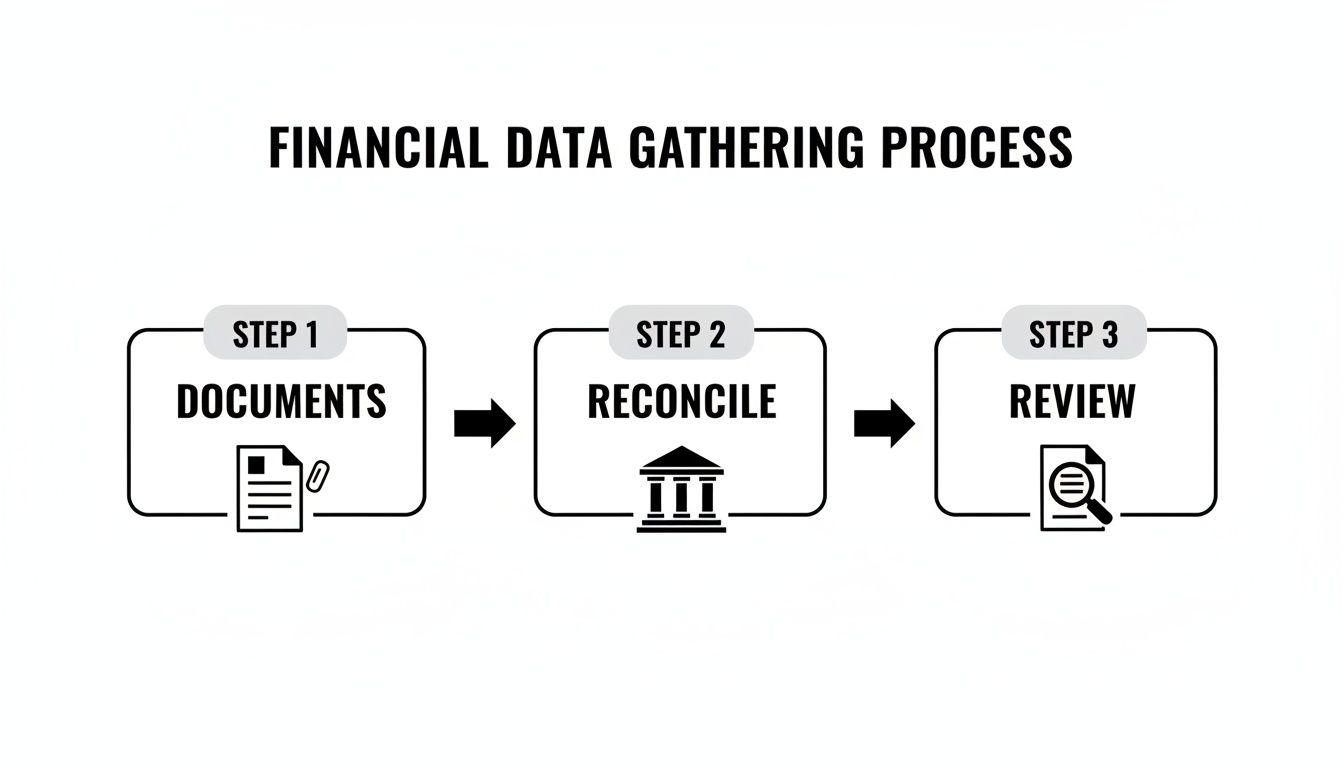
This simple three-stage flow—Document, Reconcile, Review—is the key to building a reliable foundation for your reports every single time.
The All-Important Cash Flow Statement
Finally, we get to what is arguably the most critical report for any SME: the Cash Flow Statement. A business can be profitable on paper but go under simply because it runs out of actual cash. This report gets right to the point, tracking the real money moving in and out of your bank account.
It organises all that movement into three key areas:
- Operating Activities: Cash generated from your day-to-day trading, like customer payments coming in and supplier bills going out.
- Investing Activities: Cash spent on or received from selling major assets, like buying a new van or selling old laptops.
- Financing Activities: Cash from external sources, like bank loans, director's loans, or selling shares in the company.
This report is the essential bridge between the P&L and the Balance Sheet. For instance, your P&L might proudly show £30,000 in revenue, but if a big client hasn't paid their £15,000 invoice yet, your cash flow statement will tell the real story: you only received £15,000. It’s a sobering but necessary dose of reality. For a deep dive, check out our guide on how to prepare a cash flow statement.
Having clear standard operating procedures is the secret to making this whole process smooth and consistent month after month. A documented process minimises errors and makes the entire job far more efficient.
The good news is that modern accounting software like Xero makes pulling these reports together incredibly simple once you've done the prep work. With just a few clicks, you can generate all three, giving you a complete, multi-dimensional view of your business. You'll understand your profitability, your financial stability, and your real-world cash position—everything you need to make genuinely smart decisions.
Turning Numbers Into a Narrative

Right, you’ve done the heavy lifting and produced the core financial reports: the P&L, Balance Sheet, and Cash Flow Statement. Think of these as the skeleton of your management accounts. They’re the essential structure, the hard facts. But on their own, they don't tell you the whole story.
This is where you switch hats from bookkeeper to business strategist. Your job now is to add the layers of analysis and commentary that bring those numbers to life. We’re going to transform a dry report into a compelling narrative about your business’s performance, its recent challenges, and where the real opportunities lie. This story is what will shape your next big decision.
Digging Deeper with Key Performance Indicators
Key Performance Indicators (KPIs) are the vital signs of your business. They're specific, measurable figures that show you how well you’re hitting your most important goals. By calculating a few relevant KPIs each month, you add immediate context to your main reports. Suddenly, you're not just looking at a profit figure; you’re starting to understand the quality of that profit.
Let's walk through a couple of KPIs I always recommend SME owners keep a close eye on.
Gross Profit Margin
This is a fundamental health check for your core business. It tells you exactly what percentage of revenue is left after you’ve paid for the direct costs of making your products or delivering your services.
- How to calculate it: (Gross Profit / Revenue) x 100
- What it really tells you: A healthy, high margin suggests your pricing is on point and you're managing your production costs well. If you see that margin starting to shrink, it’s an early warning sign that your input costs are creeping up, or perhaps you're offering too many discounts.
A software company might have a fantastic 90% gross margin, which is typical for the sector. A local retail shop, on the other hand, might run on a much tighter 35% margin. Both can be healthy, but the retailer has far less room for error.
Debtor Days
This KPI measures the average time it takes for your customers to pay their invoices. If you offer credit terms, this metric is absolutely critical for your cash flow.
- How to calculate it: (Trade Debtors / Revenue) x 365
- What it really tells you: A high number here (say, over 60 days) is a red flag. It means your cash is stuck in your customers' bank accounts, not yours, which can starve your business of the working capital it needs to operate. A low number (under 30 days) is a great sign that your credit control is sharp.
Let's say your standard payment terms are 30 days, but your Debtor Days metric is creeping up to 52. That’s not just a number on a page; it’s a clear signal you have a collection problem that needs fixing, fast.
The Power of Variance Analysis
Looking at this month's numbers in isolation is a huge missed opportunity. The real magic happens when you start making comparisons. Variance analysis is simply the process of comparing your actual results to a benchmark to figure out what happened differently and—most importantly—why.
The most powerful question you can ask when reviewing your management accounts is "What did we expect to happen, and what actually happened?" The gap between those two answers is where your most valuable business lessons are found.
There are two comparisons that will give you the most bang for your buck.
- Actual vs. Budget: This is the ultimate report card for your business plan. Did you hit your sales targets? Were you able to keep costs in check? A big negative variance on your revenue line demands an immediate deep-dive.
- Current Month vs. Prior Periods: Comparing performance to last month, or the same month last year, helps you spot trends. Is revenue on a steady upward curve? Are your marketing costs as a percentage of sales getting better or worse?
Imagine a café owner sees their electricity bill was £1,500 this month, but they'd budgeted £1,000. The -£500 variance is the what. The why is the crucial next step. Was it a price hike from the energy company? Or did one of the old freezer units break down and start chewing through power? The answer completely changes the action you need to take.
Writing Effective Commentary
The final, and arguably most important, piece of the puzzle is the written commentary. This is a short, plain-English summary that should sit right at the front of your management accounts pack. Its job is to highlight the key takeaways, explain the biggest variances, and point everyone towards the decisions that need to be made.
Keep your commentary brief and to the point. A good, simple structure works best:
- Executive Summary: A few bullet points hitting the headlines. (e.g., "Profit up 15% on last month, but cash is tighter due to a slow-paying client.")
- Key Variances: A quick explanation for the top two or three biggest deviations from your budget or forecast.
- KPI Analysis: A sentence or two on what the key metrics are saying about the health of the business.
- Action Points: So what’s next? (e.g., "Need to chase the overdue invoice from Client X," or "Review pricing from our main raw material supplier.")
This commentary is the bridge between raw data and smart decisions. It ensures that anyone who picks up the report—you, your business partner, or your bank manager—can instantly grasp the story the numbers are telling. This is how you prepare management accounts that actually help you run your business better.
Spotting the Common Pitfalls in Your Financial Reporting
Even with the best of intentions, small mistakes can creep into your management accounts. These little errors have a nasty habit of snowballing, leading to flawed reports and, worse, poor strategic decisions. Catching them early is absolutely vital for keeping your financial data clean and trustworthy.
Think of it as proofreading a critical email before hitting send. A few simple checks now can prevent major headaches and misunderstandings down the line. After all, the numbers in your reports are only as good as the data they come from. By building a few key habits into your monthly process, you can be confident you’re working with figures you can genuinely trust to run your business.
Miscategorising Expenses
One of the most frequent slip-ups I see is putting costs in the wrong bucket. It sounds simple, but it happens all the time. For instance, accidentally coding a big software subscription fee under 'travel' or 'office supplies' might seem minor, but it can seriously warp your understanding of where your money is actually going.
This kind of simple error can make your core operations look more or less profitable than they really are. Over time, it could lead you to cut back in the wrong areas or completely miss a key expense category that's spiralling out of control.
A Quick Sanity Check: Before you finalise anything, run a detailed P&L. Scan down the expense list and ask yourself, "Does anything look out of place here?" A quick once-over can often catch that £2,000 IT bill sitting uncomfortably in the £150 stationery budget.
Forgetting Accruals and Prepayments
This is a slightly more technical one, but it’s a biggie for getting a true picture of your monthly profitability. The reality is, your cash flow rarely lines up perfectly with your actual business activity, and these adjustments are how you fix that mismatch.
- Accruals: These account for expenses you've used but haven't paid for yet. A classic example is getting a large electricity bill in April that covers the January-March period. To get a true picture of March's performance, you must 'accrue' for that cost in your March accounts.
- Prepayments: This is just the opposite. It’s for when you pay for something in advance, like your annual business insurance premium. You shouldn't hit your P&L with the entire cost in the month you pay it. Instead, you 'prepay' it on your balance sheet and then release one-twelfth of the cost into your P&L each month.
Skipping these adjustments gives you a lumpy, inaccurate P&L. You might have a month that looks incredibly profitable, followed by one that shows a big loss, all because of the timing of a single large bill.
Overlooking the Balance Sheet Reconciliation
It’s easy to focus all your attention on the Profit & Loss statement, but ignoring the Balance Sheet is a real mistake. Your Balance Sheet holds the key control accounts—your bank, debtors (accounts receivable), and creditors (accounts payable)—which absolutely have to be reconciled regularly.
An unreconciled bank account means your data is incomplete, period. Likewise, if your debtors ledger doesn't match the figure on your Balance Sheet, you might be overstating how much cash you're actually due to receive. These checks are fundamental. They ensure the entire set of accounts hangs together and is reliable. Making them a non-negotiable part of your month-end process will stop you from making decisions based on faulty information.
Knowing When to Bring in an Expert
When you're first starting out, handling your own management accounts is a fantastic way to keep your finger on the pulse of the business. You know every pound that comes in and goes out. But for every growing business, there's a tipping point where the DIY approach starts costing more than it saves—not in cash, but in your time and strategic focus.
Realising you've hit that moment is crucial. For many founders, the trigger is rapid growth. Suddenly, your transactions have doubled, your financial structure is more complex, and the hours you’re pouring into bookkeeping are hours stolen from sales, operations, or innovation. Preparing the accounts goes from being a quick task to a major monthly headache.
When Is It Time to Call a Professional?
Another classic sign is when you're gearing up for a big move, like raising investment or applying for a hefty bank loan. At this point, investors and lenders will put your financial reporting under a microscope. Professionally prepared accounts are no longer a "nice-to-have"; they're essential for proving your credibility and showing you have tight financial controls.
The wider accountancy landscape also makes outsourcing a smart decision right now. Small and mid-sized firms are facing some serious headwinds, with a huge 67% reporting struggles with hiring talent and navigating complex regulations. For you as a business owner, this means that partnering with a qualified chartered accountant gives you direct access to expertise that's becoming increasingly difficult to secure on your own. You can read more about these industry trends in this Accountancy Age report.
At the end of the day, it all boils down to value. If you’re spending ten hours a month battling spreadsheets for a basic report, is that truly the best use of your time? Or could those ten hours be better spent leading your team and pushing the business forward?
Bringing in an expert is about more than just getting the reports done. They offer a fresh, objective pair of eyes on your numbers, often spotting trends or opportunities you're too close to the action to see. They make sure your reporting isn't just accurate but is built to support your biggest goals, freeing you up to actually go out and achieve them.
Your Top Questions About Management Accounts Answered
When you're first getting to grips with management accounts, it's natural to have a few questions. In fact, most business owners ask the same things. Let's run through the most common queries we hear from our clients to clear things up.
How Often Should I Be Doing These?
For any SME that's serious about growth, the answer is simple: monthly. This cadence is the gold standard for a reason. It gives you a regular, timely snapshot of your performance, allowing you to spot trends, tackle problems before they escalate, and make smart decisions based on fresh data.
Some very stable, predictable businesses might just about get away with quarterly reports. But honestly, if you're looking for investment or even just a bank loan, they'll expect to see monthly figures. It's a clear signal that you have your finger on the pulse and are actively managing your finances.
Think of it this way: a quarterly report is a bit like a history lesson, telling you what happened last season. A monthly report tells you what happened last month, which is far more useful for steering the business right now.
What’s the Real Difference Between These and My Year-End Accounts?
It all comes down to purpose and audience. Your year-end accounts are a formal, legal requirement. They're a backward-looking summary prepared once a year for external eyes, namely HMRC and Companies House, and they have to follow very strict accounting rules.
Management accounts, on the other hand, are for you. They’re internal, forward-looking tools designed to help you and your team make better decisions. We prepare them more frequently (usually monthly) and tailor them to what you actually need to know, often including forecasts and key performance indicators (KPIs) that have no place in a statutory report.
Can't I Just Do This Myself with Xero?
Absolutely, you can use accounting software like Xero to generate the basic reports—the Profit & Loss and Balance Sheet are just a few clicks away. But here's the catch: the software is only as good as the data you feed it.
Proper management accounts need a layer of accounting expertise. It takes experience to handle crucial adjustments for things like accruals, prepayments, and deferred income correctly. More importantly, it takes a skilled eye to build a reliable cash flow forecast, select the right KPIs, and write the commentary that turns a page of numbers into a clear story about your business. The software is a brilliant tool, but the real value comes from the expert interpretation.
If you're ready to move beyond basic reports and want expert support in creating management accounts that truly drive growth, the team at Stewart Accounting Services is here to help. Find out how we can give you more time, more money, and a clearer mind.