

Navigating the world of tax on rental income can feel like a maze, but it’s simpler than you might think. The golden rule is this: you’re taxed on your profit, not the total rent you pull in each month. Grasping this single concept is the first and most important step towards managing your landlord finances like a pro.
Understanding Your UK Rental Income Tax Obligations

Stepping into the role of a landlord is a big move, and with it comes a set of financial duties you can't ignore. Chief among them is paying the right amount of tax on your rental income. In HMRC's eyes, the money you earn from letting a property is treated just like any other income stream, like a salary from a job, and it needs to be declared properly.
Getting this right isn't just about ticking boxes for HMRC. It’s about making sure your investment works as hard for you as possible. When you know exactly what income to declare and, crucially, which expenses you can legally subtract, you can genuinely lower your final tax bill. Think of this guide as your roadmap, designed to make the whole process clear from start to finish.
Why This Matters Now More Than Ever
The UK's rental market is absolutely booming. With that growth comes increased attention from HMRC, who are keeping a close eye on landlords to ensure everyone is paying their fair share. The numbers speak for themselves. In the 2023 to 2024 tax year, private landlords declared a staggering £55.53 billion in property income—the highest it's been in five years. This shows just how many people are now earning money this way. For a closer look, you can dive into the government’s official property rental income trends.
We’ve created this guide to give you the confidence to manage your tax affairs without the stress. We'll walk you through:
- What HMRC actually counts as taxable rental income.
- The complete list of allowable expenses you can claim to slash your profit.
- How to work out your final tax bill with some easy-to-follow examples.
- The ins and outs of reporting and paying through the Self Assessment system.
By the time you've finished reading, you'll have a firm grip on your responsibilities and a clear plan to manage your rental income tax effectively. No more confusion, just financial clarity.
Identifying What Counts as Taxable Rental Income

Before you can even think about expenses and reliefs, you need to get one thing absolutely right: what HMRC actually considers to be your rental income. Getting this figure spot-on is the bedrock of a correct tax return. While the monthly rent hitting your bank account is the main event, it's far from the whole story.
The best way to approach this is to think of your property as a small business. You wouldn't just count your headline sales; you’d track every penny that comes in. For a landlord, that means adding up every single payment you receive from your tenants because of the tenancy. This is crucial for staying on the right side of HMRC and accurately calculating your tax on rental income.
This has become even more important recently. In the 12 months leading up to January 2024, private rental prices in the UK shot up by 6.2%. This jump means many landlords are seeing a higher gross income that needs to be declared. You can see the official figures on these UK private rental price trends and consider how they affect your own portfolio.
Income Streams You Must Declare
So, what exactly needs to go into your income pot? It’s easy to overlook some of the smaller, less frequent payments.
- Non-refundable deposits: If you keep any portion of a tenant's deposit at the end of their stay (for damages, for example), that money becomes taxable income.
- Payments for services: Do you charge extra for things like cleaning, gardening, or maintenance? These fees are part of your gross rental income.
- Reimbursed utility bills: When a tenant pays you back for a utility bill that’s in your name (like water), that payment is classed as income. Don't worry—you can claim the original bill as an expense later on.
- Insurance payouts: If your landlord insurance pays out for lost rent, that money is taxable and must be included in your records.
What Does Not Count as Income
Just as important is knowing what not to include. Accidentally inflating your income means you'll end up paying more tax than you need to. The main thing to leave out is simple but vital.
A refundable tenancy deposit, the one you protect in a government-approved scheme, is not your income. It's technically still the tenant's money; you're just holding it as security. It should never appear in your rental income calculations.
Getting this right from the start is fundamental. When you look at a tenanted investment property offering a significant annual income and yield, you can see how all these different income streams come together to form the final taxable figure. By carefully adding up all your genuine income sources, you establish the correct starting point for calculating your tax bill and avoid any costly mistakes down the line.
How to Reduce Your Tax Bill with Allowable Expenses
Once you’ve tallied up all your rental income for the year, the next step is the important bit – legally reducing the amount of tax you have to pay. This is all about deducting your allowable expenses.
So, what are they? In simple terms, these are the day-to-day running costs you pay out to keep your rental property in business. Think of them as the necessary evils of being a landlord. Getting a firm grip on what you can and can’t claim is the key to accurately calculating your tax on rental income and not paying HMRC a penny more than you need to.
What Can You Actually Claim?
The list of potential deductions is quite long, but every single one shares a golden rule: the cost must be ‘wholly and exclusively’ for the purpose of renting out the property. To keep your tax bill down, you need to be on top of what counts, from the cost of finding a tenant, like any allowable advertisement expenses, to the ongoing management.
Here are some of the most common costs landlords can rightly claim:
- Professional Fees: This covers your letting agent’s management fees, accountant’s bills for preparing your rental accounts, and any legal advice related to the tenancy.
- Insurance: Your landlord insurance policy – covering the building, any contents you provide, and public liability – is fully deductible.
- Maintenance and Repairs: This is a big one. The cost of keeping the property in good working order, from fixing a leaky tap to repairing a storm-damaged roof, can be claimed.
- Utilities and Council Tax: If your tenancy agreement makes you responsible for bills like gas, water, or Council Tax, you can deduct these costs.
- Direct Costs: Other unavoidable expenses like ground rent and service charges tied to the property are also allowable.
It's easy to miss things, so for a more exhaustive checklist, it's well worth looking over our complete guide to rental income allowable expenses.
The Crucial Difference: Repairs vs Improvements
This is where many landlords trip up. It’s absolutely vital to understand the difference between a repair and an improvement, because HMRC sees them in completely different ways.
A repair brings something back to its original working condition. This is an allowable expense you can deduct from your rental income right now. A capital improvement, however, is something that upgrades or enhances the property beyond what it was before. This is not an allowable expense.
The cost of a capital improvement isn't lost forever, though. You can use it to reduce your Capital Gains Tax bill if and when you come to sell the property.
Getting this right is non-negotiable for accurate tax returns. If you try to claim a new extension as a simple repair, you could be in for a difficult conversation with HMRC.
To make this crystal clear, here’s a breakdown:
Common Allowable Expenses vs Capital Improvements
| Expense Type | Description & Examples | Tax Treatment |
|---|---|---|
| Allowable Repair | Restoring an asset to its original condition. For example, mending a broken boiler, replacing a single cracked window with a similar new one, or repainting a room in the same colour. | Deductible from Rental Income. This directly reduces your taxable profit for the current tax year. |
| Capital Improvement | Upgrading or enhancing the property. For example, building a conservatory, converting the loft, or replacing a basic kitchen with a high-end, luxury one. | Not Deductible from Rental Income. This cost is instead used to reduce your Capital Gains Tax liability when you sell the property. |
As you can see, one impacts your income tax now, while the other impacts your capital gains tax later.
The Special Case of Mortgage Interest Relief
For most landlords, the mortgage is by far the biggest single cost. The rules around getting tax relief on your mortgage interest have changed dramatically in recent years, and it's a change that hits higher-rate taxpayers the hardest.
You can no longer just deduct your mortgage interest payments from your rental income like any other expense.
Instead, all residential landlords now get a tax credit equivalent to 20% of their annual mortgage interest.
Let’s walk through how that works:
- First, you work out your rental profit by taking your total rental income and subtracting all your other allowable expenses (everything except the mortgage interest).
- Then, you add this profit figure to your other income, like your salary, to find your total income for the year. This determines which tax band you’re in.
- Finally, the 20% tax credit is taken off your final income tax bill.
The sting in the tail here is for landlords paying tax at 40% or 45%. Under the old system, they got relief at their top rate. Now, everyone gets the same 20% credit. This shift has made it more critical than ever to meticulously track every single allowable expense to get that initial profit figure as low as legally possible.
Calculating Your Final Taxable Profit Step by Step
Theory is great, but nothing beats seeing the numbers in action. Let’s walk through a real-world example to see exactly how you get from your rental income to the final figure HMRC is interested in.
We'll follow a fictional landlord, Sarah, who owns a single buy-to-let flat. By crunching her numbers for the tax year, we’ll make the rules around tax on rental income crystal clear.
Step 1: Gathering Sarah's Financial Information
First things first, Sarah needs to pull together all her figures for the tax year. This is where good record-keeping really pays off, saving hours of headache down the line. She's kept all her bank statements and receipts organised.
Here’s a quick summary of Sarah’s finances:
- Total Annual Rent Received: £14,400 (£1,200 per month)
- Annual Mortgage Interest Paid: £5,000
- Letting Agent Fees (10% + VAT): £1,728
- Landlord Insurance: £250
- Gas Safety Certificate: £80
- Emergency Boiler Repair: £450
- Redecorating the Living Room (like-for-like): £500
With this information at her fingertips, Sarah is ready to start.
Step 2: Calculating the Net Rental Profit
The next job is to work out the net profit before we even think about the mortgage interest. This is a crucial distinction. Since the rules changed, mortgage interest is handled separately and isn't a simple deduction from your income anymore.
So, Sarah starts with her total income and subtracts all her other allowable running costs.
- Start with Gross Rental Income: £14,400
- Subtract Allowable Expenses:
- Letting Agent Fees: – £1,728
- Landlord Insurance: – £250
- Gas Safety Certificate: – £80
- Boiler Repair: – £450
- Redecorating Costs: – £500
- Total Allowable Expenses: £3,008
Calculation: £14,400 (Gross Income) – £3,008 (Total Expenses) = £11,392 (Net Rental Profit)
This £11,392 is the key profit figure Sarah must declare on her Self Assessment tax return. It’s this amount that gets added to her other income (like her salary from a day job) to work out which income tax band she falls into.
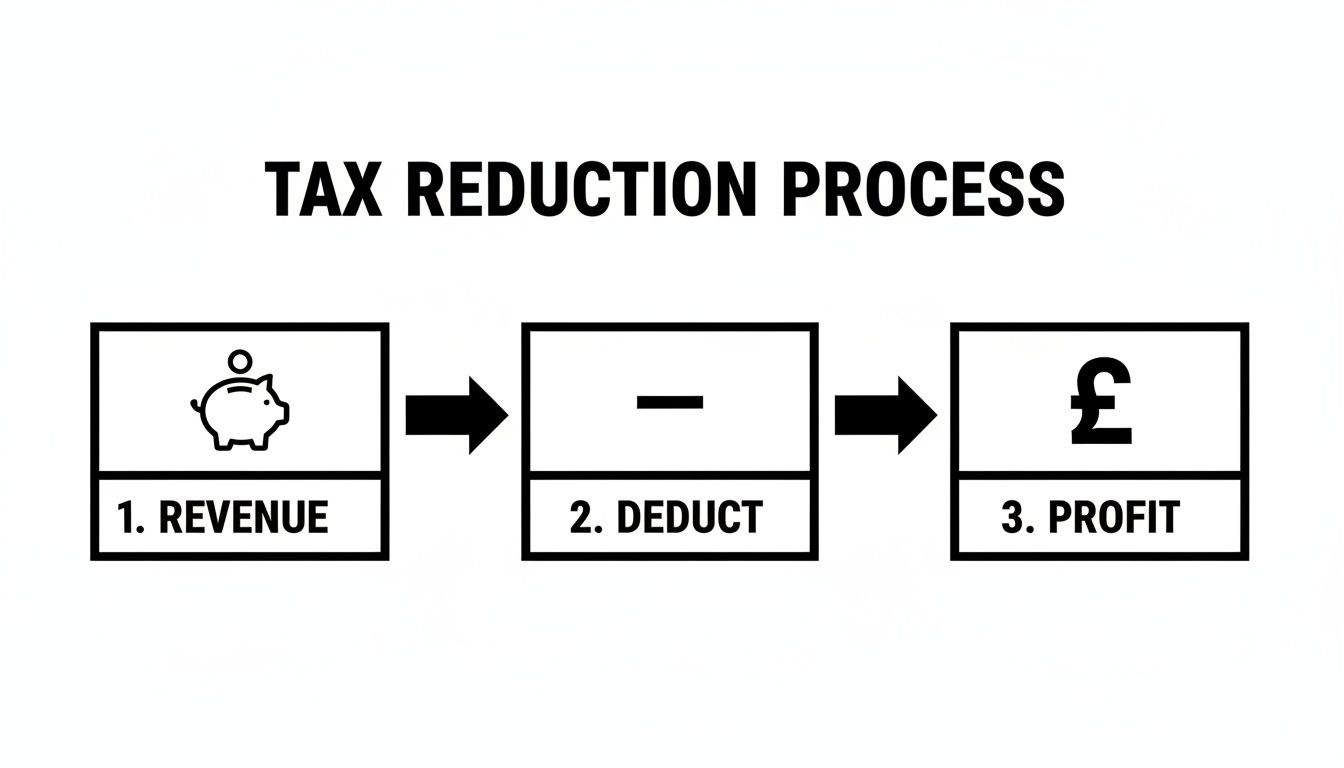
This just hammers home the point: you're taxed on your profit, not your turnover.
Step 3: Applying the Mortgage Interest Tax Credit
Now, let's deal with that £5,000 in mortgage interest. Instead of deducting it from her income, Sarah gets a tax credit for it, which is fixed at the basic rate of tax (20%).
- Mortgage Interest Paid: £5,000
- Tax Rate for Credit: 20%
Calculation: £5,000 x 20% = £1,000 (Mortgage Interest Tax Credit)
This £1,000 isn't taken off her profit. It’s much better than that – it’s a credit that gets subtracted directly from her final income tax bill once her total liability has been calculated.
So, if Sarah’s total income tax bill for the year came to £3,500, this credit would knock it right down to £2,500. Getting your head around this two-stage process is one of the most important things for any modern landlord to understand.
Reporting Your Income and Paying the Tax Man
Once you’ve worked out your taxable profit, the final piece of the puzzle is telling HMRC all about it and paying what you owe. In the UK, this is done through the Self Assessment system – the process for declaring any income that hasn't already been taxed at source (like a typical PAYE salary). For landlords, getting to grips with Self Assessment is an absolute must.
Your gross rental income determines whether you need to get involved. If you earn between £1,000 and £2,500 a year from property, you need to contact HMRC. If that income shoots past £2,500 after you’ve deducted your expenses, or hits £10,000 or more before them, you have to register for Self Assessment and file a tax return.
Key Deadlines You Can't Afford to Miss
Sticking to HMRC’s deadlines is crucial if you want to avoid some rather painful automatic penalties. The UK tax year runs from 6th April to 5th April, and there are a few key dates to circle in your calendar for that period.
- Register for Self Assessment: The deadline is 5th October following the end of the tax year you started earning rental income.
- Paper Tax Return Deadline: If you’re going old-school with a paper return, it must be in by midnight on 31st October.
- Online Tax Return Deadline: Most landlords file online, giving them until midnight on 31st January the next year.
- Pay Your Tax Bill: The deadline to pay the tax you owe is also 31st January.
A word of warning: missing the filing deadline, even by a single day, lands you an instant £100 penalty. The longer you leave it, the worse it gets, so it pays to be on time.
Getting Your Head Around Payments on Account
For many landlords, the 31st January payment isn't the end of the story. If your tax bill tops £1,000 and less than 80% of your total tax was collected at source (which is almost always the case for property income), you’ll probably need to make Payments on Account.
Think of these as advance payments towards your next year's tax bill, helping you spread the cost. Each payment is usually 50% of your previous year's bill.
- First Payment on Account: Due by midnight on 31st January.
- Second Payment on Account: Due by midnight on 31st July.
This can be a real shock for new landlords. Your first tax payment can feel like 150% of what you budgeted for, as you're paying last year's full bill and the first instalment for the current year all at once.
The Nuts and Bolts of Filing Your Return
When it's time to file, you’ll be filling out the main tax return (the SA100) along with a special supplement for property income, called the SA105 'UK Property' form. This is where you’ll declare your total rental income and list out every single allowable expense you're claiming. Keeping your records organised throughout the year will make this part a hundred times easier.
It’s also worth noting that big changes are coming. The whole process is being modernised, so it's a good idea to get familiar with what's ahead. You can learn more about the shift to digital record-keeping in our guide on Making Tax Digital for Income Tax.
Getting to Grips with More Advanced Landlord Scenarios
While the standard buy-to-let model is a great starting point, the world of property investment is full of different avenues. As your portfolio grows or your personal circumstances shift, you might find yourself in a more complex tax situation.
Getting your head around the unique rules for these scenarios is absolutely crucial. It’s not just about staying compliant; it's about making smart, forward-thinking decisions for your property journey. The tax framework for a holiday let, for instance, is a world away from that for a non-resident landlord. Let's break down some of the most common ones.
The Unique World of Furnished Holiday Lettings
In HMRC’s eyes, a Furnished Holiday Let (FHL) isn’t just another rental. If your property meets some strict criteria on how often it's available and actually let out, it gets treated more like a trading business than a simple investment. This special status can unlock some fantastic tax advantages you won’t get with a typical buy-to-let.
So, what are the perks?
- Capital Allowances: You can claim tax relief on the cost of furnishing and equipping the property. This is a huge step up from standard rentals, where you can only claim for replacing items.
- Pension Contributions: The profits you make from an FHL count as 'relevant earnings'. This is a game-changer, as it means you can make tax-efficient contributions to your personal pension.
- Capital Gains Tax (CGT) Reliefs: When it comes time to sell, an FHL might qualify for valuable CGT reliefs like Business Asset Disposal Relief. This could seriously slash your final tax bill. We dive much deeper into this in our guide to Capital Gains Tax for landlords.
Be warned, though – the rules are strict. To qualify, your property must be available for holiday letting for at least 210 days a year and actually rented out for 105 of those. Meticulous record-keeping isn't just a good idea; it's essential.
The Rules for Non-Resident Landlords
If you live outside the UK for six months or more a year but still earn rent from a UK property, you’re what HMRC calls a ‘non-resident landlord’. There’s a specific system in place to make sure tax is collected, known as the Non-Resident Landlord Scheme (NRLS).
Under this scheme, your letting agent (or even your tenant, if you don’t use an agent) has a legal duty to deduct basic rate tax from the rent before it even gets to you. They then pay this amount directly to HMRC.
It is possible, however, to receive your rent in full. You can apply to HMRC for approval to have the gross amount paid to you. If they agree, the responsibility then falls on you to declare the income and sort out the tax via a Self Assessment return, just like any UK-based landlord.
Owning Property Through a Limited Company
You’ve probably heard more and more landlords talking about using a limited company to hold their properties. This approach has shot up in popularity, largely as a response to the new rules on mortgage interest relief, but it’s a big strategic decision with its own set of pros and cons.
Here’s a look at both sides of the coin.
Why a Limited Company Can Be a Good Idea:
- Full Mortgage Interest Deduction: This is the big one. A company can still treat 100% of its mortgage interest as a business expense, deducting it from its income before tax is calculated. For higher-rate taxpayers, this is a massive advantage.
- Lower Tax Rate: Profits within the company are hit with Corporation Tax, which is often lower than the personal higher and additional income tax rates.
- Estate Planning: It can be simpler and more tax-efficient to pass on shares in a property company to family members as part of your inheritance planning.
What You Need to Be Wary Of:
- Getting Your Money Out: Taking profits out of the company to spend personally is a taxable event. Whether you take a salary or dividends, you’ll likely face a second layer of tax.
- Higher Mortgage Costs: Lenders typically see companies as a higher risk. That means you can expect to pay higher interest rates and fees on a company mortgage compared to a personal one.
- More Admin: Running a limited company means more paperwork. You’ll have to file annual accounts with Companies House and a separate company tax return with HMRC, adding a layer of complexity and cost.
Common Questions About Rental Income Tax Answered
Getting to grips with the tax on your rental income often throws up a few common questions. Let's tackle some of the queries we hear most often from landlords, giving you clear, straightforward answers to help you feel more confident.
How Does the £1000 Property Allowance Work?
Think of the £1,000 property allowance as a tax-free shortcut for small-scale landlords. If your total gross income from your property is £1,000 or less for the tax year, you don't have to report it or pay any tax on it. Simple as that.
Once your income tips over that £1,000 mark, you have a choice. You can either deduct the flat £1,000 from your gross rental income, or you can deduct your actual, itemised expenses. You can’t do both. It’s a case of running the numbers and seeing which option leaves you with a smaller tax bill – for most landlords, claiming actual expenses usually works out better.
What Records Do I Need to Keep for HMRC?
Good record-keeping isn't just a good habit; it's a legal requirement. You need to keep a clear, organised paper trail of everything related to your rental property. This is your proof, ready to go if HMRC ever decides to take a closer look at your tax return.
Make sure you hold on to these key documents:
- Tenancy agreements for every tenancy you've had.
- Bank statements that clearly show the rent coming in.
- Receipts and invoices for every single expense you claim – from the letting agent’s commission to the receipt for a replacement tap.
HMRC expects you to keep these records for at least five years after the 31st January submission deadline for that tax year. Don’t worry about mountains of paper; digital copies are fine and much easier to manage.
Can I Claim for Renovations or Property Improvements?
This is a big one, and it catches a lot of landlords out. There's a crucial difference between a repair and an improvement in the eyes of the taxman.
A repair is anything that brings the property back to its original condition. Think fixing a leak or replacing a broken window pane. These costs are considered day-to-day running expenses and can be deducted from your rental income in the year you pay for them.
A renovation or improvement, on the other hand, makes the property better than it was before. This is classed as a capital expense. Things like building an extension, putting in a completely new kitchen where there wasn't one, or adding a conservatory all fall into this category. You cannot claim these costs against your rental income. However, keep those receipts safe! You can use them to reduce your Capital Gains Tax bill when you eventually come to sell the property.
We know these rules can feel complicated, but you don't have to figure it all out on your own. The experts at Stewart Accounting Services can guide you through the process, making sure you stay compliant and claim everything you're entitled to. Contact us today to see how we can help make your property investment work harder for you.